Which streaming media device is right for you? — from cnet.com by John Falcone
Editors’ note:
This story was originally published on December 15, 2010. It was updated on August 19, 2011 with updated product recommendations.

Also see:


Abilene Christian U supports teachers through Digital Learning Institute — from convergemag.com by Tanya Roscorla

Excerpt:

This summer, Abilene Christian University in Texas hosted its first K-12 Digital Learning Institute for teachers. And this school year, the university will observe teachers’ lessons as they apply what they learned about mobile technology to their classes.

Some updates on learning from the living room:

US cable and pay TV lose another half million customers in Q2, 2011 – cord cutting continues — from appmarket.tv by Richard Kastelein
According to Bloomberg, the six largest publicly traded U.S. cable and Pay TV providers are to lose 580,000 customers in the second quarter of 2011 – which is the biggest such decline in history.

‘TV textbooks’ bring access to low-income Florida students — from eSchoolNews.com by Jenna Zwang
Jacksonville officials introduce a program to raise reading scores
Prompted by lackluster reading scores, Duval County Public Schools (DCPS) in Jacksonville, Fla., is attempting to reach low-income students by turning students’ televisions into learning centers.

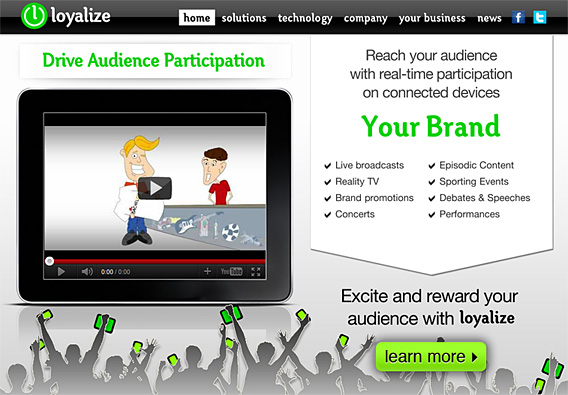
Loyalize.com

loyalize.com

Time Warner cable head says company future is broadband, not TV  –– ReelSEO Video Marketing by Jeremy Scott
Well surprise, surprise. The chief executive of Time Warner Cable, the second-largest cable operator in the U.S., says that broadband is the anchor service of the company’s future, not television. And while that may be a no-brainer for most of us observers in the industry, it’s still a pretty big deal for a cable company to admit their future isn’t in cable (emphasis DSC).

Research: Connected TV will be consumers’ portal to the Web by 2015 — from fierceonlinevideo.com

Google, Motorola deal may impact TV future — from bizreport.com by Kristina Knight
Add another destination for online giant Google – your living room (emphasis DSC). With the announcement that Google will purchase Motorola Mobility many in the space wonder what is next.


Addendum on 8/18/11:


MIT launches Center for Mobile Learning with support from Google — from readwriteweb.com by Jon Mitchell

Excerpt:

The Massachusetts Institute of Technology has announced the creation of a new Center for Mobile Learning. The center will be housed at the MIT Media Lab. Google supported the creation of the center with a grant from Google University Relations. The center’s first project will be the adoption and further development of App Inventor for Android, a do-it-yourself tool for building apps for Google’s Android mobile OS with no programming skills required.

From the announcement

The Center, housed at the Media Lab, will focus on the design and study of new mobile technologies and applications, enabling people to learn anywhere anytime with anyone. Research projects will explore location-aware learning applications, mobile sensing and data collection, augmented reality gaming, and other educational uses of mobile technologies.

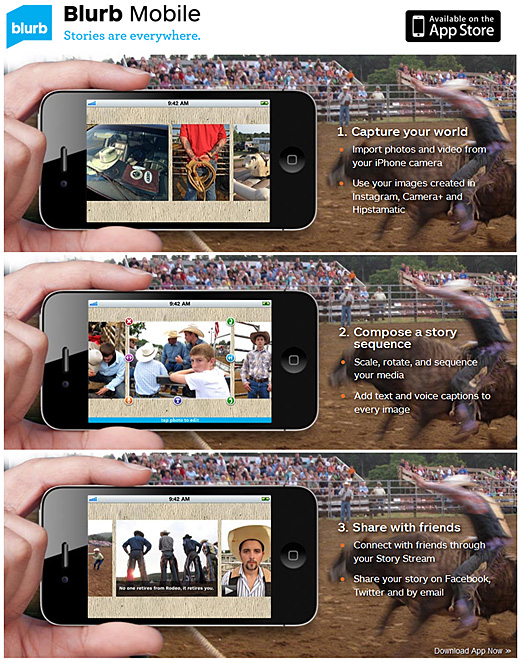
Blurb mobile -- stories are everywhere

Also see:

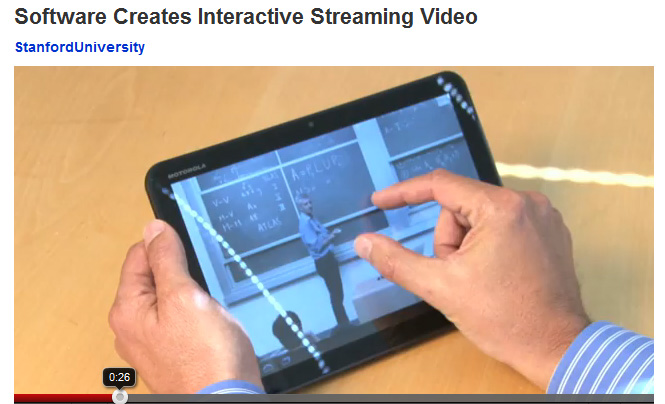
Interactive streaming video technology from Stanford - Summer 2011

Stanford researchers designed software that allows a viewer to zoom and pan while streaming online courses. They recently released the code to the public.

Closing the loop in education technology — from The Journal by David Nagel

Excerpt:

K-12 education isn’t using technology effectively and isn’t investing nearly enough in IT infrastructure to enable next-generation learning. That’s the conclusion of a new report, “Unleashing the Potential of Technology in Education,” which called for a greater financial commitment to education technology and the adoption of a holistic, “closed loop” approach to its implementation.

See also:

Unleashing the Power of Technology in Education - Report from the BCG in August 2011

 From DSC:

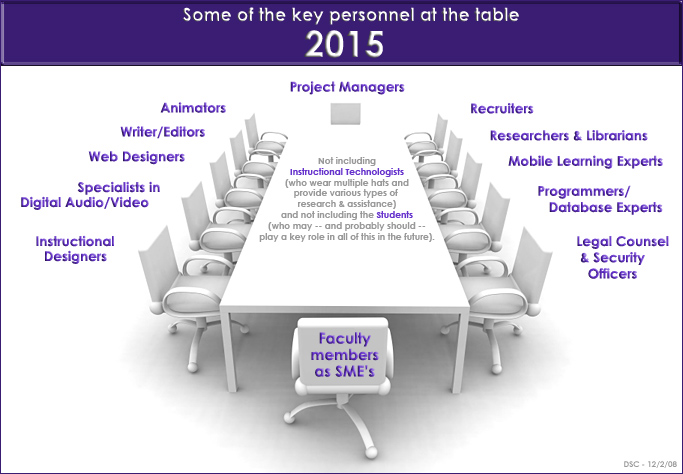
We may continue to be disappointed in our overall results — even if we do bump up our ed tech infrastructure/investments — if we continue to use the same models/ways of doing things. That is, I wish we would move more towards a team-based approach and stop trying to load up our teachers’ and professors’ plates with tasks that they probably don’t have the time, interest, or training to do.  Graphically speaking:


So…use teams to create and deliver the content — and allow for online tutoring from a team of specialists in each discipline. Like the healthcare-related billboard I kept driving by the other day said: “A team of specialists at every step.”


How the BBC is quietly, confidently shaping the future of TV –– from FastCompany.com by Kit Eaton

bbciplayer

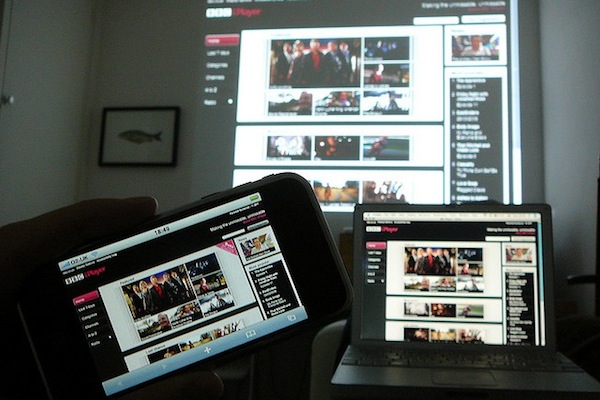
[On Monday] morning the BBC launched a whole new version of its iPlayer app, destined for connected TVs that sport a Net connection. In essence this means the BBC has taken its TV content online, added on-demand features, advanced search powers, playability on multiple platforms both mobile and static, and then fed all of its lessons back into an app…for TVs.

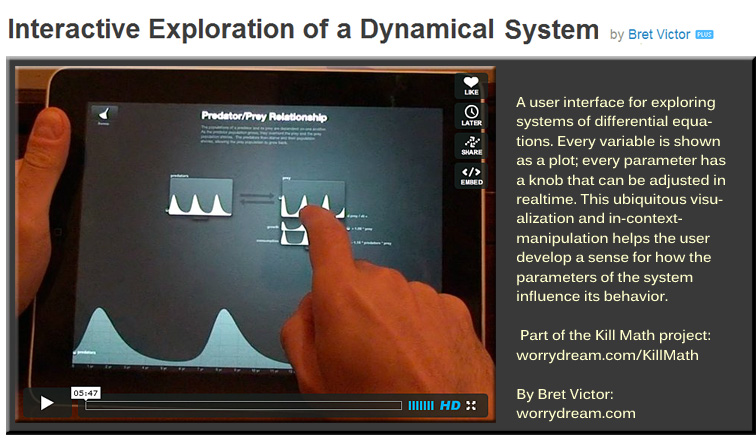
From Brett Victor’s “Kill Math” page

The power to understand and predict the quantities of the world should not be restricted to those with a freakish knack for manipulating abstract symbols.

When most people speak of Math, what they have in mind is more its mechanism than its essence. This “Math” consists of assigning meaning to a set of symbols, blindly shuffling around these symbols according to arcane rules, and then interpreting a meaning from the shuffled result. The process is not unlike casting lots.

This mechanism of math evolved for a reason: it was the most efficient means of modeling quantitative systems given the constraints of pencil and paper. Unfortunately, most people are not comfortable with bundling up meaning into abstract symbols and making them dance. Thus, the power of math beyond arithmetic is generally reserved for a clergy of scientists and engineers (many of whom struggle with symbolic abstractions more than they’ll actually admit).

We are no longer constrained by pencil and paper. The symbolic shuffle should no longer be taken for granted as the fundamental mechanism for understanding quantity and change. Math needs a new interface.

Also see:


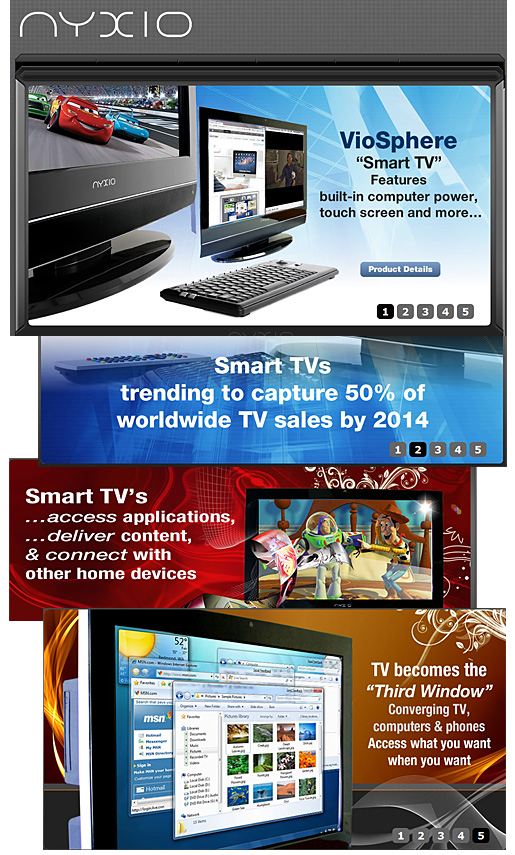
Intel predicts Smart TV is the device of the future — from nyxiotechnologies.com’s blog
Chipmaker Intel believes that the Smart TV is the electronic device of the future, in the living room anyway.

Excerpt:

The Smart TV is already upon us, in its various forms from various manufacturers. It has arrived with 3D capabilities, web browsing and social networking and applications. Currently Samsung and LG seem to be two of the big players pushing the Smart TV to consumers.

Also see:


Aruba MOVE delivers high-quality video simultaneously to 100 iPads in a single classroom at the University of Ottawa — from ArrubaNetworks.com
Multimedia applications included Apple Facetime and AirPlay, Blackboard Mobile™ Learn, Distribution Access Learning, HaiVision and Turning Technologies

Excerpt:

SUNNYVALE, Calif., June 13, 2011 – Aruba Networks, Inc. (NASDAQ: ARUN) today announced that it and several application partners delivered the next-generation classroom experience at the University of Ottawa. Validated by the university information technology (IT) department, the classroom experience consisted of six leading multimedia educational applications delivered to 100 iPads, concurrently. Each of the applications was delivered simultaneously to all 100 iPads with the highest quality and without any noticeable jitter, delay or frame loss. 100 percent of the iPads passed the multimedia Service Level Agreement (SLA), as measured by VeriWave WaveInsite, which was also used to objectively verify sustained performance of 1Mbps of multimedia streaming to each iPad.

From DSC:
I think there may be something here for the Smart Classrooms of the future. I can’t help but think of some of our courses in astronomy, for example, and that I think that sometimes we are using the wrong technologies to display images and videos to our students. Without investing an enormous amount of money on very high-end projection systems, we lose too much detail with a variety of images that feature galaxies, constellations, etc. with a projected image.

What about if a student could control where they want to zoom in on an image — and not lose any resolution or brightness? What about if they had such high res images available for viewing directly on their iPads? Sounds very interesting to me.

Also see:

  • Haivision Acquires KulaByte and MontiVision; Forms Internet Media Division
    Haivision driving toward $50 million revenue with new division combining Internet streaming and cloud transcoding to enable over-the-top media delivery
    MONTREAL and CHICAGO
    — July 21, 2011 — Haivision Network Video, a leading provider of the most advanced video networking, digital signage, and IP video distribution solutions, today announced that it has acquired both KulaByte Corporation of San Marcos, Texas, and MontiVision Imaging Technologies based in Germany. The technologies of both companies, including advanced encoding, transcoding, cloud computing, and workflow solutions, will be combined to form Haivision’s new Internet Media Division.


K-12 to see double-digit growth in e-learning through 2015 — from The Journal by David Nagel

Excerpt:

Trends in preK-12
In the United States, preK-12 will dominate all other segments, including healthcare and higher education, in the growth of annual expenditures on e-learning technologies and services. According to a report released by market research firm Ambient Insight (“The Worldwide Market for Self-paced eLearning Products and Services: 2010-2015 Forecast and Analysis”), growth will continue at a compound annual rate of 16.8 percent–despite the elimination of the federal Enhancing Education Through Technology (EETT) program and despite an overall weakening of e-learning growth, particularly in the United States.

Spending on e-learning in preK-12 reached $2.2 billion in 2010, according to Ambient Insight. That will hit $4.9 billion in 2015, or 20.25 percent of the entire market for e-learning products and services in the United States (and 9.82 percent of total worldwide annual expenditures).

Also see:

  • Higher ed e-learning growth to continue at modest pace through 2015 — from The Journal by David Nagel
    While electronic learning will continue to grow in higher education, that growth will be a bit slower than previously anticipated, according to a new report released this week. In fact, that slowing trend will be felt worldwide across nearly all segments–with a few notable exceptions.
Tagged with: • • • • •  
© 2025 | Daniel Christian