HTML5 Video Summit
Nov 8-9, 2011 | Los Angeles,CA
HTML5: The Next Generation Of Online Video

It’s becoming increasingly important to deliver video not just on the web but to a multitude of mobile devices, set-top boxes, and connected TVs, and content providers, browser developers, and end users can no longer afford to have the primary video delivery mechanisms locked up in standards that can’t adapt to new environments. The effects of HTML5 have already had an impact throughout the industry. Major media sites such as YouTube, The New York Times, CNN, Vimeo, and more are already offering HTML5 video players, while web giants Apple, Microsoft, Google, and Mozilla are rapidly adding HTML5 features. It’s time to consider how HTML5 can help your business move forward in these exciting times.


Also see:


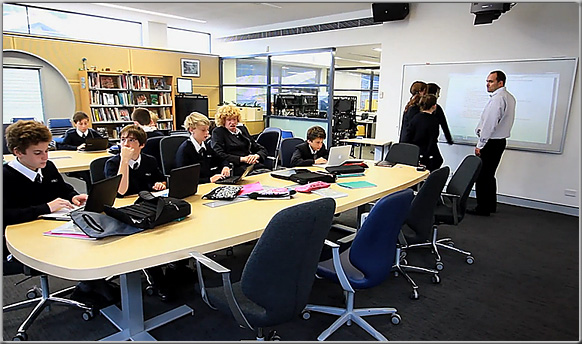
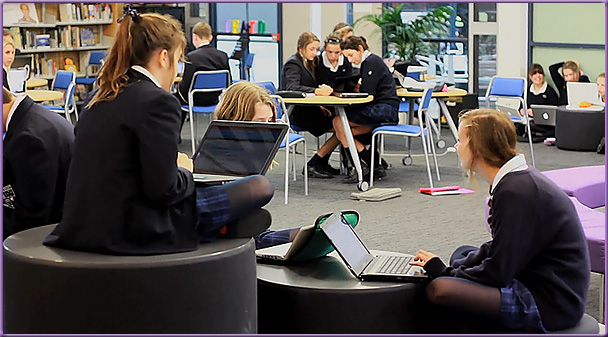
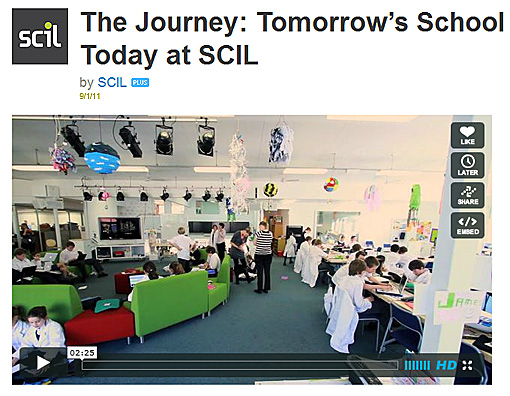
Sydney Centre for Innovation in Learning (SCIL) and Northern Beaches Christian School (NBCS)


SCIL and NBCS


From SCIL’s website:

Sydney Centre for Innovation in Learning actively promotes excellence in education by providing new learning opportunities for students and future-focused Professional Development for teachers. Established as the research and innovation unit of Northern Beaches Christian School (Sydney, Australia), SCIL runs a range of programs and research projects that seek to transform educational thinking and practice both at NBCS and in the wider educational community.


Also see:

Tagged with: • • • • •  

The Digital Revolution and Higher Education — from the Pew Research Center by Kim Parker, Amanda Lenhart, and Kathleen Moore
College Presidents, Public Differ on Value of Online Learning

Excerpt:

This report is based on findings from a pair of Pew Research Center surveys conducted in spring 2011. One is a telephone survey of a nationally representative sample of 2,142 adults ages 18 and older. The other is an online survey, done in association with the Chronicle of Higher Education, among the presidents of 1,055 two-year and four-year private, public, and for-profit colleges and universities.

Here is a summary of key findings…


From DSC:
First, [perhaps it’s in the appendices, but] how many of the people out in the public who were surveyed have actually taken an online class? If so, how many classes (each) have they taken and when did they take them? From whom did they take them? My guess is that most of them have never taken a class online.

Secondly, I wonder how many people thought that the telephone was a useful instrument/communication device shortly after it was introduced? Perhaps not too many…but did you use one today? Yesterday? I bet you did. I did…several times; and I bet that the same will be true of online learning (as online learning didn’t really begin to be used until the late 90’s).

The question is not whether online learning will blow away the face-to-face classroom, it’s when this will occur…? There will be many reasons for this, but the key one will be that you are putting up a team of specialists instead of using just one person. If they are reeeeaaaalllyy good (and a rare talent), that person can do the trick for now; but their success/job will continue to be increasingly difficult to perform, as they continue to pick up new hats each year, as the students’ attention spans and expectations continue to change, as lower cost models continue to emerge, etc, etc…

As Christensen, Horn, and Johnson assert, the innovation is taking place in the online learning world, and it will eventually surpass what’s possible (if it hasn’t already) in the face-to-face classrooms.


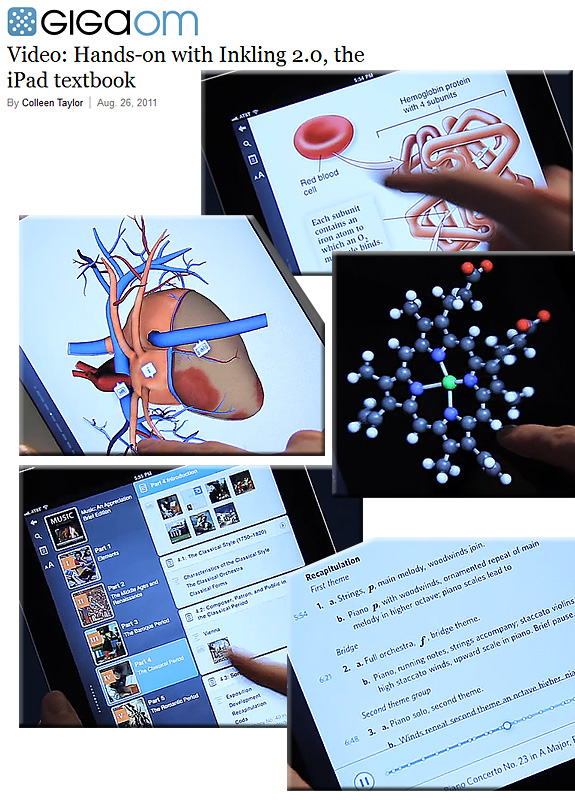
Video: Hands-on with Inkling 2.0, the iPad textbook — from gigaom.com by Colleen Taylor; my thanks go out to Mr. Johnny Ansari for this resource


A screenshot from GigaOM’s video demo of Inkling 2.0

Excerpt:

This week, digital publishing startup Inkling debuted the 2.0 version of its software, which provides interactive, digital versions of college textbooks for the iPad.

The San Francisco-based startup is just down the street from GigaOM’s office, so I headed on over to Inkling headquarters on Thursday to get an in-person demo from the company’s Founder and CEO Matt MacInnis. In short: It’s so awesome it actually makes me want to buy college textbooks again, just to play with the app some more.


From DSC:
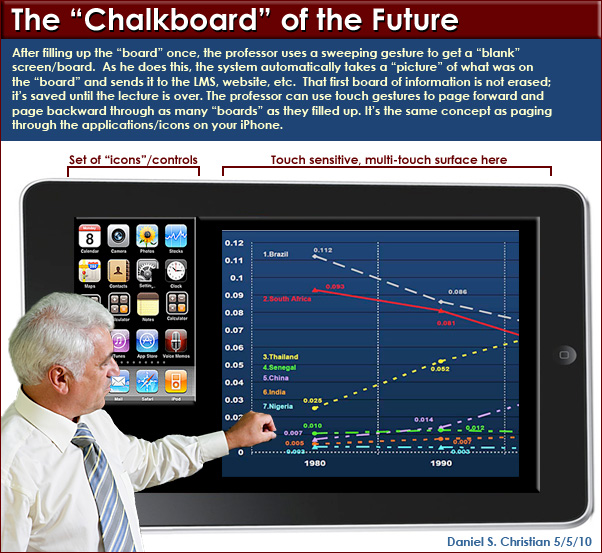
Why can’t these materials from publishers come right into an  8′ x 6′  “interactive whiteboard” (for lack of a better term) so that the professor can annotate/manipulate them in front of the classroom?

See:

Daniel Christian: The Chalkboard of the Future

and here


From DSC:
Consumers’ expectations from entertainment may likely spill over into education

  • Why the future of TV is all about personalization — from stunmedia.com 
    Excerpt:
    Fueled by the explosive development of smartphones and tablets, video clip viewing routines have [been] forever modified. It’s no surprise that buyers, who have been speedy to embrace video clip providers like HBO GO, Netflix and Hulu, are now expecting a a lot more personalized, interactive and seamless viewing experience across their traditional TV, laptops, gaming consoles, and connected TVs, as well as on smartphones and tablets (emphasis DSC). Here, we’ll discuss the present state of personalised cell video and what customers can anticipate in the future.

From DSC:
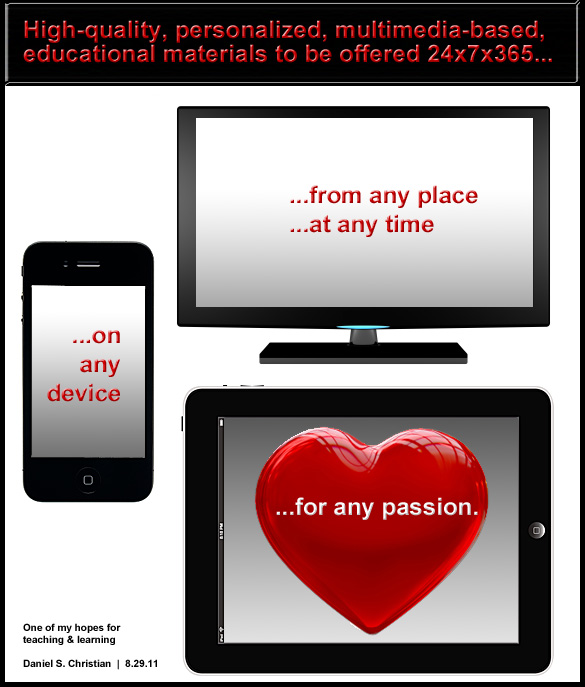
In the near future, if I can see what I want on whatever device I want — and it’s personalized/customized for me — won’t that affect my expectations for other types of content that I want to review — such as educational content? 

Yes…I think it will. Whatever discipline I want, on whatever device I want, whenever I want it — available 24x7x365 with online tutoring available (which may or may not be from the same organization that posted the original content).


From Daniel Christian: Fasten your seatbelts! An accelerated ride through some ed-tech landscapes.


From DSC:
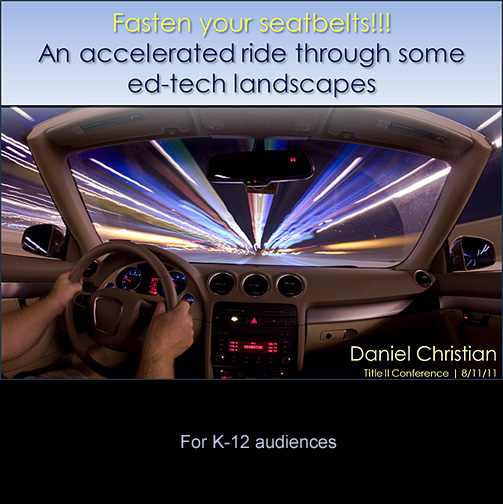
Immediately below is a presentation that I did for the Title II Conference at Calvin College back on August 11, 2011
It is aimed at K-12 audiences.


Daniel S. Christian presentation -- Fasten your seatbelts! An accelerated ride through some ed-tech landscapes (for a K-12 audience)


From DSC:
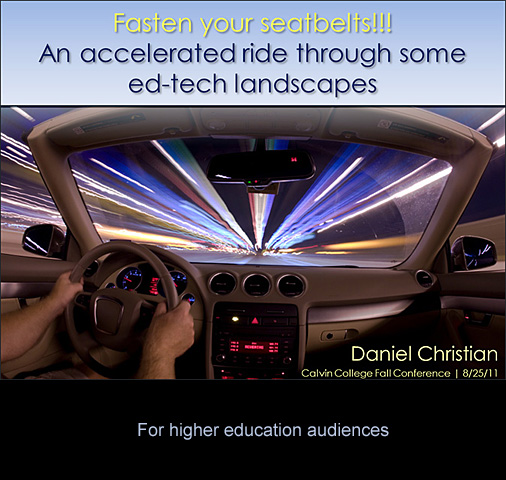
Immediately below is a presentation that I did today for the Calvin College Fall 2011 Conference.
It is aimed at higher education audiences.


 Daniel S. Christian presentation -- Fasten your seatbelts! An accelerated ride through some ed-tech landscapes (for a higher ed audience)


Note from DSC:

There is a great deal of overlap here, as many of the same technologies are (or will be) hitting the K-12 and higher ed spaces at the same time. However, there are some differences in the two presentations and what I stressed depended upon my audience.

Pending time, I may put some audio to accompany these presentations so that folks can hear a bit more about what I was trying to relay within these two presentations.


Tagged with: • • • • • • • • • • • • • • • • • • • • • • • • • • • • • • • • • • • • • • • • • • • • • • • • • • • • • • • • • • • • • • • • • • • • • • • • • • • • • • • • • • • • • • • • • • • • •  
Steve Jobs has resigned as Apple CEO "effective immediately"


From DSC:
I want to post a thank you note to Mr. Steven P. Jobs, whom you most likely have heard has resigned as Apple’s CEO. Some articles are listed below, but I want to say thank you to Steve and to the employees of Apple who worked at Apple while he was CEO:

  • Thank you for working hard to enhance the world and to make positive impacts to our world!
  • Thank you for painstakingly pursuing perfection, usability, and excellence!
  • Thank you for getting back up on the horse again when you came out of a meeting with Steve, Tim and others and you just got reamed for an idea or implementation that wasn’t quite there yet.
  • Thanks go out to all of the families who were missing a dad or mom for long periods of time as they were still at work cranking out the next version of ____ or ____.
  • Thanks for modeling what a vocation looks like — i.e. pursuing your God-given gifts/calling/passions; and from my economics training for modeling that everyone wins when you do what you do best!

Thanks again all!


Inkling 2.0: When a textbook becomes more than a textbook — from hackeducation.com by Audrey Watters

From DSC:
Audrey explores the trend that “books” are becoming more “app” like — and will likely be increasingly available as downloads via the Internet/cloud.


From DSC:
Yesterday, one of the organizations within our college hosted a conference call using Wimba Classroom.  For those of you unfamiliar with Wimba Classroom, it’s really a set of web-based collaboration tools that offer such functionality as:

  • Videoconferencing
  • Audio-conferencing
  • Interactive whiteboard space
  • Chat
  • Application sharing capabilities

(Last summer, Blackboard purchased both Elluminate and Wimba Classroom and have since created Bb Collaborate 11 from these two product lines.)

What I’ve learned about Wimba Classroom is that it’s best used as a Skype-on-steroids type of setup. That is, when one remote person is communicating with other remote persons — and all parties use headphones with attached microphones on them for their audio outputs/inputs. It is best when none of the participants are a group of people sitting in one room.  I say this because when you have a group of people in one location and you want to use VOIP-related technologies (i.e. for “free” communications), then you need to have a set of speakers powerful enough to cover the room.  However, the audio output from the speakers can present some seriously-frustrating issues with the microphone in that room — especially if any participant has the Lock Talk feature turned on (feedback/echoing occur here).

I’m very disappointed with Wimba for not having innovated more here over the last 1-2 decades — they’ve been in the business quite a while before it was known as Wimba.  Perhaps Blackboard Collaborate 11 will address some of these problems and introduce some noise-cancelling software to eliminate these sorts of communication frustrations.

Now, I’ve lost another internal customer and I’m forced into the “Have you driven a Ford lately?” mode with these folks; as any experienced Instructional Technologist or ID will tell you, this is a veeeeryyy frustrating and disappointing place to be in.

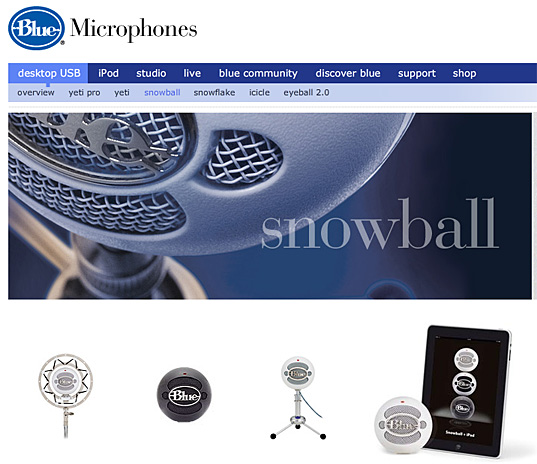
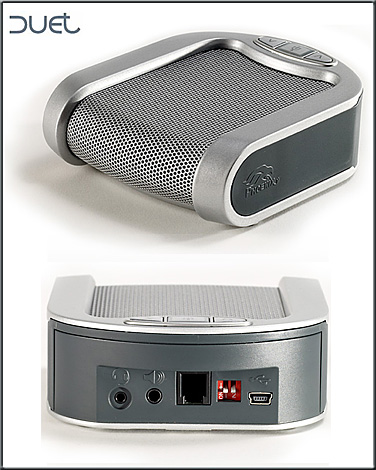
The bright side to this situation is our Implementations Consultant — who has been in my shoes before and knows what that’s like to be there.  He’s been a big help through the last 2-3 years. He recommended some different microphones that may help better address some of these issues and I thought that I would pass this information along in case it’s helpful to someone else out there:


The Snowball microphone -- for when you have a group of people in one location and want to use Wimba Classroom


Good microphone for working with Wimba Classroom when one GROUP of people are sitting in one location talking to others remotely


I must be honest though — I’m seriously considering a lobbying effort to move our college away from using Wimba/Bb Collaborate 11 and towards WebEx Meeting Center or Adobe Connect.  (Big Blue button and some others may be on the table as well, but my initial-but-not-completely-up-to-date guess is that other products don’t offer the same level of quality as WebEx or Connect.)

In retrospect (hindsight’s always 20-20, right?), I should have not been pursuaded by Wimba’s pitch that they focus solely on the education space — as that perspective may not be worth bragging rights these days (I’m constantly reminded that the education space doesn’t innovate as well as some other sectors/industries do).

Anyway…hopefully, this posting will help someone out there.  Also, it is highly possible that my relevant skillsets need further enhancements here! So feel free to give me some further education — I’m always up for expanding my learning ecosystem! 🙂


© 2025 | Daniel Christian