Tech & Learning Announces Winners of Best for Back to School 2026 — from techlearning.com by TL Editors This annual award celebrates the products that offer schools versatility, value, and solutions to specific problems to support innovative, effective teaching and learning.
The 2026-27 school year is off and running, and it’s already shaping up to be another pivotal year for education. While AI remains a massive topic, the biggest headline this fall is the screentime debate, hands down. Communities nationwide—including the country’s two largest school districts—are advocating for strict limitations and outright bans to reclaim screen-free classrooms.
Yet, if there’s one constant in education, it’s resilience. We adapt, we evolve, and we keep going because at the heart of it all, we want what’s best for our students. Instead of a setback, this heightened scrutiny around screentime and AI has forced the edtech community to be better. It demands that the tools we bring into the classroom are safe and built to inspire active creation rather than passive consumption. .
Drone Clubs in Schools Are Launching Future Careers — from edcircuit.com How drone clubs help students develop safer STEM, aviation, AI, and workforce skills while connecting classroom learning to real-world opportunities.
Drone clubs in schools help students explore aviation, Safer STEM, AI, and career pathways while building technical and leadership skills.
…
To an outside observer, it may appear that students are simply flying a drone.
In reality, they are learning many of the same skills used by engineers, surveyors, emergency responders, construction managers, agricultural specialists, aviation professionals, environmental scientists, and technology experts every day.
This is the Future of High School The Tennessee School Rewriting the Rules of High School — from xqsuperschool.org At Elizabethton High School, students wanted more from their education. So they helped rebuild it—class by class, project by project. Their idea: give students real, meaningful work, and they’ll rise to the challenge.
A cold case became a Prime Video series. A robotics club became an international competitor. And an ordinary high school became something else entirely. Elizabethton is reinventing high school—and showing what’s possible for the rest of the country.
Watch the Elizabethton+XQ story Ten years, one school, and a redesign still unfolding. It took courage to break with tradition—and that risk is paying off for an entire community.
Anthropic’s Claude Science beta and NVIDIA’s BioNeMo Agent Toolkit show AI agents moving beyond general productivity into specialized scientific research workflows.
The companies are emphasizing auditability and reproducibility, including preserved code, environments, message history, reviewer agents, and integration with existing research tools.
For enterprises and research teams, the key test will be whether agentic AI can produce traceable, reliable results while keeping humans in control of sensitive data, compute, and scientific judgment.
In March 2025, the Euclid mission led by the The European Space Agency (ESA) enabled scientists to capture the highest resolution image ever taken of the dense, glowing center of the Milky Way galaxy. .
But at a moment defined by rapid AI adoption and ongoing debates about screen time, the argument for protecting and investing in arts education needs to take on a new tone. The arts continue to be one of the most effective places in school for students to build healthier, more intentional relationships with technology.
In short, in the age of AI, we need the arts more than ever.
…
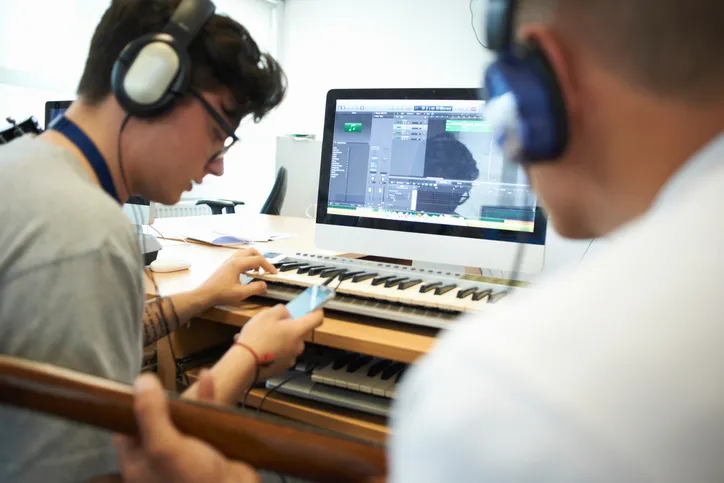
Digital composition software, notation tools, and recording platforms allow students to experiment, revise, and refine their ideas in ways that would have been far more time-consuming a decade ago. Students can layer tracks, hear immediate playback, annotate their own scores, and collaborate across devices. The same is true in other contexts besides music; in visual arts, for instance, a variety of digital drawing and painting platforms enable students to practice with new mediums, styles, and techniques without having to worry about supplies or messes. But in either case, the core intellectual work of looking and listening critically, understanding structure, and making aesthetic choices remains entirely human and part of the learning.
From DSC: I agree. At one of my previous positions, I spent 10 years supervising a digital studio — helping professors and students use a variety of applications to create things. The applications were from Adobe, Apple, and a variety of smaller vendors. The deliverables could be graphics, edited soundtracks, music, videos, flyers, posters, collages, edited photographs, presentations, websites, and more. I longed for people to discover the power of multimedia to communicate their messages, tell stories, stir emotion, powerfully engage themselves (and others), and unleash their creativity.
There were several obstacles to our digital studio being more impactful at that institution. It was under the IT department, not the academic side of the house. It was in the basement of the library, where few students and faculty traveled. During those years, it was highly uncommon for faculty members to require multimedia-based assignments — so many students had to WANT to develop these skills on their own time. The majority of students didn’t see the value in developing the types of digital skills that we were trying to build…or they didn’t have the time.
It’s that time again ~ the annual round-up of tech tools we think are worth a look this year. This year I really feel like there’s something for everyone: history teachers, math and science teachers, people who run makerspaces, teachers interested in music or podcasting, writing teachers, special ed teachers, and anyone whose course content could be made clearer through graphic organizers.
Also somewhat relevant here, see:
Edtech Show & Tell January 2026 — from techlearning.com by Diana Restifo and Ray Bendici New edtech products that have caught our attention this month
Best Sites & Apps for K-12 Education Games — from techlearning.com by Diana Restifo Game-based learning is a great way to integrate technology into the classroom while engaging kids with real learning.
Making the case for arts and humanities — from timeshighereducation.com by campus contributors, Eliza Compton The arts and humanities are often dismissed as an unaffordable luxury, when these disciplines underpin vital human skills such as critical thinking, creativity and communication. This collection explores many ways in which arts and humanities can be harnessed for the benefit of all – students, universities and wider society
Yet, amid the threat of AI-driven automation in the workforce, fierce competition for entry-level jobs, and complex global problems such as climate change, the skills that humanities disciplines are built upon are vital. These skills – such as critical thinking, communication and creativity – are also key to universities’ capacity to share knowledge with industry, policymakers and the public. When it comes to understanding how high-tech solutions can best be applied in the real world, often the barriers are not technical but human, as low vaccine take-ups show.
These human skills are not unique to disciplines such as history, philosophy, literature, linguistics, performance and visual arts, of course. The need for deep thinking and analysis across all areas of academic enquiry is embedded in interdisciplinarity and STEAM initiatives, which integrate science, technology, mathematics and engineering with arts and humanities.
At their core, the arts and humanities interrogate what makes us human and how we understand and communicate with the world. In this collection, contributors from around the globe articulate the value that these disciplines bring to students, industry, government and society, when taught and designed effectively. It also considers how arts-based research can drive discovery, the role of interdisciplinarity in teaching and research, and how humanities-led expertise supports sustainability and inclusion.
AI in K12: Today’s Breakthroughs and Tomorrow’s Possibilities (webinar) How AI is Transforming Classrooms Today and What’s Next
Audio-Based Learning 4.0— from drphilippahardman.substack.com by Dr. Philippa Hardman A new & powerful way to leverage AI for learning?
At the end of all of this my reflection is that the research paints a pretty exciting picture – audio-based learning isn’t just effective, it’s got some unique superpowers when it comes to boosting comprehension, ramping up engagement, and delivering feedback that really connects with learners.
While audio has been massively under-used as a mode of learning, especially compared to video and text, we’re at an interesting turning point where AI tools are making it easier than ever to tap into audio’s potential as a pedagogical tool.
What’s super interesting is how the solid research backing audio’s effectiveness is and how well this is converging with these new AI capabilities.
From DSC: I’ve noticed that I don’t learn as well via audio-only based events. It can help if visuals are also provided, but I have to watch the cognitive loads. My processing can start to get overloaded — to the point that I have to close my eyes and just listen sometimes. But there are people I know who love to listen to audiobooks and prefer to learn that way. They can devour content and process/remember it all. Audio is a nice change of pace at times, but I prefer visuals and reading often times. It needs to be absolutely quiet if I’m tackling some new information/learning.
In Conversation With… Ashton Cousineau — from drphilippahardman.substack.com by Dr. Philippa Hardman A new video series exploring how L&D professionals are working with AI on the ground
In Conversation With… Ashton Cousineau by Dr Philippa Hardman
A new video series exploring how L&D professionals are working with AI on the ground
AI-Infused Learning Design – A structured approach to AI-enhanced assignments using a three-step model for AI integration.
Mathematical Dance and Creativity in STEAM – Using AI-powered motion capture to translate dance movements into mathematical models.
AI-Generated Instructional Videos – How adaptive AI-powered video learning enhances problem-solving and knowledge retention.
Immersive Language Learning with XR & AI – A new framework for integrating AI-driven conversational agents with Extended Reality (XR) for task-based language learning.
Decision-Making in Learning Design – A scoping review on how instructional designers navigate complex instructional choices and make data-driven decisions.
Interactive E-Books and Engagement – Examining the impact of interactive digital books on student motivation, comprehension, and cognitive engagement.
Elevating Practitioner Voices in Instructional Design – A new initiative to amplify instructional designers’ contributions to research and innovation.
Here’s a quick teaser of key developments in the world of AI & learning this month:
DeepSeek R-1, OpenAI’s Deep Seek & Perplexity’s ‘Deep Research’ are the latest additions to a growing number of “reasoning models” with interesting implications for evidence-based learning design & development.
The U.S. Education Dept release an AI Toolkit and a fresh policy roadmap enabling the adoption of AI use in schools.
Anthropic Release “Agentic Claude”, another AI agent that clicks, scrolls, and can even successfully complete e-learning courses…
Oxford University Announce the AIEOU Hub, a research-backed research lab to support research and implementation on AI in education.
“AI Agents Everywhere”: A Forbes peek at how agentic AI will handle the “boring bits” of classroom life.
[Bias klaxon!] Epiphany AI: My own research leads to the creation of a specialised, “pedagogy first” AI co-pilot for instructional design marking the continued growth of specialised AI tools designed for specific industries and workflows.
Through my work with leading educational institutions at Kaltura, I’ve seen firsthand how AI agents are rapidly becoming indispensable. These agents alleviate the mounting burdens on educators and provide new generations of tech-savvy students with accessible, personalized learning, giving teachers the support they need to give their students the personalized attention and engagement they deserve.
This HQ includes all of my AI guides, organized by tool/platform. This list is updated each time a new one is released, and outdated guides are removed/replaced over time.
Artificial intelligence is poised to fundamentally change the job of teaching. AI-powered tools can shave hours off the amount of time teachers spend grading, lesson-planning, and creating materials. AI can also enrich the lessons they deliver in the classroom and help them meet the varied needs of all students. And it can even help bolster teachers’ own professional growth and development.
Despite all the promise of AI, though, experts still urge caution as the technology continues to evolve. Ethical questions and practical concerns are bubbling to the surface, and not all teachers feel prepared to effectively and safely use AI.
In this special report, see how early-adopter teachers are using AI tools to transform their daily work, tackle some of the roadblocks to expanded use of the technology, and understand what’s on the horizon for the teaching profession in the age of artificial intelligence.
– assessment
– funding
– deportations
– opposition to trans students
– mental health
– AI/AGI world
– a struggle to engage students
– too many hats
– war risks
– resource redistribution and civil conflict
There’s a half-billion-dollar federal program that is supposed to help students with disabilities get into the workforce when they leave high school, but most parents — and even some school officials — don’t know it exists. As a result, hundreds of thousands of students who could be getting help go without it. New Jersey had the nation’s lowest proportion — roughly 2 percent — of eligible students receiving these services in 2023.
More than a decade ago, Congress recognized the need to help young people with disabilities get jobs, and earmarked funding for pre-employment transition services to help students explore and train for careers and send them on a pathway to independence after high school. Yet, today, fewer than 40 percent of people with disabilities ages 16 to 64 are employed, even though experts say most are capable of working.
Both vocational rehabilitation agencies and schools are required by law to provide certain transition services and supports to improve post-school outcomes of students with disabilities.
The Workforce Innovation and Opportunity Act (WIOA) amends the Rehabilitation Act of 1973 and requires vocational rehabilitation (VR) agencies to set aside at least 15% of their federal funds to provide pre-employment transition services (Pre-ETS) to students with disabilities who are eligible or potentially eligible for VR services. The intent of pre-employment transition services is to:
improve the transition of students with disabilities from school to postsecondary education or to an employment outcome, increase opportunities for students with disabilities to practice and improve workplace readiness skills, through work-based learning experiences in a competitive, integrated work setting and increase opportunities for students with disabilities to explore post-secondary training options, leading to more industry recognized credentials, and meaningful post-secondary employment.
I’m a supporter of evolving classroom spaces—of redesigning the layout of the room as the needs and interests of students develop. The easiest way to accommodate students, I’ve found, is to use the furniture itself to set up a functional, spacious, and logical classroom. There are several benefits to this approach. It provides children with safe, low-stakes environmental changes; fosters flexibility; and creates opportunities for spatial adaptation and problem-solving. Additionally, rearranging the room throughout the school year enables teachers to address potential catalysts for challenging behaviors and social conflicts that may arise, while sparking curiosity in an otherwise-familiar space.
While instructional videos were prepared out of necessity in the past, I’ve rediscovered their utility as a quick, flexible, and personal way to enhance classroom teaching. Instructional videos can be created through free screencasting software such as Screencastify, ScreenRec, Loom, or OBS Studio. Screencasting would be ideal for the direct presentation of information, like a slide deck of notes. Phone cameras make practical recording devices for live content beyond the computer screen, like a science demo. A teacher could invest in a phone stand and ring light at a nominal cost to assist in this type of recording.
However, not all teacher videos are created equal, and I’ve discovered four benefits and strategies that help make these teaching tools more effective.
6 Strategies for Building a Sustainable STEM Ecosystem — from edutopia.org by Rich Schiccatano Upper elementary teachers can use these ideas to create meaningful, interdisciplinary STEM opportunities that encourage experimentation.
NVIDIA Digital Human Technologies Bring AI Characters to Life
Leading AI Developers Use Suite of NVIDIA Technologies to Create Lifelike Avatars and Dynamic Characters for Everything From Games to Healthcare, Financial Services and Retail Applications
Today is the beginning of our moonshot to solve embodied AGI in the physical world. I’m so excited to announce Project GR00T, our new initiative to create a general-purpose foundation model for humanoid robot learning.
As the FlexOS research study “Generative AI at Work” concluded based on a survey amongst knowledge workers, ChatGPT reigns supreme. … 2. AI Tool Usage is Way Higher Than People Expect – Beating Netflix, Pinterest, Twitch. As measured by data analysis platform Similarweb based on global web traffic tracking, the AI tools in this list generate over 3 billion monthly visits.
With 1.67 billion visits, ChatGPT represents over half of this traffic and is already bigger than Netflix, Microsoft, Pinterest, Twitch, and The New York Times.
Something unusual is happening in America. Demand for electricity, which has stayed largely flat for two decades, has begun to surge.
Over the past year, electric utilities have nearly doubled their forecasts of how much additional power they’ll need by 2028 as they confront an unexpected explosion in the number of data centers, an abrupt resurgence in manufacturing driven by new federal laws, and millions of electric vehicles being plugged in.
The tumult could seem like a distraction from the startup’s seemingly unending march toward AI advancement. But the tension, and the latest debate with Musk, illuminates a central question for OpenAI, along with the tech world at large as it’s increasingly consumed by artificial intelligence: Just how open should an AI company be?
…
The meaning of the word “open” in “OpenAI” seems to be a particular sticking point for both sides — something that you might think sounds, on the surface, pretty clear. But actual definitions are both complex and controversial.
In partnership with the National Cancer Institute, or NCI, researchers from the Department of Energy’s Oak Ridge National Laboratory and Louisiana State University developed a long-sequenced AI transformer capable of processing millions of pathology reports to provide experts researching cancer diagnoses and management with exponentially more accurate information on cancer reporting.




.webp)
