Campus technology leaders: Before and after – from InsideHigherEd.com by Joshua Kim

Before After
Implements Strategic Vision Develops Strategic Vision
Reports to a Top Academic Official Is a Top Academic Official
Background in Technology Background in Education or Libraries
Focus is on Systems and Technology Focus is on Learning
Supports Faculty Teaching Enables Active Learning
Manages Local Technology Infrastructure Manages Cloud Based Technology Infrastructure
Manages Enterprise Systems Manages Integration of Enterprise with Consumer Systems
Technical and Managerial Intelligence Social and Emotional Intelligence
Has To Do More with Less Has To Do More with Even Less
Focus is on Implementation Focus is on Implementation and Experimentation
Presides Over Expensive Services Key Driver of New Revenues and Increased Productivity
Manages Technology Infrastructure Evangelizes Potential of Technology for Educational Transformation

.
From DSC:
This caught my eye because I am a firm believer that all decision-making boards at each and every college and university (across the entire world) must now have a visionary, informed technology leader on them — as such technologists will be able to provide important strategic direction to their organizations. It’s not just about keeping the systems running anymore (which is a tough enough job by the way) — it’s also about setting strategic direction and using technology to increase the number of students one can assist/develop (while aiming to decrease the price of such offerings).


Susan Patrick: Why online learning is a smart solution

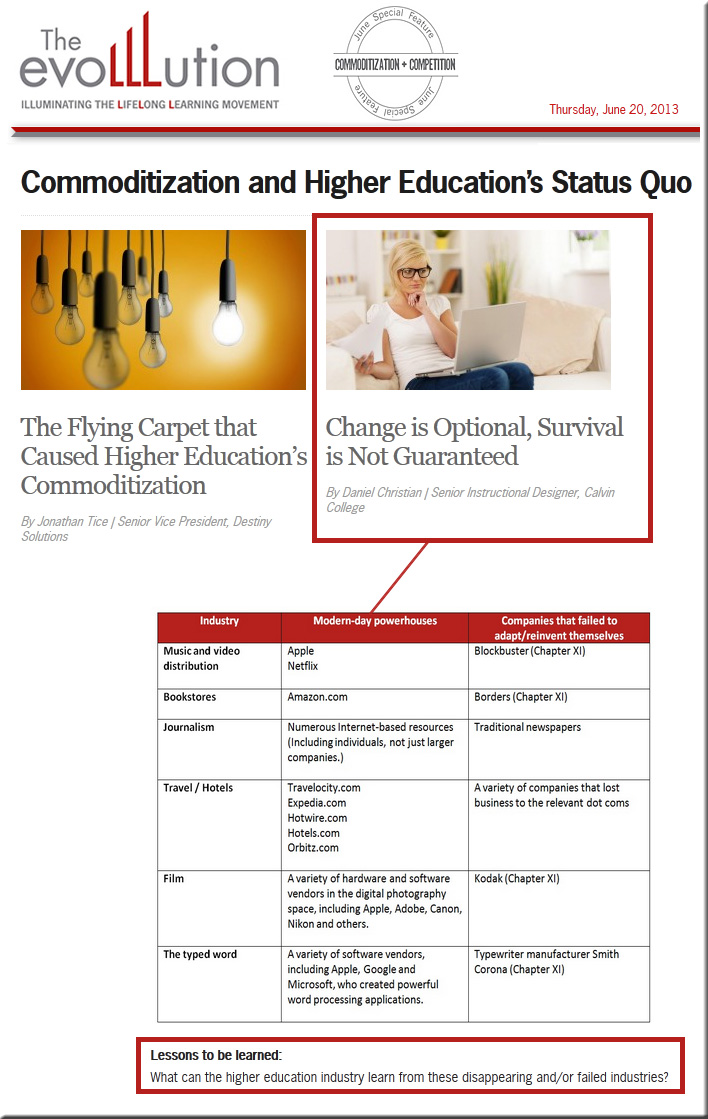
Blockbusted: A Netflix Knock-Out, Bad Metaphors on the Path to the Movie Monster’s Bankruptcy — from Fast Company – Technology by Austin Carr

The Blockbuster age is fading, and at last the company is preparing for bankruptcy. In the past two years, the shrinking video-rental store has struggled to stay afloat with $920 million in debt, drowning all the while in revenue losses of $1.1 billion. The LA Times reports that Blockbuster executives and senior debt holders have entered discussions with major movie studios for a “pre-planned” bankruptcy mid-September.

But for everyone other than Blockbuster’s sunny faced spin masters, bankruptcy was about as surprising as another Rocky comeback. Blockbuster’s brick-and-mortar business was unviable in the digital world, and competitors Netflix and Redbox took every advantage to pick apart the dinosaur’s carcass. The company’s numbers have signaled extinction, too, with value withering from $8.4 billion when Viacom purchased it in 1994 to total market value of $24 million today. Continuing the Mesozoic metaphor, here’s why bankruptcy hit Blockbuster like a surprise asteroid.

Netflix Who?

From DSC:
And I would add the questions:

  • “Who cares about the iPod?”
  • “What does Internet-related technology have to do with our business anyway?”

In a presentation I created last year (see Section II), I used Blockbuster as an example of an organization who completely discounted the disruptive impact of technology..and now they are paying the price (along with much of the newspaper industry).

There IS a lesson here for those of us in higher ed.

I’ll end this posting with the following quote/excerpt:

“This is a pattern we see over and over,” he said, of the many parallels he could draw to Blockbuster’s financial troubles. “If a company is not able to keep up with the changing needs of its customer, it will become irrelevant,” he said.

Ultimately, it was these words which may have saved the company. Blockbuster was not able to keep up with the changing needs of its customers.

Blockbuster has become irrelevant.

Staying Relevant

Relevant addendum:

Tagged with:  
Tagged with:  

Distance Education: The Centralization vs. Decentralization Debate — from Faculty Focus

The debate for “control” of distance education at institutions of higher learning continues. On one side, the administration side, there is a need for centralization of operations, to include course development, instructor training and development, scheduling, evaluation, and student and faculty issues. On the other side of the debate, faculty leaders (deans, department chairs, program coordinators) tend to favor decentralization.

In June 2010, the Western Cooperative for Educational Telecommunication (WCET) asked the membership how institutions were doing with this issue: centralization vs. de-centralization. Twenty-three administrators (provosts, VPs, associate VPs, directors, associate directors, COOs, deans, associate deans) and faculty members provided their valuable insights on the issue.

Tagged with:  

Lecture Capture: Policy and Strategy — University Business by Ellen Ullman
What is happening to the pedagogical process because of lecture capture?
July/August 2010 2010

http://innovations.helixhighered.com/

HELIX Innovations Collection Press Release

A NEW, CROWDSOURCED RESOURCE FOR HIGHER EDUCATION PRACTITIONERS, RESEARCHERS, AND POLICY MAKERS HIGHLIGHTS POSTSECONDARY INNOVATION
The Higher Education Leadership and Innovation eXchange Launches the HELIX Innovations Collection

Boston, Massachusetts – August 19, 2010 – The Higher Education Leadership and Innovation eXchange announces the launch of their online, crowdsourced resource HELIX Innovations Collection at http://innovations.helixhighered.com. The Innovations Collection is intended to spark conversation about new ideas and promising practices for the next generation of higher education.

“The Collection invites higher education practitioners, researchers, and policy makers to make their voices heard and speak out about potential solutions to the challenges faced by the education field today,” said Jim Woodell, HELIX co-founder. “True innovation is open. We created the HELIX Innovations Collection to allow everyone concerned with improving higher education to share and comment on innovative solutions.”

Applying the interactive potential of Web 2.0 technologies to problems in higher education provides the opportunity to share innovations quickly, identify their potential, and refine them with the help of peers worldwide. Visitors to the Collection can suggest innovative solutions, comment on suggested ideas, and rate an idea’s potential to influence the field along several ‘innovation dimensions’.

“It is our hope that the innovations which receive broad support and fine-tuning by the ‘crowd’ will be picked up by practitioners in the field and discussed, piloted, and perhaps even implemented by their home institutions. We hope that true linkages between and among research, policy, and practice will be forged from such collaborative efforts,” said HELIX co-founder Greg Lamontagne.

About the Higher Education Leadership & Innovation eXchange (HELIX)
HELIX is a networking and information sharing resource for Higher Education research, policy, and practice. Founded in 2010 by Jim Woodell and Greg Lamontagne, HELIX is located in Boston Massachusetts. More information is available at http://www.helixhighered.com.

Tagged with:  

Digital Learning Council press release — from EdReformer.com

Tallahassee, Florida and Washington, D.C. August 18, 2010 – Jeb Bush, governor of Florida 1999 – 2007, and Bob Wise, governor of West Virginia 2001 – 2005, today launched the Digital Learning Council to identify policies that will integrate current and future technological innovations into public education. The Digital Learning Council unites a diverse group of more than 50 leaders from education, government, philanthropy, business, technology, and think tanks to develop the roadmap of reform for local, state and federal lawmakers and policymakers.

“Technology has the power to customize education for every student in America,” said Jeb Bush, co-chair of the Digital Learning Council. “Providing a customized, personalized education for students was a dream just a decade ago. Technology can turn that dream into reality today. The Digital Learning Council will develop the roadmap to achieve that ultimate goal.”

Looking for something?

Use the form below to search the site:

Still not finding what you're looking for? Drop a comment on a post or contact us so we can take care of it!

© 2010 Learning Ecosystems