“OpenAI’s Atlas: the End of Online Learning—or Just the Beginning?” [Hardman] + other items re: AI in our LE’s

OpenAI’s Atlas: the End of Online Learning—or Just the Beginning? — from drphilippahardman.substack.com by Dr. Philippa Hardman

My take is this: in all of the anxiety lies a crucial and long-overdue opportunity to deliver better learning experiences. Precisely because Atlas perceives the same context in the same moment as you, it can transform learning into a process aligned with core neuro-scientific principles—including active retrieval, guided attention, adaptive feedback and context-dependent memory formation.

Perhaps in Atlas we have a browser that for the first time isn’t just a portal to information, but one which can become a co-participant in active cognitive engagement—enabling iterative practice, reflective thinking, and real-time scaffolding as you move through challenges and ideas online.

With this in mind, I put together 10 use cases for Atlas for you to try for yourself.

6. Retrieval Practice
What:
Pulling information from memory drives retention better than re-reading.
Why: Practice testing delivers medium-to-large effects (Adesope et al., 2017).
Try: Open a document with your previous notes. Ask Atlas for a mixed activity set: “Quiz me on the Krebs cycle—give me a near-miss, high-stretch MCQ, then a fill-in-the-blank, then ask me to explain it to a teen.”
Atlas uses its browser memory to generate targeted questions from your actual study materials, supporting spaced, varied retrieval.


From DSC:
A quick comment. I appreciate these ideas and approaches from Katarzyna and Rita. I do think that someone is going to want to be sure that the AI models/platforms/tools are given up-to-date information and updated instructions — i.e., any new procedures, steps to take, etc. Perhaps I’m missing the boat here, but an internal AI platform is going to need to have access to up-to-date information and instructions.


At the most recent NVIDIA GTC conference, held in Washington, D.C. in October 2025, CEO Jensen Huang announced major developments emphasizing the use of AI to “reindustrialize America”. This included new partnerships, expansion of the Blackwell architecture, and advancements in AI factories for robotics and science. The spring 2024 GTC conference, meanwhile, was headlined by the launch of the Blackwell GPU and significant updates to the Omniverse and robotics platforms.

During the keynote in D.C., Jensen Huang focused on American AI leadership and announced several key initiatives.

  • Massive Blackwell GPU deployments: The company announced an expansion of its Blackwell GPU architecture, which first launched in March 2024. Reportedly, the company has already shipped 6 million Blackwell chips, with orders for 14 million more by the end of 2025.
  • AI supercomputers for science: In partnership with the Department of Energy and Oracle, NVIDIA is building new AI supercomputers at Argonne National Laboratory. The largest, named “Solstice,” will deploy 100,000 Blackwell GPUs.
  • 6G infrastructure: NVIDIA announced a partnership with Nokia to develop a U.S.-based, AI-native 6G technology stack.
  • AI factories for robotics: A new AI Factory Research Center in Virginia will use NVIDIA’s technology for building massive-scale data centers for AI.
  • Autonomous robotaxis: The company’s self-driving technology, already adopted by several carmakers, will be used by Uber for an autonomous fleet of 100,000 robotaxis starting in 2027.


Nvidia and Uber team up to develop network of self-driving cars — from finance.yahoo.com by Daniel Howley

Nvidia (NVDA) and Uber (UBER) on Tuesday revealed that they’re working to put together what they say will be the world’s largest network of Level 4-ready autonomous cars.

The duo will build out 100,000 vehicles beginning in 2027 using Nvidia’s Drive AGX Hyperion 10 platform and Drive AV software.


Nvidia stock hits all-time high, nears $5 trillion market cap after slew of updates at GTC event — from finance.yahoo.com by Daniel Howley

Nvidia (NVDA) stock on Tuesday rose 5% to close at a record high after the company announced a slew of product updates, partnerships, and investment initiatives at its GTC event in Washington, D.C., putting it on the doorstep of becoming the first company in history with a market value above $5 trillion.

The AI chip giant is approaching the threshold — settling at a market cap of $4.89 trillion on Tuesday — just months after becoming the first to close above $4 trillion in July.


2. Concern and excitement about AI — from pewresearch.org by Jacob Poushter,Moira Faganand Manolo Corichi

Key findings

  • A median of 34% of adults across 25 countries are more concerned than excited about the increased use of artificial intelligence in daily life. A median of 42% are equally concerned and excited, and 16% are more excited than concerned.
  • Older adults, women, people with less education and those who use the internet less often are particularly likely to be more concerned than excited.

Also relevant here:


AI Video Wars include Veo 3.1, Sora 2, Ray3, Kling 2.5 + Wan 2.5 — from heatherbcooper.substack.com by Heather Cooper
House of David Season 2 is here!

In today’s edition:

  • Veo 3.1 brings richer audio and object-level editing to Google Flow
  • Sora 2 is here with Cameo self-insertion and collaborative Remix features
  • Ray3 brings world-first reasoning and HDR to video generation
  • Kling 2.5 Turbo delivers faster, cheaper, more consistent results
  • WAN 2.5 revolutionizes talking head creation with perfect audio sync
  • House of David Season 2 Trailer
  • HeyGen Agent, Hailuo Agent, Topaz Astra, and Lovable Cloud updates
  • Image & Video Prompts

From DSC:
By the way, the House of David (which Heather referred to) is very well done! I enjoyed watching Season 1. Like The Chosen, it brings the Bible to life in excellent, impactful ways! Both series convey the context and cultural tensions at the time. Both series are an answer to prayer for me and many others — as they are professionally-done. Both series match anything that comes out of Hollywood in terms of the acting, script writing, music, the sets, etc.  Both are very well done.
.


An item re: Sora:


Other items re: Open AI’s new Atlas browser:

Introducing ChatGPT Atlas — from openai.com
The browser with ChatGPT built in.

[On 10/21/25] we’re introducing ChatGPT Atlas, a new web browser built with ChatGPT at its core.

AI gives us a rare moment to rethink what it means to use the web. Last year, we added search in ChatGPT so you could instantly find timely information from across the internet—and it quickly became one of our most-used features. But your browser is where all of your work, tools, and context come together. A browser built with ChatGPT takes us closer to a true super-assistant that understands your world and helps you achieve your goals.

With Atlas, ChatGPT can come with you anywhere across the web—helping you in the window right where you are, understanding what you’re trying to do, and completing tasks for you, all without copying and pasting or leaving the page. Your ChatGPT memory is built in, so conversations can draw on past chats and details to help you get new things done.

ChatGPT Atlas: the AI browser test — from getsuperintel.com by Kim “Chubby” Isenberg
Chat GPT Atlas aims to transform web browsing into a conversational, AI-native experience, but early reviews are mixed

OpenAI’s new ChatGPT Atlas promises to merge web browsing, search, and automation into a single interface — an “AI-native browser” meant to make the web conversational. After testing it myself, though, I’m still trying to see the real breakthrough. It feels familiar: summaries, follow-ups, and even the Agent’s task handling all mirror what I already do inside ChatGPT.

OpenAI’s new Atlas browser remembers everything — from theneurondaily.com by Grant Harvey
PLUS: Our AIs are getting brain rot?!

Here’s how it works: Atlas can see what you’re looking at on any webpage and instantly help without you needing to copy/paste or switch tabs. Researching hotels? Ask ChatGPT to compare prices right there. Reading a dense article? Get a summary on the spot. The AI lives in the browser itself.

OpenAI’s new product — from bensbites.com

The latest entry in AI browsers is Atlas – A new browser from OpenAI. Atlas would feel similar to Dia or Comet if you’ve used them. It has an “Ask ChatGPT” sidebar that has the context of your page, and choose “Agent” to work on that tab. Right now, Agent is limited to a single tab, and it is way too slow to delegate anything for real to it. Click accuracy for Agent is alright on normal web pages, but it will definitely trip up if you ask it to use something like Google Sheets.

One ambient feature that I think many people will like is “select to rewrite” – You can select any text in Atlas, hover/click on the blue dot in the top right corner to rewrite it using AI.


Your AI Resume Hacks Probably Won’t Fool Hiring Algorithms — from builtin.com by Jeff Rumage
Recruiters say those viral hidden prompt for resumes don’t work — and might cost you interviews.

Summary: Job seekers are using “prompt hacking” — embedding hidden AI commands in white font on resumes — to try to trick applicant tracking systems. While some report success, recruiters warn the tactic could backfire and eliminate the candidate from consideration.


The Job Market Might Be a Mess, But Don’t Blame AI Just Yet — from builtin.com by Matthew Urwin
A new study by Yale University and the Brookings Institution says the panic around artificial intelligence stealing jobs is overblown. But that might not be the case for long.

Summary: A Yale and Brookings study finds generative AI has had little impact on U.S. jobs so far, with tariffs, immigration policies and the number of college grads potentially playing a larger role. Still, AI could disrupt the workforce in the not-so-distant future.


Amazon’s AWS outage on October 20 knocked services like Alexa, Snapchat, Fortnite, Venmo and more offline for hours — from engadget.com by Kris Holt
A massive outage highlights why relying on a few companies to power much of the internet is far from ideal.

It felt like half of the internet was dealing with a severe hangover on October 20. A severe Amazon Web Services outage took out many, many websites, apps, games and other services that rely on Amazon’s cloud division to stay up and running.

Sites and services that were affected by the AWS outage include:

  • Amazon
  • Amazon Alexa
  • Bank of America
  • Snapchat
  • Reddit
  • Lyft
  • Apple Music
  • Apple TV
  • Pinterest
  • Fortnite
  • Roblox
  • The New York Times
  • Disney+
  • Venmo
  • Doordash
  • Hulu
  • Grubhub
  • PlayStation
  • Zoom

From DSC:
Hmmm…doesn’t this put a bit of alarm in your mind? I can’t help but wonder…if another government wants to wreak havoc on another country — or even the world — that is an increasingly possible situation these days. In fact, its already happened with social media and with cybersecurity-related issues. But taking down banking, commerce, exchanges, utilities, and more is increasingly possible. Or at least that’s my mental image of the state of cyberwarfare. 


OpenAI and NVIDIA announce strategic partnership to deploy 10 gigawatts of NVIDIA systems — from openai.com

  • Strategic partnership enables OpenAI to build and deploy at least 10 gigawatts of AI datacenters with NVIDIA systems representing millions of GPUs for OpenAI’s next-generation AI infrastructure.
  • To support the partnership, NVIDIA intends to invest up to $100 billion in OpenAI progressively as each gigawatt is deployed.
  • The first gigawatt of NVIDIA systems will be deployed in the second half of 2026 on NVIDIA’s Vera Rubin platform.

Also on Nvidia’s site here.

The Neuron Daily comments on this partnership here and also see their thoughts here:

Why this matters: The partnership kicks off in the second half of 2026 with NVIDIA’s new Vera Rubin platform. OpenAI will use this massive compute power to train models beyond what we’ve seen with GPT-5 and likely also power what’s called inference (when you ask a question to chatGPT, and it gives you an answer). And NVIDIA gets a guaranteed customer for their most advanced chips. Infinite money glitch go brrr am I right? Though to be fair, this kinda deal is as old as the AI industry itself.

This isn’t just about bigger models, mind you: it’s about infrastructure for what both companies see as the future economy. As Sam Altman put it, “Compute infrastructure will be the basis for the economy of the future.”

Our take: We think this news is actually super interesting when you pair it with the other big headline from today: Commonwealth Fusion Systems signed a commercial deal worth more than $1B with Italian energy company Eni to purchase fusion power from their 400 MW ARC plant in Virginia. Here’s what that means for AI…

…and while you’re on that posting from The Neuron Daily, also see this piece:

AI filmmaker Dinda Prasetyo just released “Skyland,” a fantasy short film about a guy named Aeryn and his “loyal flying fish”, and honestly, the action sequences look like they belong in an actual film…

What’s wild is that Dinda used a cocktail of AI tools (Adobe FireflyMidJourney, the newly launched Luma Ray 3, and ElevenLabs) to create something that would’ve required a full production crew just two years ago.


The Era of Prompts Is Over. Here’s What Comes Next. — from builtin.com by Ankush Rastogi
If you’re still prompting your AI, you’re behind the curve. Here’s how to prepare for the coming wave of AI agents.

Summary: Autonomous AI agents are emerging as systems that handle goals, break down tasks and integrate with tools without constant prompting. Early uses include call centers, healthcare, fraud detection and research, but concerns remain over errors, compliance risks and unchecked decisions.

The next shift is already peeking around the corner, and it’s going to make prompts look primitive. Before long, we won’t be typing carefully crafted requests at all. We’ll be leaning on autonomous AI agents, systems that don’t just spit out answers but actually chase goals, make choices and do the boring middle steps without us guiding them. And honestly, this jump might end up dwarfing the so-called “prompt revolution.”


Chrome: The browser you love, reimagined with AI — from blog.google by Parisa Tabriz

A new way to get things done with your AI browsing assistant
Imagine you’re a student researching a topic for a paper, and you have dozens of tabs open. Instead of spending hours jumping between sources and trying to connect the dots, your new AI browsing assistant — Gemini in Chrome 1 — can do it for you. Gemini can answer questions about articles, find references within YouTube videos, and will soon be able to help you find pages you’ve visited so you can pick up exactly where you left off.

Rolling out to Mac and Windows users in the U.S. with their language set to English, Gemini in Chrome can understand the context of what you’re doing across multiple tabs, answer questions and integrate with other popular Google services, like Google Docs and Calendar. And it’ll be available on both Android and iOS soon, letting you ask questions and summarize pages while you’re on the go.

We’re also developing more advanced agentic capabilities for Gemini in Chrome that can perform multi-step tasks for you from start to finish, like ordering groceries. You’ll remain in control as Chrome handles the tedious work, turning 30-minute chores into 3-click user journeys.


ChatGPT: the world’s most influential teacher — from drphilippahardman.substack.com by Dr. Philippa Hardman; emphasis DSC
New research shows that millions of us are “learning with AI” every week: what does this mean for how (and how well) humans learn?

This week, an important piece of research landed that confirms the gravity of AI’s role in the learning process. The TLDR is that learning is now a mainstream use case for ChatGPT; around 10.2% of all ChatGPT messages (that’s ~2BN messages sent by over 7 million users per week) are requests for help with learning.

The research shows that about 10.2% of all messages are tutoring/teaching, and within the “Practical Guidance” category, tutoring is 36%. “Asking” interactions are growing faster than “Doing” and are rated higher quality by users. Younger people contribute a huge share of messages, and growth is fastest in low- and middle-income countries (How People Use ChatGPT, 2025).

If AI is already acting as a global tutor, the question isn’t “will people learn with AI?”—they already are. The real question we need to ask is: what does great learning actually look like, and how should AI evolve to support it? That’s where decades of learning science help us separate “feels like learning” from “actually gaining new knowledge and skills”.

Let’s dive in.


One-size-fits-all learning is about to become completely obsolete. — from linkedin.com by Allie Miller


AI in the University: From Generative Assistant to Autonomous Agent This Fall — from insidehighered.com by
This fall we are moving into the agentic generation of artificial intelligence.

“Where generative AI creates, agentic AI acts.” That’s how my trusted assistant, Gemini 2.5 Pro deep research, describes the difference.

Agents, unlike generative tools, create and perform multistep goals with minimal human supervision. The essential difference is found in its proactive nature. Rather than waiting for a specific, step-by-step command, agentic systems take a high-level objective and independently create and execute a plan to achieve that goal. This triggers a continuous, iterative workflow that is much like a cognitive loop. The typical agentic process involves six key steps, as described by Nvidia:


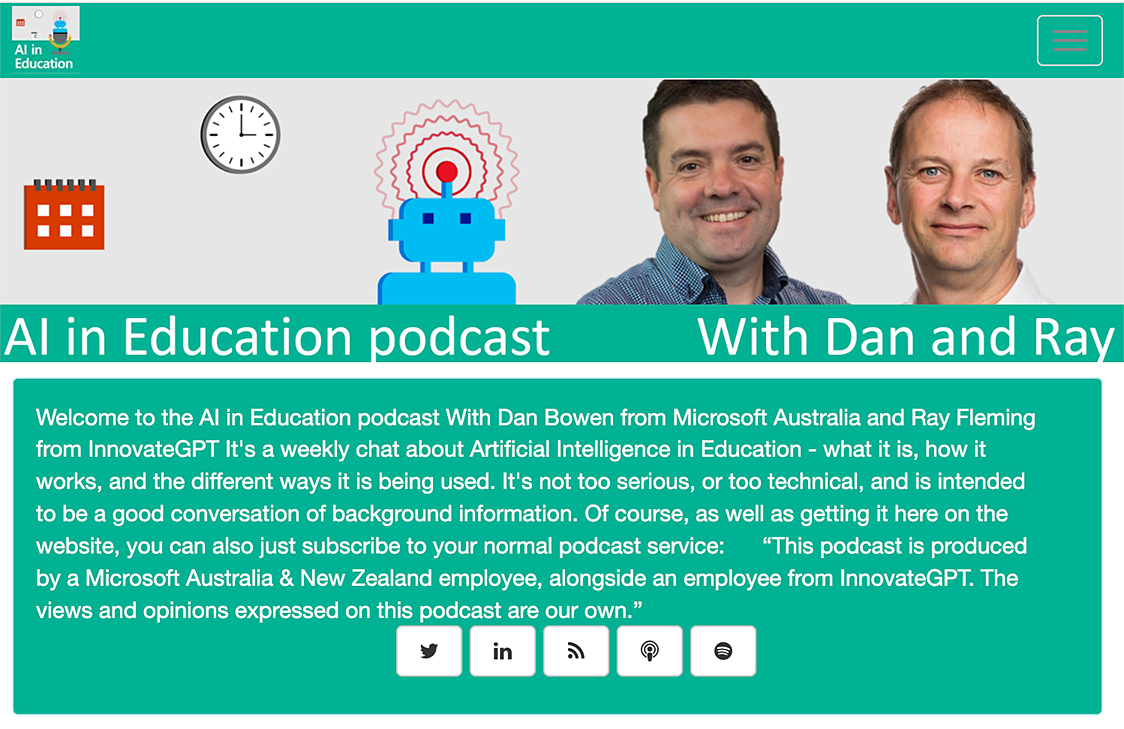
AI in Education Podcast — from aipodcast.education by Dan Bowen and Ray Fleming


The State of AI in Education 2025 Key Findings from a National Survey — from Carnegie Learning

Our 2025 national survey of over 650 respondents across 49 states and Puerto Rico reveals both encouraging trends and important challenges. While AI adoption and optimism are growing, concerns about cheating, privacy, and the need for training persist.

Despite these challenges, I’m inspired by the resilience and adaptability of educators. You are the true game-changers in your students’ growth, and we’re honored to support this vital work.

This report reflects both where we are today and where we’re headed with AI. More importantly, it reflects your experiences, insights, and leadership in shaping the future of education.


Instructure and OpenAI Announce Global Partnership to Embed AI Learning Experiences within Canvas — from instructure.com

This groundbreaking collaboration represents a transformative step forward in education technology and will begin with, but is not limited to, an effort between Instructure and OpenAI to enhance the Canvas experience by embedding OpenAI’s next-generation AI technology into the platform.

IgniteAI announced earlier today, establishes Instructure’s future-ready, open ecosystem with agentic support as the AI landscape continues to evolve. This partnership with OpenAI exemplifies this bold vision for AI in education. Instructure’s strategic approach to AI emphasizes the enhancement of connections within an educational ecosystem comprising over 1,100 edtech partners and leading LLM providers.

“We’re committed to delivering next-generation LMS technologies designed with an open ecosystem that empowers educators and learners to adapt and thrive in a rapidly changing world,” said Steve Daly, CEO of Instructure. “This collaboration with OpenAI showcases our ambitious vision: creating a future-ready ecosystem that fosters meaningful learning and achievement at every stage of education. This is a significant step forward for the education community as we continuously amplify the learning experience and improve student outcomes.”


Faculty Latest Targets of Big Tech’s AI-ification of Higher Ed — from insidehighered.com by Kathryn Palmer
A new partnership between OpenAI and Instructure will embed generative AI in Canvas. It may make grading easier, but faculty are skeptical it will enhance teaching and learning.

The two companies, which have not disclosed the value of the deal, are also working together to embed large language models into Canvas through a feature called IgniteAI. It will work with an institution’s existing enterprise subscription to LLMs such as Anthropic’s Claude or OpenAI’s ChatGPT, allowing instructors to create custom LLM-enabled assignments. They’ll be able to tell the model how to interact with students—and even evaluate those interactions—and what it should look for to assess student learning. According to Instructure, any student information submitted through Canvas will remain private and won’t be shared with OpenAI.

Faculty Unsurprised, Skeptical
Few faculty were surprised by the Canvas-OpenAI partnership announcement, though many are reserving judgment until they see how the first year of using it works in practice.


These 40 Jobs May Be Replaced by AI. These 40 Probably Won’t — from inc.com by Bruce Crumley
A new Microsoft report ranks 80 professions by their risk of being replaced by AI tools.

A new study measuring the use of generative artificial intelligence in different professions has just gone public, and its main message to people working in some fields is harsh. It suggests translators, historians, text writers, sales representatives, and customer service agents might want to consider new careers as pile driver or dredge operators, railroad track layers, hardwood floor sanders, or maids — if, that is, they want to lower the threat of AI apps pushing them out of their current jobs.

From DSC:
Unfortunately, this is where the hyperscalers are going to get their ROI from all of the capital expenditures that they are making. Companies are going to use their services in order to reduce headcount at their organizations. CEOs are even beginning to brag about the savings that are realized by the use of AI-based technologies: (or so they claim.)

“As a CEO myself, I can tell you, I’m extremely excited about it. I’ve laid off employees myself because of AI. AI doesn’t go on strike. It doesn’t ask for a pay raise. These things that you don’t have to deal with as a CEO.”

My first position out of college was being a Customer Service Representative at Baxter Healthcare. It was my most impactful job, as it taught me the value of a customer. From then on, whoever I was trying to assist was my customer — whether they were internal or external to the organization that I was working for. Those kinds of jobs are so important. If they evaporate, what then? How will young people/graduates get their start? 

Also related/see:


Microsoft’s Edge Over the Web, OpenAI Goes Back to School, and Google Goes Deep — from thesignal.substack.com by Alex Banks

Alex’s take: We’re seeing browsers fundamentally transition from search engines ? answer engines ? action engines. Gone are the days of having to trawl through pages of search results. Commands are the future. They are the direct input to arrive at the outcomes we sought in the first place, such as booking a hotel or ordering food. I’m interested in watching Microsoft’s bet develop as browsers become collaborative (and proactive) assistants.


Everyone’s an (AI) TV showrunner now… — from theneurondaily.com by Grant Harvey

Amazon just invested in an AI that can create full TV episodes—and it wants you to star in them.

Remember when everyone lost their minds over AI generating a few seconds of video? Well, Amazon just invested in a company called Fable Studio whose system called Showrunner can generates entire 22-minute TV episodes.

Where does this go from here? Imagine asking AI to rewrite the ending of Game of Thrones, or creating a sitcom where you and your friends are the main characters. This type of tech could create personalized entertainment experiences just like that.

Our take: Without question, we’re moving toward a world where every piece of media can be customized to you personally. Your Netflix could soon generate episodes where you’re the protagonist, with storylines tailored to your interests and sense of humor.

And if this technology scales, the entire entertainment industry could flip upside down. The pitch goes: why watch someone else’s story when you can generate your own? 


The End of Work as We Know It — from gizmodo.com by Luc Olinga
CEOs call it a revolution in efficiency. The workers powering it call it a “new era in forced labor.” I spoke to the people on the front lines of the AI takeover.

Yet, even in this vision of a more pleasant workplace, the specter of displacement looms large. Miscovich acknowledges that companies are planning for a future where headcount could be “reduced by 40%.” And Clark is even more direct. “A lot of CEOs are saying that, knowing that they’re going to come up in the next six months to a year and start laying people off,” he says. “They’re looking for ways to save money at every single company that exists.”

But we do not have much time. As Clark told me bluntly: “I am hired by CEOs to figure out how to use AI to cut jobs. Not in ten years. Right now.”


AI Is Coming for the Consultants. Inside McKinsey, ‘This Is Existential.’ — from wsj.com by Chip Cutter; behind a paywall
If AI can analyze information, crunch data and deliver a slick PowerPoint deck within seconds, how does the biggest name in consulting stay relevant?


ChatGPT users shocked to learn their chats were in Google search results — from arstechnica.com by Ashley Belanger
OpenAI scrambles to remove personal ChatGPT conversations from Google results

Faced with mounting backlash, OpenAI removed a controversial ChatGPT feature that caused some users to unintentionally allow their private—and highly personal—chats to appear in search results.

Fast Company exposed the privacy issue on Wednesday, reporting that thousands of ChatGPT conversations were found in Google search results and likely only represented a sample of chats “visible to millions.” While the indexing did not include identifying information about the ChatGPT users, some of their chats did share personal details—like highly specific descriptions of interpersonal relationships with friends and family members—perhaps making it possible to identify them, Fast Company found.


Character.AI Launches World’s First AI-Native Social Feed — from blog.character.ai

Today, we’re dropping the world’s first AI-native social feed.

Feed from Character.AI is a dynamic, scrollable content platform that connects users with the latest Characters, Scenes, Streams, and creator-driven videos in one place.

This is a milestone in the evolution of online entertainment.

For the last 10 years, social platforms have been all about passive consumption. The Character.AI Feed breaks that paradigm and turns content into a creative playground. Every post is an invitation to interact, remix, and build on what others have made. Want to rewrite a storyline? Make yourself the main character? Take a Character you just met in someone else’s Scene and pop it into a roast battle or a debate? Now it’s easy. Every story can have a billion endings, and every piece of content can change and evolve with one tap.


On blogging (again) — from by Martin Weller

I also pondered what functions blogging has provided for me over the years.

  • Continuity – as an individual you persist across multiple organisations, roles and jobs. Although I stayed in one institution, I had many roles and the blog wasn’t associated with one specific project. Now I have left it continues.
  • Holistic – you can blog about one topic, but over time I think some personality will creep in. You are not just one thing, you have a personal life, tastes, interests etc which will all feed into what you do. A blog allows this more rounded representation.
  • Experimentation – there is relatively low cost and risk for much of it (this may not be the case for many people online, we need to acknowledge), so you can try things, and if they don’t work, so what? Also you can try formats that conventional outlets might not be appropriate for.
  • Development – the blog has been both an intentional and unintentional vehicle for working up ideas, documenting the process and getting feedback, which have led to more substantial outputs, such as books, project proposals and papers. Most importantly though it has been the means through which I have continually developed writing.
  • Connecting – particularly in those halcyon early days, it was a good way of finding others, working on ideas together, sharing something of yourself. A lot of my career related personal friendships have resulted from blogging.
  • Publicity – I became at one point (the OU crisis of 2018) something of a public voice of the OU, and have often used the blog for projects such as GO-GN

That’s not a bad return for a lil’ ol’ blog. I couldn’t say the same for academic journals.


Google I/O 2025: From research to reality — from blog.google
Here’s how we’re making AI more helpful with Gemini.


Google I/O 2025 LIVE — all the details about Android XR smart glasses, AI Mode, Veo 3, Gemini, Google Beam and more — from tomsguide.com by Philip Michaels
Google’s annual conference goes all in on AI

With a running time of 2 hours, Google I/O 2025 leaned heavily into Gemini and new models that make the assistant work in more places than ever before. Despite focusing the majority of the keynote around Gemini, Google saved its most ambitious and anticipated announcement towards the end with its big Android XR smart glasses reveal.

Shockingly, very little was spent around Android 16. Most of its Android 16 related news, like the redesigned Material 3 Expressive interface, was announced during the Android Show live stream last week — which explains why Google I/O 2025 was such an AI heavy showcase.

That’s because Google carved out most of the keynote to dive deeper into Gemini, its new models, and integrations with other Google services. There’s clearly a lot to unpack, so here’s all the biggest Google I/O 2025 announcements.


Our vision for building a universal AI assistant— from blog.google
We’re extending Gemini to become a world model that can make plans and imagine new experiences by simulating aspects of the world.

Making Gemini a world model is a critical step in developing a new, more general and more useful kind of AI — a universal AI assistant. This is an AI that’s intelligent, understands the context you are in, and that can plan and take action on your behalf, across any device.

By applying LearnLM capabilities, and directly incorporating feedback from experts across the industry, Gemini adheres to the principles of learning science to go beyond just giving you the answer. Instead, Gemini can explain how you get there, helping you untangle even the most complex questions and topics so you can learn more effectively. Our new prompting guide provides sample instructions to see this in action.


Learn in newer, deeper ways with Gemini — from blog.google.com by Ben Gomes
We’re infusing LearnLM directly into Gemini 2.5 — plus more learning news from I/O.

At I/O 2025, we announced that we’re infusing LearnLM directly into Gemini 2.5, which is now the world’s leading model for learning. As detailed in our latest report, Gemini 2.5 Pro outperformed competitors on every category of learning science principles. Educators and pedagogy experts preferred Gemini 2.5 Pro over other offerings across a range of learning scenarios, both for supporting a user’s learning goals and on key principles of good pedagogy.


Gemini gets more personal, proactive and powerful — from blog.google.com by Josh Woodward
It’s your turn to create, learn and explore with an AI assistant that’s starting to understand your world and anticipate your needs.

Here’s what we announced at Google IO:

  • Gemini Live with camera and screen sharing, is now free on Android and iOS for everyone, so you can point your phone at anything and talk it through.
  • Imagen 4, our new image generation model, comes built in and is known for its image quality, better text rendering and speed.
  • Veo 3, our new, state-of-the-art video generation model, comes built in and is the first in the world to have native support for sound effects, background noises and dialogue between characters.
  • Deep Research and Canvas are getting their biggest updates yet, unlocking new ways to analyze information, create podcasts and vibe code websites and apps.
  • Gemini is coming to Chrome, so you can ask questions while browsing the web.
  • Students around the world can easily make interactive quizzes, and college students in the U.S., Brazil, Indonesia, Japan and the UK are eligible for a free school year of the Google AI Pro plan.
  • Google AI Ultra, a new premium plan, is for the pioneers who want the highest rate limits and early access to new features in the Gemini app.
  • 2.5 Flash has become our new default model, and it blends incredible quality with lightning fast response times.

Fuel your creativity with new generative media models and tools — from by Eli Collins
Introducing Veo 3 and Imagen 4, and a new tool for filmmaking called Flow.


AI in Search: Going beyond information to intelligence
We’re introducing new AI features to make it easier to ask any question in Search.

AI in Search is making it easier to ask Google anything and get a helpful response, with links to the web. That’s why AI Overviews is one of the most successful launches in Search in the past decade. As people use AI Overviews, we see they’re happier with their results, and they search more often. In our biggest markets like the U.S. and India, AI Overviews is driving over 10% increase in usage of Google for the types of queries that show AI Overviews.

This means that once people use AI Overviews, they’re coming to do more of these types of queries, and what’s particularly exciting is how this growth increases over time. And we’re delivering this at the speed people expect of Google Search — AI Overviews delivers the fastest AI responses in the industry.

In this story:

  • AI Mode in Search
  • Deep Search
  • Live capabilities
  • Agentic capabilities
  • Shopping
  • Personal context
  • Custom charts


It’s the end of work as we knew it
and I feel…

powerless to fight the technology that we pioneered
nostalgic for a world that moved on without us
after decades of paying our dues
for a payday that never came
…so yeah
not exactly fine.


The Gen X Career Meltdown — from nytimes.com by Steeven Kurutz (DSC: This is a gifted article for you)
Just when they should be at their peak, experienced workers in creative fields find that their skills are all but obsolete.

If you entered media or image-making in the ’90s — magazine publishing, newspaper journalism, photography, graphic design, advertising, music, film, TV — there’s a good chance that you are now doing something else for work. That’s because those industries have shrunk or transformed themselves radically, shutting out those whose skills were once in high demand.

“I am having conversations every day with people whose careers are sort of over,” said Chris Wilcha, a 53-year-old film and TV director in Los Angeles.

Talk with people in their late 40s and 50s who once imagined they would be able to achieve great heights — or at least a solid career while flexing their creative muscles — and you are likely to hear about the photographer whose work dried up, the designer who can’t get hired or the magazine journalist who isn’t doing much of anything.

In the wake of the influencers comes another threat, artificial intelligence, which seems likely to replace many of the remaining Gen X copywriters, photographers and designers. By 2030, ad agencies in the United States will lose 32,000 jobs, or 7.5 percent of the industry’s work force, to the technology, according to the research firm Forrester.


From DSC:
This article reminds me of how tough it is to navigate change in our lives. For me, it was often due to the fact that I was working with technologies. Being a technologist can be difficult, especially as one gets older and faces age discrimination in a variety of industries. You need to pick the right technologies and the directions that will last (for me it was email, videoconferencing, the Internet, online-based education/training, discovering/implementing instructional technologies, and becoming a futurist).

For you younger folks out there — especially students within K-16 — aim to develop a perspective and a skillset that is all about adapting to change. You will likely need to reinvent yourself and/or pick up new skills over your working years. You are most assuredly required to be a lifelong learner now. That’s why I have been pushing for school systems to be more concerned with providing more choice and control to students — so that students actually like school and enjoy learning about new things.


Introducing the 2025 Wonder Media Calendar for tweens, teens, and their families/households. Designed by Sue Ellen Christian and her students in her Global Media Literacy class (in the fall 2024 semester at Western Michigan University), the calendar’s purpose is to help people create a new year filled with skills and smart decisions about their media use. This calendar is part of the ongoing Wonder Media Library.com project that includes videos, lesson plans, games, songs and more. The website is funded by a generous grant from the Institute of Museum and Library Services, in partnership with Western Michigan University and the Library of Michigan.


What DICE does in this posting will be available 24x7x365 in the future [Christian]

From DSC:
First of all, when you look at the following posting:


What Top Tech Skills Should You Learn for 2025? — from dice.com by Nick Kolakowski


…you will see that they outline which skills you should consider mastering in 2025 if you want to stay on top of the latest career opportunities. They then list more information about the skills, how you apply the skills, and WHERE to get those skills.

I assert that in the future, people will be able to see this information on a 24x7x365 basis.

  • Which jobs are in demand?
  • What skills do I need to do those jobs?
  • WHERE do I get/develop those skills?


And that last part (about the WHERE do I develop those skills) will pull from many different institutions, people, companies, etc.

BUT PEOPLE are the key! Oftentimes, we need to — and prefer to — learn with others!


From DSC:
The above item is simply excellent!!! I love it!


Also relevant/see:

3 new Chrome AI features for even more helpful browsing — from blog.google from Parisa Tabriz
See how Chrome’s new AI features, including Google Lens for desktop and Tab compare, can help you get things done more easily on the web.


On speaking to AI — from oneusefulthing.org by Ethan Mollick
Voice changes a lot of things

So, let’s talk about ChatGPT’s new Advanced Voice mode and the new AI-powered Siri. They are not just different approaches to talking to AI. In many ways, they represent the divide between two philosophies of AI – Copilots versus Agents, small models versus large ones, specialists versus generalists.


Your guide to AI – August 2024 — from nathanbenaich.substack.com by Nathan Benaich and Alex Chalmers


Microsoft says OpenAI is now a competitor in AI and search — from cnbc.com by Jordan Novet

Key Points

  • Microsoft’s annually updated list of competitors now includes OpenAI, a long-term strategic partner.
  • The change comes days after OpenAI announced a prototype of a search engine.
  • Microsoft has reportedly invested $13 billion into OpenAI.


Excerpt from by Graham Clay

1. Flux, an open-source text-to-image creator that is comparable to industry leaders like Midjourney, was released by Black Forest Labs (the “original team” behind Stable Diffusion). It is capable of generating high quality text in images (there are tons of educational use cases). You can play with it on their demo page, on Poe, or by running it on your own computer (tutorial here).

Other items re: Flux:

How to FLUX  — from heatherbcooper.substack.com by Heather Cooper
Where to use FLUX online & full tutorial to create a sleek ad in minutes

.

Also from Heather Cooper:

Introducing FLUX: Open-Source text to image model

FLUX… has been EVERYWHERE this week, as I’m sure you have seen. Developed by Black Forest Labs, is an open-source image generation model that’s gaining attention for its ability to rival leading models like Midjourney, DALL·E 3, and SDXL.

What sets FLUX apart is its blend of creative freedom, precision, and accessibility—it’s available across multiple platforms and can be run locally.

Why FLUX Matters
FLUX’s open-source nature makes it accessible to a broad audience, from hobbyists to professionals.

It offers advanced multimodal and parallel diffusion transformer technology, delivering high visual quality, strong prompt adherence, and diverse outputs.

It’s available in 3 models:
FLUX.1 [pro]: A high-performance, commercial image synthesis model.
FLUX.1 [dev]: An open-weight, non-commercial variant of FLUX.1 [pro]
FLUX.1 [schnell]: A faster, distilled version of FLUX.1, operating up to 10x quicker.

Daily Digest: Huge (in)Flux of AI videos. — from bensbites.beehiiv.com
PLUS: Review of ChatGPT’s advanced voice mode.

  1. During the weekend, image models made a comeback. Recently released Flux models can create realistic images with near-perfect text—straight from the model, without much patchwork. To get the party going, people are putting these images into video generation models to create prettytrippyvideos. I can’t identify half of them as AI, and they’ll only get better. See this tutorial on how to create a video ad for your product..


7 not only cool but handy use cases of new Claude — from techthatmatters.beehiiv.com by Harsh Makadia

  1. Data visualization
  2. Infographic
  3. Copy the UI of a website
  4. …and more

Achieving Human Level Competitive Robot Table Tennis — from sites.google.com


What to Know About Buying A Projector for School — from by Luke Edwards
Buy the right projector for school with these helpful tips and guidance.

Picking the right projector for school can be a tough decision as the types and prices range pretty widely. From affordable options to professional grade pricing, there are many choices. The problem is that the performance is also hugely varied. This guide aims to be the solution by offering all you need to know about buying the right projector for school where you are.

Luke covers a variety of topics including:

  • Types of projectors
  • Screen quality
  • Light type
  • Connectivity
  • Pricing

From DSC:
I posted this because Luke covered a variety of topics — and if you’re set on going with a projector, this is a solid article. But I hesitated to post this, as I’m not sure of the place that projectors will have in the future of our learning spaces. With voice-enabled apps and appliances continuing to be more prevalent — along with the presence of AI-based human-computer interactions and intelligent systems — will projectors be the way to go? Will enhanced interactive whiteboards be the way to go? Will there be new types of displays? I’m not sure. Time will tell.

 
© 2025 | Daniel Christian