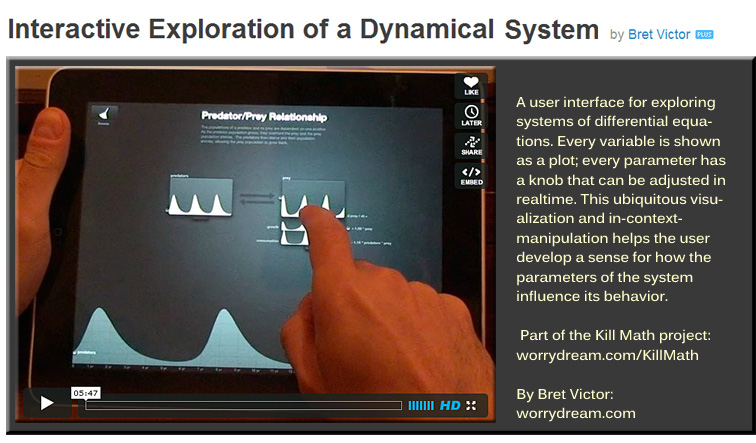
From Brett Victor’s “Kill Math” page

The power to understand and predict the quantities of the world should not be restricted to those with a freakish knack for manipulating abstract symbols.

When most people speak of Math, what they have in mind is more its mechanism than its essence. This “Math” consists of assigning meaning to a set of symbols, blindly shuffling around these symbols according to arcane rules, and then interpreting a meaning from the shuffled result. The process is not unlike casting lots.

This mechanism of math evolved for a reason: it was the most efficient means of modeling quantitative systems given the constraints of pencil and paper. Unfortunately, most people are not comfortable with bundling up meaning into abstract symbols and making them dance. Thus, the power of math beyond arithmetic is generally reserved for a clergy of scientists and engineers (many of whom struggle with symbolic abstractions more than they’ll actually admit).

We are no longer constrained by pencil and paper. The symbolic shuffle should no longer be taken for granted as the fundamental mechanism for understanding quantity and change. Math needs a new interface.

Also see:


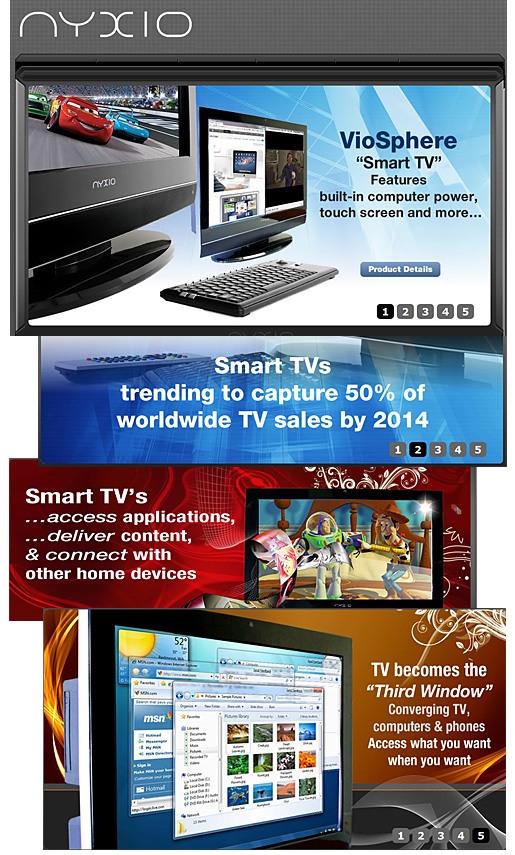
Intel predicts Smart TV is the device of the future — from nyxiotechnologies.com’s blog
Chipmaker Intel believes that the Smart TV is the electronic device of the future, in the living room anyway.

Excerpt:

The Smart TV is already upon us, in its various forms from various manufacturers. It has arrived with 3D capabilities, web browsing and social networking and applications. Currently Samsung and LG seem to be two of the big players pushing the Smart TV to consumers.

Also see:


Aruba MOVE delivers high-quality video simultaneously to 100 iPads in a single classroom at the University of Ottawa — from ArrubaNetworks.com
Multimedia applications included Apple Facetime and AirPlay, Blackboard Mobile™ Learn, Distribution Access Learning, HaiVision and Turning Technologies

Excerpt:

SUNNYVALE, Calif., June 13, 2011 – Aruba Networks, Inc. (NASDAQ: ARUN) today announced that it and several application partners delivered the next-generation classroom experience at the University of Ottawa. Validated by the university information technology (IT) department, the classroom experience consisted of six leading multimedia educational applications delivered to 100 iPads, concurrently. Each of the applications was delivered simultaneously to all 100 iPads with the highest quality and without any noticeable jitter, delay or frame loss. 100 percent of the iPads passed the multimedia Service Level Agreement (SLA), as measured by VeriWave WaveInsite, which was also used to objectively verify sustained performance of 1Mbps of multimedia streaming to each iPad.

From DSC:
I think there may be something here for the Smart Classrooms of the future. I can’t help but think of some of our courses in astronomy, for example, and that I think that sometimes we are using the wrong technologies to display images and videos to our students. Without investing an enormous amount of money on very high-end projection systems, we lose too much detail with a variety of images that feature galaxies, constellations, etc. with a projected image.

What about if a student could control where they want to zoom in on an image — and not lose any resolution or brightness? What about if they had such high res images available for viewing directly on their iPads? Sounds very interesting to me.

Also see:

  • Haivision Acquires KulaByte and MontiVision; Forms Internet Media Division
    Haivision driving toward $50 million revenue with new division combining Internet streaming and cloud transcoding to enable over-the-top media delivery
    MONTREAL and CHICAGO
    — July 21, 2011 — Haivision Network Video, a leading provider of the most advanced video networking, digital signage, and IP video distribution solutions, today announced that it has acquired both KulaByte Corporation of San Marcos, Texas, and MontiVision Imaging Technologies based in Germany. The technologies of both companies, including advanced encoding, transcoding, cloud computing, and workflow solutions, will be combined to form Haivision’s new Internet Media Division.


K-12 to see double-digit growth in e-learning through 2015 — from The Journal by David Nagel

Excerpt:

Trends in preK-12
In the United States, preK-12 will dominate all other segments, including healthcare and higher education, in the growth of annual expenditures on e-learning technologies and services. According to a report released by market research firm Ambient Insight (“The Worldwide Market for Self-paced eLearning Products and Services: 2010-2015 Forecast and Analysis”), growth will continue at a compound annual rate of 16.8 percent–despite the elimination of the federal Enhancing Education Through Technology (EETT) program and despite an overall weakening of e-learning growth, particularly in the United States.

Spending on e-learning in preK-12 reached $2.2 billion in 2010, according to Ambient Insight. That will hit $4.9 billion in 2015, or 20.25 percent of the entire market for e-learning products and services in the United States (and 9.82 percent of total worldwide annual expenditures).

Also see:

  • Higher ed e-learning growth to continue at modest pace through 2015 — from The Journal by David Nagel
    While electronic learning will continue to grow in higher education, that growth will be a bit slower than previously anticipated, according to a new report released this week. In fact, that slowing trend will be felt worldwide across nearly all segments–with a few notable exceptions.
Tagged with: • • • • •  

What the Kindle textbook rental program portends for higher education — from xplana.com by Rob Reynolds

Excerpt:

Almost as soon as the press release hit the Internet yesterday, I began fielding questions about Amazon’s new Kindle textbook rental program. What does this mean for publishers? How will this affect textbook prices? What impact will it have on institutions and their students?

While the general answer to all of these questions is “We don’t know yet,” there are a number of projections I think we can make based on current market trends. Before launching into those projections, however, let’s take a quick look at what the Kindle textbook rental program actually offers.

Wikipedia to launch article-quality ranking system — from digitaltrends.com by Andrew Couts


wikipedia-logo


Digital Book 2011 – presentation slides now available — from International Digital Publishing Forum (idpf.org)

Presentation slides from IDPF Digital Book 2011 at BEA (May 23-24 2011) can be downloaded from links in each speaker’s biography.


Also see:

  • Introduction to e-books — from JISC
    This guide discusses the various types of electronic book (e-book) and  ways to read them. It also discusses some key design considerations for e-book production and introduces  the types of multimedia file formats that can be supported.

RTS game runs on a 20 foot-wide multi-touch LCD wall — from gizmag.com by Pawel Piejko

A graduate student has developed an RTS game played on a 20-foot wide LCD multi-touch wall...

A graduate student has developed an RTS game played on a 20-foot wide LCD multi-touch wall
(Image: University of Illinois)

From DSC:
What about if others from another college, university, school, etc. could partake in this as well?


New ways of learning effects library design — Aaron Cohen Associates

Excerpt:

Technology has impacted the way we use library collections. It has impacted the way we interact in the library building. The landscape of learning has changed so much that we need to ask – “Is someone literate if they can not use digital technology?”

New ways of learning effect library learning spaces
Also see:


Watch the full episode. See more Digital Media – New Learners Of The 21st Century.

Some items re: Blackboard’s announcement of their Collaborate product:


Schools struggle to balance digital innovation, academic accountability — from Education Week’s Digital Directions by Michelle Davis
Using educational technology in new and different ways to improve student learning is often at odds with standardized testing and other traditional measures of achievement.
Excerpt:

But how do you move forward with such an innovation, when there isn’t definitive proof that it will work? That is the key question educators and policymakers are grappling with.

Under the education priorities of President George W. Bush’s administration, the catchphrase “research base” was drilled into educators” heads when it came to new programs and initiatives. If it wasn’t research-based, it wasn’t worth adopting.

But technology innovations occur so rapidly that it’s often impossible to do scientifically based trials proving effectiveness before schools embrace new approaches. Think of social-networking tools, iPads, and e-readers. And what other new digital-learning tools might also emerge well before scientifically based research can justify their use in classrooms?

Also see:

From DSC:

From my 20+ years of experience with working with a variety of technologies, while there is an element of risk taking to implementing technologies, there are also enormous payoffs if organizations implement the appropriate technologies.

But how can we select and implement the most effective technologies? This is where we need to rely on our technologists out there and keep them growing in the knowledge of “the business”, not just the technologies.  Tell them what you are trying to achieve, and they can greatly assist.  No one can hit 100% — but good technologists can get you into the right game and into the right ballpark (if not exactly lining up the exact right players, which may change or take some tweaking).

NOTE:
Don’t rely on technologists who only see their jobs as keeping the systems running. Though we need technologists who keep the infrastructures up and running, at this juncture what organizations really need are visionaries who are knowledgeable about the needs of the business (as well as the technologies), and those who are willing to explore, experiment, and take some risks…i.e. to lead….to be instrumental in forming strategies and visions. The areas outside IT need to be aware of how critical technologies are becoming in their core strategies and plans. It’s not the same ball-game as it was. Those who use technologies strategically will survive and thrive.

It should be noted that there have been risks inherent in maintaining the status quo — a 20%-30% dropout rate (in K-12) across the United States is pretty risky too, at least in my mind.

Forget the next iPhone, your next TV will be on the Internet — from forbes.com by Brian Caulfield

Excerpt:

It looks like we’ve reached an inflection point for Internet-connected televisions. Forty-seven percent of all flat-panel televisions shipped worldwide in 2015 will have some form of Internet connectivity, up from more than 25% today tech tracker DisplaySearch said Tuesday.


© 2025 | Daniel Christian