From DSC:
The other day, I mentioned how important it will be for institutions of higher education to increase the priority of experimentation. Clicking on the graphic below will give you an example of the kind of vision/experiment that I’m talking about.

(Though, more practically speaking, to operationalize this type of vision would actually require a series of much smaller experiments; I just wanted to present the overall vision of how these pieces might fit together).
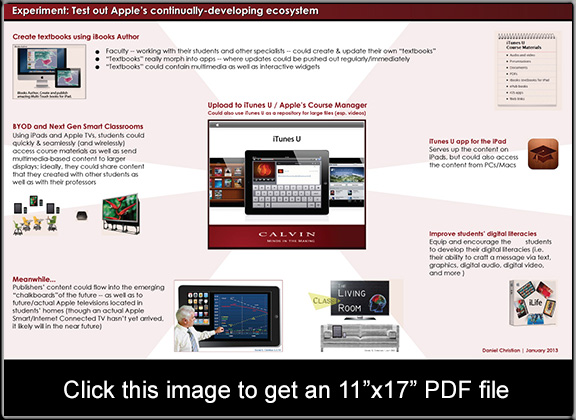
 

DanielChristian--Jan2013-Experiment-with-Apples-Ecosystem

NOTE:
This 11″x17″ image is a 10MB PDF file, so it may take some time to appear.
Feel free to right-click on the graphic in order to download/save/print the file as well.


Also relevant is this upcoming event from educause:


1/8/13 addendum resulting from a Tweet from a great colleague, Mr. Travis LaFleur (@travislafleur), UX Designer at BiggsGilmore


Developing a MOOC-inspired course — from the User Generated Education blog by Jackie Gerstein

Excerpt:

During Fall, 2012, I developed and taught a graduate course entitled, Social Networked Learning, for the Boise State University’s Educational Technology Program.  Most of the students were in-service K-12 educators. I provided an overview of the learning activities for this course in two previous blog posts.

Sample student projects from this course can be viewed at http://learni.st/users/jackiegerstein/boards/4710-social-networked-learning.

This was a new course in educational technology.  As is true for many of us using educational technology in the classroom, we are experimenting with how technology can enhance the learning experiences of our students.  Sometimes we have failures, often times we have successes.

Also see Jackie’s posting:


Driven to distraction: How to help wired students learn to focus — from eschoolnews.com by Larry Rosen

Excerpt:

A recent Pew Internet & American Life Project report surveyed 2,462 middle and high school Advanced Placement and national writing project teachers and concluded that: “Overwhelming majorities agree with the assertions that today’s digital technologies are creating an easily distracted generation with short attention spans, and today’s students are too ‘plugged in’ and need more time away from their digital technologies.”

Two-thirds of the respondents agree with the notion that today’s digital technologies do more to distract students than to help them academically.

Mind you, we are talking about teachers who typically teach the best and brightest students and not those who we would generally think of as highly distractible.

.

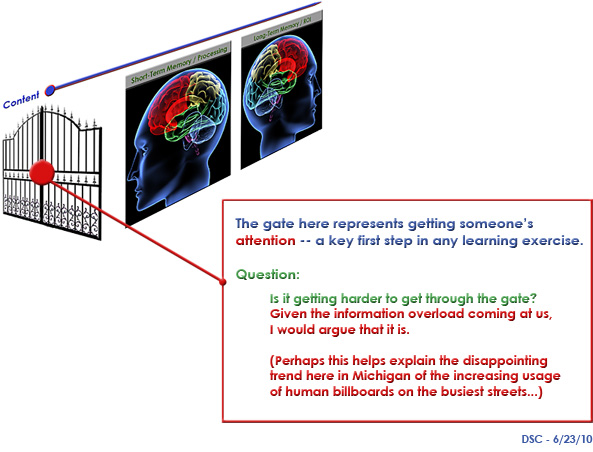
If attention can be visualized as a gate...is it getting harder to get through the gate?


From DSC:
If I’m an educator or a trainer and I can’t get through the gate (i.e. get someone’s attention), I have zero chance of getting a piece of information into someone’s short-term memory/working memory — and then ultimately into their long-term memory.

Also, from my own experience…
Especially in regards to information in a textual format, I know that I’ve grown increasingly impatient when someone doesn’t get to the point. When drinking (information) from the firehose, I seem to be almost forced into this type of situation/perspective.


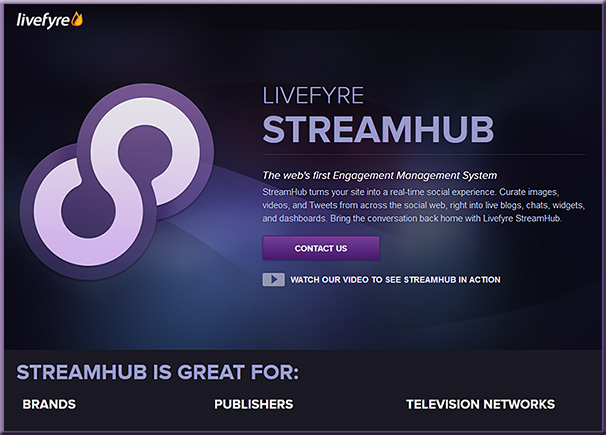
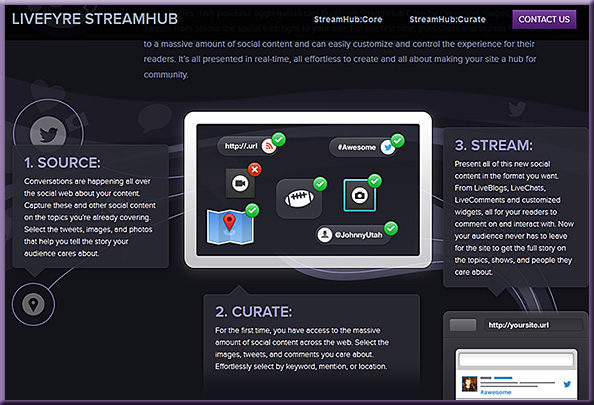
Looks like a very interesting set of tools/technologies out at livefyre.com — a piece of which is subtitled, the “Web’s first Engagement Management System.”
.

  • How might this set of technologies/functionalities affect what’s possible with MOOCs?
    .
  • Could universities and colleges use something like this to talk to their constituencies?
    .
  • As the computer, the telephone, and the television continue to converge, what educationally-related opportunities might be possible here?


http://www.livefyre.com/


.

http://www.livefyre.com/


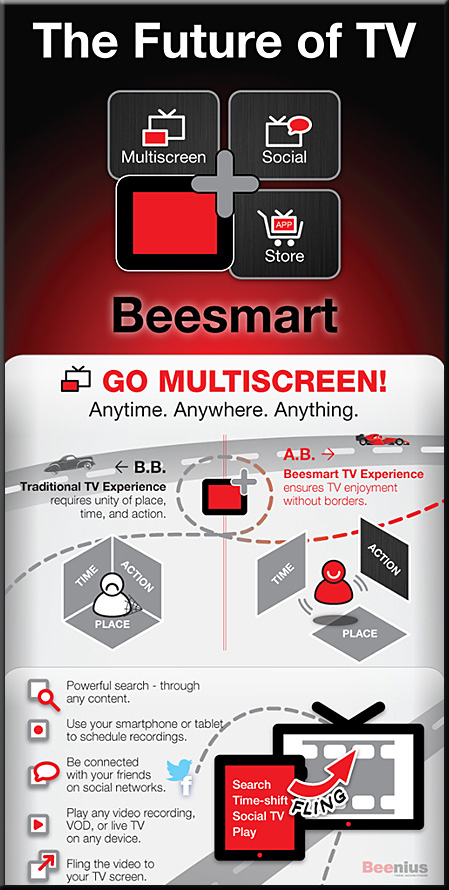
The Future of TV -- an infographic from Beesmart


From DSC:
The educational “store” part of this graphic could take several forms:

  • Online-based exchanges between buyers and sellers (teachers/professors and learners) — professors as their own brand
  • Institutional offerings/brands
  • Team-based content from newly-developed firms, organizations
  • Each of us puts up our own learning materials for others to take (for free or for a price)
  • Other


Also see the following items from Genius:

  • The New Consumer Agenda:
    From authentic collaboration to small indulgences … what consumers want in 2013 and beyond, and how brands are responding.
  • Marketing Trends 2013+:
    From black marketing to crowd creatives, brand gaming to urban formats, solomo and diffusion … what will be big in marketing in 2013


Additional notes from DSC:

  • With thanks going out to Mr. Jim Woods (@hyperinnovation) on twitter for this resource
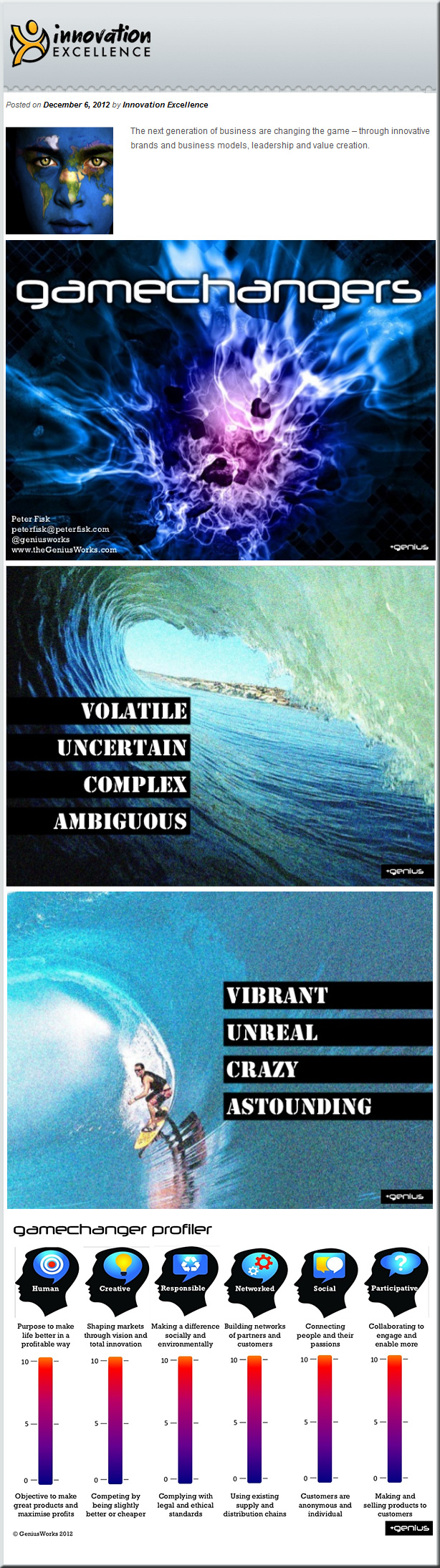
  • The wave-related graphics above are very appropriate for our times — and I’d rather be surfing the waves then being crushed by them!


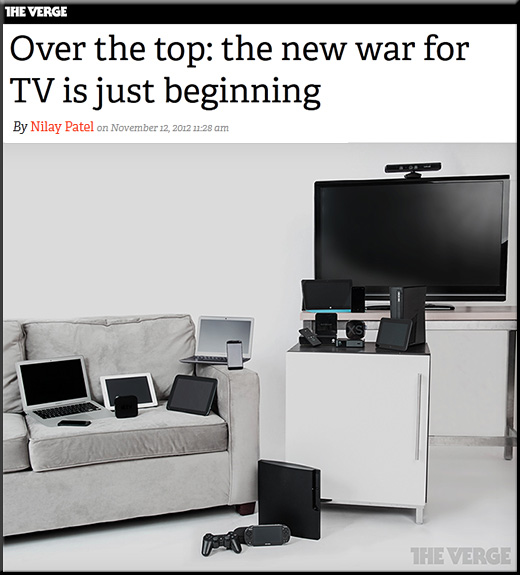
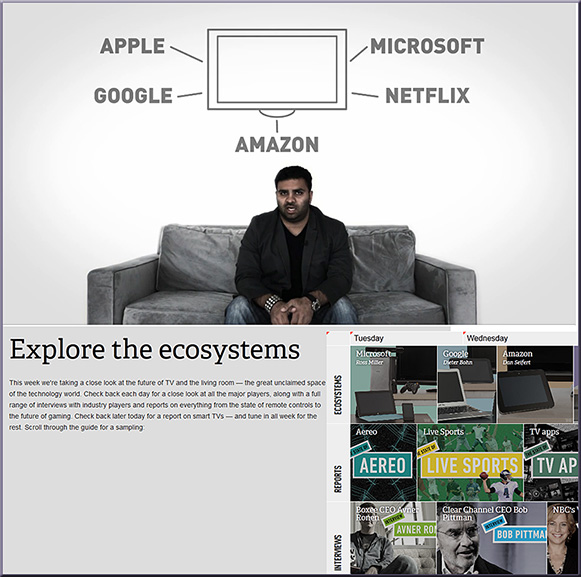
Over the top: the new war for TV is just beginning [Patel]

Over the top: the new war for TV is just beginning  -- from The Verge by Nilay Patel -- November 12 2012


.

 Future of TV


.
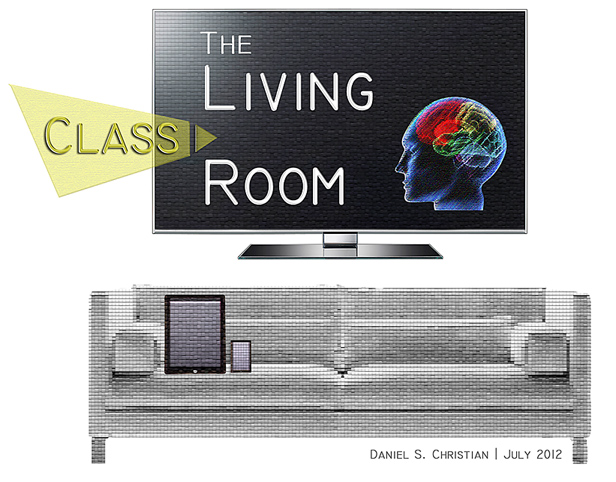
The Living [Class] Room -- by Daniel Christian -- July 2012 -- a second device used in conjunction with a Smart/Connected TV


.

From DSC:
I’m beginning to wonder if many of us will be moving off of Moodle, Sakai, Bb Learn, Desire2Learn, etc. to platforms and ecosystems that are being created by Apple, Google, Amazon, and Microsoft.  Rockstar professors on “primetime” — or anytime. If that happens, you can be sure there will be teams of specialists creating and delivering the content and learning experiences.


From DSC:

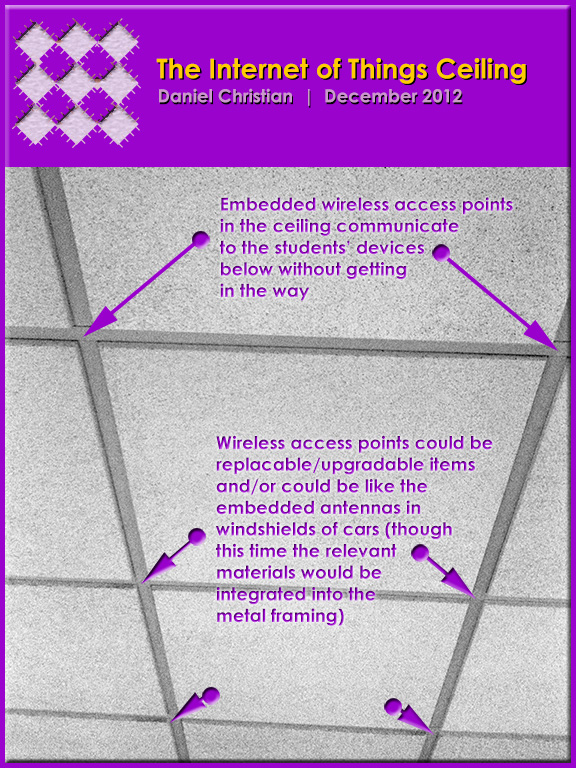
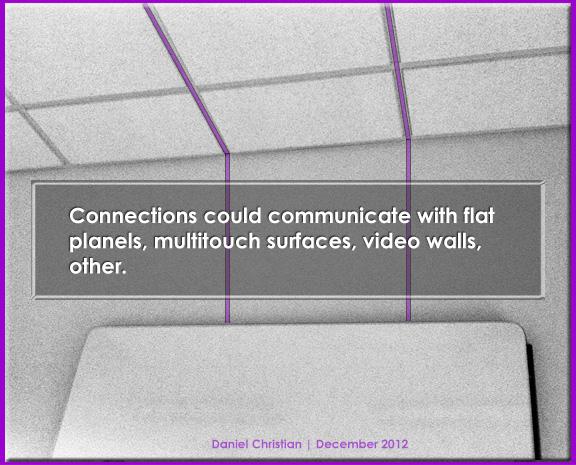
I’ve been trying to figure out the best ways to incorporate a BYOD/BYOT into the Smart Classroom.  That is, how can students’ devices seamlessly communicate with the main displays around the classroom? How can they quickly display a blog posting or a Google doc for example…or play a song they wrote, etc.  So I was excited to wake up this morning with the following concept/idea:


The Internet of Things Ceiling -- A concept for our future Smart Classrooms by Daniel Christian in December 2012

.

The Internet of Things Ceiling -- concept by Daniel Christian -  December 2012

.

.

Other features/thoughts:

  • Line of sight communications — students must be in the room to display something up on the main displays
  • Information travels many ways:  From large multitouch displays/walls to students’ devices and vice versa; so a professor could hit “Save” in order to send his/her annotations to all of the students’ devices (allowing them to be more cognitively present — vs madly writing down what the professor is writing)
  • The Smart Classroom’s infrastructure becomes like a multi-thredded processor — instantaneously and simultaneously handling a far greater amount of data — going in multiple directions
  • What’s an interesting idea here is for discipline-specific, cloud-based storage mechanisms for students who want to contribute their pieces of content to their schools repositories of content
  • This topic reminds me of a graphic I created a while back, re: The “Chalkboard” of the Future:


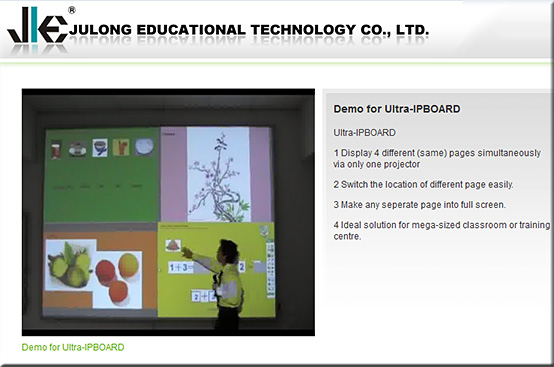
So…what if the 4 screen’s on Julong’s Ultra-IPBOARD were coming from 4 different sources? Perhaps:

  1. One from a publisher’s cloud-based content repository
  2. Another from a stream of content originating from a student’s iPad
  3. Another from a stream of content originating from the Smart Classroom’s PC or Mac
  4. …and the last source originating from a student’s smartphone?


Demo for Ultra-IPBOARD


Also see:

.

Will Richmond on Top 2013 TV Trends [from Videomind by Greg Franzese]

Will Richmond on Top 2013 TV Trends -- from Videomind by Greg Franzese -- 11-29-2012


From DSC:
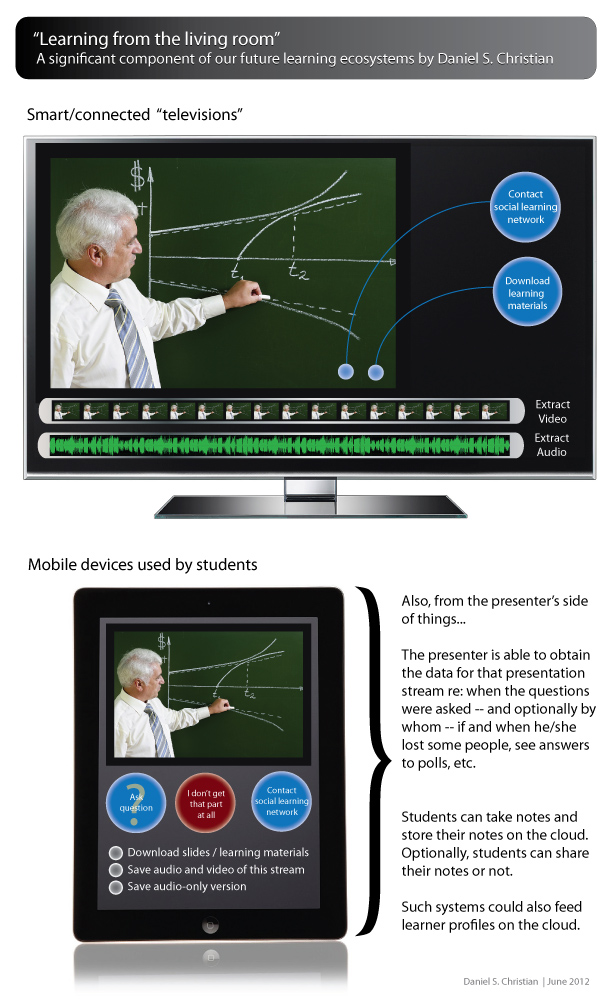
I continue to watch this space as the foundations are being put into place for what I’m calling, “Learning from the Living [Class] Room.”

.

Learning from the living room -- a component of our future learning ecosystems -- by Daniel S. Christian, June 2012


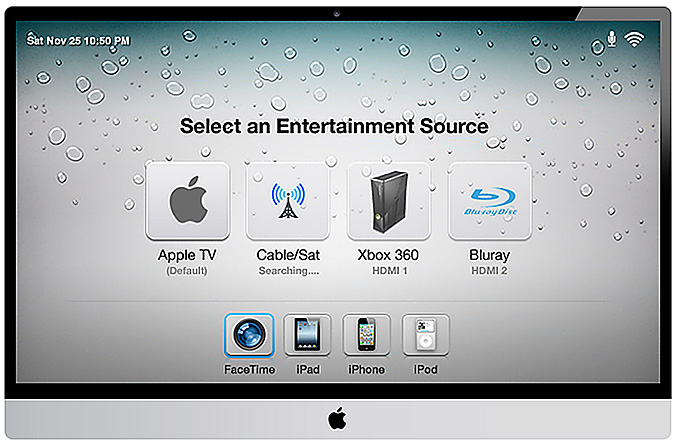
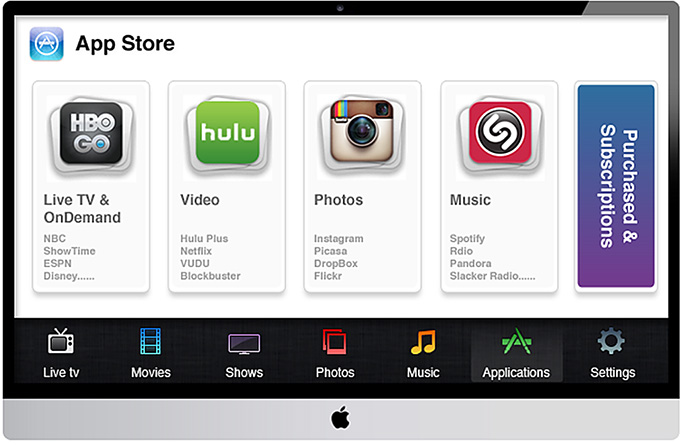
An innovative, sharp concept for a potential Apple TV

An à la carte Apple TV concept integrates Siri, FaceTime, and cable/satellite providers (Gallery) — from 9to5mac.com by Jordan Kahn

Example “screenshots” from this concept:

Apple TV Concept - Nov 2012

.


Also see:


From DSC:
This relates to what I’m calling “Learning from the Living [Class] Room”

.

The Living [Class] Room -- by Daniel Christian -- July 2012 -- a second device used in conjunction with a Smart/Connected TV


Connected learning: The Power Of Social Learning Models — from teachthought.com

Excerpt:

Connected Learning “is an answer to three key shifts as society evolves from the industrial age of the 20th century and its one-size-fits-all factory approach to educating youth to a 21st century networked society.”

1) A shift from education to learning. Education is what institutions do, learning is what people do. Digital media enable learning anywhere, anytime; formal learning must also be mobile and just-in-time.

2) A shift from consumption of information to participatory learning. Learning happens best when it is rich in social connections, especially when it is peer-based and organized around learners’ interests, enabling them to create as well as consume information.

3) A shift from institutions to networks. In the digital age, the fundamental operating and delivery systems are networks, not institutions such as schools, which are one node of many on a young person’s network of learning opportunities. People learn across institutions, so an entire learning network must be supported.

.

From DSC:
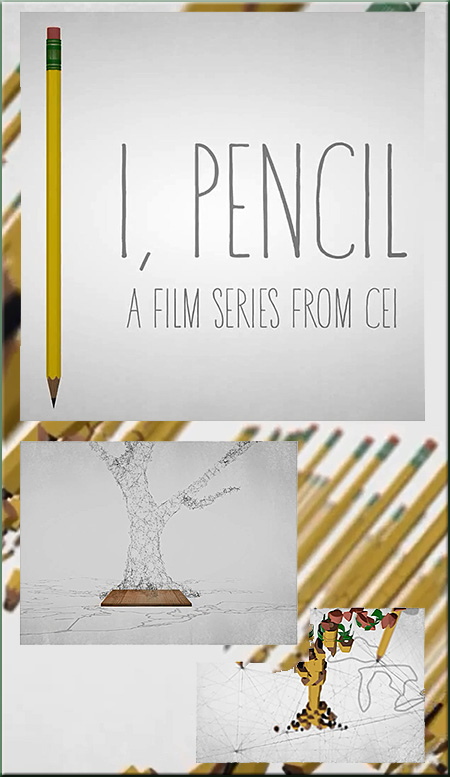
This reminds me of the animated video that I recently ran across at remixteaching.com entitled, “I, Pencil”:

.


If that’s what’s involved with creating a pencil, what does the family tree look like for creating the Internet?!

Current/Future State of Higher Education — from Educause Live by George Siemens, Andy Caulkins, Malcolm Brown

Change drivers

  • Globalization
  • Commercial/entrepreneurial activity
  • Funding cuts
  • Online learning
  • Unbundling of education systems
  • Technology advancement (mobiles)
  • Employment-oriented education
  • Big data and analytics

Net Pedagogies: New Models for Teaching & Learning

  • New pedagogies emerging from:
    • Concerns about how well institutions are meeting their mission, on behalf of students they serve
    • Pressures resulting from feeling constrained within the “Iron Triangle” of costs, access, and quality
    • New technologies
  • How to balance personalization with competency-based pathways
  • How to build community among students who are geographically distant and proceeding at different rates (a different cohort dynamic taking place here)
  • Personalized learning divisions/groups
  • Innovation labs <– From DSC: This lines up nicely with my posting here

Entrepreneurship

  • Deborah Quazzo, GSV Advisors
  • Velocity of change
  • e-books up
  • 200K education apps
  • 98% of students own some sort of device
  • Coursera — 33 partners, 1.7 million students
  • 13% of students now at for-profits
  • The Bear Story
    • Readiness — freshmen often needing remediation
    • Completion rates
    • Cost
    • Career
  • Venture capital and startups increasing
  • What’s driving investment
    • Funding issues
    • Accountability
    • Technology
    • Consumer choice
  • Waves of HE innovation
  • “Traditional institutions are not standing still”
  • Higher ed arms race — online program delivery (tuition-based) / MOOC (free)
  • Growth in MOOC students — .51 in Fall 2011, 2.79 in Fall 2012; 447% growth rate
  • Need to increase learning outcomes, access, capacity, and decrease costs

Big Data & Analytics

  • Erik Duval, Simon Buckingham Shum, Caroline Haythornthwaite
  • State of learning analytics
    • Open analytics
    • Standards
    • Methods and metrics
    • Impact on learner success
    • Early risk detection
    • Common language
    • Institutional use of analytics
    • Planning and deployment of LA
    • Move from concept to application
  • Participation wall seems to be occurring 30-40% of the time into the course
  • 762 tweets, 305 links, 172 RTs, 244 Unique Twitter accounts

Leadership in Education

  • James Hilton
    • Characterizing change
    • Not a linear system often times; instead, an emergent change; not always orderly and linear
    • Unknown end point
    • Adjust as you go
    • Adjust fundamental conditions
      • 2 fundamental forces in HE
      • Commoditization
      • Unbundling
    • “Find your North Star”
  • George Mehaffy
    • Challenge and change article
    • Massive change and great uncertainty
    • Technology changes everything
    • Traditional institutions loss of control
    • Students abilities to interact and learn without mediating
    • “Outsiders” becoming players
    • Venture capital
    • Models of college changing
    • Course models
    • Data analytics
    • Cost discrepancies
    • Measuring success
    • Loss of credentialing monopoly
    • Leadership vacuum
    • Change is rapid, profound, emergent
    • We need to rethink HE leadership model
    • We need to rethink HE in many fundamental dimensions
    • Now is the time for bold, imaginative, entrepreneurial leadership

Distributed Research

  • Traditional methods of sharing research, established centuries ago
  • Need to re-imagine those methods and generate higher, faster, better outcomes from research
  • Challenges: pace, dissemination, incentive to collaborate
  • Opportunities: immediacy, openness, new/richer tools and indicators, unprecedented progress

Still some challenges in offering a MOOC-based course:

  • Skillset development
  • Getting participants orientated to the course
  • Technological glitches

.


Other resources/links:


From DSC:
Mr. Rob Bobeldyk and I were brainstorming last week about the
need to create A Center for Innovation — a smaller organization within our overall organization — that can be far more nimble and responsive.  Such a Center could be:

  • Constantly pulse-checking the relevant landscapes (technological, pedagogical, business models, other)
  • Researching potential approaches
  • Experimenting
  • Innovating
  • Failing
  • Succeeding some of the time — and handing off/transitioning the projects that gain traction to others in the larger organization (which may require building some new groups and/or departments at that point)

As I discovered HBR’s interview with John Kotter today, I felt our idea/direction/brainstorming is heading in the right direction!

.

A revolutionary approach to strategic change -- John Kotter -- November 2012


That is, we are trying to keep the plane in flight while making some significant changes. Put another way, we are trying to keep the bread and butter in tact while experimenting with new business models and/or new products and services.

Kotter’s “Dual Operating System” affirms that a new/smaller/more nimble organization is appropriate.  Here are some graphics of Kotter’s “dual operating system”:

.


 .


.

The work of Christensen, Horn, and Johnson is highly-relevant here as well:

  • Disrupting Class
  • Disrupting College
  • The Innovator’s Dilemna


Addendums on 11/20/12:

.


The training world is changing — from Harold Jarche

Excerpt:

Open online courses, talent management, social collaboration: The training world is changing. Traditional training structures, based on institutions, programs, courses and classes, are under pressure. One of the biggest changes we are seeing in online training is that the content-delivery model is being replaced by social and collaborative frameworks.

Here are just some of things happening now that trainers should be prepared to tackle in the new year:

From DSC:
I understand that Mr. George Lucas is going to express his generosity in donating the $4.05 billion from the sale of Lucasfilm to education.

Here’s a question/idea that I’d like to put forth to Mr. Lucas (or to the United States Department of Education, or to another interested/committed party):

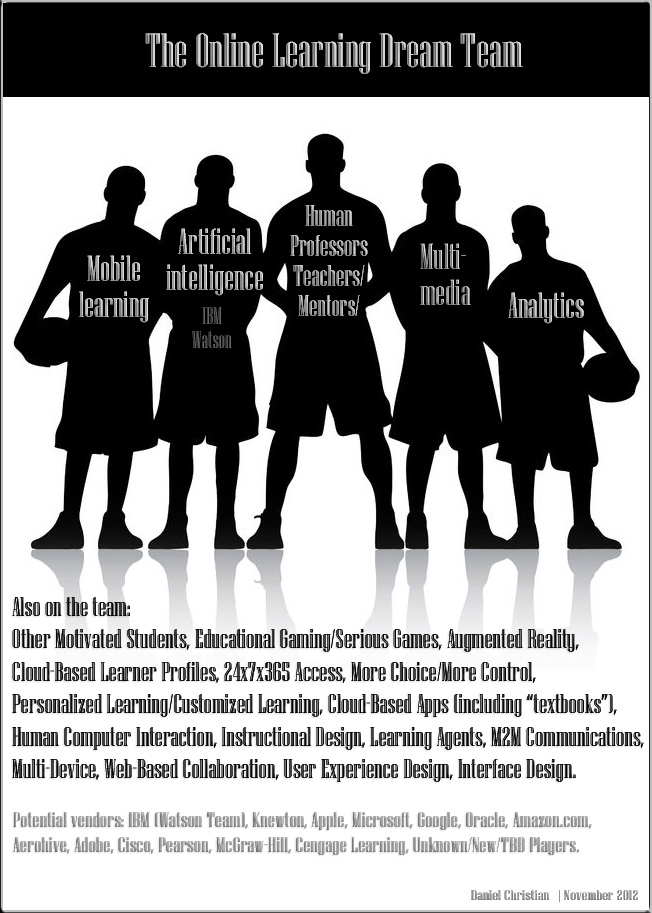
Would you consider using the $4+ billion gift to build an “Online Learning Dream Team?”

.

Daniel Christian -- The Online Learning Dream Team - as of November 2012

.

 Original image credit (before purchased/edited by DSC)
yobro10 / 123RF Stock Photo


From DSC:
What do you think? What other “players” — technologies, vendors, skillsets, etc. — should be on this team?

  • Perhaps videography?
  • Online tutoring?
  • Student academic services?
  • Animation?
  • Digital photography?


© 2025 | Daniel Christian