Georgia Tech Center to explore 21st century universities — from CampusTechnology.com by Dian Schaffhauser

The Georgia Institute of Technology is setting up a new center specifically to serve as a living laboratory for testing new forms of education. Driven by the growth of social networking, online learning, and other developments, the Center for 21st Century Universities will enable faculty at the Atlanta institution to experiment with new approaches to curriculum and its delivery. According to former College of Computing Dean Rich DeMillo, who will lead the center, it will also work with national and international groups involved in higher education reform. The first item on the center’s agenda is to develop a seed grant program for promising early proposals.
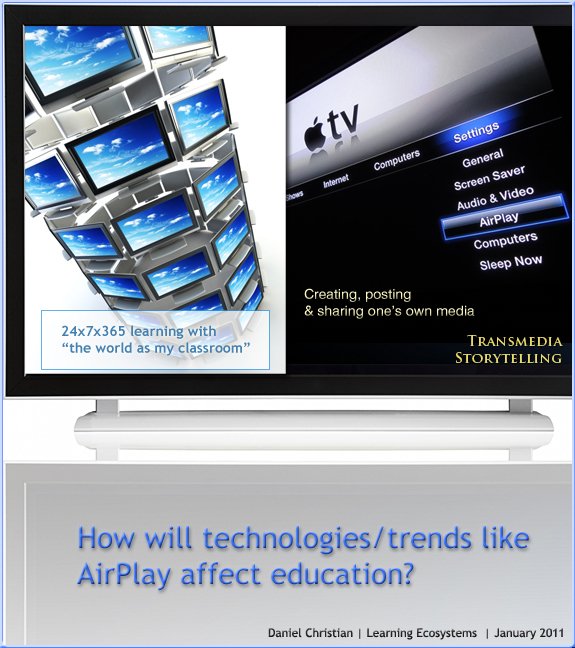
How will technologies like AirPlay affect education? I suggest 24x7x365 access on any device may be one way. By Daniel S. Christian at Learning Ecosystems blog-- 1-17-11.

.


Addendum on 1-20-11:
The future of the TV is online
— from telegraph.co.uk
Your television’s going to get connected, says Matt Warman


Connecting classrooms globally — from prometheanplanet.com

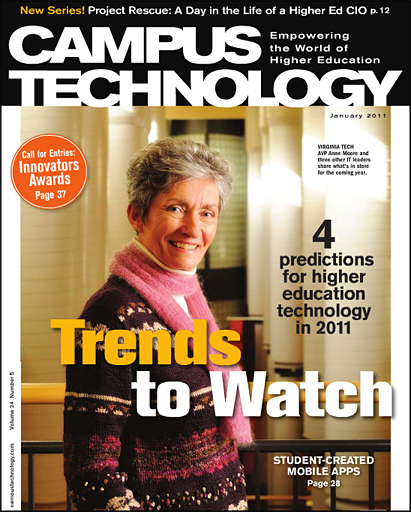
Includes the acceleration of learning analytics and learner-generated content, knowledge application supplanting information access, digital textbooks making their move, data-intensive computing challenging IT — as well as predictions concerning faculty development (as even more courses move online), mobile learning, student expectations, open education, collaboration, social media and others.

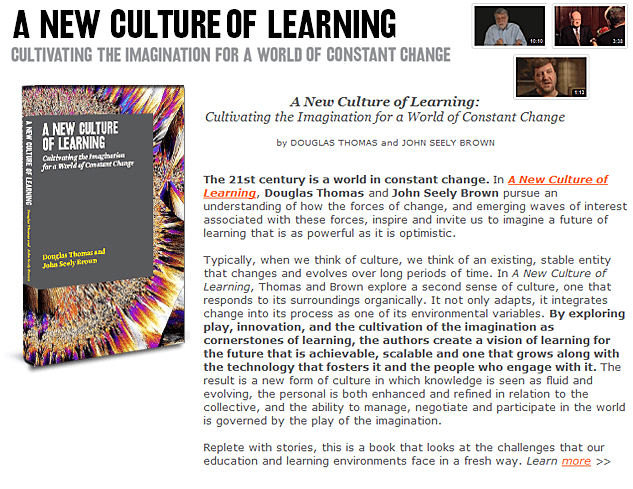
A New Culture of Learning -- Brown and Thomas.

Original posting from:
A New Culture of Learning — weblogg-ed.com

Addendum on 1-31-11:
I just saw this posting from Catherine Lombardozzi on the Learning Journal blog, as she comments on Thomas’ & Seely Brown’s book. She concludes:

“I’m thinking that the new culture of learning doesn’t replace the old, it enriches it.”

See:
http://learningjournal.wordpress.com/2011/01/30/thenew-culture-of-learning/

2011 NMC Symposium on New Media and Learning
March 29, 2011 – March 31, 2011
Online hosted by NMC

The 2011 NMC Symposium on New Media and Learning, the seventeenth in the NMC’s Series of Virtual Symposia, will explore the impact of new media on teaching, learning, research, and creative inquiry, especially in higher education.

The 2011 NMC Symposium on New Media and Learning, the seventeenth in the NMC’s Series of Virtual Symposia, will explore the impact of new media on teaching, learning, research, and creative expression, especially in higher education. New media, for this event, is interpreted broadly as anything from creative uses of digital media and new forms of communication to alternative publishing methods and media-rich tools. The Symposium seeks to explore new media in the context of a current social phenomenon and not simply as a means of content delivery.

Proposals are encouraged on any of the following themes, but this list is not exhaustive and selections will not be limited to these categories:

  • digital gaming in education
  • digital storytelling practices
  • new forms of multimedia production and delivery
  • social media, social networking and global connections
  • new media and mobile devices
  • data visualization
  • media-rich communication tools
  • new literacies
  • any technology or practice that shows promise for engaging students and supporting teaching and learning using new media

Interview with Josh Little, Bloomfire: E-Learning Innovators Series — from E-Learning Queen

Excerpt:

2. What is Bloomfire and what inspired you to develop it?
A platform that allows anyone to start a Bloomfire, which is a website geared specifically for easily sharing knowledge and the discussions that surround it. You can invite members to find and follow experts, ask questions, and share with others. Members can share and upload documents, videos, or presentations, record a video from their webcam, or create screencasts on the fly.

I developed Bloomfire out of the pain I felt along my career as a public school teacher, corporate trainer, and small business owner. In every one of these roles I felt like I was just scratching the surface of what my students, trainees, or employees needed to know to be successful. There needed to be a better way to rapidly share knowledge with people all over the world. Although traditional eLearning tools allow this, the time and cost to create content was still limiting. I knew that by using the power of the crowd, any organization could harness the the long talk of knowledge, how-to’s and tricks if they had the right tool.

What They Know – Mobile — from WSJ

Your apps are watching you — from WSJ
A WSJ investigation finds that many apps on the iPhone and Android are breaching the privacy of smartphone users

Facebook in Privacy Breach — WSJ
Many of the most popular applications, or “apps,” on the social-networking site Facebook Inc. have been transmitting identifying information—in effect, providing access to people’s names and, in some cases, their friends’ names—to dozens of advertising and Internet tracking companies, a Wall Street Journal investigation has found. The issue affects tens of millions of Facebook app users, including people who set their profiles to Facebook’s strictest privacy settings. The practice breaks Facebook’s rules, and renews questions about its ability to keep identifiable information about its users’ activities secure.

Facebook Apps Sending Personal Information to Internet Tracking Companies — from consumeraffairs.com
FarmVille and other popular games collect IDs and sell them, Wall Street Journal reports

The Web’s New Gold Mine: Your Secrets — from WSJ
A Journal investigation finds that one of the fastest-growing businesses on the Internet is the business of spying on consumers. First in a series.

  • The study found that the nation’s 50 top websites on average installed 64 pieces of tracking technology onto the computers of visitors, usually with no warning. A dozen sites each installed more than a hundred. The nonprofit Wikipedia installed none.
  • Tracking technology is getting smarter and more intrusive. Monitoring used to be limited mainly to “cookie” files that record websites people visit. But the Journal found new tools that scan in real time what people are doing on a Web page, then instantly assess location, income, shopping interests and even medical conditions. Some tools surreptitiously re-spawn themselves even after users try to delete them.
  • These profiles of individuals, constantly refreshed, are bought and sold on stock-market-like exchanges that have sprung up in the past 18 months.

Facebook’s Zuckerberg Says The Age of Privacy is Over — from readwriteweb.com

Why Facebook is Wrong: Privacy Is Still Important — from readwriteweb.com

Leaving Facebook — technologyreview.com
Will Diaspora provide a social-networking haven for those fed up with Facebook?

.


Also see:
Obama administration calls for online privacy bill of rights
— from cnn.com


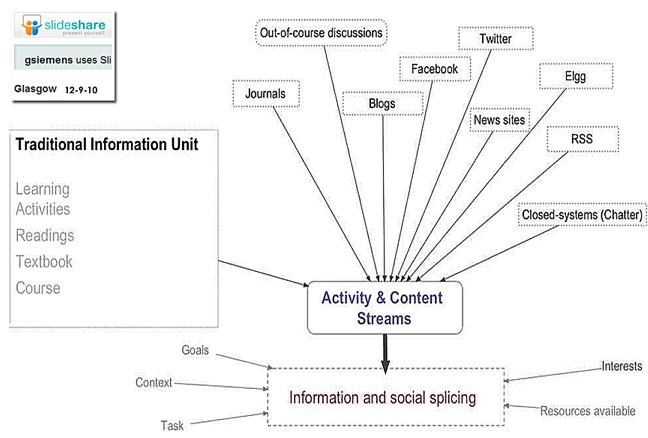
Connections, Clouds, Things & Analytics –– from George Siemens

From DSC:
In looking through George’s presentation, the following graphic reminded me of a learning ecosystem. The idea of activity and content streams speaks of constant flow, change, new information. Look are the sources of where learning can come from:

George Siemens 12-9-10 presentation: Connections, Clouds, Things & Analytics

.

As an instructional designer, how do we incorporate all of this?

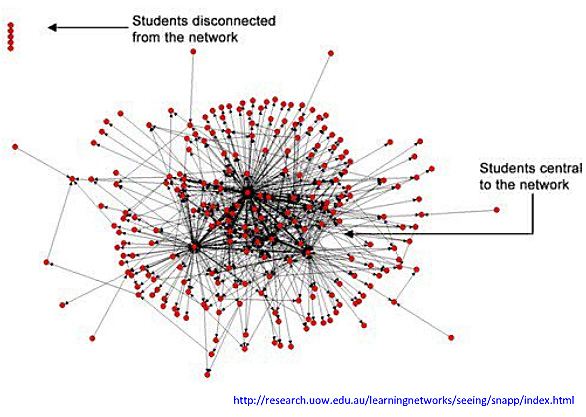
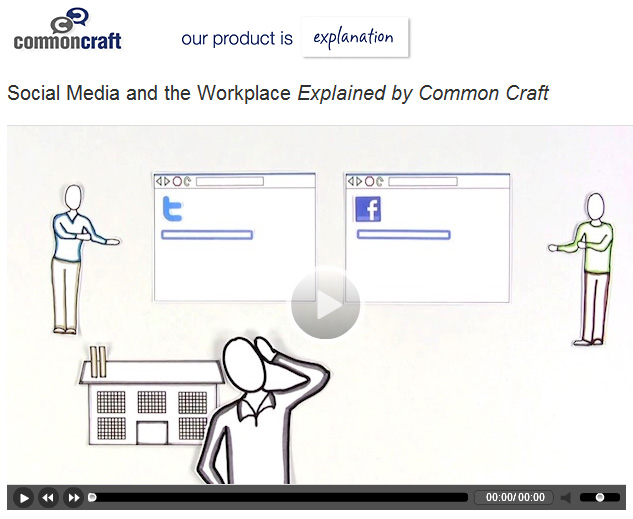
Finally, one other thought, if we are not connected to a network of bloggers (and have a series of RSS feeds keeping us constantly up-to-date) or have some other means of tapping into these streams of activities and sources of content, we will look like this:


Social Media and the Workplace Explained by Common Craft

The 2011 NMC Summer Conference includes four themes:

Threads in these themes include, but are not limited to, the following:

  • Emerging uses of mobile devices and applications in any context
  • Highly innovative, successful applications of learning analytics or visual data analysis
  • Uses of augmented reality, geolocation, and gesture-based computing
  • Discipline-specific applications for emerging technologies
  • Challenges and trends in educational technology
  • Projects that employ the Horizon Report or Navigator in any capacity

.

  • Challenge-based learning
  • Game-based learning
  • Digital storytelling as a learning strategy
  • Immersive learning environments
  • Open content resources and strategies
  • New media research and scholarship
  • Challenges and trends in new media and learning

.

  • Fostering/Supporting/budgeting for innovation
  • Supporting new media scholarship
  • Collaboration as a strategy
  • Learning space design, in all senses of the words
  • Use, creation, and management of open content
  • Experiment and experience; gallery as lab, lab as gallery
  • Challenges and trends related to managing an educational enterprise

.

  • Designing for mobile devices in any context
  • Social networking — designing, monitoring, maximizing social tools
  • Experience design
  • Creating augmented reality
  • Creating the next generation of electronic books
  • Optimizing digital workflows
  • Strategies for staying current with new media tools
© 2025 | Daniel Christian