From the January/February 2013 issue of The American Interest:

.
Excerpts (emphasis DSC):
The most important part of the college bubble story—the one we will soon be hearing much more about—concerns the impending financial collapse of numerous private colleges and universities and the likely shrinkage of many public ones. And when that bubble bursts, it will end a system of higher education that, for all of its history, has been steeped in a culture of exclusivity*. Then we’ll see the birth of something entirely new as we accept one central and unavoidable fact: The college classroom is about to go virtual.
…
Because recent history shows us that the internet is a great destroyer of any traditional business that relies on the sale of information. The internet destroyed the livelihoods of traditional stock brokers and bonds salesmen by throwing open to everyone access to the proprietary information they used to sell. The same technology enabled bankers and financiers to develop new products and methods, but, as it turned out, the experience necessary to manage it all did not keep up. Prior to the Wall Street meltdown, it seemed absurd to think that storied financial institutions like Bear Stearns and Lehman Brothers could disappear seemingly overnight. Until it happened, almost no one believed such a thing was possible. Well, get ready to see the same thing happen to a university near you, and not for entirely dissimilar reasons.
The higher-ed business is in for a lot of pain as a new era of creative destruction produces a merciless shakeout of those institutions that adapt and prosper from those that stall and die.
…
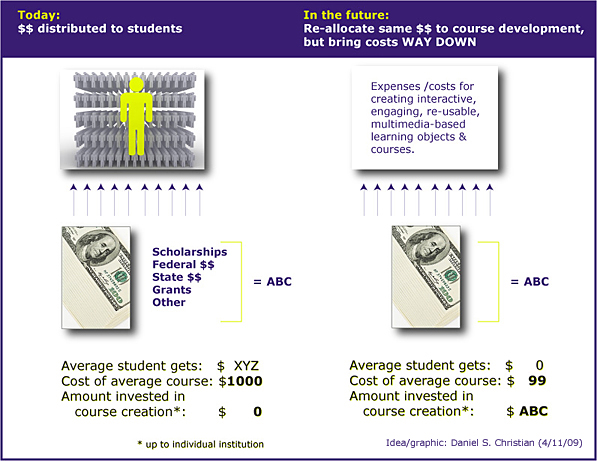
But what happens when a limited supply of a sought-after commodity suddenly becomes unlimited? Prices fall. Yet here, on the cusp of a new era of online education, that is a financial reality that few American universities are prepared to face.
…
Anyone who can access the internet—at a public library, for instance—no matter how poor or disadvantaged or isolated or uneducated he or she may be, can access the teachings of some of the greatest scholars of our time through open course portals. Technology is a great equalizer.
Big changes are coming, and old attitudes and business models are set to collapse as new ones rise. Few who will be affected by the changes ahead are aware of what’s coming. Severe financial contraction in the higher-ed industry is on the way, and for many this will spell hard times both financially and personally. But if our goal is educating as many students as possible, as well as possible, as affordably as possible, then the end of the university as we know it is nothing to fear. Indeed, it’s something to celebrate.
* The old way:
Colleges rise as they reject — from online.wsj.com
Schools invite more applications, then use denials to boost coveted rankings

Also relevant/see: