Digital skills in Higher Education - Spring 2011

April 2011:
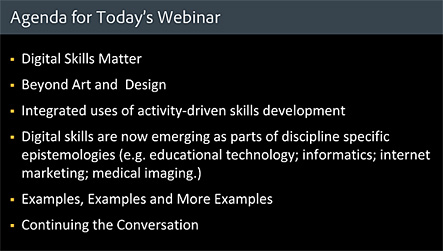
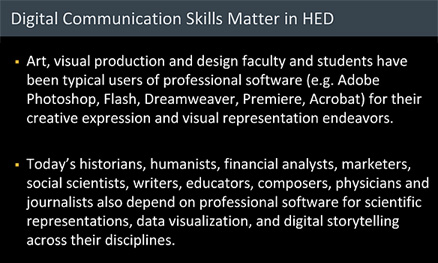
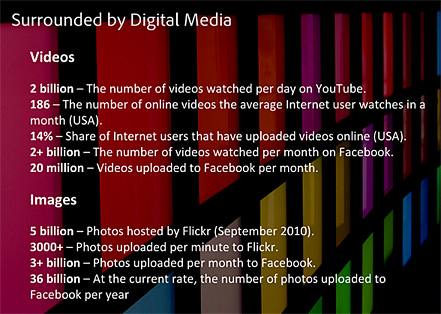
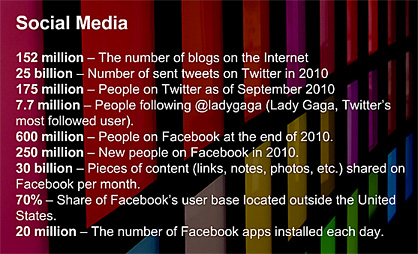
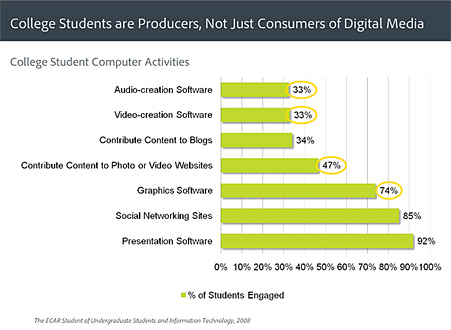
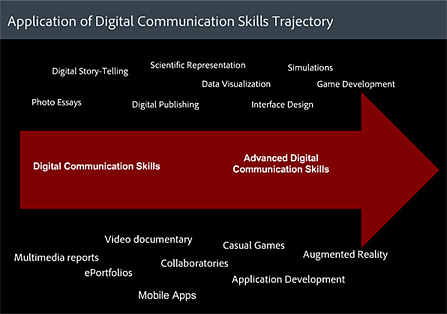
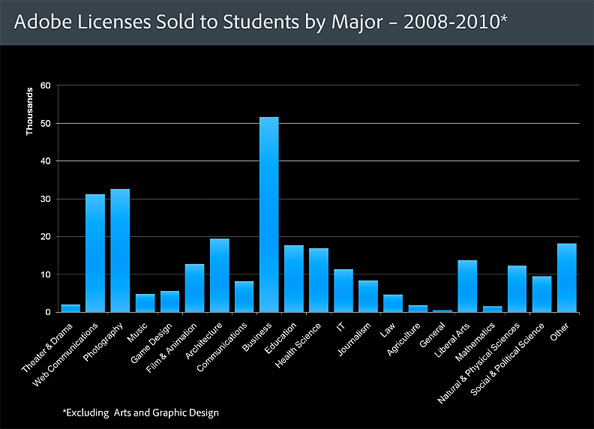
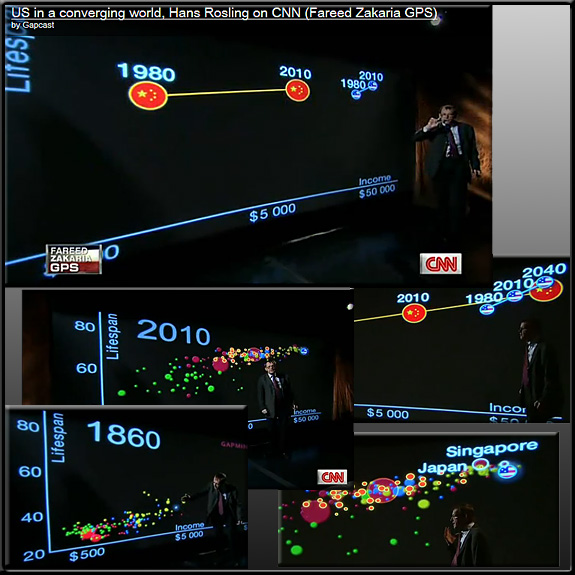
Hear from analyst Ellen Wagner as she covers research showing the expansion of technology in higher education. Evolving expectations for digital skills for students and faculty require use of technology that have traditionally been used by art and design schools.


Also see:


Does online education put traditional universities at a ‘grave risk’? — from eCampusNews.com by Denny
An expert on ‘disruptive innovation’ says ed tech could change the way powerhouse universities operate

Excerpt from article:

Christensen, a Harvard Business School professor and author of The Innovator’s Dilemma and The Innovator’s Prescription, delivered the keynote address to an audience of higher-education officials March 7 at the American Council on Education’s Annual Meeting in Washington, D.C.

Christensen outlined the ways upstart, innovative businesses have toppled the giants of industry—such as Toyota’s rise coinciding with American automakers’ downfall—and how that model might translate to colleges and universities.

While online college classes have grown more available and affordable over the past decade, Christensen said a major shift had not yet occurred in higher education. Not until online learning grew in popularity was higher education even “amenable” to a major “disruption,” he said.

“When technology gets good enough, it sucks customers out of the old into the new,” he said, referring to institutions that have specialized in online learning, rather than traditional schools that have slowly adopted online college classes. “It doesn’t work the other way around.”

That move away from traditional powerhouses of education, he said, likely would happen in the next 20 years, and elite schools should be prepared.

…

National data support Christensen’s warning to traditional universities. Online student enrollment increased by 21 percent in 2010, according to the annual Sloan Survey of Online Learning. Overall, higher-education enrollment grew by 2 percent.

The survey of more than 2,500 colleges and universities showed online college classes gained 1 million students from 2009. More than 5.6 million students were enrolled in at least one web-based class in the fall 2009 semester.

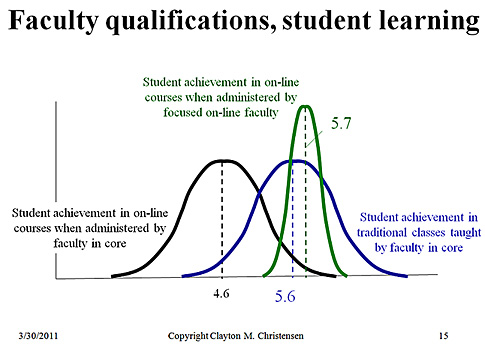
Some example items from Christensen’s and Cizik’s keynote presentation:
The Innovative University: Changing the DNA of Higher Education From the Inside Out


Also relevant/see:
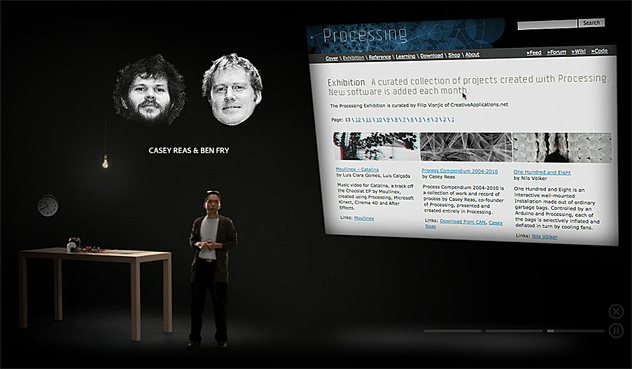
 

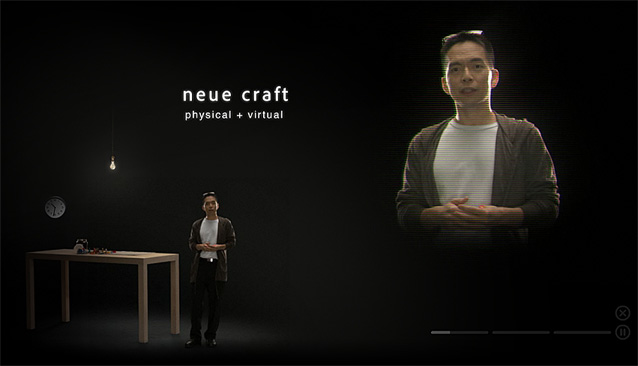
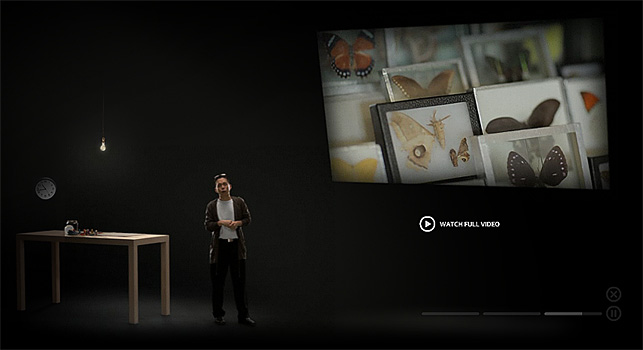
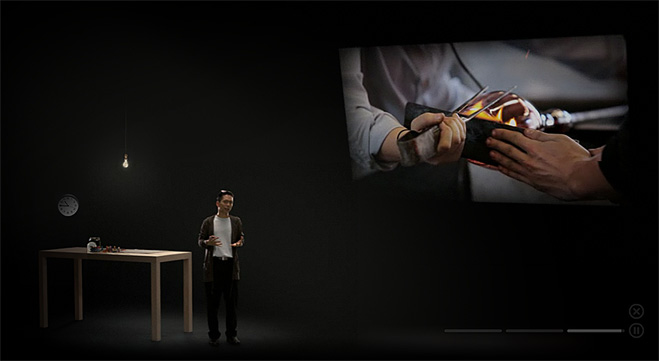
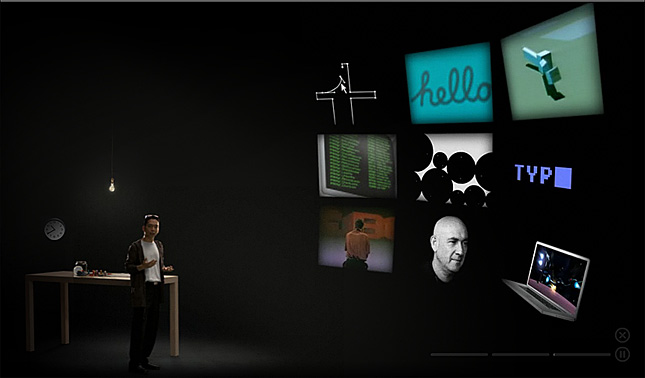
Adobe Museum of Digital Media, A lecture by John Maeda

From DSC:
If online courses could feature content done this well…wow! Incredibly well done. Engaging. Professsional. Cross-disciplinary. Multimedia-based. Creative. Innovative. Features a real craftsman at his work. The Forthcoming Walmart of Education will feature content at this level…blowing away most of the competition.


John Maeda -- Adobe Museum -- March 2011


This is also true for materials like the item below!


21st century education requires lifewide learning — from Harvard Business Review by Chris Dede

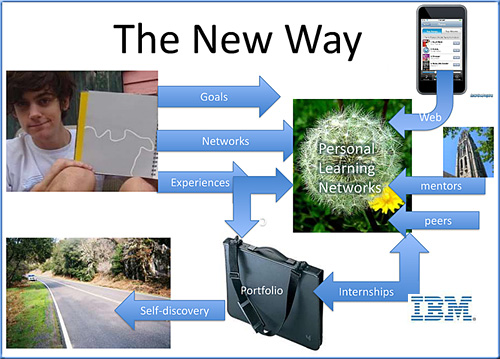
I have decided to spend the remainder of my career helping to replace industrial era schooling with educational structures better suited to our 21st century, global, innovation-based economy. This sweeping goal of total educational transformation may seem overly ambitious for someone whose work centers in learning technologies. However, in my research I consistently find that new media are at the heart of innovative models for education: contributing to the obsolescence of traditional schools/universities as educational vehicles, while simultaneously empowering new forms of learning and teaching.

Pearson & McGraw-Hill make multi-million dollar investment in Inkling — from Kirsten Winkler

It seems as if the latest study from Xplana in which they predict that the tipping point for digital textbooks is as near as 2015 has opened up the wallets of two major publishers for an undisclosed “multi million Dollar” investment.

Inkling, the maker of the iPad application and platform which delivers enhanced and engaging textbooks, leaving the “flat, PDF-based digital textbooks” behind is the beneficiary and it could give the startup a competitive edge over the well funded competitor the Kno.

But as money is not everything Inkling, Pearson and McGraw-Hill also made some significant content commitments, boosting the number of titles available on the Inkling platform…


Also see:

Blockbuster’s largest shareholder calls Blockbuster worst investment ever made — from FastCompany.com by Austin Carr

.

After years as Blockbuster’s largest shareholder, Carl Icahn, who at one point amassed some 17 million shares of the now-bankrupt company, has called Blockbuster “the worst investment I ever made.”

In a candid piece written for the Harvard Business Review, Icahn opens up about the rental giant’s struggles and failures in an ever-changing industry.

“[Blockbuster] failed because of too much debt and changes in the industry. It had too many stores, Netflix created a better business model, and then Redbox kiosks and the whole digital phenomenon eliminated the need for consumers to go to a separate DVD store,” Icahn wrote. “Maybe the board did make a mistake in picking Jim Keyes as [John] Antioco’s successor—Keyes knows retailing and did an excellent job with the stores, but he isn’t a digital guy.”

From DSC:
I write about Blockbuster — and I emphasize the items above — because Blockbuster did not respond to the changes that were occurring around them.

.

What about those of us in higher education?
How’s our response(s) coming along?

.

The pace has changed -- don't come onto the track in a Model T

.

Staying Relevant


5/2/11 addendum:

4/7/11 addendum:


Schools use digital tools to customize education — from Education Week by Michelle R. Davis

“In regular, face-to-face classrooms, it’s very difficult to create an individual experience for each student unless you can make the learning independent but also interactive,” says Jeff Snyder, a former classroom social studies teacher who is now an assistant principal with the Jefferson County, Ky., public schools’ eSchool, an online school with more than 6,000 students. “Technology allows students to go in their own direction, which is really difficult to do in a classroom with 30 different kids

Disrupting the learning dynamic with technology — from Cisco

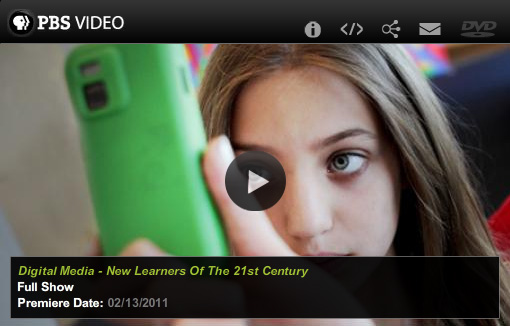
So how can technology disrupt the academic learning dynamic as effectively as it has disrupted the process for becoming more adept with social engagements? A new PBS documentary, Digital Media: New Learners of the 21st Century, explores this subject in depth. View an excerpt from the documentary…

.

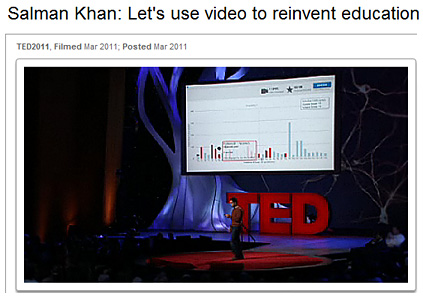
Salman Khan: Let’s use video to reinvent education — March 2011

Salman Khan talks about how and why he created the remarkable Khan Academy, a carefully structured series of educational videos offering complete curricula in math and, now, other subjects. He shows the power of interactive exercises, and calls for teachers to consider flipping the traditional classroom script — give students video lectures to watch at home, and do “homework” in the classroom with the teacher available to help.

.

Sal Kahn at TED -- March 2011

.

From DSC:
Before rushing to a quick take/judgment on this, hear him out. Turning over more control to the students during the relaying of the information makes sense to me. They can pause, rewind, fast forward, etc.  They can re-listen to the lecture again and again, without affecting the flow of a typical face-to-face classroom. Then they come into class and can get help on their homework, instantly and when they need the assistance.

Also see:


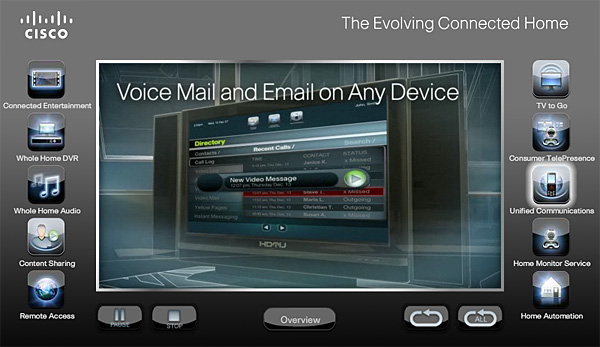
The connected life at home -- from Cisco

.

.

From DSC:

How will these types of technologies affect what we can do with K-12 education/higher education/workplace training and development? I’d say they will open up a world of new applications and opportunities for those who are ready to innovate; and these types of technologies will move the “Forthcoming Walmart of Education” along.

Above item from:

Tagged with: • • • • • • • • • • • • • • • • • • • • • • • • • • • • • • • • • • • • • • • • • • • • • • • • • • • • • • • • • • • • • • • • • • • • • • • •  

Evidence of learning online: Assessment beyond the paper — from CampusTechnology.com by Judith Boettcher
…learning designer Judith Boettcher examines online assessment strategies beyond the traditional end-of-term paper.

Excerpts:

Professional Work Products

  • Written and audio communications of all types, such as press announcements, white papers, briefs, summaries, memos, project management documentation
  • Creating and planning news events, such as announcements, interviews, or regular updates of interests, such as podcasts
  • Setting up personal or group blogs within different contexts of leadership, business, etc.
  • Setting up wikis for team projects, areas for monitoring developments
  • Many more listed…

Interviews
The interview medium is a very flexible communication tool and can be used by both faculty and students for demonstrating understanding and eliciting the state of concept development. Here are some possible strategies that can require research, critical thinking, and writing.

  • Learners identify an expert or a person of interest to them in a particular field germane to the course and then prepare the interview questions, do the interview, and then post the results
  • Learners identify and interview the author of a textbook or article closely related to the course, possibly updating information critical to the course
  • Many more listed…

Audio, Video, and Visual Projects
What about other media such as audio and video projects? Today’s learners live surrounded by audio and video and the tools that make it possible for everyone to create and produce audio and video products. Here are some of the possibilities with audio and video spaces.

  • Podcasting resources now are very common so learners are familiar enough with the format to embrace creating audio and video podcasts of their own
  • Video shorts and ad hoc documentaries engage learners and draw in their friends and families
  • Creating and posting short reports via VoiceThread is another “writing space” to consider as are Flickr, YouTube, and Slideshare

Blogs
Blogs are a very underutilized writing space. Blogs share many characteristics with journals and thus can capture snapshots of what learners are thinking, and when; plus they often can also capture the sources of some of their thinking. Blogs help learners understand the growth cycle of learning new concepts and how and why they think the way they do. Here are some ideas on how blogs, both personal and class, might be used.

  • Personal commentary and self-reflection
  • Capturing thought processes and generating new ideas
  • Assist learners in finding their “voice”
  • Many more…

Wikis

  • Collaborating on group and team projects of all kinds
  • Capturing and developing ideas for solving critical problems and case studies and simulations
  • Developing “featured” Bronze star Wikipedia articles on specific topics in particular disciplines

Google’s Gadfly — from InsideHigherEd.com

“Uncomfortably familial.” That is how Siva Vaidhyanathan, a professor of media studies at the University of Virginia, describes the relationship between higher education and Google — a company that has, in a little more than a decade, evolved from pet project of Stanford doctoral students to chief usher of the information age.

…

But as is often the case with cousins, the genetic differences between higher education and Google are more striking than their similarities. Beneath the interdependence and shared hereditary traits, tensions creep. And like an awkward Thanksgiving dinner, Vaidhyanathan’s new book, The Googlization of Everything (And Why We Should Worry) (University of California Press), provokes these tensions to the surface.

The Virginia professor, who is not afraid to confess his affection for the ease and usefulness of Google, nevertheless distrusts the company’s basic motivations as it vies for our intellectual inheritance. “Google has fostered a more seamless, democratized, global, cosmopolitan information ecosystem,” he writes. “Yet it has simultaneously contributed to the steady commercialization of higher education and the erosion of standards of information quality.”

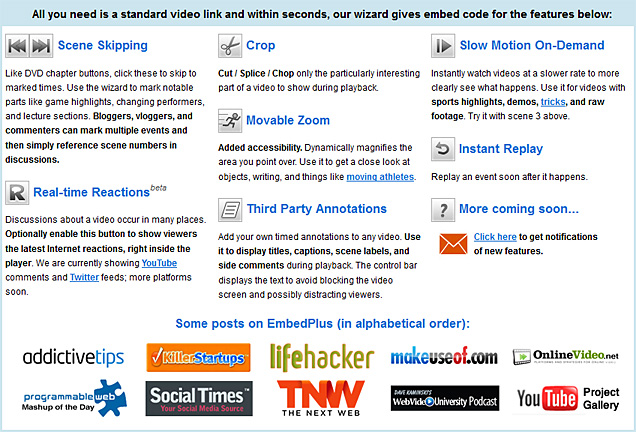
Embedplus.com — resource and quote below from Shola ‘Tay’ Omojokun, Co-founder, EmbedPlus.com

EmbedPlus can allow users to seamlessly and freely upgrade the videos they embed with attractive features that the standard YouTube player does not currently offer.  It was recently mentioned to me that supported features like annotations and scene editing would be useful for teachers wanting to mark up lecture, demo, and videos posted on wikis, blogs, etc.  Slow motion and zoom can have some useful applications for art, nature, and science videos.

.

EmbedPlus helps teachers focus students on relevant parts of existing videos and allows them to add extended material.
EmbedPlus as an educational tool for videos

.

From DSC:
With the increase of digital video, digital storytelling, lecture capture, and other related educational technologies, this tool may be helpful to you. Thanks Tay for the resource.

Addendum on 2-18-11 — also see:

© 2025 | Daniel Christian