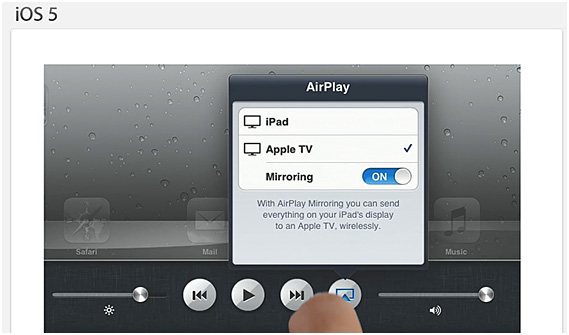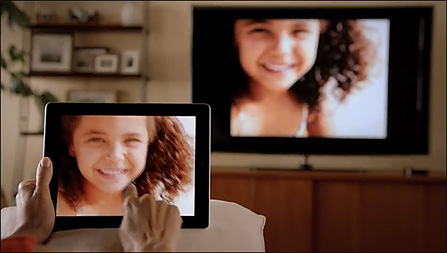
Apple’s new video regarding their iOS 5 operating system


Apple's video regarding their new iOS5


Apple's video regarding their new iOS5


From DSC:
I have it that these technologies will be used for educationally-related purposes/materials as well; including digital storytelling, transmedia storytelling, transmedia-based interactive/participative educational materials and more.


Digital storytelling tools (K-12) — from Tech & Learning by Özge Karaoglu

  • Audio tools
  • Picture tools
  • Animations tools
  • …and more

College? There’s an app for that: How USC built a 21st century classroom — from theatlantic.com by Derek Thompson | May 27 2011
“Everything about this program pushes definitions about what is a semester, what is the university, what is a classroom, and where do the faculty belong?”

Excerpt:

usc5.png


In the spring of 2008, John Katzman, the founder of the Princeton Review, approached the Masters of Arts in Teaching (MAT) program at at the University of Southern California with a revolutionary idea. USC could increase its graduates by a factor of ten without building another room.

Every year, California adds 10,000 new teachers. And every year until 2008, USC graduated about 100. The school felt “invisible.” How could it build influence without new buildings? Katzman said his new project, 2tor, Inc, an education technology company, promised a solution. Forget the brick and mortar, and go online, he said. USC was skeptical. Surely, no Web program could possibly deliver an in-classroom quality of instruction.

Katzman disagreed. I have something to show you, he said.

The rise of new e-book business models — from TrendBiz.net by futurist Thomas Frey
Experimenting our way to success – reinventing publishing models


??? ?? ???


Excerpt:

Futurist Thomas Frey: Amazon revolutionized book reading in 2007 when it introduced its Kindle book reader. Within the past three years, the explosive sale of book readers has caused a massive surge in the sale of e-books, already outpacing the sale of hardcover books, with a prediction by Amazon CEO Jeff Bezos that they will outsell paperbacks within the next year.

We are witnessing a major transformation of this industry. Within five years, the vast majority of all books sold will be e-books. Big box retailers like Barnes & Nobel and Borders will have shuttered most of their storefronts. The printing press industry, along with the craftsmen of ages past who have made a fine art of applying ink to paper, will be mothballing their machines. And the media, almost in unison, will begin writing the eulogy for this 500-year old industry.

But before we focus too much on what we’ve lost, we need to pay close attention to the other side of the equation. Digital book publishing will be an exciting new industry with truly amazing potential for growth.

Would you like a $49 electronic college textbook with lifetime updates? — from crunchgear.com by Scott Merrill

From DSC:
I was just talking about this idea earlier today at lunch. Why can’t a textbook be like/look like/act like/and be distributed more along the lines of an app from an online app store than a static, physical textbook? Why can’t someone purchase a lifetime stream of updates? Or at least an annual agreement for such a stream of updates for the next 12 months? Alternatively, perhaps after purchasing the original book, a person could opt in for an upgrade at some point (much life software)?

Also see:


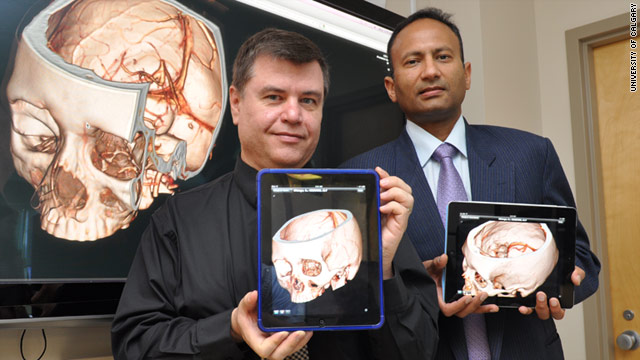
Mobile app helps doctors diagnose strokes — from cnn.com by Mark Milian

Ross Mitchell, left and Mayank Goyal display the ResolutionMD Mobile iPad app, which could help doctors diagnose strokes.

Tagged with: • • • • • • •  

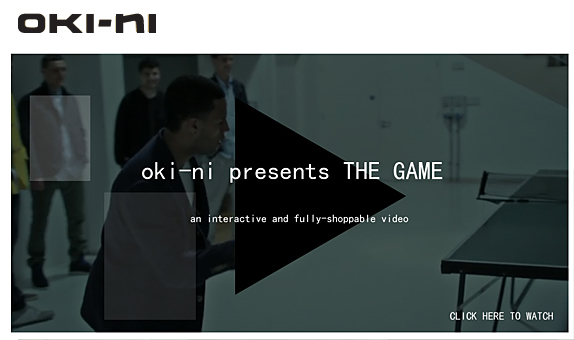
oki-ni presents THE GAME — from oko-ni.com

Excerpt:

At oki-ni we make the everyday extraordinary. That’s why, when it came to creating our latest video, we wanted to do something truly remarkable. What we came up with is this, an interactive and fully-shoppable video.

An interactive and fully-shoppable video from oko-ni

LiveScribe's new connections -- sharp!


From DSC:
Taking this concept into learning spaces…I would like to see this type of thing in all Smart Classrooms; for example:


Also see:

New way to learn with AR — from edlab.tc.columbia.edu by Pengfei Li


Addendum later on 5/17 — also see:


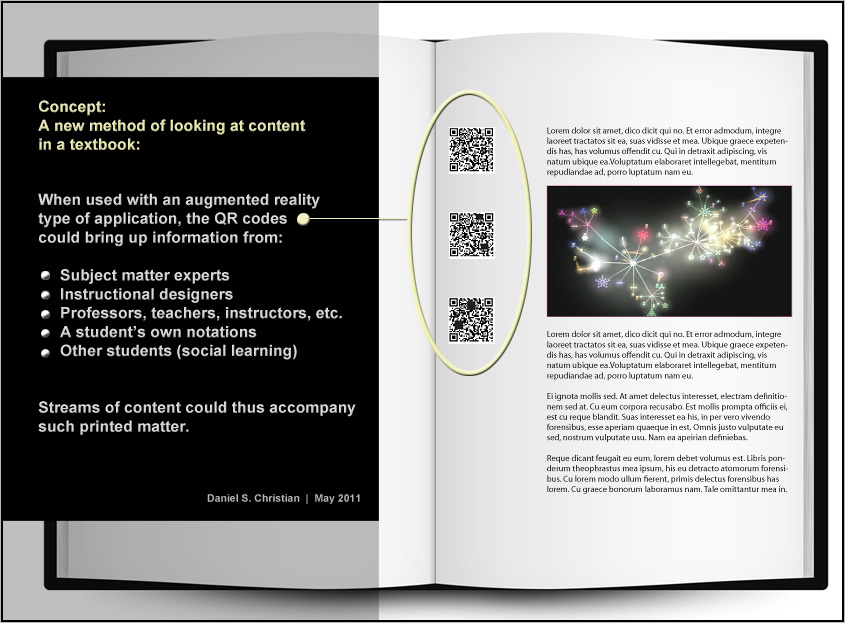
[Concept] The new “textbook”: A multi-layered approach — from Daniel S. Christian
I’ve been thinking recently about new approaches to relaying — and engaging with — content in a “textbook”.


For a physical textbook


When opening up a physical textbook to a particular page, QR-like codes would be printed on the physical pages of the textbook.  With the advent of augmented reality, such a mechanism would open up some new possibilities to interact with content for that page. For example, some overall characteristics about this new, layered approach:

  • Augmented reality could reveal multiple layers of information:
    • From the author/subject matter expert as well as the publisher’s instructional design team
      • Main points highlighted
      • Pointers that may help with metacognition, such as potential mnemonics that might be helpful in moving something into long-term memory
      • Studying strategies
    • A layer that the professor or teacher could edit
      • Main points highlighted
      • Pointers that may help with metacognition, such as potential mnemonics that might be helpful in moving something into long-term memory
      • Studying strategies
    • A layer for the students to comment on/annotate that page
    • A layer for other students’ comments


For an electronic-based textbook


  • The interface would allow for such layers to be visible or not — much like Google’s Body Browser application
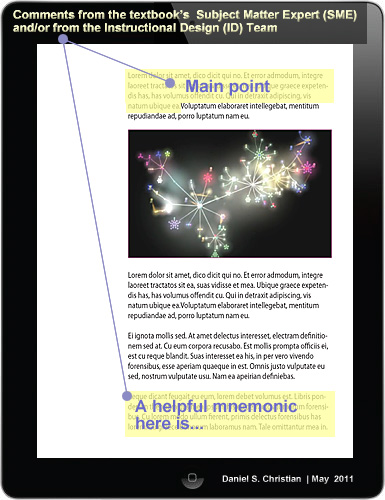
  • For example, in this graphic, comments from the SME and/or ID are highlighted on top of the normal text:


Advantages of this concept/model:

  • Ties physical into virtual world
  • We could economically update information (i.e. opens up streams of content)
  • Integrates social learning
  • Allows SMEs, IDs, faculty members to further comment/add to content as new information becomes available
  • Instructors could highlight the key points they want to stress
  • Many of the layers could offer items that might help with students’ meta-cognitive processes (i.e. to help them learn the content and move the content into long-term memory)
  • One could envision the textbook being converted into something more akin to an app in an online-based store — with notifications of updates that could be constantly pushed out


Addendum (5/26):


The New 3 E's of Education: Enabled; Empowered; Engaged -- May 2011 from Project Tomorrow


Excerpt from introduction (emphasis DSC):

Three factors are driving this new interest and enthusiasm for digital learning by educators. First, teachers and administrators are increasingly become technology-enabled themselves, using emerging technologies such as mobile devices, online classes and digital content to improve their own productivity. This development of a personal value proposition with the technology is propelling educators to think creatively about how to leverage these same tools in the classroom. Second, students and increasingly parents are demanding a different kind of learning experience and that is forcing even the most reluctant teachers and administrators to re-evaluate their perspectives about the value of technology within learning. As noted in prior Speak Up national reports, students have a very clear vision for 21st century learning. Their preference is for learning environments that are socially-based, un-tethered and digitally rich. Parents are also supportive of this new learning paradigm and as we noted in our first Speak Up 2010 report (released in April 2011) the emergence of a new trend of parental digital choice is an indication of this unprecedented support level. And schools and districts are waking up to this new trend. Concerns about parents’ capability to, for example, enroll their children in non-district provided online classes are compelling many districts to start virtual schools themselves. The third factor, the economy, and its resulting financial pressures on school and district budgets, has created a sense of urgency to more fully investigate how technologies can help educators meet their instructional goals with less expense.

All three factors converging at the same time has opened up a new window of possibilities for achieving the promise of technology to transform education. Evidence of this shift in perspective and vision by educators is noted in some comparative Speak Up findings over the past few years.

…

This report is the second in a two-part series to document the key national findings from Speak Up 2010.
…
In this companion report, “The New 3E’s of Education: Enabled, Engaged, Empowered – How Today’s Educators are Advancing a New Vision for Teaching and Learning,” we explore how teachers, principals, district administrators, librarians and technology coordinators are addressing the student vision for learning around three key trends. These trends have generated significant interest in the past year at conferences, in policy discussions and within our schools and districts: mobile learning, online and blended learning and digital content.

While each of these trends includes the essential components of the student vision of socially-based, un-tethered and digitally-rich learning, they also provide a unique backdrop for investigating the role of educators to engage, enable and empower students through the use of these emerging technologies.
• Role of Librarians and Technology Coordinators: To enable student use of the emerging technologies through their planning, support and recommendation responsibilities.
• Role of Classroom Teachers: To engage students in rich, compelling learning experiences through the effective use of these technologies in the classroom.
• Role of School and District Administrators: To empower both teachers and students to creatively envision the future of digital learning, and to provide opportunities for exploring the elements of a new shared vision for learning.


6 companies aiming to digitize the textbook industry — from Mashable.com by Sarah Kessler


© 2025 | Daniel Christian