This Visible College — from Educause (Vol. 34, No. 2, 2011) by Bryan Alexander

Excerpt:

In this column we’ll explore another part of higher education using only one scenario — but it’s a doozy.

“Class begins when the classroom door closes.” This image is enshrined in many practices, much popular memory, and even campus policies. But the concept may well be turned inside out in the near future as several trends coincide, altering the ways we teach and learn. That shut door is about to be wrenched open and our closed classes drawn into a global, visible college (compared to the invisible college described by David Staley and Dennis Trinkle1).

None of these supporting trends is mysterious or surprising:

  • Social media
  • Mobile computing
  • Open content

…

When these three trends combine, though, the synthesis surpasses each individual trend. What they do is turn the classroom inside out.

…

Everything I’ve described is happening now. What happens when these trends continue to grow and cross-pollinate?


Future of Higher Education — from Educause (Vol. 34, No. 1, 2011) by Bryan Alexander

Excerpt:

What does the future hold for higher education? How is American academia changing under the impact of continuous technological transformation?

…

The Future of Scholarly Publication
Scholarly publication is one of the most vital parts of higher education.4 Publications are in many ways the acme of faculty assessment: publish or perish. Our articles and books are the visible, enduring record of academic work, outlasting the lifespans of researchers, staff, and students. An entire industry both depends on and supports this output. Research output is deeply interwoven into many aspects of campus life, from hiring policies to library budgets and admissions materials. It is also a field in crisis, hammered by the Great Recession and torqued by ongoing technological revolutions.
Are you ready for the second wave of social media? — from smartblogs.com by Jesse Stanchak

Excerpt (emphasis DSC):

When people ask what the next big thing in social media will be, they’re usually looking for an ascendant platform that will supplant Facebook the way Facebook supplanted MySpace or they’re expecting a feature set, such as geo-location or group messaging. But what if it’s not a network or a tool? What if it’s an application?

“Internal social media is the second wave … the future of work is in communities,” said Cisco’s Andrew Warden at this week’s Corporate Social Media Summit.

Warden gave the crowd four reasons to start looking at internal social tools…


From DSC:
My thanks to Tracy Gravesande for posting this item over at the “The Social Learning Community Network” (a Yammer-based community of practice)

Also of potential interest here is:


Addendum on 7/5/11:

LinkedIn leaps (further) into the content game with SlideShare –– from FastCompany.com by E.B. Boyd

Excerpt:

Everyone knows LinkedIn as a networking tool. But slowly, it’s becoming a media publisher too–or at least a place to find great work-related content.

Back in March, Reid Hoffman’s crew launched LinkedIn Today, a way for businesspeople to share and discover great articles. Today, it announces a tighter integration with SlideShare, so folks can share and discover presentations, videos, and documents from that site.

101 quick ideas to ignite your online learning community — from Bloomfire.com by Josh Little and Nehemiah Chu

Excerpt:

Our quick start guide to starting your online learning community (or taking your existing one to another level). Includes community management tips touching on contests, awards, prizes, recognition, and internal marketing.

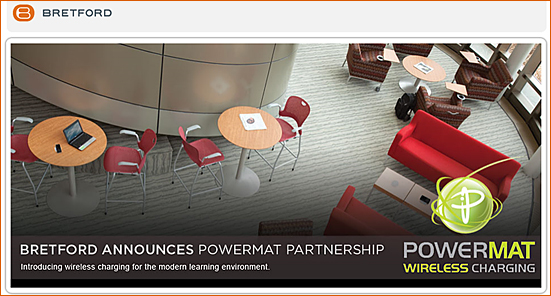
Powermat and Bretford -- wireless charging for learning spaces


Bretford -- Edu 2.0 announcements - June 2011


From DSC:
I hesitated in posting this because I don’t know what the future will tell us re: the use of wireless technologies. But for now, the majority of the tests/research that I’ve seen assert that we are not in much danger from using wireless technologies. (I just hope this arena doesn’t turn out to be another Philip Morris type of move from the manufactures/companies selling these items.)


Why we need less instruction — from Clive on Learning by Clive Sheperd

Excerpt:

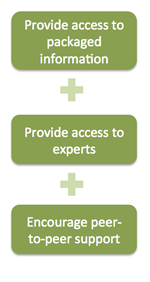
Another reason you might back away from instruction as a strategy is because it is more efficient to provide how-to materials at the point-of-need – it isn’t learning that’s required, it’s performance support:


Information flow150x282

icarewecare.org


From DSC:
I originally saw this at:

Excerpt:

Of course, the future belongs to the young. You get a decent look at it ahead of time, though, by watching how they build new ways seize it.

Earlier today a 17 year old named Priyanka Jain launched a student run nonprofit called iCAREweCARE, which is dedicated to helping high school and college students identify causes they care about, find local organizations that address those problems, and then write about their experiences,  or connect with their friends over them. There is a Web site, and Facebook connections for rapid and deep information sharing.

The cause-centered orientation is praiseworthy. The implications of this kind of social platform, however, could be what proves really world-changing

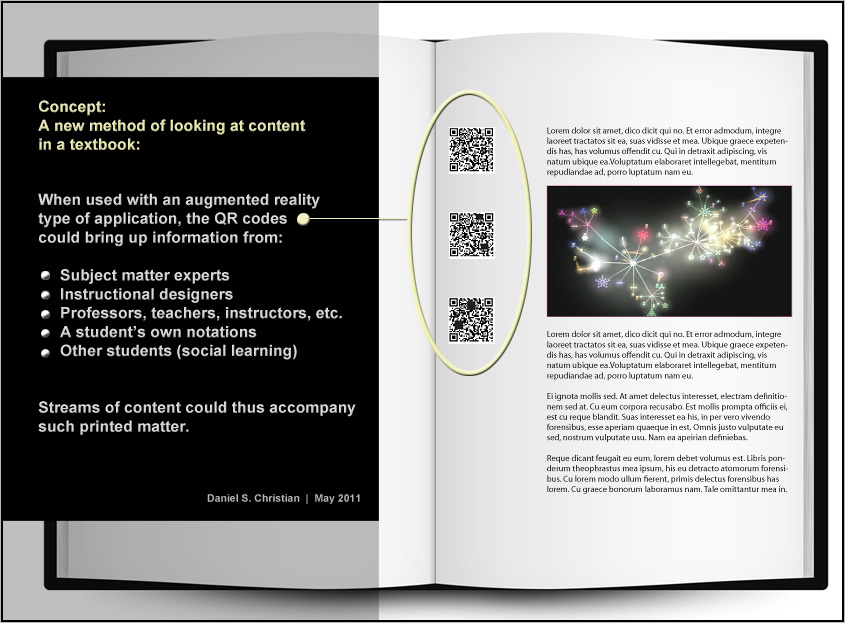
[Concept] The new “textbook”: A multi-layered approach — from Daniel S. Christian
I’ve been thinking recently about new approaches to relaying — and engaging with — content in a “textbook”.


For a physical textbook


When opening up a physical textbook to a particular page, QR-like codes would be printed on the physical pages of the textbook.  With the advent of augmented reality, such a mechanism would open up some new possibilities to interact with content for that page. For example, some overall characteristics about this new, layered approach:

  • Augmented reality could reveal multiple layers of information:
    • From the author/subject matter expert as well as the publisher’s instructional design team
      • Main points highlighted
      • Pointers that may help with metacognition, such as potential mnemonics that might be helpful in moving something into long-term memory
      • Studying strategies
    • A layer that the professor or teacher could edit
      • Main points highlighted
      • Pointers that may help with metacognition, such as potential mnemonics that might be helpful in moving something into long-term memory
      • Studying strategies
    • A layer for the students to comment on/annotate that page
    • A layer for other students’ comments


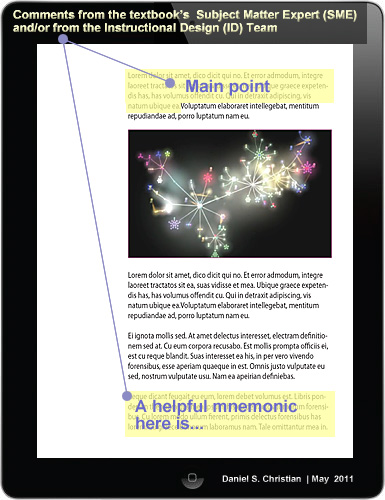
For an electronic-based textbook


  • The interface would allow for such layers to be visible or not — much like Google’s Body Browser application
  • For example, in this graphic, comments from the SME and/or ID are highlighted on top of the normal text:


Advantages of this concept/model:

  • Ties physical into virtual world
  • We could economically update information (i.e. opens up streams of content)
  • Integrates social learning
  • Allows SMEs, IDs, faculty members to further comment/add to content as new information becomes available
  • Instructors could highlight the key points they want to stress
  • Many of the layers could offer items that might help with students’ meta-cognitive processes (i.e. to help them learn the content and move the content into long-term memory)
  • One could envision the textbook being converted into something more akin to an app in an online-based store — with notifications of updates that could be constantly pushed out


Addendum (5/26):


MyTVBuddy kicks off as the first pan-European Social TV app on iPad — from appmarket.tv (emphasis DSC)

Excerpt:

Today E-ZONE unveiled its iPad app MyTVBuddy claiming it takes Social TV to the next level of exploration, interaction, engagement and participation by letting users check in to TV programs, watch videos, post messages on Facebook, share Twitter messages, participate in conversations  and see where other users are located. MyTVBuddy kicks off with a special launch edition of Eurovision 2011.

MyTVBuddy comes with a solution for turning TV viewing into a social experience by using mobile devices such as the iPad. According to a recent study from Yahoo, nearly 90 percent of people watching television are using a mobile device at the same time. Be it Twitter, Facebook, email or instant messaging, they are doing more than just watching.


From DSC:
TV and entertainment coming up to bat — with learning-related applications on deck!   🙂


Also see:


Addendum on 5/11/11:

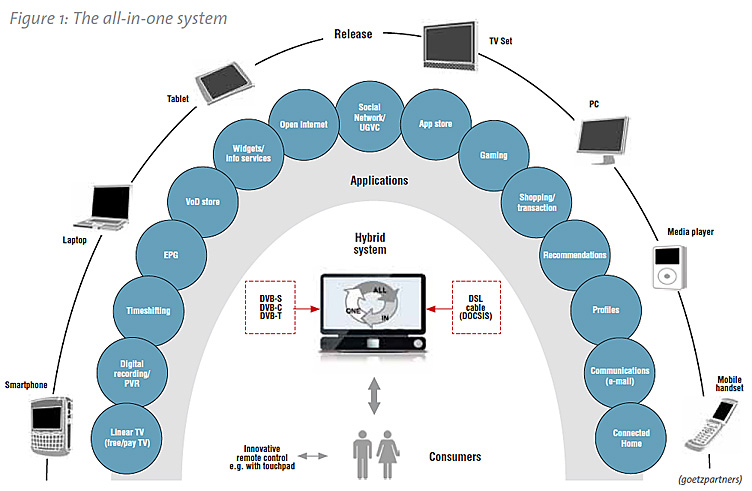
TV 3.0


Also see:


Also see:


From DSC:
Check out the topics:

  • Pay-TV in the Connected World
  • Making Apps Part of the TV Experience
  • Meeting Higher Quality Expectations
  • Connecting Broadcasters and Audiences
  • Making Subscription TV Work on Multiple Screens
  • Content Discovery Becomes Business Critical
  • The Impact of Connected TV Standards
  • CE Strategies Including Co-Opetition
  • What Connected TV Means For IPTV


The future of television: Why you won’t recognize your television just a few years from now — from iptvmagazine.com by Scott Puopolo, Cisco

Excerpt:

Imagine you are watching a program on your refrigerator. You browse through the program choices using hand gestures. When you walk into the bathroom, the display of your program automatically transfers to the display inside the bathroom mirror.

Does this seem farfetched? All of these capabilities are here now and research gathered by the Cisco “Internet Business Solutions Group” (IBSG) from manufacturers, content producers, service broadcasters and academic experts identifies amazing predictions of what is going to happen in the TV industry and when these changes are likely to occur.

Analysis of the research shows that the three main influences to these events happening include technology, consumer behavior and business models. Multiple supporting technologies have emerged including displays (digital paper and projection devices), ultra-high bandwidth connections and new types of human interfaces (sensory devices). The ways consumers discover and consume media are changing including using social networks (Digg) and on demand content (YouTube), and participating in the creation of TV programs. Business models are changing from pushing a limited number of linear based channels to aggregating many content sources (NetFlix), recommending relevant programs, and adapting media for specific viewers (personalized ads on Facebook). Using this information, the IBSG has identified 10 Predictions for the future of TV.

Social Learning Examples – in the Workplace — from the Centre for Learning & Performance Technologies by Jane Hart

100+ Examples of  the use of Social Media in Learning — from the Centre for Learning & Performance Technologies by Jane Hart

Addendum:

© 2025 | Daniel Christian