The Inspiration Bookshelf — from Julie Dirksen

From DSC:
Here’s a solid list of resources re: books ID’s should read that seems to support the KISS principle (of which I’m a huge fan) as well as how to make learning fun and engaging.
.
Excerpt:

One of the things I had while writing the book was an inspiration bookshelf.  These were books that not only inspired the content of Design for How People Learn, but also the style of it.  None of these are instructional design books, but they are all books that instructional designers should read…

Also see:

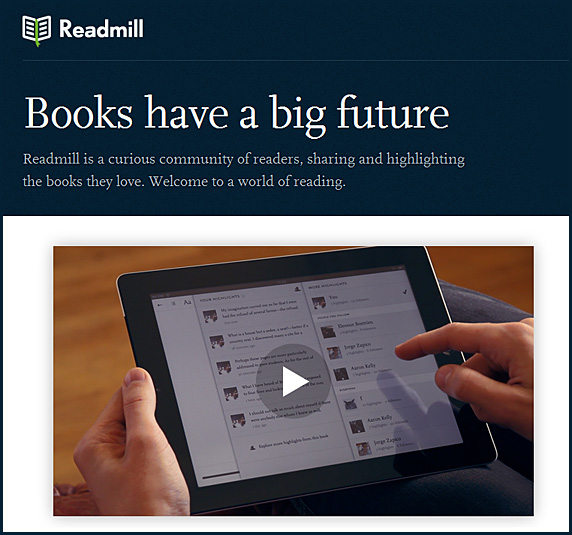
readmill.com


From DSC:
I originally saw this at:

Educational content and learning experiences wirelessly delivered to home TV console — from marketwatch.com

Excerpt:

DALLAS, Dec. 6, 2011 /PRNewswire via COMTEX/ — Don’t touch that dial. A new variety of interactive educational content for the youngsters in the household is headed to a TV near you.

AT&T* today announced an agreement with TVTextbook to provide mobile broadband connectivity to TVTextbook’s eLearning connected device portfolio. TVTextbook (TVT) delivers high-quality K-12 curriculum that is distributed through a learning console connected to the television. Only TVTextbook leverages basic television-a product found in virtually every U.S. household-to help school districts deliver a digital education to 100% of their students. AT&T’s connectivity will bring a seamless, wireless connection between school and home.

From DSC:
Do I think this will be excellent in 2012? No. Do I think it’s innovative? Yes. Do I think it will be potentially helpful to many? Yes…and so will many apps that are coming to our living rooms in the next 1-3 years.

Also see:


From DSC:
Below are some items concerning the continued convergence of the telephone, the television, and the computer — it involves the smart/connected TV as well as human-computer-interaction (HCI)-related items.  But this time, I’m focusing on a recent announcement from Microsoft. 

However, I have to disagree that, given this announcement, Microsoft will now rule the living room — or at least I surely hope not. Why do I say this? For several reasons.

1)  How long has Microsoft Office been around? Years and years, right?  If you think that Microsoft should control your living room, I ask you to show me how I can quickly and easily insert some audio-based feedback with one easy click of a record button within Microsoft Word.  Go ahead and check…such a quick and easy method is not there….still…and it’s almost 2012.  (BTW, here are some resources on this if you’re interested in seeing how this could be done, but you will quickly notice that this is not a streamlined process — and it should have been so years ago.)

2)  Performance/not doing what it’s supposed to do.  My Dell PC running Windows 7 still can’t even shut itself down half the time.  It just sits there with wheels-a-spinnin’ at some point…but not powering down.  I’m not sure why this is the case, but I never have had trouble with this simple task on my Macs.

3)  Regarding troubleshooting Microsoft’s solutions, an entire support industry has been built on supporting Microsoft’s software — go to a local bookstore and see how to get MS certified on some particular package/application/service — none of the books are thin.

4)  Security has never been Microsoft’s strong point.

Bottom line:
I think you get my point.
Microsoft has a loooooonnnnngggg way to go in my mind before I want their products and services controlling my living room.

With that said, I do congratulate Microsoft on being more innovative and forward thinking with the Xbox announcements mentioned below. I just hope that items such as usability, user experience, security, and streamlined interfaces  are high on the list of their priorities/deliverables.

Disclosure/note:
I do use PCs with Windows a significant amount of the time and they do a nice job with many items.  But if I were to assign grades to Microsoft, usability, performance, and security are not items that I would give A’s to Microsoft on.


Microsoft XBox

Upgrade: The Xbox 360 Slim game console.

Also:

Blowing out the digital book as we know it –– from MindShift by Tina Barseghian

Excerpt (emphasis DSC):

Inkling also produced the epic The Professional Chef by the Culinary Institute of America. The book in its entirety costs $50, but you can also purchase individual chapters for $3 a piece. The new model makes book buying much like buying music — choose only the pieces you like best.  MacInnis fluidly demonstrates how to float from one chapter to the next, launch videos, close in on images, tap on sidebars and recipe instructions. It’s like watching a magician performing sleight-of-hand tricks.

From DSC:
Books — and textbooks — will continue to be more cloud-based, interactive, multimedia-based, and will be able to be completely up-to-date as they move more towards becoming like apps (vs. hard copy books/textbooks). I see more experimentation in terms of the implementation of social media tools as well as in trying out different business models.  However, when all’s said and done (at least for this next phase), I hope that we can get to the iTunes-like purchasing model mentioned above. I think students, faculty, and staff at educational institutions would benefit greatly from this. 

Count on Apple iTV in 2012, analyst says — from technewsdaily.com by Leslie Meredith

.

apple+tv-100604-02


Excerpt:

  • The rumors that Apple will launch an actual TV have hit the headlines again following comments made today (Nov. 30) by analyst Gene Munster at an industry conference. Munster went so far as to tell his audience at the Ignition: Future of Media conference in New York City to wait to buy a new TV, because Apple’s TV is “going to be awesome.”

Addendum on 12/2/11: 

MultiTaction turns walls into giant touch screens — from cnet.com by Jacqueline Seng
.MultiTaction

A maximum of 24 MultiTouch cells can be stacked together to form a ginormous touch-screen display.
(Credit: MultiTouch)

Excerpt:

MultiTouch, a Finland-based company known for its interactive display systems, has launched the MultiTaction Cell 55″. The display is supposedly the “world’s largest integrated multiuser LCD multitouch display,” which means (way) more than one person can use it at a time.

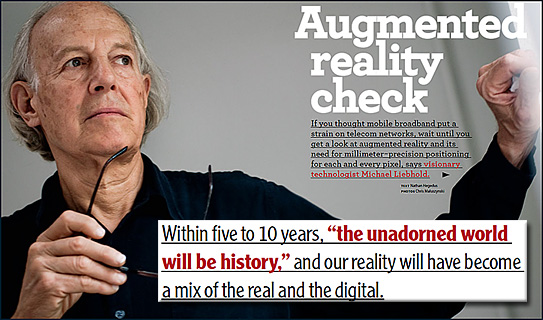
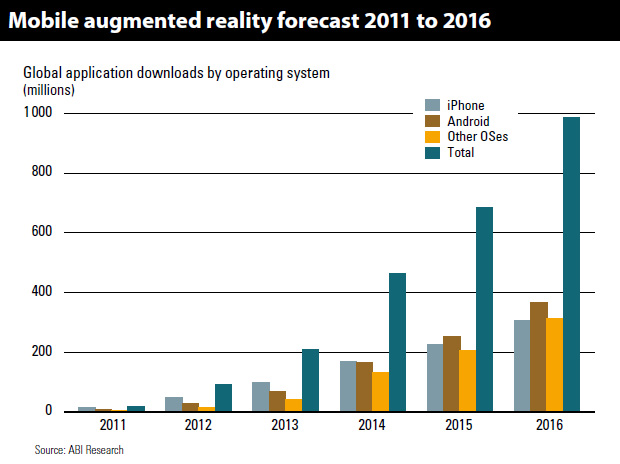
Augmented Reality Check - from Michael Liebhold - Nov 2011


Excerpt:

A REVOLUTION IN PERCEPTION is in the air, a transformation decades in the making. It will require a radical shift in viewpoint, as the way we experience data and information revolves 90 degrees from our traditional bird’s-eye view of maps, paper and screens to a more natural cinematic vision of the real world, one overlaid with digital information virtually attached to specific places.

And while augmented reality may still be in its infancy – with smartphone viewfinders displaying floating objects that are only vaguely connected to real places – don’t let that fool you.

The changes could reach far beyond mobile broadband and potentially be as profound as the development of the World Wide Web, says Michael Liebhold of the Institute for the Future. Liebhold forecasts that within five to 10 years, “the unadorned world will be history,” and our reality will have become a mix of the real and the digital. Telecom companies need to be ready, he says, to meet the demands of networks in which we are connected right before our eyes.

.

Could “Badges for Lifelong Learning” be our tipping point? –– from hastac.org by Cathy Davidson

Excerpt:

As more and more fascinating and creative and surprising applications to our DML Badges for Lifelong Learning Competition flood in (we’re at almost 100 and the competition does not close until the end of today), I am wondering if, a hundred years from now, some historian ploughing through the dusty data archives of the Internet, will see this moment as digital learning’s tipping point. I mean that.

This could be our tipping point for how we measure, the entry point to thinking up an array of new forms of deciding what counts for our era.

…

So many of us work in schools or in jobs where what counts has been decided for us. The array of badging systems in these applications is starting to suggest that there are many, many of us who are frustrated with our inherited systems and want to come up with new ways of deciding what we want to count, what we want to value and acknowledge and credit and reward. A badge system can be the symbol of all that, visible proof of  some quality of participation and contribution that previously wasn’t even defined.


Schools transitioning to digital content by 2015 — from by Patti Palancia

Excerpt:

Students in Florida schools will experience a digital learning environment by 2015. The Florida Department of Education is requiring schools to make a transition to all digital content within the next few years. The materials adoption process will no longer be in paper format, but through digital review. Major tasks include assessing district technology needs, identifying teacher preparation and professional development, and monitoring district pilot programs currently in place.

Tagged with: • •  

Cloud Learning as Universal Primary Education — from Teemu Arina

Excerpts:

The internet is lowering the transaction costs of learning. This leads to a situation where learning happens more and more in the open markets, in a distributed and decentralized manner. It is obvious that the primary interface will be based on mobile, cloud-based devices. Some principles…

…

There are effectively three levels of certification: 1st hand, 2nd hand and 3rd hand certification.

  • 1st hand certification is what you say you know.
    In the old world you would describe your skills in a resume and leave it to the employer to evaluate if that holds true. In the new world you can make your work and learning processes visible as it happens, demonstrating progress and increasing the believability of your 1st hand descriptions. A simple blog (a log of thoughts) makes reflection visible  and demonstrates the evolution and iteration of thinking as it happens.
  • 2nd hand certification is what others say about you.
    In the old world you would describe your references in a resume and leave it to the employer to call these references to evaluate if these people really value your work and learning. In the new world people accumulate links, likes and comments to the resources you produce on social networks. A Klout score on social media or a personal stock price based on social media activity on EmpireAvenue demonstrate your social capital through a simple metric. The question is, are you making an impact with your progress, enabling other people to build on top of your work through reflection and co-creation, or are you effectively invisible to others?
  • 3rd hand certification is what an authority says about you.
    In the old world you would get a certificate on hand to add in your resume that you have demonstrated the ability to pass a specific rat test (a school). This doesn’t necessarily mean you have mastered all the topics involved, but it demonstrates that you have been capable of passing such tests under the supervision of an authority. In the new world a single test in isolation is not enough but your ability to solve problems in connection with others.
© 2025 | Daniel Christian