Dear Web Design Community, Where Have You Gone? — from SmashingMagazine.com by Vitaly Friedman
On 03/18/2011,
in 21st century, 24x7x365 access, active learning, adult learning, career development, change, collaboration, content development, aggregation, repositories, corporate / business world, dangers of the status quo, Daniel S. Christian, digital textbooks, distance education, informal learning, instructional design, learning ecosystem, learning theories, lifelong learning, microlearning, online learning, online media, pace of change, professional development, publishing, social learning / networks, social media, staying relevant, strategy, student-related, surviving, teaching & learning, training / L&D, ubiquitous learning, workplace,
by Daniel Christian

From DSC:
After looking at some items concerning Connectivism*, I’ve been reflecting upon the following questions:
- What’s the best way for us to dip our feet into the constantly moving streams of content?
(No matter the topic or discipline, the streams continue to flow.) - What’s the optimal setup for K-12 based “courses”?
- What’s the optimal setup for “courses” within higher education?
- How should L&D departments deal with this phenomenon?
- How do publishers and textbook authors want to address this situation?
Thinking of Gonzalez (2004; as cited in Siemens (2005)) description of the challenges of rapidly diminishing knowledge life:
“One of the most persuasive factors is the shrinking half-life of knowledge. The “half-life of knowledge” is the time span from when knowledge is gained to when it becomes obsolete. Half of what is known today was not known 10 years ago. The amount of knowledge in the world has doubled in the past 10 years and is doubling every 18 months according to the American Society of Training and Documentation (ASTD). To combat the shrinking half-life of knowledge, organizations have been forced to develop new methods of deploying instruction.”
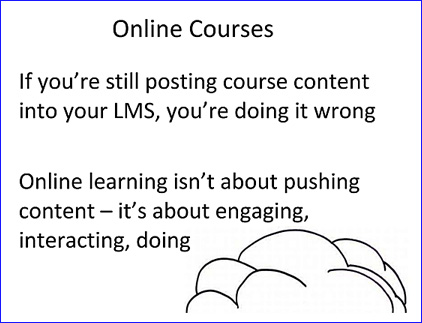
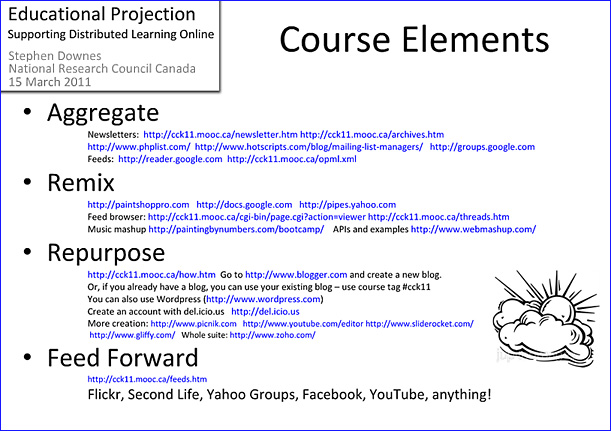
Stephen Downes addresses this and points to a possible solution to this phenomenon in his presentation from 3/15/11 entitled “Educational Projection: Supporting Distributed Learning Online.”
Excerpt/slides:
.
I need to put more thought into this, but wanted to throw this question out there…more later…
* From DSC: Some of the items I looked at regarding Connectivism — some directly related, others indirectly-related — were:
Siemens, G. (2005). Connectivism: A learning theory for the digital age. Retrieved from http://www.elearnspace.org/Articles/connectivism.htm.
Downes, S. (2005). An introduction to connective knowledge. Retrieved from http://www. downes. ca/post/33034. Downes noted that this was published in Hug, Theo (ed. ) (2007): Media, knowledge & education – exploring new spaces, relations and dynamics in digital media ecologies. Proceedings of the International Conference held on June 25-26, 2007. November 27, 2007.
Kop, R. & Hill, A. (2008). Connectivism: Learning theory of the future or vestige of the past? International Review of Research in Open and Distance Learning, v9 n3 p1-13 Oct 2008.
Tracey, R. (2009). Instructivism, constructivism or connectivism? Training & Development in Australia, December, 2009. p08-09, 2p. Retrieved from EBSCOhost. ISSN 0310-4664.
Kerr, B. (2007). A challenge to connectivism. Retrieved at http://learningevolves. wikispaces. com/kerr.
Sims, R. (2008). Rethinking (e)learning: A manifesto for connected generations. Distance Education Vol. 29, No. 2, August 2008, 153–164. ISSN 0158-7919 print/ISSN 1475-0198 online. DOI: 10. 1080/01587910802154954
Lisa Dawley. (2009). Social network knowledge construction: emerging virtual world pedagogy. On the Horizon, 17(2), 109-121. Retrieved from ProQuest Education Journals. (Document ID: 1880656431).
Hargadon, S. (2011). Ugh. Classic politics now extends to social networking in education. Retrieved from http://www. stevehargadon. com/2011/03/ugh-classic-politics-now-extends-to. html.
Cross, J. (2001). Crowd-inspired innovation. Retrieved from http://www.internettime.com/2011/03/crowd-inspired-innovation.
Rogers-Estable, M.. (2009). Web 2.0 and distance education: Tools and techniques. Distance Learning, 6(4), 55-60. Retrieved from ProQuest Education Journals. (Document ID: 2017059921).
Marrotte-Newman, S.. (2009). Why virtual schools exist and understanding their culture. Distance Learning, 6(4), 31-35. Retrieved from ProQuest Education Journals. (Document ID: 2017059881).
Hilton, J., Graham, C., Rich, P., & Wiley, D. (2010). Using online technologies to extend a classroom to learners at a distance. Distance Education, 31(1), 77-92. Retrieved from ProQuest Education Journals. (Document ID: 2074810921).
Attwell, G. (2010). Personal learning environments and Vygotsky. Retrieved from http://www.pontydysgu.org/2010/04/personal-learning-environments-and-vygotsky.
On 03/18/2011,
in corporate / business world, corporate universities / corporate training, informal learning, lifelong learning, productivity / tips and tricks, professional development, social learning / networks, social media, training / L&D, UK,
by Daniel Christian
10 Steps for Working Smarter with Social Media — from the Centre for Learning & Performance Technologies by Jane Hart
Webinar for Learning & Skills Group, 17 March 2010
Excerpt below:
10 Steps for Working Smarter with Social Media
Webinar for Learning & Skills Group, 17 March 2010

 Workplace Learning is changing!
A number of people, my Internet Time Alliance (ITA) colleague Charles Jennings in particular, have highlighted the fact that training that simply involves filling people’s heads with knowledge, is ineffective and inefficient – as most people forget what they have learnt very quickly. And that online courses, which do pretty much the same, take time, effort and money to develop.
Many are also “over-engineered” solutions – and this often leads to resentment by those who have to spend time to work through courses – when the material could have been provided in a much simpler way. But in fact this whole approach to workplace learning is not sustainable in a world that is moving very fast and where there is need for access to constantly changing information.
On the other hand, although we have now realized – due largely to the work of (my ITA colleague) Jay Cross – that most of an individual’s “real” learning takes place outside formal learning .. continuously … in the workflow … by reading or listening to things, or more significantly in conversations and interactions with other people, L&D have struggled to understand how to harness informal learning, and perhaps understandably often try to force it into the formal model they feel comfortable with it.
But it is in fact, the emergence of social media, that has really begun to make us think differently about the way work and learning is happening. For an increasing number of individuals and groups are using these new technologies in the workplace to connect with colleagues both inside and outside the organisation in order to share ideas, resources and experiences – often under the radar of IT and L&D. This use of social media has become a revolution in the sense that these tools are now in the hands of the employees. So the question is what role does L&D play in all this?
One key thing to remember is Learning is not the end goal; but is a means to an end. It’s about PERFORMANCE; people doing their jobs (better). In fact it’s all about working smarter. So what is working smarter?
.
Also related:
On 03/17/2011,
in creativity, education, education reform, future, ideas, innovation, social learning / networks, teaching & learning,
by Daniel Christian
On 03/17/2011,
in CMS/LMS, interface design, social learning / networks, student-related,
by Daniel Christian
.
From DSC:
I saw this at Mashable, and I wanted to post it here for a couple of reasons:
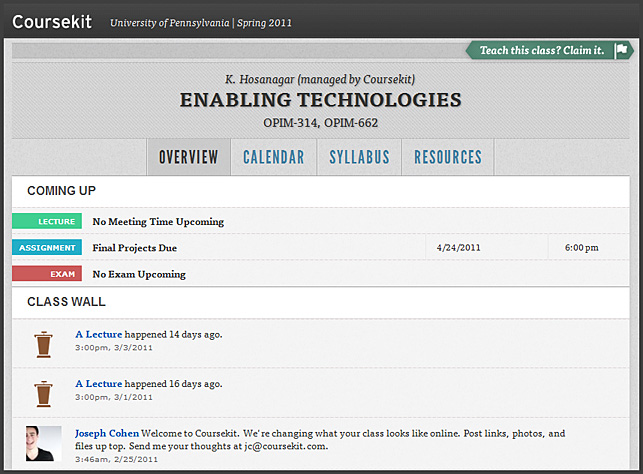
- Note the consistent interface between their courses — when putting a course online, we are entering into the world of interface design where consistency is very key, very helpful.
- Students at the University of Pennsylvania created this — so this provides a glimpse into what these students think a “course” should look like.
On 03/15/2011,
in creativity, digital storytelling, media/film, social learning / networks, social media, storytelling, writing,
by Daniel Christian
On 03/14/2011,
in education, education technology, social learning / networks, technology (general),
by Daniel Christian
On 03/01/2011,
in 21st century, A/V -- audio/visual, social learning / networks, videoconferencing, web-based collaboration,
by Daniel Christian
DEMO: SocialEyes wants to make video social networking a reality — from VentureBeat.com by Anthony Ha

On 03/01/2011,
in cloud-based computing / apps / other cloud-related, global, learning ecosystem, mobile learning, mobile technologies, platforms, social learning / networks,
by Daniel Christian
.
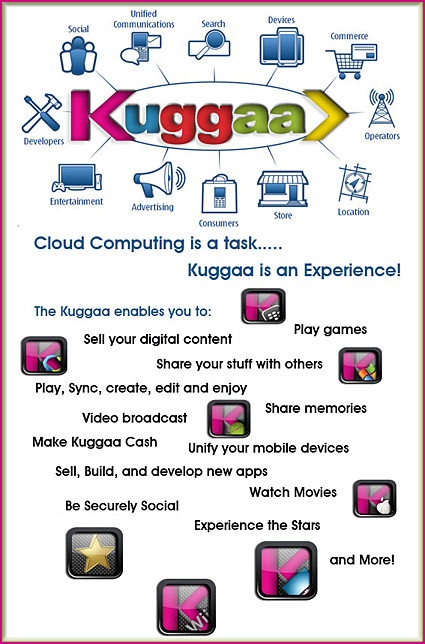
What is Kuggaa?
Kuggaa is a global mobile ecosystem. Kuggaa’s revolutionary ‘cloud’ based service allows its subscribers the ability to socialize, share, sync, create, edit, play, and enjoy access to their favorite content across many different mobile ecosystems at anytime from anywhere.
What Problem does Kuggaa Solve?
Device eco systems do not interoperate with competing eco systems, depriving the user of a truly global computing experience across a wide range of devices. Eco systems today are defined as device and platform specific environments that cannot be shared with other competing mobile eco systems. Smartphone and tablet owners’ are beginning to demand new ‘experiences’ in eco system functionality. Mobile computing must enable cross eco system compatibility as users buy more competing mobile devices.
What is the Solution to the Problem?
Kuggaa creates cross device integrated ‘experiences’ for consumers in a new product category dubbed ‘Global Mobile eco system.’ Kuggaa defines a global mobile ecosystem as a platform that integrates into diverse mobile devices unique shared experiences, services, relevant content, user generated media, fun apps, as well as inclusion of legacy computing platforms like the at anytime from anywhere. Kuggaa users can share, create, watch, listen, and communicate on different Tablets, smart phones, internet TV’s, and PC’s without losing the current eco systems they have adopted on their captive mobile devices.
Company Information:
Kuggaa is an Nevada Company based in Las Vegas.
On 03/01/2011,
in emerging technologies, entrepreneurship, innovation, mobile technologies, multimedia, new media literacies, social learning / networks, social media, technologies for your home, technology (general),
by Daniel Christian
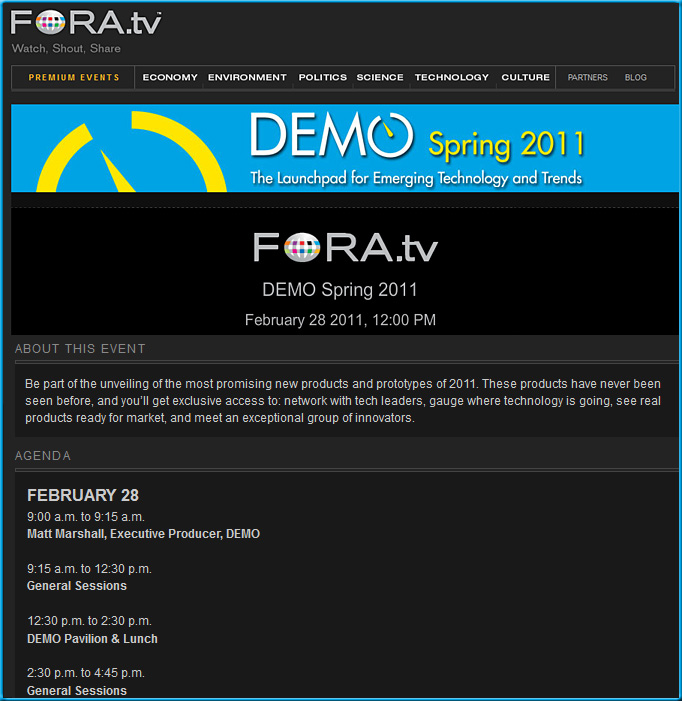
New technologies introduced at the DEMO Spring 2011 Event
Promising new products and prototypes of 2011 that have never been seen before. These are real products that are ready for market.
February 28:
Consumer Technologies
- AboutOne.com from AboutOne, LLC
- ecoATM from ecoATM
- flyRuby.com from flyRuby.com
- Manilla from Manilla
- MindWave BrainCubed Education Bundle from NeuroSky
- PhotoRocket from PhotoRocket
- Primadesk from Primadesk, Inc.
- SocialEyes from SocialEyes
- Cyclic Variations in Altitude Conditioning™ from CVAC Systems, Inc.
- ICaR Expert Systems from ICaR Systems (Alpha Pitch)
- KloudDock from InfiniWing, Inc. (Alpha Pitch)
- Qffers App from Dvmmy (Alpha Pitch)
Enterprise Technologies
- DataRoket from DataRoket, Inc.
- GageIn from GageIn, Inc.
- Swivel from FaceCake Marketing Technologies
- VIOLIN Platform from EMBRIA Technologies
- Workface from Workface, Inc.
- The Webcam Social Shopper from Zugara
- Outline.com from Outline.com (Alpha Pitch)
Cloud Technologies
- ApSynth from ApSynth
- Cloud9 IDE from Ajax
- Defensio for Facebook from Websense
- EPflow from EyePredict
- Kuggaa from Kuggaa
- Nimble from Nimble
- Stratosphere from V3
- VECTOR™ from HBMG, Inc.
MARCH 1
Social and Media Technologies
- eLive from eLive Entertainment
- FetchFans.com from Fetch Plus Asia Pacific, Pte. Ltd.
- GutCheck from GutCheck
- HeyStaks from HeyStaks
- Ecobe.com from Ecobe (Alpha Pitch)
- Marginize from Marginize
- Next Island virtual world from Next Island
- OneGoodLove.com from OneGoodLove.com
- Pixable Photofeed (on iPad) from Pixable
- Speaku from Speaku (Alpha Pitch)
- SocialReplay from Silentale
- Thoora for Tablets from Thoora
- TrendSpottr from TrendSpottr
- Viafoura from Viafoura
- The Geco from The Geco (Alpha Pitch)
Mobile Technologies
- Dynamic Device Identity from mSIGNIA
- Guardly from Guardly
- HighNote from HighNote
- JetStreamHD from Nuvyyo, Inc.
- MobileNation from MobileNation
- News360 for iPad from News360
- Screach from Screenreach Interactive, Ltd.
- ShowUhow Product Experience Platform from ShowUhow, Inc.
- Small Business iPhone and Android Apps from Bizness Apps
- ON Voicefeed from Life Is Better ON
On 02/28/2011,
in education, educational games / serious games, future, K-12 related, learning, personalized/customized learning, simulations, social learning / networks, staying relevant,
by Daniel Christian
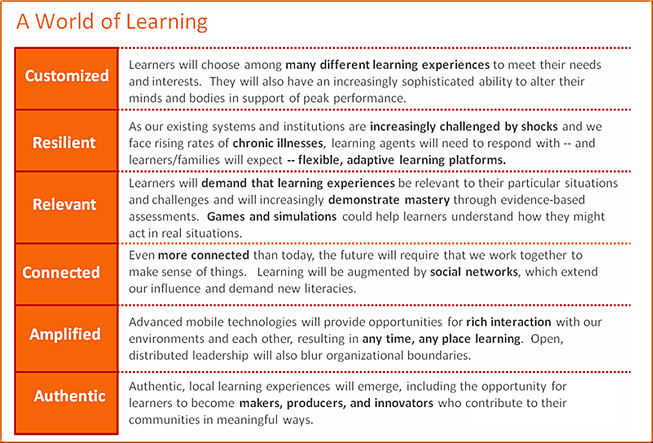
Models for the Future of Learning — from KnowledgeWorks by Katherine Prince, Jesse Moyer, Lisa Scheerer, and Jamie Feltner
January 2011
This report was prepared for, and with the support of, Yellow Springs School District as part of a series of engagements related to its Class of 2020 initiative.
On 02/28/2011,
in 21st century, 24x7x365 access, 3D, A/V -- audio/visual, adult learning, cloud-based computing / apps / other cloud-related, communications, convergence, corporate / business world, corporate universities / corporate training, cost of getting a degree, dangers of the status quo, Daniel S. Christian, digital audio, digital learning, digital photography, digital storytelling, digital textbooks, digital video, disruption, distance education, e-readers, education, education technology, educational games / serious games, elearning, emerging technologies, entrepreneurship, future, future of higher education, game-changing environment, higher education, homeschooling/homeschoolers, informal learning, intelligent tutoring, internet, K-12 related, learner profiles, learning, learning agents, learning ecosystem, learning spaces, lifelong learning, mobile learning, mobile technologies, online learning, online media, online tutoring, open courseware and systems, personalized/customized learning, social learning / networks, social media, technologies for your home, technology (general), telepresence, television, tools, training / L&D, trends, ubiquitous learning, user experience (UX), vendors, videoconferencing, virtual field trips, virtual K-12 schools, Virtual Reality (VR) / worlds / learning, virtual tutoring, vision/possibilities, web-based collaboration, workplace,
by Daniel Christian
.

.
From DSC:
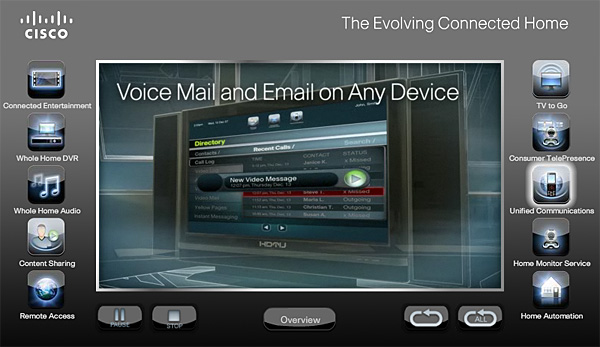
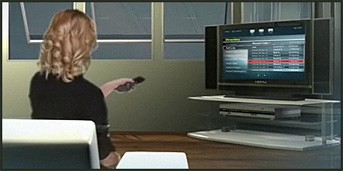
How will these types of technologies affect what we can do with K-12 education/higher education/workplace training and development? I’d say they will open up a world of new applications and opportunities for those who are ready to innovate; and these types of technologies will move the “Forthcoming Walmart of Education” along.
Above item from:
On 02/26/2011,
in informal learning, learning theories, lifelong learning, social learning / networks,
by Daniel Christian
On 02/25/2011,
in business, convergence, disruption, economics, Europe, future, social learning / networks, sociology,
by Daniel Christian