The future of broadcast is more than integrating tweets into programming — from Brian Solis

The future of broadcast is literally at our fingertips…

The future of broadcast is more than integrating tweets into programming — from Brian Solis
The future of broadcast is literally at our fingertips…
Computer science programs use mobile apps to make coursework relevant — from The Washington Post by Jenna Johnson
From DSC:
The incredible potential of location-aware educational materials, which could greatly enable a student to pursue their passions.
The other day, I was talking to my son after he had just finished playing a Wii-based football game. As we were talking, the situation made me reflect upon the power* that could come into play when a game/resource knows your (general) location. For example, in this NFL-based game, the system might ask if my son wants the Detroit Lions involved in the game. If he said yes, then the system might ask if my son were interested in knowing more about the Detroit Lines upcoming schedule. Again, if he answers in the affirmative, the system could provide a link to instantly take him to that information.
Now…take that same concept into the world of education, as a student attempts to pursue her passions, interests, and gifts. If she’s using a device that is teaching her how to draw, the “game” might present a list of art shows and exhibits in her area, along with information on how to get tickets to such events. In this manner, she could feed her passion. Such applications could open up a network of opportunities — in real-time — and present to a student what’s currently happening around them that could further involve them in the very thing that they are working with at that time (be it music, art, math, physics, or whatever discipline that’s involved). This is especially powerful if one were traveling or on a field trip.
Museums and educational institutions could tag their events so that such software goes out looking for such information and would bring such information back to the “game”.
It seems to me that if such technologies uncover chances to further one’s passion, the student will develop more of a love for learning. If a student develops a love for learning, the chances are better that that person will become a lifelong learner.
My bet? Some pretty cool teaching and learning times are ahead…
.
* I realize there are reflections going on in my mind — and others’ minds as well — that such power needs to be taken seriously, responsibly…and not abused from a commercial standpoint nor from a security standpoint. Software may even be needed to absolutely block such inquiries — but if we get to that point, we’ve let the bad apples out there control everything…again.
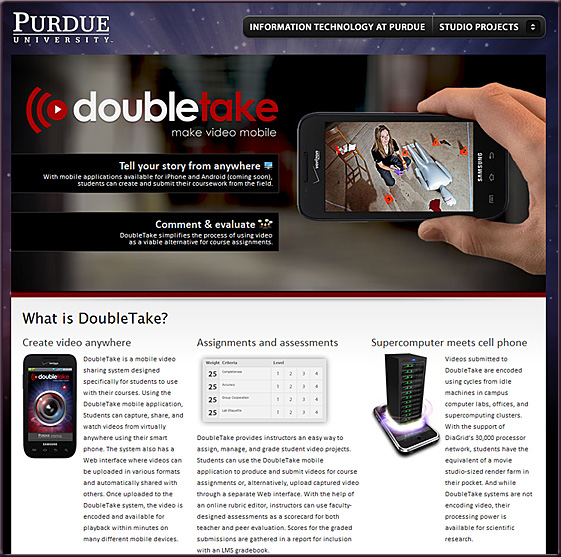
Computer science courses use mobile apps to make coursework relevant — from The Washington Post
The Virginia Tech student’s concern about buses, Tilevich said, offered a chance to show students that coding can be relevant. By the end of the semester, the advanced software engineering class had partnered with the city transit system to obtain data from Global Positioning System devices on dozens of city buses. An algorithm soon was predicting arrival times and beaming the information to a prototype mobile application.
“Sometimes as faculty members, we have to step back. We have to let them run wild,” said Tilevich, a former professional clarinet player who blogs about his teaching experiments.
Originally saw this at GetIdeas.org
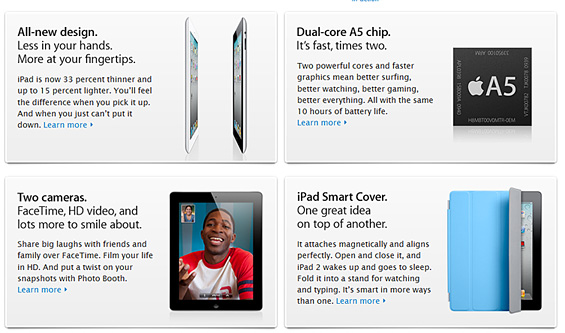
Apple iPad 2 ‘sold out’ — from telegraph.co.uk
Analysts at Piper Jaffray and Deutsche Bank claim the Apple iPad 2 is now totally sold out after its Friday launch, with 70% sold to new purchasers
iPad 2 Sold Out, 70% Went to New Buyers — from Mashable.com by Stan Schroeder
Also see:
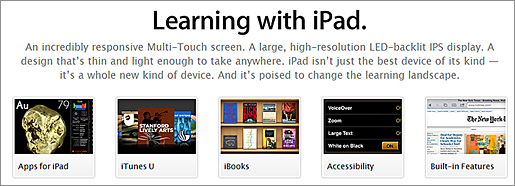
Tablet devices: iPad takes over as the lecture hall aid of choice — from ft.com by Tim Bradshaw
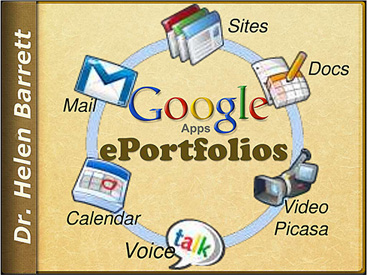
From NCCE Presentation — March 11, 2011
.
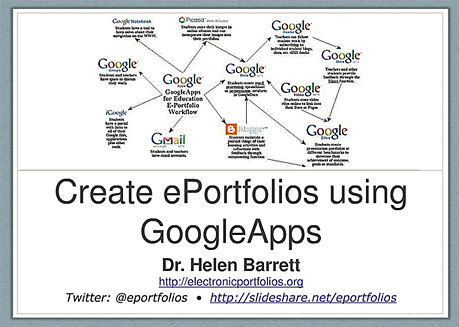
From NCCE workshop 2011
.
From AAEEBL SLC February 11, 2011

Augmented reality: A travel essential — from wired.co.uk by David Rowan

It’s 2011, and you’re standing by the Brandenburg Gate in Germany’s capital examining the cracks and graffitied slogans of the vast and intimidating Berlin Wall. Sure, the physical wall fell back in 1989 — but now it’s back to add context to your journey, thanks to creative use of smartphone technology. Point your iPhone or your Android phone towards the wall’s original location, and superimposed on the phone’s camera image is an intricate 3D representation of the wall where it originally stood. City discovery just became augmented.
Until recently, “augmented reality” was an awkward and generally disappointing technology that involved downloading special software, holding strange symbols up to computer webcams, and waiting with fingers crossed for your movements to yield some sort of interactive movement on the screen. But the latest GPS-enabled, high-resolution-camera smartphones have given “AR” (as it’s known) a new and often very engaging life. So if you download a free app from a Dutch company called Layar, you can select layers of real-world information that will be displayed on your phone’s screen according to your location. When I travel, I now use these layers to learn the history of Rome or Red Square, or simply which way to walk to the nearest subway station. Just point your camera and follow the virtual signs.
.
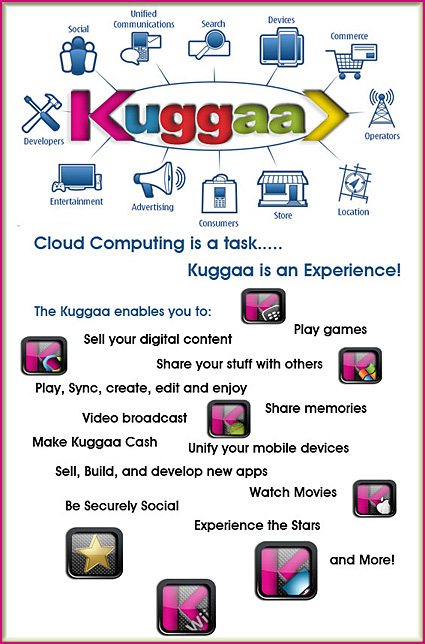
What is Kuggaa?
Kuggaa is a global mobile ecosystem. Kuggaa’s revolutionary ‘cloud’ based service allows its subscribers the ability to socialize, share, sync, create, edit, play, and enjoy access to their favorite content across many different mobile ecosystems at anytime from anywhere.
What Problem does Kuggaa Solve?
Device eco systems do not interoperate with competing eco systems, depriving the user of a truly global computing experience across a wide range of devices. Eco systems today are defined as device and platform specific environments that cannot be shared with other competing mobile eco systems. Smartphone and tablet owners’ are beginning to demand new ‘experiences’ in eco system functionality. Mobile computing must enable cross eco system compatibility as users buy more competing mobile devices.
What is the Solution to the Problem?
Kuggaa creates cross device integrated ‘experiences’ for consumers in a new product category dubbed ‘Global Mobile eco system.’ Kuggaa defines a global mobile ecosystem as a platform that integrates into diverse mobile devices unique shared experiences, services, relevant content, user generated media, fun apps, as well as inclusion of legacy computing platforms like the at anytime from anywhere. Kuggaa users can share, create, watch, listen, and communicate on different Tablets, smart phones, internet TV’s, and PC’s without losing the current eco systems they have adopted on their captive mobile devices.
Company Information:
Kuggaa is an Nevada Company based in Las Vegas.
New technologies introduced at the DEMO Spring 2011 Event
Promising new products and prototypes of 2011 that have never been seen before. These are real products that are ready for market.
February 28:
Consumer Technologies
Enterprise Technologies
Cloud Technologies
MARCH 1
Social and Media Technologies
Mobile Technologies