From DSC:
First of, when I saw the article:
Lynda.com acquires online video training rival Video2brain to boost its international expansion — from thenextweb.com

…it reminded me of taking a class with Lynda Weinman years ago out at SFSU’s Multimedia Studies Program.  She relayed a lot of very valuable information in a short time.  She knows how to explain things well — using helpful techniques and understandable vocabulary.  She struck me as not only a creative person with a heart for teaching and learning, but she surrounds herself with people who also can effectively teach others.  Our institution gives a thumbs up to this solid resource and I wish Lynda & all of the other entrepreneurs at Lynda.com all the best.


From DSC:
Below are some reflections after seeing these items:
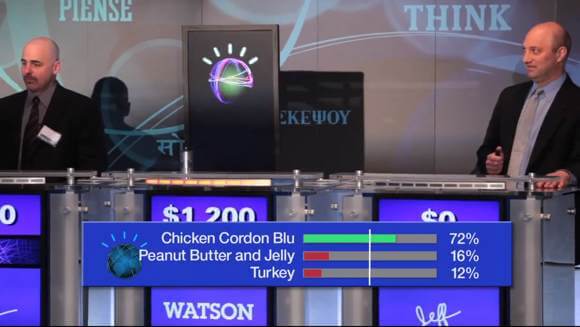
Image1


  • Watson supercomputer goes to college, Revenge Of The Nerds style antics imminentnot an exemplary article from geekosystem.com, but the underlying topic has enormous implications
    Excerpt:
    …the team developing Watson is sending the computer to college, where it will bone up on coursework in English and math.

    While the original Watson will be staying put at the IBM research center it calls home, the hardware to run the program is being installed at the Rensselaer Polytechnic Institute in upstate New York, where researchers and grad students will be spend the next three years teaching Watson all they can while also hoping to learn more about how the software learns and make it more effective.


.
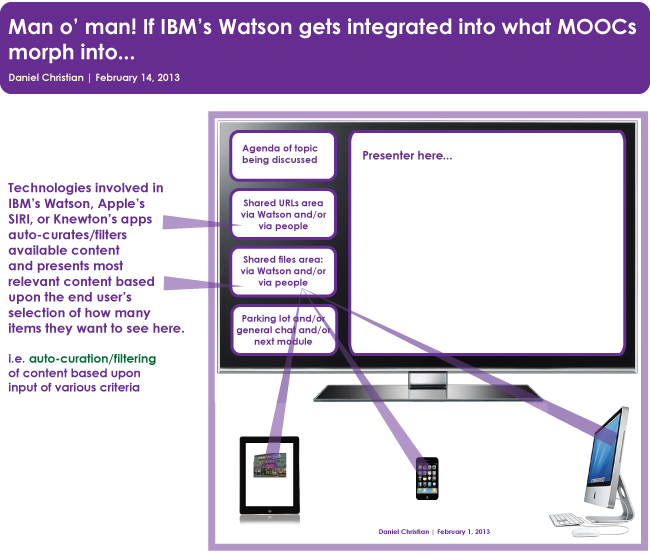
 

Watson-MOOCs-NewTypesCollaboration-DChristian-2-14-13


From DSC:
The current set of MOOCs are very powerful, but, like a bush that needs pruning, they can become unwieldy and hard to control.  Not only do the current set of MOOCs help me to see the importance of instructional design, but trying to drink from the firehose often presents problems (i.e. wading through thousands of tweets, hundreds of blog posts, etc.).  How can we still provide openness and yet provide people with better methods/tools for setting their desired level of drinking from this firehose? Tags are helpful, but for most people, they are not doing enough to filter/curate the content at this point.

Enter the technologies being developed in IBM’s Watson, Apple’s SIRI, or in Knewton’s product lines. End-user controllable setting might include:

  • Full throttle — like current form of MOOCs — thousands of tweets, hundreds of blog posts, etc.
  • IBM Watson-enabled curation/filtering only — each individual adjusts how many items they want to see in the various portions of the interface (see above); these settings control how many items and/or streams of content get presented to you

The ideas involving learning agents, artificial intelligence, intelligent tutoring, intelligent systems and more seem to get roped in here…hmm…just thinking out loud and sharing potentially-useful ideas.


YouTube another MOOP (Massive Open Online Pedagogy) Learning will not be televised, it will be digitised.  — from Donald Clark

and/or

More pedagogic change in 10 years than last 1000 years: Donald Clark at TEDxGlasgow

Some notes I took:

Lecture capture:

  • It’s dumb not to record lectures
  • Have to give more than 1 chance to hear a piece of content
  • Repeated access to content matters

Khan Academy:

  • 2800 videos;110 million viewed on YouTube
  • Short chunks of information
  • Flipped classroom

Sebastian Thrun

  • Flipped classroom

Social media

  • Scalable
  • Accessible
  • Has already changed the world of education forever


College branding: The tipping point — from forbes.com by Roger Dooley

Excerpt:

Change is coming to this market. While there are multiple issues of increasing importance to schools, two stand out as major game-changers.


From DSC:
Important notes for the boards throughout higher education to consider:


Your institution can’t increase tuition by one dime next year. If you do, you will become more and more vulnerable to being disrupted. Instead, work very hard to go in the exact opposite direction. Find ways to discount tuition by 50% or more — that is, if you want to stay in business.

Sounds like the scene in Apollo 13, doesn’t it? It is. (i.e. as Tom Hanks character is trying to get back to Earth and has very little to do it with. The engineers back in the United States are called upon to “do the impossible.”)

Some possibilities:

  • Pick your business partners and begin pooling resources and forming stronger consortia. Aim to reduce operating expenses, share the production of high-quality/interactive online courses, and create new streams of income. Experimentation will be key.
  • Work with IBM, Apple, Knewton and the like to create/integrate artificial intelligence into your LMS/CMS in order to handle 80% of the questions/learning issues. (Most likely, the future of MOOCs involves this very sort of thing.)
  • Find ways to create shorter courses/modules and offer them via online-based exchanges/marketplaces.  But something’s bothering me with this one..perhaps we won’t have the time to develop high-quality, interactive, multimedia-based courses…are things moving too fast?
  • Find ways to develop and offer subscription-based streams of content


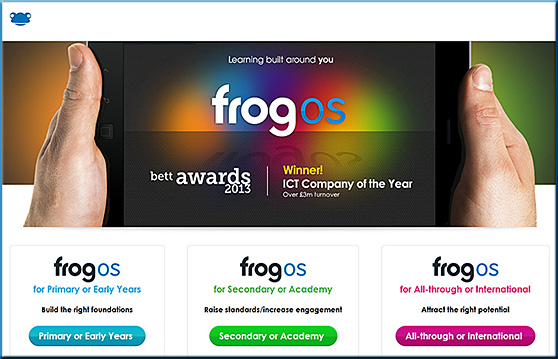
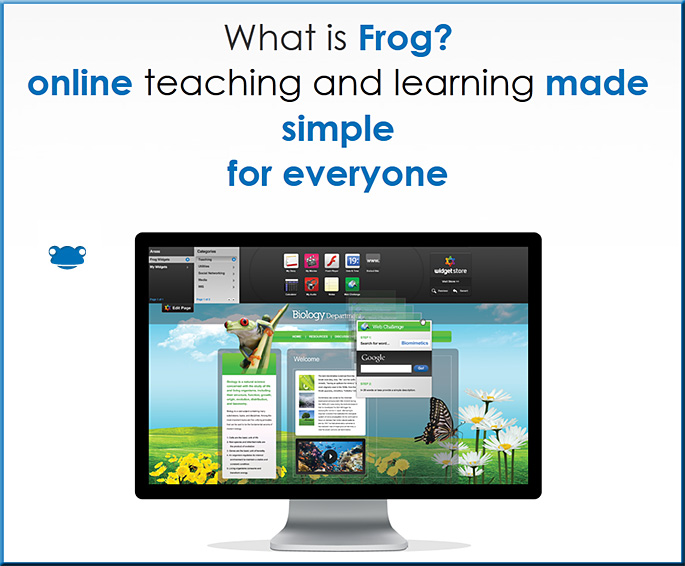
FrogOS video walkthrough – The future of learning technology — from frogtrade

Excerpt:

Well here it is, two years in the making, 1000’s of man hours and finally we can proudly show you the new software we have been showcasing at Bett 2013.

FrogOS

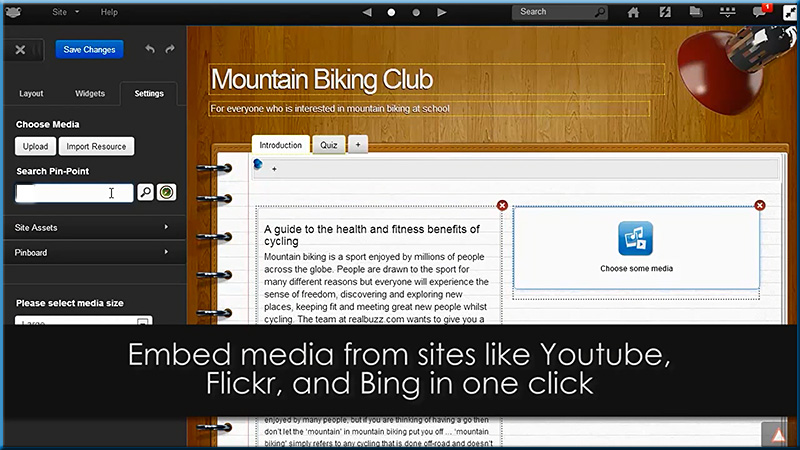
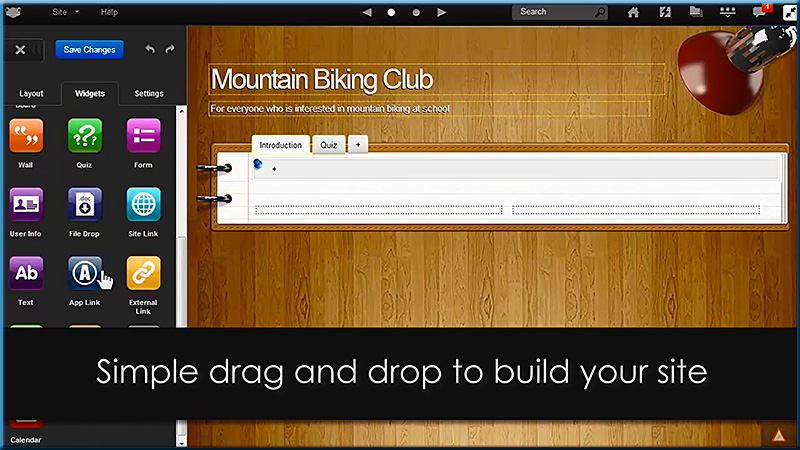
What better way to whet your appetites than to give you a simple video walkthrough that shows you just how easy it is to create a site in FrogOS.


FrogOS-Feb2013


.


Frog-Feb2013


.


Frog2-Feb2013


.


Frog3-Feb2013

From DSC — with a special thanks to Mr. Michael Haan, Technology Integration Specialist at Calvin College, for this resource
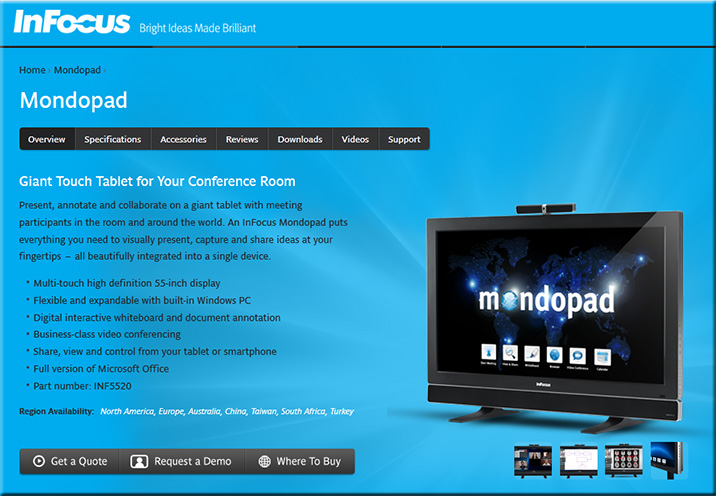
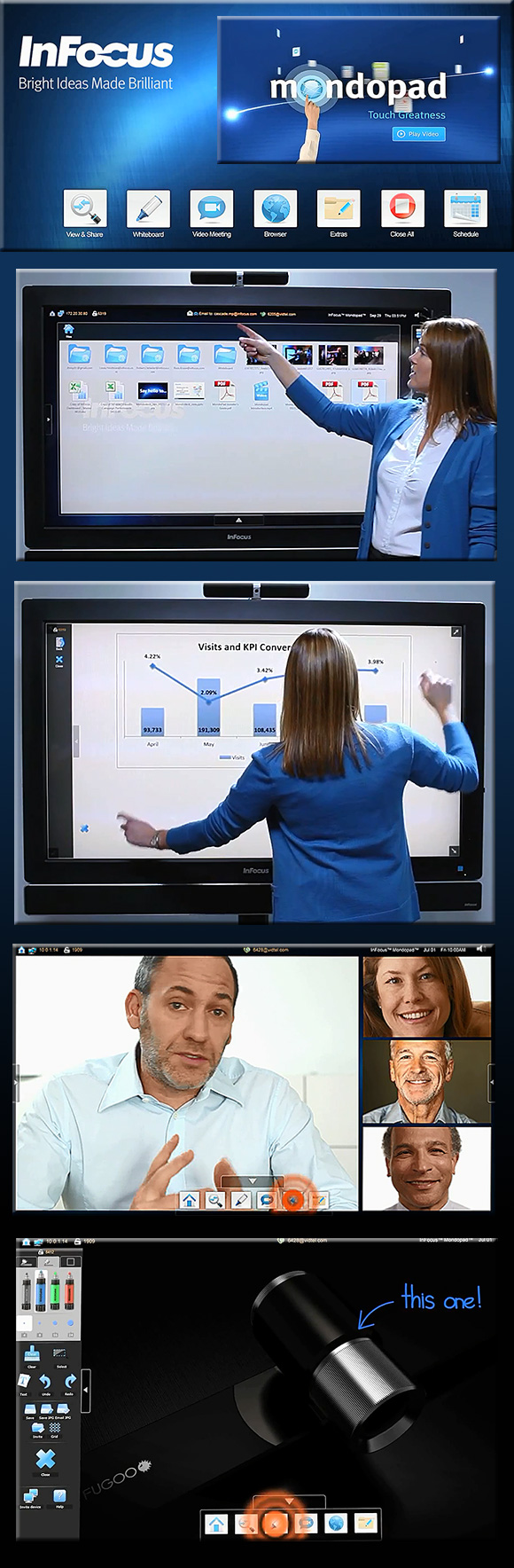
Now we’re talking! The Mondopad from InFocus is starting to morph into what I thought the “chalkboard of the future” might look like. Now I’d like to see:

  • An entire wall offer this sort of functionality
  • More content from publishers flow into this sort of setup — i.e the kind of content that leverages the interactivity and flexibility that these sorts of technologies now make available
  • The ability of students and employees to transmit their content up to these devices/walls — have it be scanned for viruses — and then moved into a viewing area (with an option for folks to download that file if they want to)


InfocusMondoPad2-Feb2013


Key features:

  • Multi-touch high definition 55 inch display (From DSC: A 70″ version is also available I believe)
  • Flexible and expandable with built-in Windows PC
  • Digital interactive whiteboard and document annotation
  • Business-class video conferencing
  • Share, view and control from your tablet or smartphone
  • Full copy of Microsoft® Office ensures file compatibility


Also see the information out at Precision Data Products:


MondoPad-Feb2013

Games for a Digital Age: K-12 Market Map and Investment Analysis — from joanganzcooneycenter.org by John Richards, Leslie Stebbins and Kurt Moellering
January 28, 2013

Tagged with:  

From DSC:
As a team of us have been charged with putting together a new collaborative workspace/conference room, I’ve been thinking about some ideas for a new type of interface as well as some new types of Human Computer Interaction (HCI) to be used in group collaboration/web-based collaboration.  I was thinking it would be good to not only display files from various devices but also to be able to share files/URLs/other resources with each other.  (Some type of storage device that processes files — and scans them for viruses would be needed in addition to a large display or an interactive multitouch surface/wall.)

People within the same room could contribute files/items to a variety of “areas” — and so could others who joined in via the Internet.  Here’s what I had wanted to be able to do and I had pictured in my mind:


New-types-of-collaboration--DChristian-2-1-13


ADDITIONAL NOTES:
.

  • People could select which files/URLs/resources that they wanted to contribute
    .
  • People could select which files/URLs/resources that they wanted to download to their own devices (during and after the meeting)
    .
  • Could be powerful in the next generation of our Smart Classrooms as well as in corporate training/learning spaces
    .
  • Could be powerful in the what I’m envisioning in “Learning from the Living [Class] Room”
    .
  • Could be powerful in conference room situations
    .


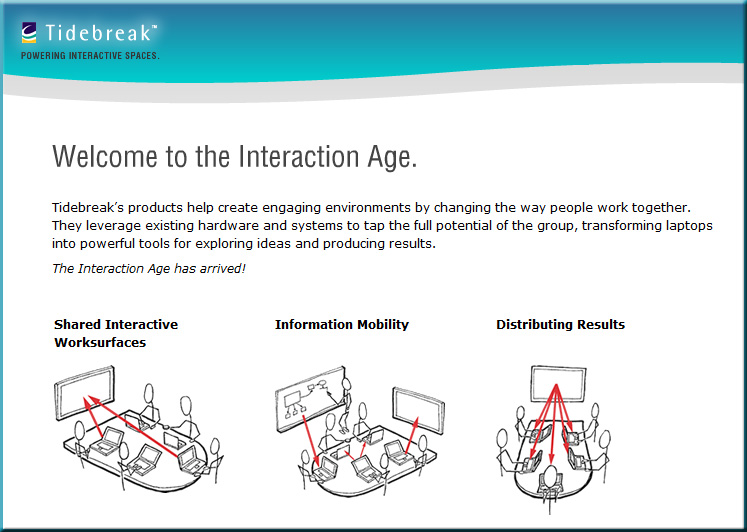
 It’s very similar to what Tidebreak has created/envisioned in their product lines.
Check out their innovative work/products/concepts!


Transforming learning spaces: 3 big ideas — from Tidebreak


Also see:


Tidebreak-Jan2013


The MOOC goes to high school — from blogs.edweek.org by Lisa Duty (@lisaduty1 )

Excerpt:

Last summer when Reynoldsburg City Schools connected with Udacity, the highly acclaimed provider of free university-level education, it envisioned a new model for learning with Massive Open Online Courses (MOOCs) that would come to life during, not after, high school.

MOOCs are gaining some momentum in the post-secondary arena, bringing learning opportunities that are generally free or inexpensive, to the masses. Viewed by some as shaking up higher education, and seen by others as mostly hype, MOOCs have moved into a position of public attention that is certain to endure. While that dialogue continues, some high school students and teachers at eSTEM Academy are drawing on the best of MOOCs to deepen and personalize learning .

The object formerly known as the textbook– from The Chronicle by Jeff Young

.

Don't Call Them Textbooks 1

Holly Gressley for The Chronicle


Excerpt:

Textbook publishers argue that their newest digital products shouldn’t even be called “textbooks.” They’re really software programs built to deliver a mix of text, videos, and homework assignments. But delivering them is just the beginning. No old-school textbook was able to be customized for each student in the classroom. The books never graded the homework. And while they contain sample exam questions, they couldn’t administer the test themselves.

One publisher calls its products “personalized learning experiences,” another “courseware,” and one insists on using its own brand name, “MindTap.” For now, this new product could be called “the object formerly known as the textbook.”


From DSC:
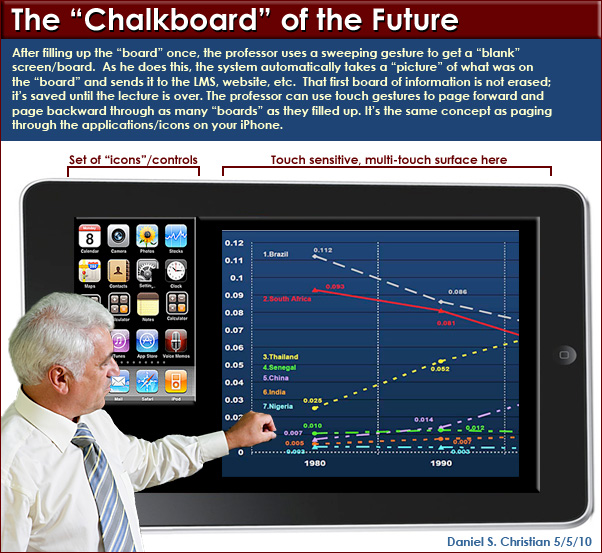
Imagine how this sort of thing might fit into the “chalkboard of the future” — as applications and content flow onto the “board” from open source repositories and/or from the publishers’ cloud-based repositories of content…

.

Daniel Christian: The Chalkboard of the Future

.

or in learning from the living room…

.

The Living [Class] Room -- by Daniel Christian -- July 2012 -- a second device used in conjunction with a Smart/Connected TV


Also see:

A seat at the table at lastfrom campustechnology.com by Andrew Barbour
One result of the Year of the MOOC is that IT is finally getting a say in the strategic direction of the institution.

Excerpt:

It’s interesting that it took an external force to propel IT into this inner circle. I can’t recall how many stories CT has run proposing strategies for how CIOs could win a place at the table. At the end of the day, though, changing an institution as hidebound as the average college is not easily tackled from within. In contrast, there’s nothing like a little existential angst to shake things up.

But MOOCs aren’t the only drivers of this change. We often think of BYOD as stripping IT of control but–on the broader stage–it may be playing its own part in elevating IT’s profile on campus. For years, faculty resisted IT recommendations on how technology could improve teaching and learning. Saying no was easy–preserving the status quo always is. That’s changing now. BYOD is a force that faculty can’t resist. It is, after all, their customers bringing the devices to school. Suddenly, faculty are faced with demands for new styles of teaching that accommodate student preferences for technology and much more. Enter IT and a host of others who see the potential of tech in education.

Also relevant/see:

  • The University’s Dilemma– from strategy-business.com by Tim Laseter; with thanks to Ross Dawson for the recent tweet on this

From DSC:
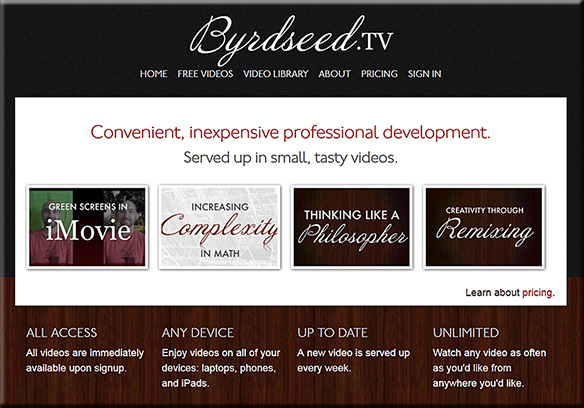
I wonder…are we migrating more towards brands and products/services provided by individuals or smaller teams of people? Consider Ian Byrd’s recent announcement re: Byrdseed.TV.


ByrdseedDotTV-Jan2013

Mayer & Clark – 10 brilliant design rules for e-learning — from Donald Clark

Excerpt:

Richard Mayer and Ruth Clark are among the foremost researchers in the empirical testing of media and media mix hypotheses in online learning. Their e-Learning and the Science of Instruction (2003) covers seven design principles; multimedia, contiguity, modality, redundancy, coherence, personalisation, and practice opportunities. Clear explanations are given about the risks of ignoring these principles – with support from worked examples and case study challenges. It should be a compulsory text for online learning designers.

LG’s 55” OLED television is thin as a pencil and first to market — from singularityhub.com


Microsoft’s epic plan to turn your living room into a giant TV — from
How big is your TV? 40 inches? 50 inches? Well, what if it were the size of your whole room?

From DSC:
And if they can do that, what might the applications be for educationally-related applications? Perhaps something like this.


CES 2013: trends in connected TV — from guardian.co.uk
Michael Berliner on why all media professionals should be keeping a close eye on smart TVs in 2013

7th graders publish their own textbook — from learninginhand.com by Tony Vincent


Also see:

  • Readz launches to provide publishers DIY solution to optimize content for tablets — from betakit.com by Humayun Khan
    .
  • 7 outstanding free books for your iPad — from educatorstechnology.com
    Excerpt:
    Below is a list of some excellent books for your iPad. I have curated this list over  the last couple of months and I kept adding to it every time I stumble upon a resource somewhere online.I don’t know if you like reading books on your iPad or not but let me tell you this: having at least a couple of titles installed on your iPad would really be of great help particularly in those moments when you are stuck somewhere and have nothing to do but waiting. Reading is a habit ( luckily a good one ) that we can ACQUIRE  by force of habituation at least in the eyes of Skinnerian theory.The more you read , the fluent you get at reading and the more used your mind becomes to the act of reading.  Check out these books I selected for you. All of them are free and require iBooks. Enjoy.


Addendum on 1/22/13:

© 2025 | Daniel Christian