Nine steps to quality online learning — from Tony Bates


Also see:

  • How [not] to Design an Online Course — from onlinelearninginsights.wordpress.com
    Moving a face-to-face credit course to an online environment is far more challenging than one might expect – as numerous experienced and esteemed professors have discovered. In this post learn vicariously through one professor’s experience of ‘what not to do’.


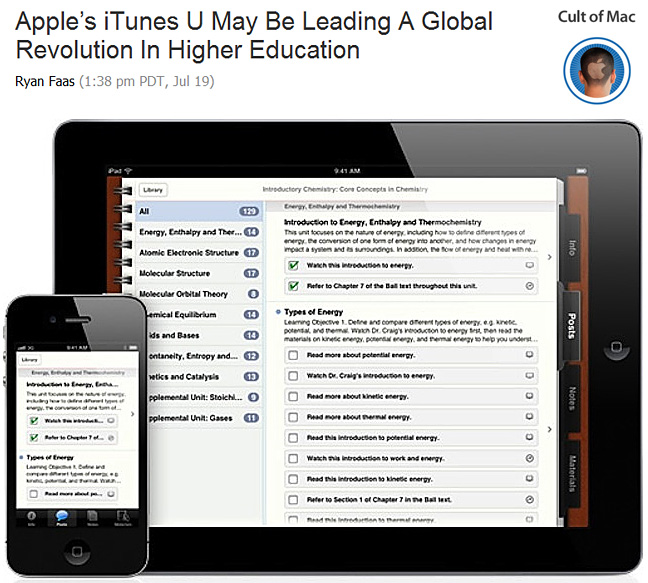
Apple's iTunes U may be leading a global revolution in higher education


From DSC:

Apple has been putting together a solid ecosystem of hardware and software that allows for the creation and distribution of content.  “Easy is hard” I like to say and Apple’s done a great job of creating easy-to-use devices and apps. They have a long way to go before iTunes U has all the built-in functionality needed to replace a Blackboard Learn or a Moodle type of CMS/LMS.  But given their solid history of creating highly-usable hardware and software, they could deal a smashing blow to what’s happening in the CMS/LMS world today. 

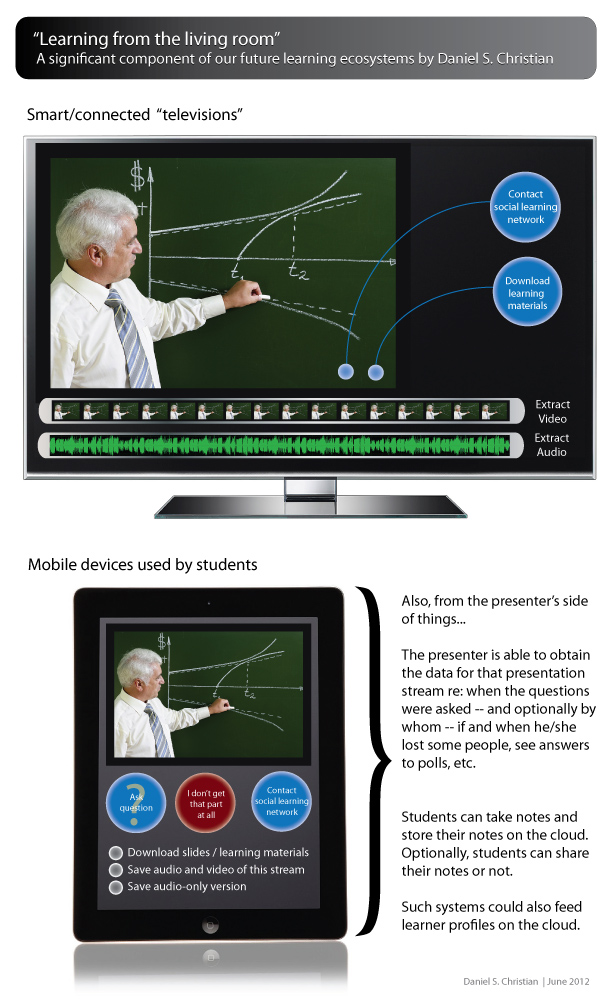
Plus, with Apple TV, Airplay mirroring, the growth of second screen-based apps, and machine-to-machine communications, Apple is poised to get into this game…big time. If my thoughts re: “Learning from the Living [Class] Room” come to fruition, Apple would be positioned for some serious worldwide impact on lifelong learning; especially when combined with the developments such as the use of MOOCs, AI and HCI-related innovations, learning agents, web-based learner profiles, and potential/upcoming changes to accreditation.

Too far fetched do you think? Hmmm….well considering that online learning has already been proven to be at least as affective as f2f learning — and in some studies has produced even greater learning outcomes/results — I wonder how things will look in mid-2015…? (That is, where is the innovation occurring?)


 Addendum:

  • Connected TV penetration to top 50% by 2017 — from worldscreen.com by Mansha Daswani
    Excerpt:
    SCOTTSDALE: ABI Research forecasts that more than 50 percent of television homes in North America and Western Europe will have Internet-connected TV sets by 2017, up from just 10 percent last year, while Blu-ray player penetration is expected to rise to more than 76 percent from about 25 percent. The report notes that the popularity of connected TV is not limited to developed markets—there have been increasing shipments to China, ABI notes.
    .
  • Advertisers need to pay attention to connected TV [INFOGRAPHIC] — from Mashable.com
    .
  • The future of TV is two screens, one held firmly in your hands — from FastCompany.com by Kit Eaton
    Excerpt:

    The connected TV, sometimes called the smart TV (and even branded as such by Samsung) is a growing phenomenon: TV makers are adding limited apps, Net connectivity, and even streaming media powers to their newer TVs in the hope they’ll persuade you to upgrade your newish LCD for a flatter, smarter unit. They’re desperate to, given how flat this market is. But according to new research from Pew, the future of TV may actually be a little more closely aligned with the notion of a “connected TV viewer,” an important distinction. Pew spoke to over 2,200 U.S. adults a couple of months ago and discovered that 52% of all adult cell phone owners now “incorporate their mobile devices into their television watching experiences.”


4 ways to gamify learning in your classroom — from tophatmonocle.com

Excerpt:

This post explores the role of gamification in education and provides four examples of how you can bring the learning method into your classroom.

.

Top Hat Monocle closes $8M to bring gamification to university classrooms — from betakit.com

Excerpt:

Today another student engagement platform, Top Hat Monocle, announced it has closed $8 million in Series A funding led by Emergence Capital Partners and iNovia Capital, with participation from SoftTech VC, Version One Ventures, and Golden Venture Partners. The Toronto- and San Francisco-based company, which raised $1.5 million in seed funding in November 2011, launched their product in 2010 and has been used by 65,000 students at over 150 global universities.

.

Gamified courses from Course Hero and Bunchball boost student engagement — from gigaom.com by Ki Mae Heussner
Excerpt:

In some circles, the phrase “gamification” may have gone out of fashion, but Course Hero and Bunchball are intent on showing that it can still pack a punch in education.

In April, Course Hero, which uses free online resources to offer students digital study guides and other tools, launched a series of full-length online courses infused with game mechanics from Bunchball’s gamification platform. The companies Tuesday revealed some of the initial results from the partnership.

On average, users spend three times more time on the gamified courses than on all of CourseHero.com and total time on the platform has increased five percent since the Bunchball integration, Course Hero reported. The company also said that social sharing of achievements, which are awarded as students progress through the courses, has climbed nearly 400 percent since the Bunchball partnership.

.

From DSC:

  • There is enormous power when resources are reallocated to teams of specialists that come together in order to create engaging, multimedia-based, interactive learning materials!   The products of these endeavors should prove to be highly beneficial — especially when they can be integrated into more hybrid/blended teaching and learning situations. That way, we can utilize the best of both the face-to-face and virtual worlds.

.

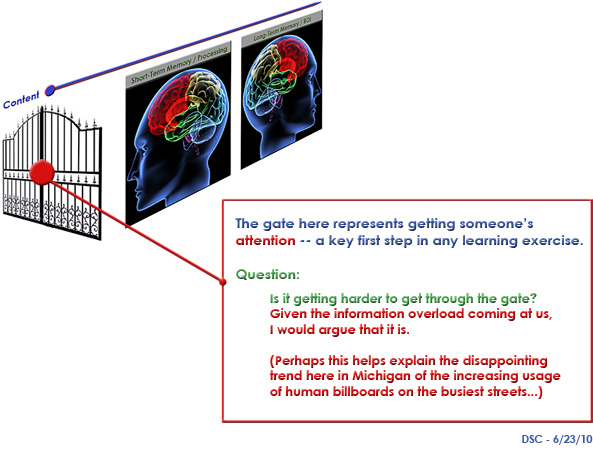
If attention can be visualized as a gate...is it getting harder to get through the gate?


.

Addendum on 7/19/12:

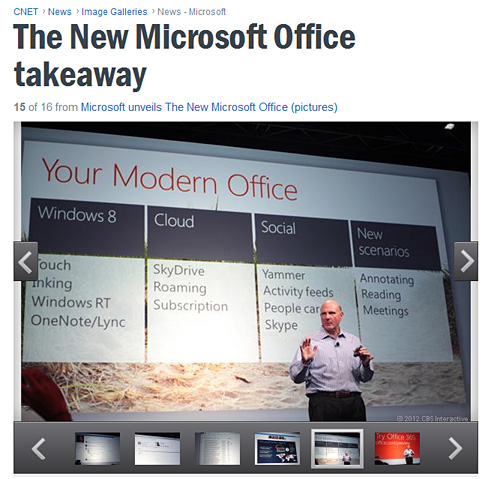
8 things to know about the new Microsoft Office  — from inc.com by Christina DesMarais

Microsoft starts integrating Skype into Office — from techcrunch.com by Frederic Lardinois

Next version of Microsoft Office puts emphasis on subscriptions with Office 365 — from techcrunch.com by Frederic Lardinois

Licensing is the Achilles Heel for the new Microsoft Office — from techcrunch.com by Alex Williams

Microsoft’s new Office: The cloud finally takes center stage — from cnet.com by Mary Jo Foley
A public preview of Microsoft’s coming Office 2013 client is out today. But Office 365 and SkyDrive are the real stars of the new Office show.

New Microsoft Office taps into the cloud — from cnet.com by Lance Whitney
Like Windows 8, the new version of Office will let you sign in with an online account, providing you with the same settings across different devices.

The new Microsoft Office — in pictures – from cnet.com

.

http://news.cnet.com/2300-10805_3-10012965-15.html


.

New Microsoft Office to embrace Windows 8 touch-screen tablets — from cnet.com by Lance Whitney
Demoing the applications in the new Office suite today, Microsoft emphasized the ability to integrate with Windows 8 using taps and other touch-based gestures.

Microsoft Office Home and Student 2013 to be bundled on all Windows RT tablets

Hands On: Microsoft Office 2013 and Office 365 — from PCMag.com by Jill Duffy

New Microsoft Office ropes in Skype, Yammer, SkyDrive — from gigaom.com by Barb Darrow

What the new Microsoft Office gets wrong — from fastcodesign.com by Austin Carr
Microsoft unveiled a preview of its latest version of Office, and the design is a schizophrenic mess. Here’s why.

Office 15: Microsoft’s Best Bet For Beating Dropbox, iCloud, Google Drive — from FastCompany.com by Austin Carr
With one billion Office users worldwide, the newest upgrade to Microsoft’s productivity suite could give the company a significant hold on the cloud, which Gartner estimates will become a $149 billion industry by 2015.


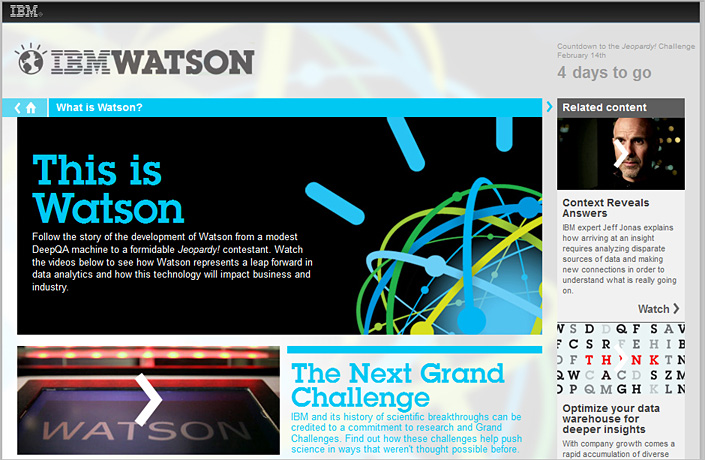
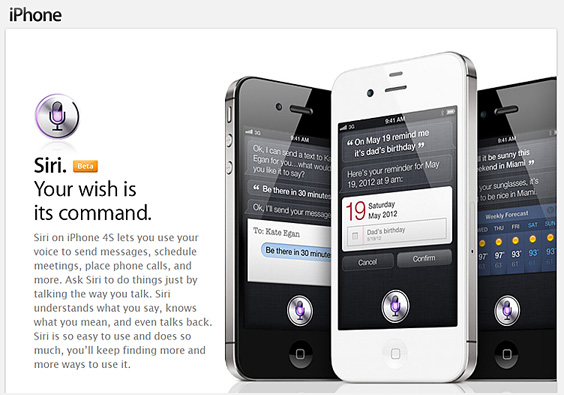
When the technologies behind Watson and Siri get perfected and integrated into the “Learning from the Living [Class] Room” environment [Christian]


From DSC:

When the technologies behind IBM’s Watson and Apple’s Siri get perfected and integrated into products and services that will make up the near future “Learning from the Living [Class] Room” environment— there will be:


  • A high degree of personalization and customization — available 24x7x365 on multiple kinds of devices
    .
  • The option to turn on tracking and analytics — reporting from which can be moved into the learner’s cloud-based profile upon completion of the unit/activity/badge
    .
  • Students of all ages will have access to their own virtual tutors so to speak
    .
  • When a virtual tutor is unable to resolve or address the student’s issue to the student’s satisfaction, the student will be able to instantly access a human tutor (with the option of keeping the existing work/issue/problems visible to the human tutor)


IBM's Watson -- incredible AI!


The Living [Class] Room -- by Daniel Christian -- July 2012 -- a second device used in conjunction with a Smart/Connected TV


.

Addendums:


10 best colleges for game-based learning — from bestcollegesonline.com

.

Excerpt:

If you were busy playing Call of Duty and you missed it, July 8 was Video Games Day. While most people’s experience with gaming involves mindless destruction or sports competition, educators have begun to see the value in the medium for helping students learn. While the research is still developing and some professors are still skeptical, these 10 colleges represent your best bets for learning while playing video and other games.


Bridging Our Future, envisioned by Intel  -- June 2012


Description:

By connecting education with smarter technology, Intel offers a look into the future of K-12 education. Watch as students use technology to collaborate with peers and industry experts to build a bridge model, from the initial design phase through the final structure testing. Intel’s education solutions help teachers provide innovative, personalized and secure learning environments to prepare students for successful futures in the 21st century.

I originally saw this at


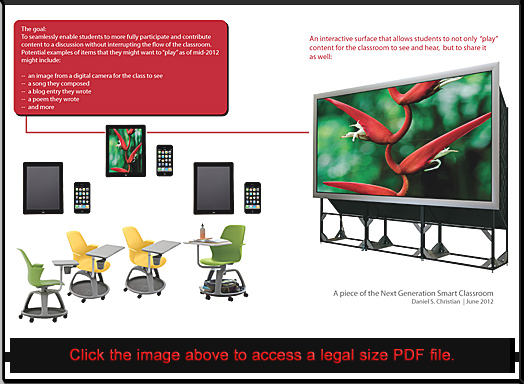
A piece of the Next Generation Smart Classroom -- Daniel Christian -- June 2012


From DSC:
I wonder:

  • If the video wall  pictured above could be a Smart/connected TV and if it can share files as well as play files?
  • If such a setup will involve machine-to-machine communications (NFC, other)?
  • If it will be like banking setups whereby the student’s device must obtain a constantly rotating password to access a resource that expires in ___ seconds — and they must be in that room to get it?
  • If it will be hardware or software based…or both?


“Learning from the living room” — Part I [Christian]

Learning from the living room -- a component of our future learning ecosystems -- by Daniel S. Christian, June 2012


Legal size PDF here


Addendum on 7/3/12 from an article I wrote for EvoLLLution.com (for LifeLong Learning):
Establishing better collaboration between the corporate world and higher education [Christian]

In the near future, perhaps we could have second screen-based activities whereby corporate leaders are giving TED-like presentations or expressing the current issues in their worlds via a program on Smart TVs, and the students are communicating and collaborating about these presentations via tablets or smart phones.  Perhaps there will be electronic means whereby students could submit their ideas and feedback to the presenting companies (and whereby selected ideas could be rewarded in terms of free products or services that the company produces).

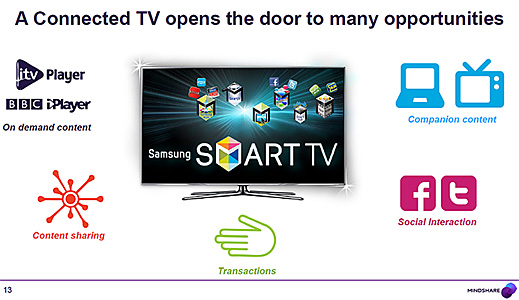
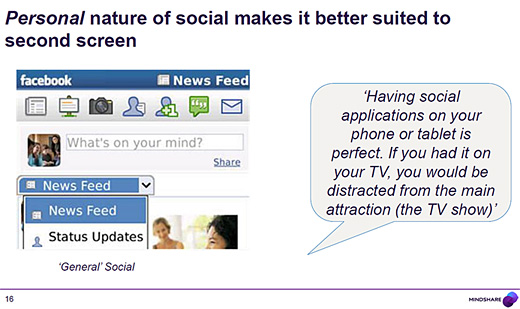
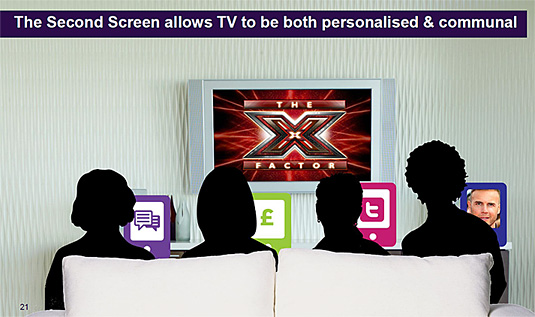
Future of…connected TV — by Mindshare

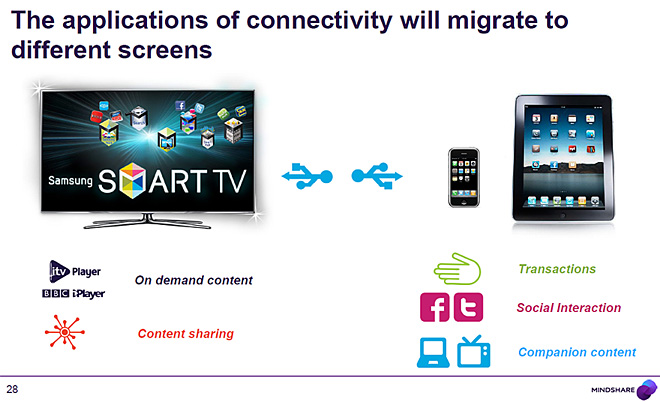
  • Connected TV penetration & usage will lag behind second screens
  • Most of the opportunities that connectivity creates are better suited to the second screen
  • Connected TV usage will mostly focus on video
  • For advertisers, the real opportunity lies on the second screen
For the full analysis, download Future of Connected TV (pdf, 1.8 Mb); some example slides include:


.

.

.


Also see:

iTunes U Just Got A Killer New Feature — from edudemic.com by Jeff Dunn

Excerpt:

Available To You
The good news is that the social learning tools are available for ALL courses on iTunes U. So it’s now a free, socially-enabled, robust learning platform that has seen more than 700 million downloads. Hard to argue with that.

If you’re looking to take your classroom lectures and presentations online to share them with the world, this new development out of iTunes U could be just what you’ve been waiting for.

Nerds of the World, Unite! iTunes U Just Got Interactive — from The Atlantic by Megan Garber
Stanford is adding a social layer to its most popular class on Apple’s platform.

From DSC:
I’d rather see Apple, themselves, get more invested in — and committed to — helping design and integrate more tools inherent within the iTunes U ecosystem itself, capabilities such as:

  • Web-based videoconferencing and collaboration tools
  • Audio/visual-based discussion boards (use voice and video to submit an initial posting as well as to respond to someone else’s posting)
  • Interactive whiteboards
  • Application sharing
  • Social networking/learning
  • E-payments
  • Etc.


.

Excerpt from website:

Your Classroom Just Got A Little Bigger. OK, A Lot Bigger.
There are millions of people around the globe with a thirst for educational content but have little available to them. You have tremendous educational resources and a desire to reach more people.
The ClevrU platform offers educators the marketplace to reach across the barriers of today’s classroom and out to the rest of the world.  Our service combines the power of a complete online learning environment with a scalable platform designed to handle from 1 to a billion users while adapting to the users language of choice, their available bandwidth, and their type of mobile device or internet access.
We welcome free, open source material as well as fee based learning programs for which we can provide in country e-commerce support.
.
Excerpt from University? There’s an app for that  — from oncampus.macleans.ca by Cathy Gulli
A Waterloo start-up provides courses on smartphones
For Tushar Singh, the 32-year-old co-founder of ClevrU and chief technology officer, the potential impact of providing education to those who are too poor or isolated to get one locally is what’s driving the company forward. “Education is a lifeline. It doesn’t just change a person, it also changes a community.”
© 2025 | Daniel Christian