Three new ways to re-think digital literature — from criticalmargins.com

Excerpt (emphasis DSC):

I am not the only writer out there thinking about the e-book’s new potential. Today, I’d like to highlight three examples of writers who take on this challenge. These three approaches are nothing alike, and none of them do what is typical of the e-book today, which is to take a standard, printed novel and put it on a screen (sort of boring). What all three of these approaches have going for them is that they take standard literary modes (the novel, the poem, the art book) and force them to interact with new digital modes (the Web page, the mix tape, the webcam). Both old and new are needed in order for the reader to gain a full experience. This is significant because with most commercially available digital reading, there is not much attempt to play with form.

Comments (emphasis DSC)

  • If you ever wanted to know what four dimensional geometry could be like, install this app. For the low, low price of $2.99, you’ll take an exciting journey into the Fourth Dimension. “Textbook” doesn’t do this app justice, virtually every page is interactive.  — Nicholas Nguyen March 19, 2012
  • “The app is very cool, and it’s unlike pretty much anything we’ve seen in the App Store.” — Sam Byford, The Verge
  • “This is one of my most favorite iOS apps ever.” — George Musser, senior editor at Scientific American and author of The Complete Idiot’s Guide to String Theory
  • “Fantastic! This is what someone really smart, and who really knows how to teach well, can do with a tablet. And the authors are funny, too, which is a neat bonus.” — DNY
  • “Blew my mind. I generally don’t use ‘learning’ apps as they’re mostly gimmicks. This one, though, truly made me think. I hope this developer comes out with more outstanding apps such as this one. Bravo!” — Iceitic
  • “Fantastic app. I work at a leading UK university. If only all our material was this well written and presented. Definitely worth buying and then spending a bit of time with over a day or two to get your head around the fourth dimension. Great app!” — JulesFM

Also see:

  • fourthdimensionapp.com
  • ‘The Fourth Dimension’ for iOS: learn to see in 4D (hands-on) — from the Verge.com by Sam Byford
    It’s priced fairly low ($2.99 for a universal iPhone/iPad app) and uses innovative design to explore a single, focused concept, and while you’ll be done with it after twenty minutes or so that actually adds to the appeal. It’s a bite-sized chunk of brain training that’s a lot of fun to wrap your head around, and it probably couldn’t have been produced any other way. That’s about the most you can ask for in an app these days.


Considerations for deploying the AppleTV in your school or enterprise — from williamstites.net by William Stites

Excerpt (emphasis DSC):

We are begin­ning to look at using the AppleTV in our school as part of our iPad deploy­ment but much like the iPads them­selves we are in the posi­tion of try­ing to fig­ure out how to deploy and man­age a con­sumer device in the enter­prise (schools to all of you).

The rea­son for con­sid­er­ing the use of the AppleTV in the class­room has every­thing to do (for us) with Air­Play. The abil­ity to give any stu­dent the oppor­tu­nity to share what they are doing on their device with the class and demon­strate their learn­ing is amaz­ing — – can you say bye-bye Smartboards!

But as I play with this idea and dis­cuss it with my col­leagues there are some man­age­ment issues and ques­tions that I have…

Also see:

AirPlay Mirroring & Apple TV — from Steve Zalot

From DSC:

  1. Steve has a nice list of related resources and some helpful items re: deployment considerations such as the network, security, and audio/video considerations.
    .
  2. This topic directly relates to one of my dreams for our “Smart Classrooms” and learning spaces (and why Steelcase’ MediaScape product is exciting and gaining traction)—  to enable students to “play” media from many types of devices (laptops, smart phones, tablets, etc.) without disrupting the flow of the classroom!
    .
  3. Apple must address the network, security, and A/V-related issues for this to really take off in our learning spaces — but if and when they get by these hurdles, amazing results will soon follow!

.

Also see:

Addendums


Are apps the future of book publishing? — from forbes.com by Alex Knapp

Excerpt:

It’s no surprise, then, that publishers are turning to the app as a possible product for books moving forward.  This has led to another movement towards enhanced books, particularly as apps for iPhone, Android, and other tablets. Are tablet apps the book of the future? In order to find out, I talked to authors, publishers, and app programmers, and read more than a few book apps.

McGraw-Hill report demonstrates power of adaptive learning technology to personalize education and support needs of 21st century students — prnewsire.com
Report illustrates how personalized learning is the key to engage, retain and graduate students and prepare them for the global workforce

Excerpt:

NEW YORK, April 12, 2012 /PRNewswire/ — A new report released today by the McGraw-Hill Education characterizes adaptive learning technology as the lynchpin in personalizing education in today’s K-12 and higher education classrooms. According to the report, adaptive learning technology, also known as a computer-assisted smart tutor, helps teachers tailor instruction for every student in the class, effectively creating a “class of one” and significantly improving learning outcomes.

…

The authors highlight three of McGraw-Hill’s adaptive programs:

  • LearnSmart is the leading interactive study tool for higher education that adaptively assesses students’ skill and knowledge levels to track which topics students have mastered and which require further instruction and practice. It then adjusts the learning content based on students’ strengths and weaknesses…
  • Power of U is a revolutionary, digitally rich personalized middle school math pilot program that uses real-time assessment data to group students in ways that allow them to learn at their own pace, in their own style, using the medium that works best for them…
  • ALEKS®, one of the pioneer products to use adaptive learning technology, is a web-based assessment and learning system created by the ALEKS Corporation and exclusively distributed by McGraw-Hill Higher Education to colleges and universities.

.

From DSC:
These are the types of technologies that will make their way into courses that you can take from your Smart/Connected TV (i.e. “learning from your living room” and “The Forthcoming Walmart of Education” trends continue to develop and are moving one step closer to reality).  


A stunning watercolor speed painting by Agnes-Cecile — from thisiscolossal.com from Christopher Jobson

From DSC:
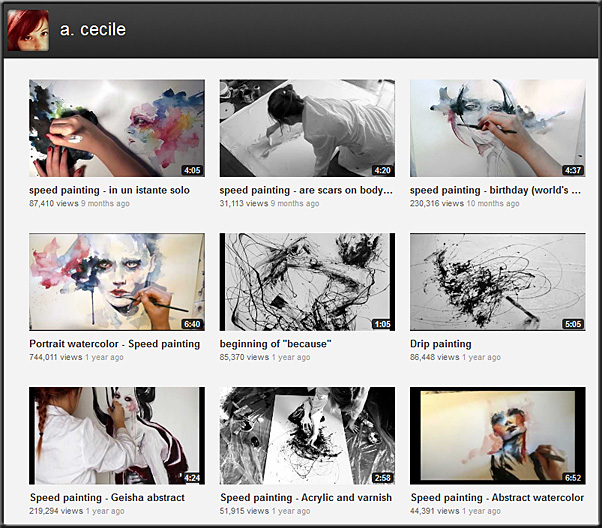
The filming and speed painting allow us to see how these pieces “unfold” and the techniques she uses…very cool.  Also see her collection of videos by clicking the image below:

.

Videos of various selections of speed painting -- by Agnes Cecile as of April 2012


Tagged with: • • •  

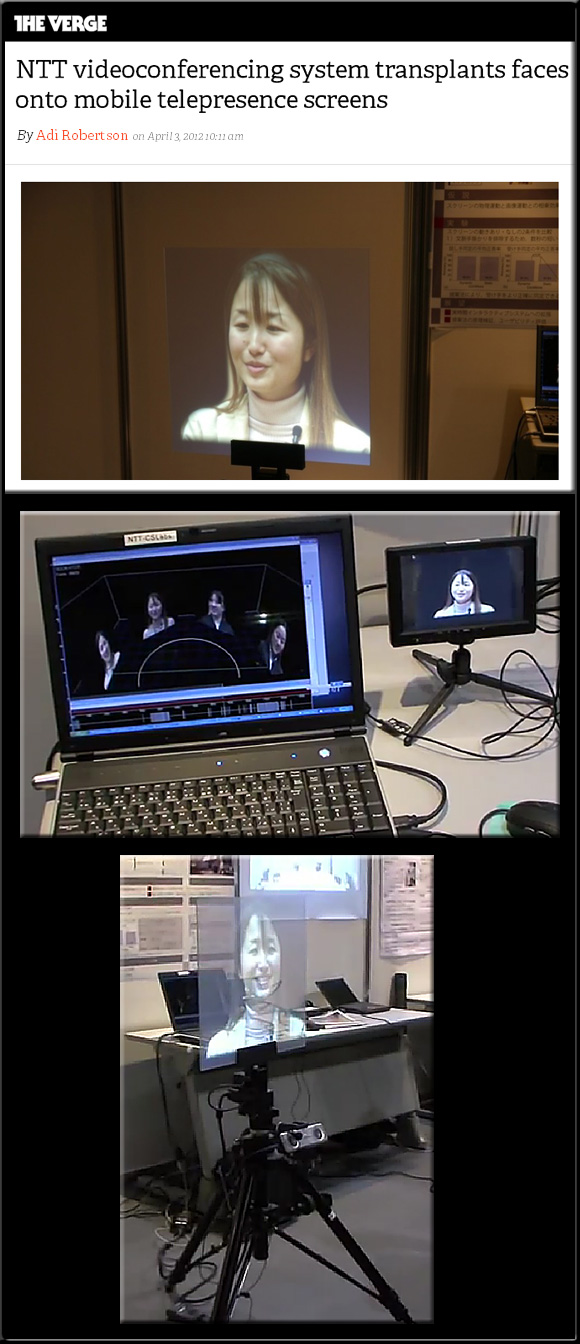
NTT videoconferencing system transplants faces onto mobile telepresence screens


From DSC:

  • Another innovation that aids web-based collaboration.
  • Make that one more movement up the disruptive innovation curve (of online learning).


As an addendum on 3/4, check out:

Items re: the connected living room; relates to what I call a future “learning from the living room” environment

The human voice, as game changer — from nytimes.com by Natasha Singer


Matthew Cavanaugh for The New York Times

Vlad Sejnoha demonstrated Nuance’s Dragon TV system, which obeys spoken commands to
flip channels, for example, or shop on screen on Amazon.com.

Apple’s iCloud will teach Apple’s Smart TV remote new tricks — from patentlyapple.com

6 answers about your next TV, with or without Apple — from forbes.com by Michael Humphrey

10 tech commandments for the TV industry — from thenextweb.com by Martin Bryant

Smart TVs are growing in popularity — from business-news.thestreet.com by Steve Adams

smartTV Quincy gh 032112-284-wihr.jpg

Image from Gary Higgins/The Patriot Ledger

Paul Berrini, a salesman at Hancock T.V.& Appliance in Quincy, demonstrates
some of the new features of “smart” televisions, Wednesday, March 21.

.

10 AirPlay-ready iPad apps that make Apple TV worth it — from  readwriteweb.com by John Paul Titlow

Entertainment and Streaming Media – The Recent Past and the Future — from homesystemintegration.com by Alan Ruby

Connected Living Room 1

.

TVs may soon be used to spy on you — from smartplanet.com by Tuan C. Nguyen


The potential of cloud-based education marketplaces — from evoLLLution.com (LifeLong Learning) by Daniel Christian; PDF-based version here

Excerpt:

Such organizations are being impacted by a variety of emerging technologies and trends – two of which I want to highlight here are:

  • Online-based marketplaces – as hosted on “the cloud”
  • The convergence of the television, telephone, and the computer

One of the powerful things that the Internet provides is online-based marketplaces. Such exchanges connect buyers with sellers and vice versa. You see this occurring with offerings like Craig’s List, e-Bay, PaperBackSwap.com, and others.


A Communiqué from the Horizon Project Retreat [2012]
Building on ten years of research into emerging technology in education

Excerpt:

From these discussions, 28 hugely important metatrends were identified. The ten most significant are listed here and will be the focus of the upcoming NMC Horizon Project 10th Anniversary Report:

  1. The world of work is increasingly global and increasingly collaborative. As more and more companies move to the global marketplace, it is common for work teams to span continents and time zones. Not only are teams geographically diverse, they are also culturally diverse.
  2. People expect to work, learn, socialize, and play whenever and wherever they want to. Increasingly, people own more than one device, using a computer, smartphone, tablet, and ereader. People now expect a seamless experience across all their devices.
  3. The Internet is becoming a global mobile network — and already is at its edges. Mobithinking reports there are now more than 6 billion active cell phone accounts. 1.2 billion have mobile broadband as well, and 85% of new devices can access the mobile web.
  4. The technologies we use are increasingly cloud-based and delivered over utility networks, facilitating the rapid growth of online videos and rich media. Our current expectation is that the network has almost infinite capacity and is nearly free of cost. One hour of video footage is uploaded every second to YouTube; over 250 million photos are sent to Facebook every day.
  5. Openness — concepts like open content, open data, and open resources, along with notions of transparency and easy access to data and information — is moving from a trend to a value for much of the world. As authoritative sources lose their importance, there is need for more curation and other forms of validation to generate meaning in information and media.
  6. Legal notions of ownership and privacy lag behind the practices common in society. In an age where so much of our information, records, and digital content are in the cloud, and often clouds in other legal jurisdictions, the very concept of ownership is blurry.
  7. Real challenges of access, efficiency, and scale are redefining what we mean by quality and success. Access to learning in any form is a challenge in too many parts of the world, and efficiency in learning systems and institutions is increasingly an expectation of governments — but the need for solutions that scale often trumps them both. Innovations in these areas are increasingly coming from unexpected parts of the world, including India, China, and central Africa.
  8. The Internet is constantly challenging us to rethink learning and education, while refining our notion of literacy. Institutions must consider the unique value that each adds to a world in which information is everywhere. In such a world, sense-making and the ability to assess the credibility of information and media are paramount.
  9. There is a rise in informal learning as individual needs are redefining schools, universities, and training. Traditional authority is increasingly being challenged, not only politically and socially, but also in academia — and worldwide. As a result, credibility, validity, and control are all notions that are no longer givens when so much learning takes place outside school systems.
  10.  Business models across the education ecosystem are changing. Libraries are deeply reimagining their missions; colleges and universities are struggling to reduce costs across the board. The educational ecosystem is shifting, and nowhere more so than in the world of publishing, where efforts to reimagine the book are having profound success, with implications that will touch every aspect of the learning enterprise.

These metatrends are the first of much yet to come in the next year. Watch NMC.org for news and more throughout the Horizon Project’s 10th Anniversary. To be part of the discussions, follow #NMChz!


From DSC:
Arguably, Sal Kahn has become the most famous, influential educator on the planet today — his videos are watched millions of times a day now.  The question — which Eric Schmidt answers in the piece — I couldn’t help but ask was, “Why didn’t this type of innovation come from someone who was working in education at the time of their innovation?”

My thanks to Dr. Kate Byerwalter and her colleagues for passing along this resource.
The tags/associated categories for this posting point out the relevant areas covered.


Khan Academy: The future of education?

Also see:

  • Khan Academy: The future of education?
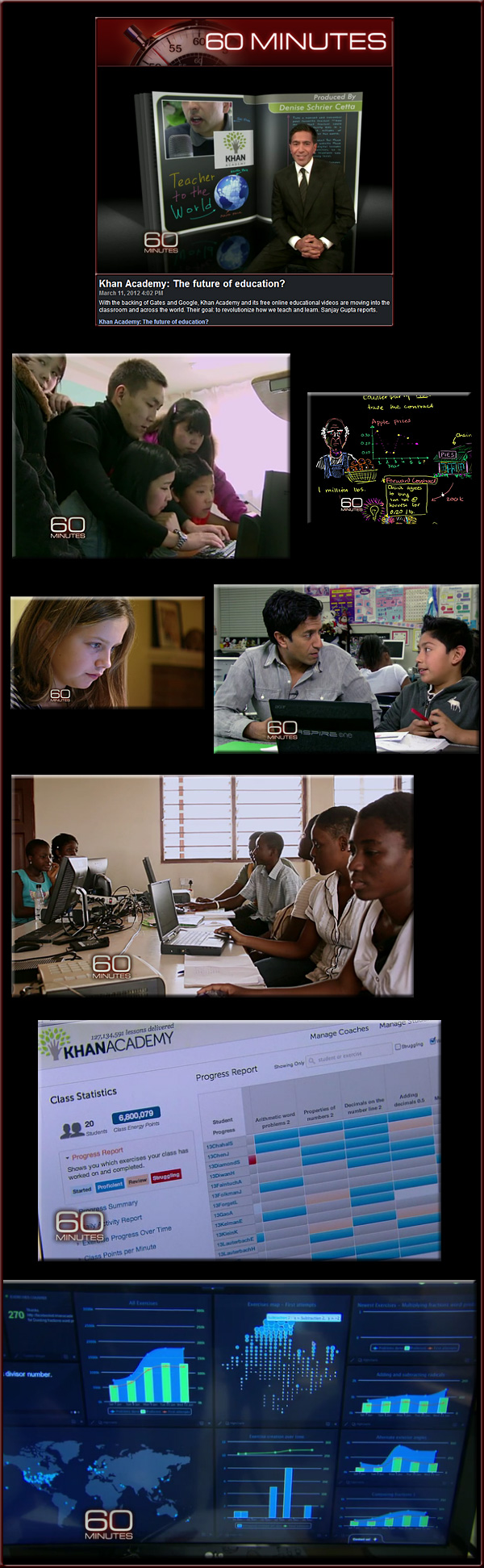
    (CBS News) Sal Khan is a math, science, and history teacher to millions of students, yet none have ever seen his face. Khan is the voice and brains behind Khan Academy, a free online tutoring site that may have gotten your kid out of an algebra bind with its educational how-to videos. Now Khan Academy is going global. Backed by Google, Gates, and other Internet powerhouses, Sal Khan wants to change education worldwide, and his approach is already being tested in some American schools. Sanjay Gupta reports.

From DSC:
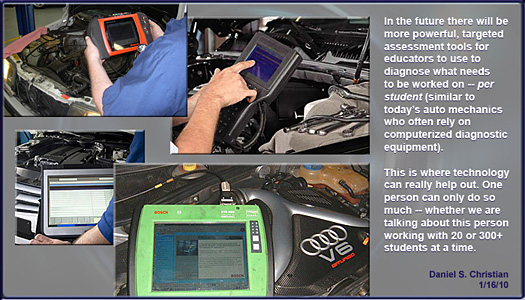
A relevant graphic comes to mind with what Sal is trying to achieve with analytics:

i.e. Highly-effective diagnostic tools for the educators and trainers out there!


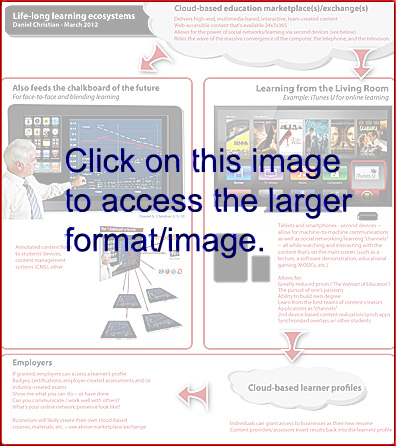
Lifelong learning ecosystems!!! A powerful vision for our future [Daniel Christian]

From DSC:
The vision below involves:
(click on the image below to access it)
 

  • The convergence of the telephone, the television, and the computer
  • Cloud-based education stores/marketplaces/exchanges
  • Second screen devices and machine-to-machine communications
  • Social networking/learning
  • Smart classrooms/learning spaces
  • Content recognition/synchronization applications
  • Apps as “channels”
  • Web-based learner profiles
  • Video overlays
  • New business models in higher ed
  • New jobs/needs for the future
  • A new way for employers to hire highly-effective employees/contractors/consultants
  • …and more


Click this thumbnail image to access the larger image / vision

.


From DSC:
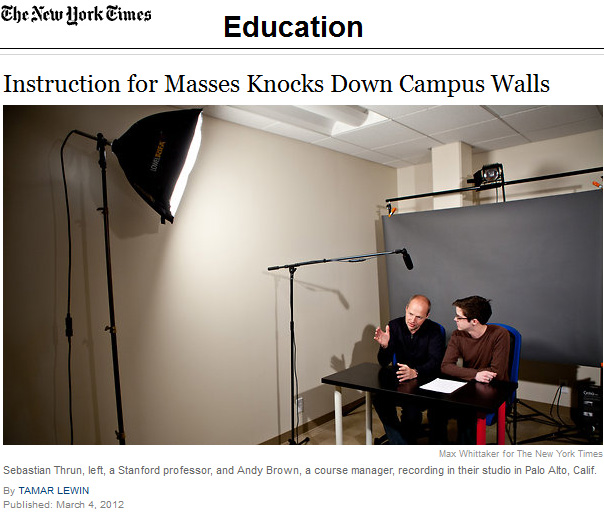
This is exactly what I was getting at with The Forthcoming Walmart of Education (2008) and it points out, again, that innovation is much faster and stronger in the online world than it is in the face-to-face world. The tools being developed to engage, track, diagnose, and adapt continue to be developed. What may have once been poo-pooed continues to pick up steam. (Christensen, Johnson, & Horn are right on track.) The trend will be towards more team-based endeavors that can be made available at a greatly reduced price. They will be multimedia-based, highly-interactive, and state-of-the-art (technically and pedagogically).

Treating Higher Ed’s ‘Cost Disease’ With Supersize Online Courses — from The Chronicle by Marc Parry

Excerpt (with emphasis from DSC):

Professors should move away from designing foundational courses in statistics, biology, or other core subjects on the basis of “intuition,” she argues. Instead, she wants faculty to work with her team to put out the education equivalent of Super Bowl ads: expensively built online course materials, cheaply available to the masses.

“We’re seeing failure rates in these large introductory courses that are not acceptable to anybody,” Ms. Thille says. “There has to be a better way to get more students—irrespective of where they start—to be able to successfully complete.”

Her approach brings together faculty subject experts, learning researchers, and software engineers [from DSC — a TEAM-based approach] to build open online courses grounded in the science of how people learn. The resulting systems provide immediate feedback to students and tailor content to their skills. As students work through online modules outside class, the software builds profiles on them, just as Netflix does for customers. Faculty consult that data to figure out how to spend in-person class time.

From DSC:
Such learner profiles will most likely reside in the cloud and eventually standards will be established to insert new data into these profiles. The access to view/edit these profiles will be controlled by the individual learners (hopefully!).  What if learners could selectively grant corporations access to this type of profile as their new resume?

For items concerning team-based approaches, see this recording (June 2009) as well as this collection of items.

For items concerning consortia and pooling resources, see here and here.


© 2025 | Daniel Christian