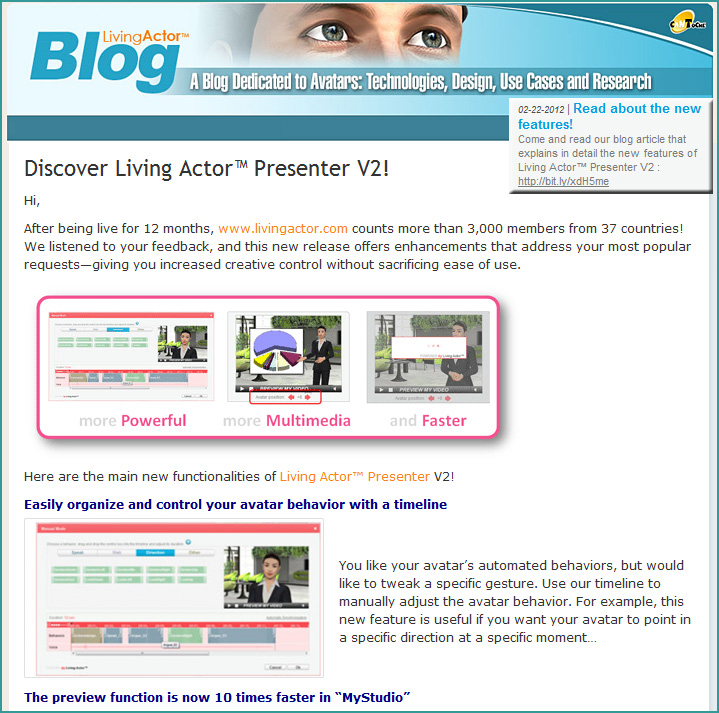
Discover Living Actor™ Presenter Version 2 -- announced Feb 22, 2012

Per Benoît Morel:

We just launched a new release of Living Actor™ Presenter, a 100% online tool that generates video animations from an audio or text file, automatically animating a high quality 3D full body avatar. This new version is more powerful, offers more multimedia, and is faster to use.

University of California to start YouTube channel — San Francisco Business Times by Steven E.F. Brown, Web Editor

Excerpt:

On March 1, the University of California system will start its own dedicated channel on YouTube.

The UC system plans to run “15 minutes of fresh content” every week on the channel using San Bruno-based YouTube’s service. News on the channel will include documentaries, interviews, commentaries and video shorts based on events and research at all 10 university campuses as well as its medical schools like UCSF. Content may also come from UC-managed labs like Lawrence Livermore National Laboratory and Lawrence Berkeley National Laboratory.

The Digital Classroom
Via:
Accredited Online Universities Guide

Addendum on 2/14/12 — also see:

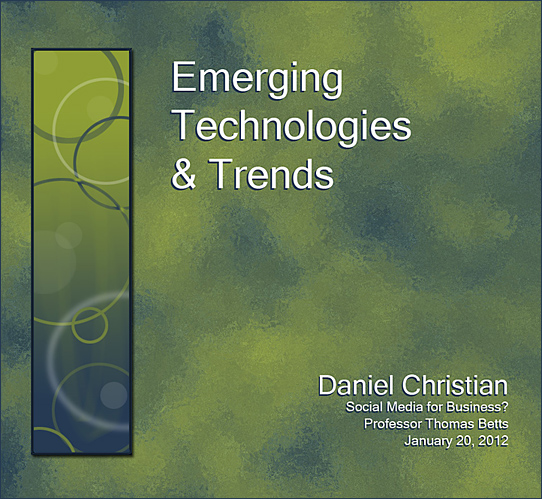
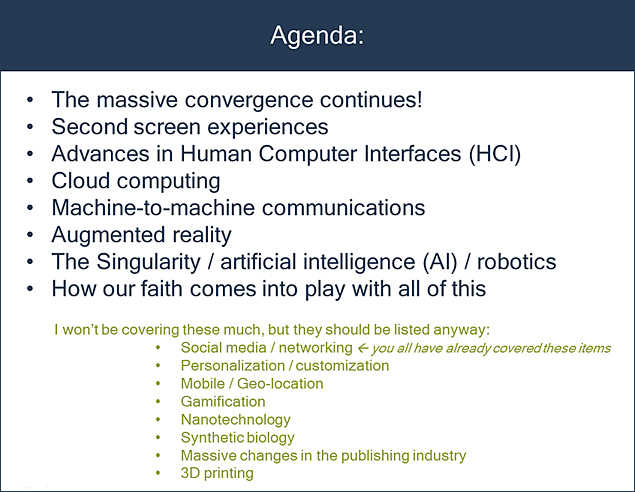
Daniel Christian - Emerging Technologies and Trends - January 20th 2012 Presentation at Calvin College

.

Daniel Christian - Emerging Technologies and Trends - January 20th 2012 Presentation at Calvin College

.

From DSC:
In case it’s helpful, clicking on this link or on one of the images above will link you to a recent presentation that I did for an Interim course at Calvin College entitled, “Social Media for Business?”  As the class had already covered a lot of the topics relating to social media, my job was to focus more on some of the recent emerging trends and technologies.  I will continue to keep pulse checking on those technologies which will allow for ubiquitous, mobile (as well as from the living room), 24x7x365, multimedia-based learning.

NOTE:

  • Almost all of the images on the slides are linked up to web-based resources; so if you see something of interest, go ahead and click on that image/slide in order to learn more about that topic/article/etc.


Announcing the 2012 Media for eLearning - Top Tools Report [elearningguild.com]

Digital learning: What kids really want — from The Journal by Chris Riedel

Excerpt:

According to [Project Tomorrow CEO Julie] Evans, the data from those surveys indicated that students:

  • Have a growing interest in social-based learning;
  • Want to connect with and develop a personal network of expert resources;
  • Are looking for tools that increase untethered learning; and
  • Want a digitally rich learning environment, unencumbered by traditional rules.

Also:

Other things students at all grade levels are looking for include access to online tutoring, the ability to take online classes, access to real-word data and databases, greater access to teachers using SMS/text messaging, education-based virtual reality and games, and increased access to digital collaboration tools.

Living room video calling users to surpass 16 million in 2015 — from instat.com

Excerpt:

The video calling market can be divided into three sub-markets depending on the device which is being used to make the call: PCs, Mobile, and living room (digital home) devices.  Living room video calling is a nascent market and currently has a relatively small user base. New NPD In-Stat (www.in-stat) research forecasts that total users will increase from 1.5 million in 2011 to 16.4 million in 2015. Asia Pacific will be the largest market for living room video calling by a significant margin as this is the region with the highest video calling enabled device shipments.

.

From DSC:

  1. The massive convergence of the TV, the computer, and the telephone continues
  2. The current model of higher ed has run it’s course — the model is breaking down
  3. The cost of obtaining an education must decrease; new business models are and will continue to come to fruition
  4. One of those business models is what I call “The Forthcoming Walmart of Education“
  5. One of the pieces of this “Walmart of Education” will involve “learning from the living room“
  6. “Students” will be able to watch one device while interacting with another device (though I could also see everything happening via one device as well)
  7. Learning will likely be more interactive, multimedia-based, available 24x7x365, personalized, customized and backed up by some serious social networking/learning, analytics, artificial intelligence, learning agents, and online-based tutoring
  8. “Textbooks” will flow into the living rooms as well as to tablets, smart phones, and other devices; but they will be more like apps where updates will occur as necessary
  9. Rock-star profs are likely to emerge
  10. Anyway…”stay tuned”


Also see:

A Disrupted Higher-Ed System — from The Chronicle by Jeff Selingo

Excerpt:
Just look at the last month:

  • The Massachusetts Institute of Technology announced that it would create MITx, a self-service learning system in which students can take online tests and earn certificates after watching free course materials posted by the university.
  • StraighterLine, which offers self-paced introductory courses online, said that it would give students access to the Collegiate Learning Assessment and other similar tests, allowing them to take results to employers or colleges to demonstrate their proficiency in certain academic areas.
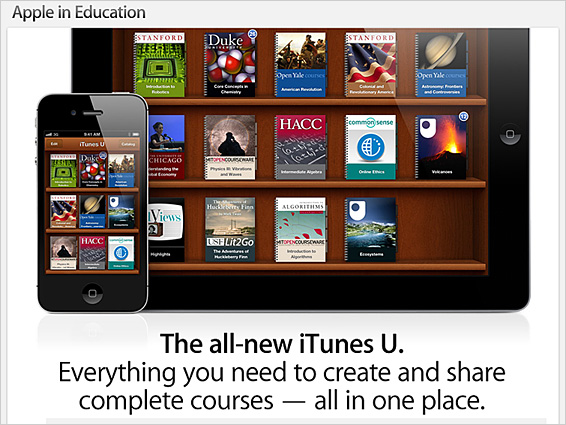
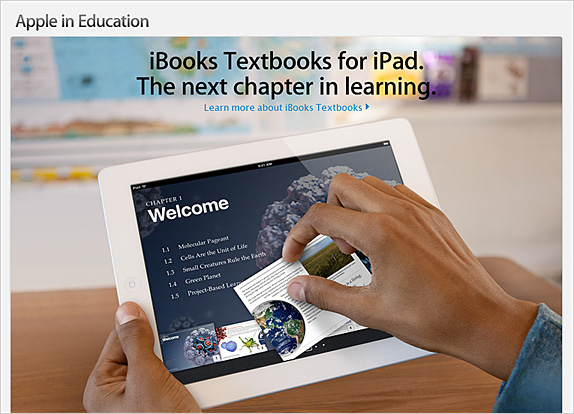
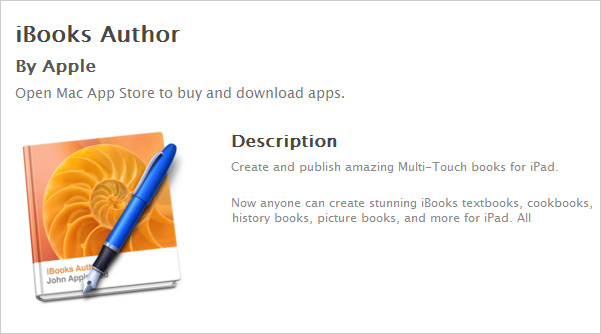
  • Apple introduced three free pieces of software that allow students to download or create textbooks, and that permit instructors to create a digital curriculum in iTunesU.


Stormy waters ahead as ‘disruptive forces’ sweep the old guard — from timeshighereducation.co.uk by Sarah Cunnane
Online education will turn the academy inside out, argue US authors. 

Excerpt:

Graduation rates in the US have fallen, and states have slashed funding for higher education. As a result, public universities have raised tuition fees, and many are struggling to stay afloat during the recession. But two authors working in the US higher education sector claim that the academy has a bigger battle on the horizon: the “disruptive innovation” ushered in by online education.

This disruption, they say, will force down costs, lure prospective students away from traditional “core” universities, transform the way academics work, and spell the end for the traditional scholarly calendar based around face-to-face teaching.

Clayton M. Christensen, the Kim B. Clark professor of business administration at Harvard Business School, and Henry J. Eyring, advancement vice-president at Brigham Young University-Idaho, outline their ideas in The Innovative University: Changing the DNA of Higher Education from the Inside Out.

.
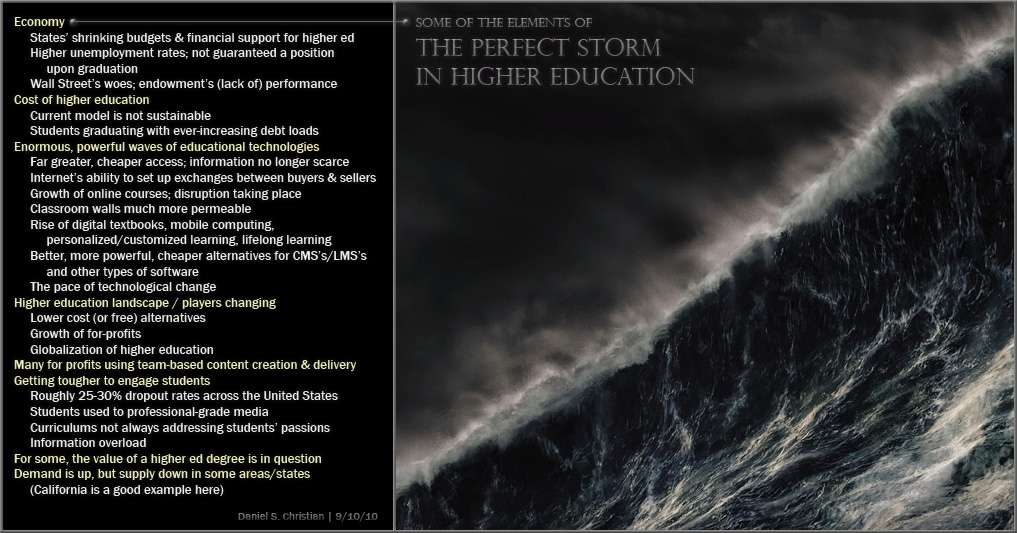
The perfect storm in higher ed


Also see:

How iBooks Author Stacks Up to the Competition [CHART] — from Mashable.com by Chelsea Stark

Author, Author! Apple, Apple! — from The Journal by Therese Mageau
Apple’s new interactive textbook authoring system might just revolutionize the way districts develop their own curriculum. 

iTunes U vs. Blackboard – A Look at Apple’s New Online System — from padgadget.com

Thanks to iPads and Kindles, E-Book Lending at Libraries Explodes — from ReadWriteWeb.com by John Paul Titlow

Why textbooks of the future are not books — from gigaom.com by Erica Ogg

Apple Jumps Into Textbooks — from the WSJ
With More iPads in Classrooms, Education Push Would Help Fend Off Android-Device Competition

Apple’s iTunes U Morphs Into a Tool for Full Online Classes — from Mashable.com by Sarah Kessler

Reinventing Textbooks: A Hard Course — from the New York Times by David Streitfeld


Also see:

.

Donald Chan/Reuters
People flooded Foxconn Technology with résumés at a 2010 job fair in Henan Province, China.

AcademicPub adds 22 new publishers to its content library — from edukwest.com by Kirsten Winkler

Excerpt:

AcademicPub is an online platform for college professors that enables them to create custom print or digital textbooks. This way professors can pick the content relevant to their course only which leads to much lower prices for the students when they purchase the books.

Launched in April 2011 by SharedBook Inc., AcademicPub started with less than 20 publishers but the platform quickly attracted new partners and now offers copyright-cleared material from over 100 publishers including…


© 2025 | Daniel Christian