Do you really need separate social learning tools or platforms in the workplace? Part 1 — from c4lpt.co.uk  by Jane Hart

Excerpt:

As business is becoming more social and we are using new social tools to work collaboratively with one another as we work, do we really need another set of social tools specifically for learning?

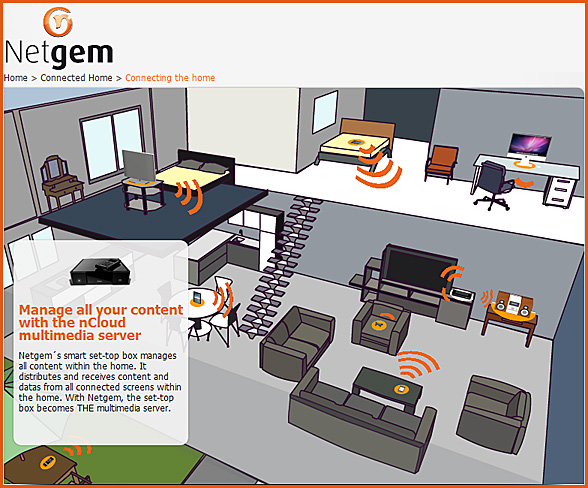
U-verse TV goes social with new apps to interact with what you’re watching, while you’re watching — from appmarket.tv by Richard Kastelein

Excerpt:

The way viewers watch TV today has become a multi-screen, multi-tasking experience. According to Nielsen, nearly 30 percent of TV viewers looked up info related to a TV program while they were watching it. AT&T U-verse TV customers now have new and better ways to bring together their favorite social apps on their smartphone or tablet with what they’re watching on TV.

“Customers want their TV viewing experience to be social, without distracting from the TV show on their TV screen, and they want their choice of apps from their smartphone or tablet to work seamlessly with their TV and enhance their favorite TV shows,” said Jeff Weber, vice president of video services, AT&T Mobility and Consumer Markets. “These apps allow you to interact and share details about the shows you’re watching in simple and engaging ways. And you can do that on the devices that are in your hands or right next to you on the couch.”

Building Learning Communities 2011 Keynote: Dr. Eric Mazur — from November Learning

Excerpt:

Today, we are officially relaunching our opening keynote from BLC11 with Dr. Eric Mazur. Dr. Mazur is the Area Dean of Applied Physics and Balkanski Professor of Physics and Applied Physics at Harvard University in Cambridge, MA.

In his keynote, Dr. Mazur shares his vast research on teaching and learning. Students in Dr. Mazur’s class are moving far away from the traditional stand and deliver lectures given in many k-12 and university classrooms around the world, and they are gaining a much deeper understanding of the material being taught in the process.

As you watch this video, we invite you to take some time and respond to one or more of the following questions…


From DSC:
What I understood the key points to be:

  • Teaching and learning should not be about information transfer alone; that is, it’s not about simply having students “parrot back” the information.  That doesn’t lead to true learning and long-term retention.
  • The more a teacher is an expert in his/her content, the more difficulty this teacher has in understanding how a first time learner in this subject struggles
  • Rather we need to guide and use peer instruction/social learning/collaboration amongst students to construct learning and then be able to apply/transfer that learning to a different context
  • Lecturing is not an effective way to create a long term retention of information
  • Peer instruction/human interaction creates effective learning
  • “The plural of anecdotes is not data.”
  • Eric is seeking data and feedback to sharpen his theories of how to optimize learning
  • Technology serves pedagogy — technology should afford a new mode of learning
  • Towards that end, Eric and team working on “Peer instruction 2.0”
  • How do I design good questions?  Optimize the discussions? Manage time? Insure learning is taking place?
  • Eric is working with several other colleagues to create a system for building and using data analytics to give useful information to instructor about who’s “getting it” and who isn’t; about how we learn
  • Peer instruction not without issues — how people group themselves and who students choose to collaborate with can be problematical
  • Why not have the system do the pairing/grouping?
  • System uses algorithms, facial recognition, posture analysis; cameras, microphones
  • Surveys also used
  • The system is attempting to help Eric and his team learn about learning
  • The system being used at Harvard and by invitation only

Eric ended with a summary of the 2 key messages:

  1. Education is not about lecturing
  2. We can move way beyond the current technologies and use new methods and technologies to actively manage learning as it happens


From DSC:
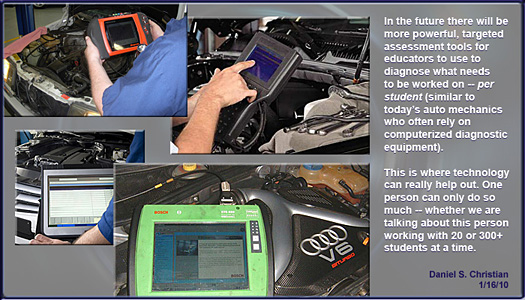
After listening to this lecture, the graphic below captures a bit of what he’s getting at and reflects some of my thinking on this subject as well.  That is, we need diagnostic tools — along the lines of those a mechanic might use on our cars to ascertain where the problems/issues are:


91% of hiring mangers use social networking to screen — from readwriteweb.com by Alicia Eler

Excerpt:

In a study of 300 hiring managers and recruiters, Palo Alto-based social networking monitoring service Reppler reports that 76% of hiring managers look at applicants’ Facebook profiles. An additional 56% are looking at Twitter, and 48% check out LinkedIn – which seems ironic, considering that LinkedIn is where you’re supposed to present your professional self.

Announcing the 2011 Social Media for Learning Report — from eLearningGuild.com
76% of organizations plan to use more social media for learning. What’s your strategy?

ABC – The 21st Century Learning Model — by Dan Pontefract


abc_21st_century_learning_model_pontefract


Not your mother’s connected world [infographic] — from Cisco.com by Marie Hattar


What the Internet means to young adults around the world


Also see:

Air, Food, Water, Internet – Cisco Study Reveals Just How Important Internet and Networks Have Become as Fundamental Resources in Daily Life
Global Report Examines Focus on Next Generation of World’s Workforce, Spotlights Impact on Future Demands and Behavior Involving Network and Information Access in Work Environments
SAN JOSE, Calif. – September 21, 2011 –

Demonstrating the increasing role of the network in people’s lives, an international workforce study announced today by Cisco revealed that one in three college students and young professionals considers the Internet to be as important as fundamental human resources like air, water, food and shelter. The 2011 Cisco Connected World Technology Reportalso found that more than half of the study’s respondents say they could not live without the Internet and cite it as an “integral part of their lives” – in some cases more integral than cars, dating, and partying.

These and numerous other findings provide insight into the mindset, expectations, and behavior of the world’s next generation of workers and how they will influence everything from business communications and mobile lifestyles to hiring, corporate security, and companies’ abilities to compete.

The findings will be presented today by Cisco executives during a free Internet TV broadcast at www.cisco.com/go/connectedreport.


50 expert networking tips you should start using in school — from bestcollegesonline.com with thanks to Tim Handorf for the resource

From DSC:
One brief comment I want to add here is that I used to think networking was manipulative and bogus. But over time, I began to see that that was not the case (or at least it doesn’t have to be that way).  Networking can be a great way to meet people, learn from others and find out more about what they do, identify talent in a variety of fields in case you are looking to hire someone, find out if you might be passionate about some discipline, get your foot in the door at a company/firm/etc.  Also, networking comes to mind when I think of the lyrics to Bill Withers song:

Lean on me, when you’re not strong
And I’ll be your friend
I’ll help you carry on
For it won’t be long
‘Til I’m gonna need
Somebody to lean on

http://www.learning2011.com/sessions


Learning 2011 Breakout Session Formats:

  • Thought Leader
  • Learning Story
  • “Learning @” Session
  • Targeted Session
  • Panel
  • Discussion
  • Workshops
  • FLIP Sessions
  • Supplier Showcase
  • Ten Ways Session
  • Author Sessions
  • Learning Café
  • Step-by-Step How-To Session


Spotlight Award: iPad as “Game Changer”

The Learning CONSORTIUM is proud to announce that the iPad will receive a special “Game Changer” Learning Spotlight Award at Elliott Masie’s Learning 2011, November 6-9, in Orlando, FL.


Social networking meets problem solving — from MIT’s Technology Review by Tom Simonite
The website Jig wants to solve your needs—with a little help from your friends.

© 2025 | Daniel Christian