iTunes U downloads top 300 million — press release from Apple.com

CUPERTINO, California—August 24, 2010—In just over three years, iTunes® U downloads have topped 300 million and it has become one of the world’s most popular online educational catalogs. Over 800 universities throughout the world have active iTunes U sites, and nearly half of these institutions distribute their content publicly on the iTunes Store®. New content has just been added from universities in China, Hong Kong, Japan, Mexico and Singapore, and iTunes users now have access to over 350,000 audio and video files from educational institutions around the globe.

“iTunes U makes it easy for people to discover and learn with content from many of the world’s top institutions,” said Eddy Cue, Apple’s vice president of Internet Services. “With such a wide selection of educational material, we’re providing iTunes users with an incredible way to learn on their computer, iPhone, iPod or iPad.”

Created in collaboration with colleges and universities, iTunes U makes it easy to extend learning, explore interests or learn more about a school. A dedicated area within the iTunes Store (www.iTunes.com), iTunes U offers users public access to content from world class institutions such as Harvard, MIT, Cambridge, Oxford, University of Melbourne and Université de Montréal. iTunes U gives anyone the chance to experience university courses, lab demonstrations, sports highlights, campus tours and special lectures. All iTunes U content is free and can be enjoyed on a Mac® or PC, or wirelessly downloaded directly onto an iPhone®, iPod touch® and iPad™.

.

Also see the following graphic (from http://tech.fortune.cnn.com/2010/08/24/itunes-u-enrollment-soars/)

http://fortunebrainstormtech.files.wordpress.com/2010/08/screen-shot-2010-08-24-at-10-10-09-am.png

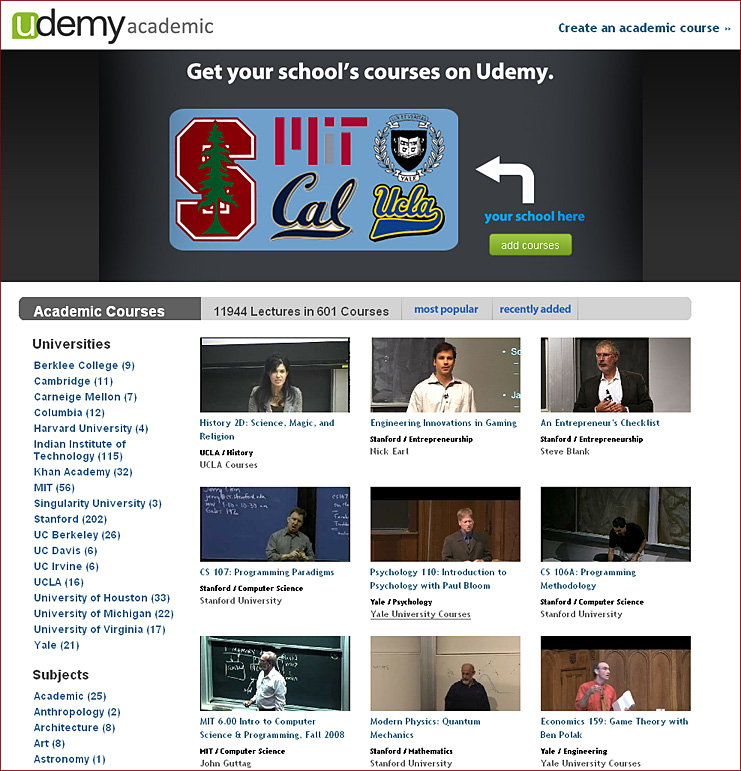
Udemy launches Udemy Academic with 600 courses – 12,000 video lectures — from kirstenwinkler.com

According to an email of Gagan Biyani, Co-Founder of Udemy their platform is now even bigger than Academic Earth or VideoLectures.net.

Udemy Academic features courses from 18 institutions, including UC Berkeley, MIT, Stanford, UCLA, Yale, Columbia, Khan Academy, and more. In total, there are nearly 12,000 free video lectures on Udemy organized into courses – sequential, on-demand content collections that allow anyone to take a University class online.

The most interesting part about this project is that Udemy will be giving away the course creating tool to all major universities which are interested in building their own OpenCourseWare but don’t have the funds or technical skills to do so (emphasis DSC).

OpenCourseWare can cost thousands of dollars per course, and Udemy wants to minimize those costs.

.

Udemy launches Udemy Academic with 600 courses – 12,000 video lectures

.

Buffett, Gates persuade 40 billionaires to donate half of wealth — from OregonLive.com

SEATTLE — Forty wealthy families and individuals have joined Microsoft co-founder Bill Gates and billionaire investor Warren Buffett in a pledge to give at least half their wealth to charity.

Those who have joined the Giving Pledge, as listed on its website, are: Paul G. Allen, Laura and John Arnold, Michael R. Bloomberg, Eli and Edythe Broad, Warren Buffett, Michele Chan and Patrick Soon-Shiong, Barry Diller and Diane von Furstenberg, Ann and John Doerr, Larry Ellison, Bill and Melinda Gates, Barron Hilton, Jon and Karen Huntsman, Joan and Irwin Jacobs, George B. Kaiser, Elaine and Ken Langone, Gerry and Marguerite Lenfest, Lorry I. Lokey, George Lucas, Alfred E. Mann, Bernie and Billi Marcus, Thomas S. Monaghan, Tashia and John Morgridge, Pierre and Pam Omidyar, Bernard and Barbro Osher, Ronald O. Perelman, Peter G. Peterson, T. Boone Pickens, Julian H. Robertson Jr., David Rockefeller, David M. Rubenstein, Herb and Marion Sandler, Vicki and Roger Sant, Walter Scott Jr., Jim and Marilyn Simons, Jeff Skoll, Tom Steyer and Kat Taylor, Jim and Virginia Stowers, Ted Turner, Sanford and Joan Weill and Shelby White.

From DSC:
This is fantastic news! Excellent. I’m a big supporter of various charities myself — albeit with far fewer O’s ($$) behind the amounts of my checks than what these folks are able to provide!  🙂     But it got me to thinking…

If the United States government — or the government from another interested nation — could even get 1-2 billion of this enormous accumulation of wealth, think what could be done to create interactive, multimedia-based, engaging, customized/personalized, online learning-based materials that could be offered FREE of charge to various age groups/cognitive levels. Creative simulations and animations could be built and offered — free of charge — to students throughout the world. The materials would be available on a variety of devices for maximum flexibility (laptops, notebooks, iPads, iPhones, tablet PCs, workstations, etc.)

An amazing amount of digital scaffolding could be provided on a variety of disciplines. THIS could represent the Walmart of Education that I’ve been talking about…wow!

July/August 2010 Educause Review: The Open.

David Wiley
As institutions and as individuals, we seem to have forgotten the core values of education: sharing, giving, and generosity.
.
Vicki Davis
Open content is not yet changing students’ lives because there are questions that should be answered first.
.
Dave Cormier and George Siemens
Online open courses can leverage communications technologies and open the door to learners to fully engage with the academic process.
.
Maria H. Andersen
Open digital faculty do more than just share and participate in open resources; they transfer their approaches to the teaching space.
.
Brian Lamb and Jim Groom
Has the wave of the open web crested? What does “open educational technology” look like, and does it stand for anything?
.
Carolina Rossini
The right to be a creator, the right to govern and develop one’s own knowledge, and the right to share with others are fundamental freedoms for the Internet age.

U People partners with Computer Exchange to support worldwide schooling — from CampusTechnology.com by Dian Schaffhauser

An online university that offers tuition-free education is teaming up with an organization that works to make computer labs available to young people in developing countries. The University of the People will work with the World Computer Exchange with the goal of enabling qualified people without computers to become students within U People.

The Computer Exchange is a grassroots network of volunteers in 71 countries that provides logistics for finding and deploying computers, materials, and services; training partners and maintaining networks; and building partnerships between universities in rich and poor countries. The organization estimated that, currently, its partners run 2,650 computer labs. As part of the new agreement, the Exchange will promote U People to prospective students using its services.

Tagged with:  

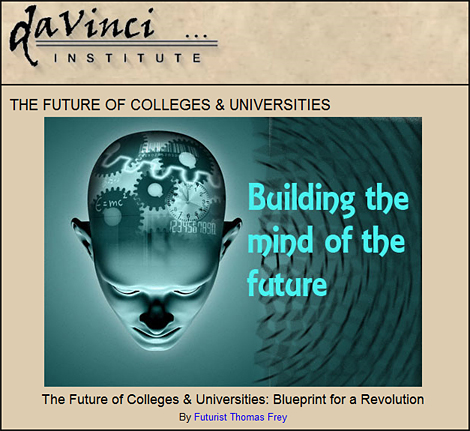
The future of colleges and universities -- from the spring of 2010 by futurist Thomas Frey

From Spring 2010

From DSC:

If you are even remotely connected to higher education, then you *need* to read this one!


Most certainly, not everything that Thomas Frey says will take place…but I’ll bet you he’s right on a number of accounts. Whether he’s right or not, the potential scenarios he brings up ought to give us pause to reflect on ways to respond to these situations…on ways to spot and take advantage of the various opportunities that arise (which will only happen to those organizations who are alert and looking for them).


…BYU has just received a grant from the William and Flora Hewlett Foundation. The pilot project will examine the deeper learning and cost savings that can be achieved when open textbooks replace traditional, expensive textbooks in public high school science classrooms.

15-20 public high school science teachers in Utah will replace their expensive, traditional textbooks with open textbooks from CK12.org for the 2010-2011 school year. Approximately 2,000 students will be impacted by the changes. Most will use printed versions of the books, while a few hundred students in one-to-one schools will use the online versions of the books on netbooks or iPads. Teachers will continue to supplement the CK12 books with additional resources and activities just as they have historically supplemented expensive, traditional textbooks.

Tagged with:  
Tagged with:  

How to get started with open source in K-12 — from The Journal by Natasha Wanchek

Open source has proved attractive for K-12 school districts for any number of reasons, from upfront cost savings to freedom from cumbersome restrictions to the quality of the software itself. But how does a school or district get started with it? Three K-12 IT directors shared their experiences with THE Journal–the good and the bad, as well as the lessons they’ve learned in the process.

Tagged with:  

Free Online Journalism Classes Begin To Gain Ground – from Media Shift via Ray Schroeder:

The CEO of Creative Commons, Joi Ito, is currently teaching a free online journalism class through Peer 2 Peer University, an online community of “open study groups for short university-level courses.” The online class syncs with a graduate-level class Ito teaches at Keio University in Japan, and features a UStream presentation and IRC chat once a week. IRC chat? Yes, the class glues together tools like UStream and IRC, and the platform, which was built on a Drupal base, continues to evolve. P2PU’s organizers make it clear they know the tools aren’t perfect, so they’re using feedback from participants to refine things as they go.

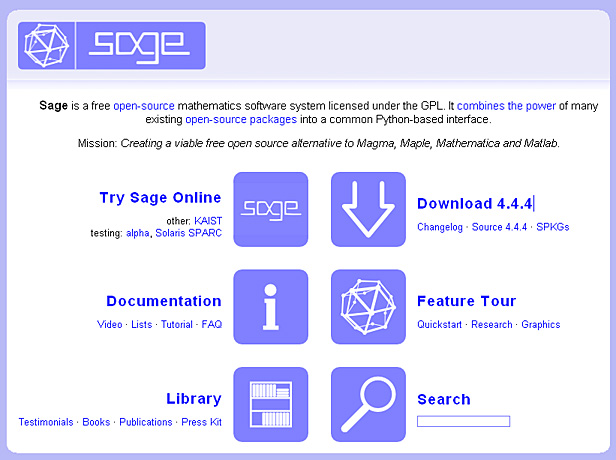
Sage (mathematics)

SageMath.org

Tagged with:  

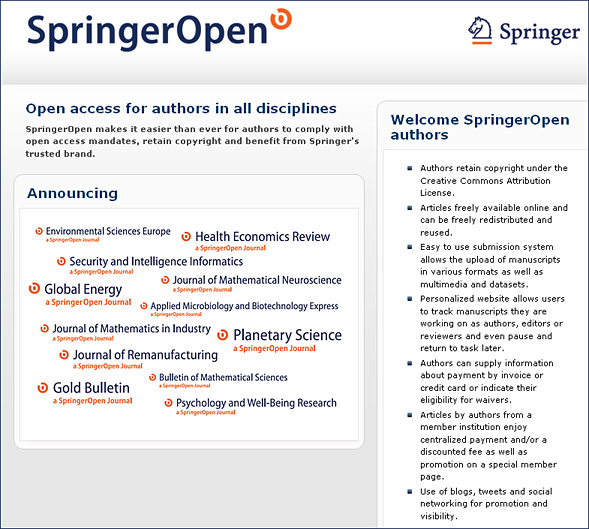
Springer announces new open-access journals — from __ by Jennifer Howard

The Springer publishing company today announced that it is setting up a new open-access journal program. Called SpringerOpen, the program will initially include 12 new online-only, peer-reviewed journals in science, technical, and medical fields.

The Chronicle sat down with Eric Merkel-Sobotta, Springer’s executive vice president for corporate communications, and Bettina Goerner, the company’s manager of open access, to talk about the program. (They were in town for the annual meeting of the American Library Association.) They emphasized that all SpringerOpen journals will be published under a Creative Commons Attribution license, which allows reuse of articles as long as the authors are given credit. So if you’re an instructor who wants to use a SpringerOpen article in a course you’re teaching, “you can include it in course packages without e-mailing Springer’s rights department,” Mr. Merkel-Sobotta said.

SpringerOpen.com

Tagged with:  

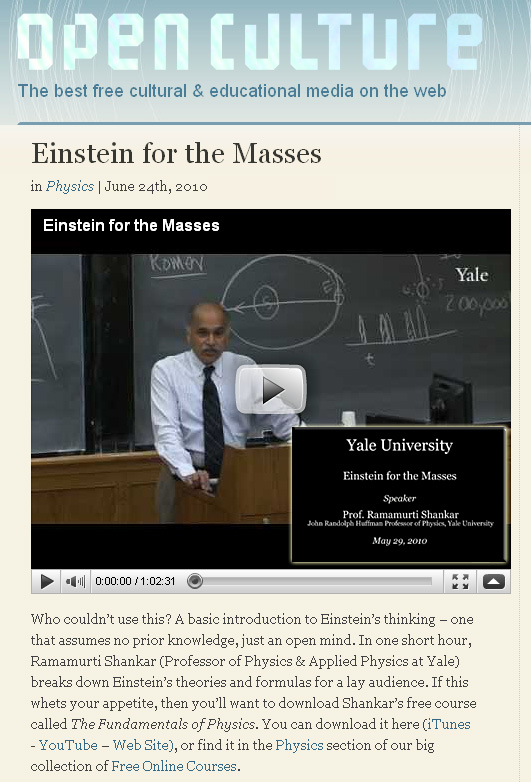
Einstein for the Masses - from presentation at Yale in May 2010

Tagged with:  
© 2025 | Daniel Christian