The transformation of textbook publishing in the Digital Age — new business models — from Xplana by Rob Reynolds

Introduction
In April, we published a report on Digital Textbook Sales in U.S. Higher Education, in which we outlined sales for e-textbooks over the next five years based on current trends and variables. This series — The Transformation of Textbook Publishing in the Digital Age — provides an in-depth look at textbook publishing in Higher Education, and offers a roadmap for evolution and profitability in the industry. In this first installment, we will discuss New Business Models. In subsequent installments, we will explore New Product Models, New Authoring Models, and New Production Workflows.

My goal with this series is neither to extol nor criticize the textbook industry, but rather to provide an understanding of the business as it exists today, and to offer a digital success strategy for the companies that comprise that industry. By doing so, I hope to lay the groundwork for our subsequent summer series on The Transformation of Learning Systems, and The Transformation of Learning Content.


Strategies for New Business Models for a Digital Age

The majority of this post has been about existing practices and product/business models in the textbook publishing world. These practices and models are based on a print-centric paradigm that will be outdated within three years, and are also the result of old assumptions about Higher Education and learning in general.

While the path to digital transformation will be unique for the different publishing companies, there are some constants that will be part of any successful plan for Higher Education learning content in the coming years. The surface chatter will continue to be about e-textbooks — reaching 18%-20% of the new textbook market by 2014 — but the strategies that drive success will all take the following elements into consideration.

  • The Disaggregation of Content — Future profitability will be incumbent on publishers’ ability to conceive of and produce meaningful content at a more granular level and disaggregated from the notions of textbooks. It is not that they should produce less or different content, necessarily, but rather that content must become agile, malleable, and designed to be mashed up easily by customers — institutions, instructors, and students. This means thinking at the key concept or learning objective level. It also means arriving at new revenue streams that are also disassociated from textbooks and ISBNs.
  • A Focus on Lifelong Learning — New estimates have social media sites accounting for two-thirds of U.S. Web traffic withing five years. This growth and dominance is related to a sense of personal connectedness and long-term residence that users associate with such sites. Textbook publishers must find ways to move past outdated notions of students and instructors bound within narrow windows of consumer opportunity, and learn to embrace lifelong learning and see every adult citizen as a potential customer.
  • Embracing Self-Publishing — In the new world order of business in publishing, self-publishing will be a primary avenue for partnership and revenue. And unlike the stigma associated with self-publishing in trade fiction, the educational content market already recognizes self-published content as valuable and embraces it. In the future, textbook publishers should plan on abandoning much of their current content authoring model in favor of aggressive self-publishing services. This will lead to broader partnerships throughout the educational community as well as to more sustainable models for revenue.
  • Partner with Open Content — Make no mistake about it. Open content and open educational resources (OERs) will become leading alternatives to proprietary textbooks for at least 25% of the Higher Education market within five years.  There are many services than can be offered around OERs and there is great value in mapping OERs to existing publisher content. Textbook publishers must take advantage of this opportunity to make their content and services more relevant, or they will see the value of their businesses diminish.

In next week’s installment, I will discuss specific new product models that textbook publishers will need to embrace in order to remain competitive in the coming years.
New ELI 7 Things... Brief Explores Open Educational Resources

Tagged with:  

college open textbooks blog

Tagged with:  

Steeple

steeple.oucs.ox.ac.uk

opencastproject.org
The Opencast community is a collaboration of individuals, higher education institutions and organizations working together to explore, develop, define and document best practices and technologies for management of audiovisual content in academia. Through the mailing list, website and collaboration among its members, the community will strive to offer guidance and information to help others choose the best approach for the delivery and usage of rich media online.

Matterhorn logo

Matterhorn is an open source project working within the Opencast Community to develop an end-to-end, open source platform that supports the scheduling, capture, managing, encoding and delivery of educational audio and video content.

Tagged with:  

Congress rejected grant, but free online courses growing — USA Today –by Steve Kolowich, Inside Higher Ed

President Obama’s original plan for community colleges included $500 million to create free online courses that individual institutions could then customize for their students. That money never materialized — it was left out of the student aid legislation in last month’s health care bill.

But a foundation-supported effort with similar goals is actually growing. The National Repository for Online Courses (NROC) was hoping for that government money to help expand its existing vault of free courses, says Gary Lopez, the repository’s director. Still, with online education becoming mainstream and many community colleges experiencing enrollment booms beyond their physical capacity, NROC’s membership is on the rise. At the same time, the repository’s reliance on membership fees calls into question how “free” its courses actually are.

Tagged with:  

Retired professor writes free online textbook — from eCampusNews.com
Some people play golf when they retire. William Reusch learned programming and created 2,000 online problem sets for organic chemistry. (p. 12)

Tagged with:  

See:

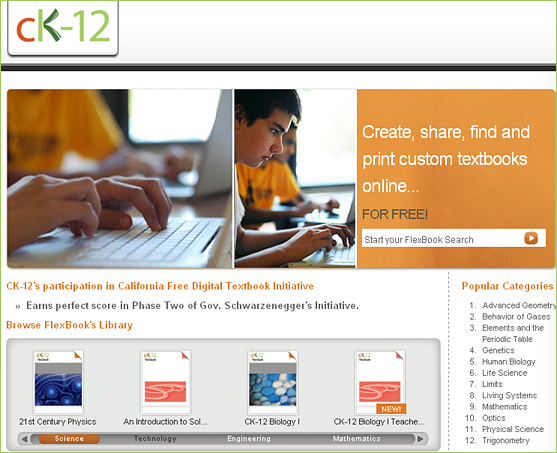
Press Release: CK-12, Leading Non-Profit Provider of Digital Textbooks to Schools, Makes the Grade with California’s Free Digital Textbook Initiative — eSchoolNews.com

CK-12 FlexBooks:

CK-12's flexbooks

CK Foundation

ck12.org

Key Benefits

Access to free textbooks
High quality educational content created by educators
Content customized to reflect “today” and the different needs of students
Quality ensured by CK-12’s Community of Educational Practitioners
Increased pedagogic choice for all teachers, aligned to state standards as well as developmentally correct content
Supported by publishing tools that facilitate quick and easy content creation and distribution
Collaborative learning via a community where authors, teachers, and students create, access, share, rate, recommend, and publish

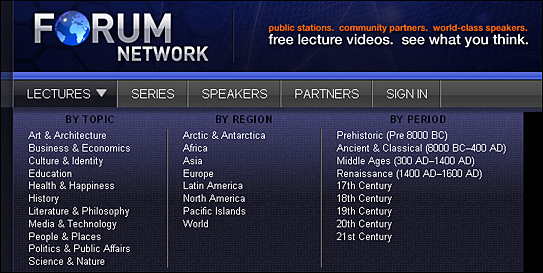
The Forum Network

Tagged with:  

Harvard establishes their own channel on iTunes U on 4/24/10

Tagged with:  

Education Innovation: Top Five Education Industry Trends Predictions from the Gilfus Education Group Make Significant Progress in 2010
Education Industry leaders see tangible evidence of Education Innovation and Technology Trends predicted from October 2009.

In October 2009 the Gilfus Education Group predicted the:

  1. Emergence of robust “Enterprise” Open Source Learning Management Systems
  2. Combination of academic and administrative functionality into a more cohesive experience
  3. Proliferation of “Software-as-a-Service” administrative and academic applications
  4. Growth of independent content object repositories to support teaching and learning
  5. Introduction of successful learning applications from other countries into North America
Tagged with:  

The Virtual University — by Anya Kamenetz | April 20, 2010 — my thanks to Mr. Jeff Wiggerman at Davenport University for this resource
Why cash-strapped colleges need to stop worrying and learn to love the online classroom.

“At this point, however, the hybrid, NCAT-style course-redesign models seem most compelling. Not only do they show some of the best learning results, but they’re in keeping with the multifaceted history of the university, and they offer the reassurance of familiarity — a scaffolding, if you will, for the transition to new modes of teaching.”

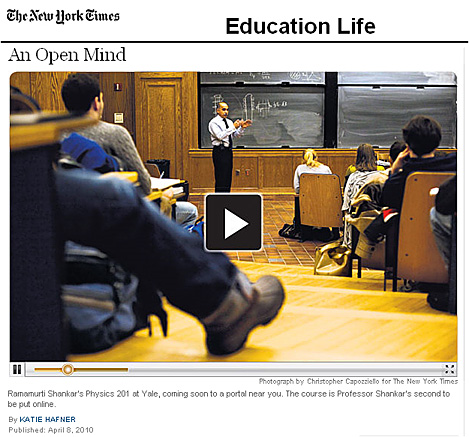
An open mind — New York Times

An open mind -- from the New York Times Education Section

“Undoubtedly, open educational resources have given higher education unprecedented reach. So, a decade in, what has it taught us? This is not an idle question.”

Tagged with:  

Moving college into the 21st century — politico.com (see quotes below)

Today, we’ve reached another turning point. The global economy is changing, and the United States needs to educate its way to a better economy for the 21st century. President Barack Obama has set a goal that by 2020, America will once again have the highest proportion of college graduates in the world. To reach that goal, we need to bring 5 million more Americans into higher education and ensure that future generations will have the same opportunity for a college education and success in the work force.

The president has proposed a comprehensive agenda to keep a college education within reach, especially for America’s poorest families, and to dramatically increase college graduation rates in the next decade. President Obama’s agenda includes the largest increase in federal financial aid since the GI Bill — a 30 percent increase in fiscal 2010 alone. In addition, the president’s American Graduation Initiative would provide $12 billion more during the next 10 years to improve community colleges and help students gain access to higher education and ensure that they earn their degrees.

Beyond these investments in our future, one part of the AGI has the potential to have a lasting impact on the future of higher education: The president is proposing to invest $500 million over the next 10 years to create world-class online college and high school courses that will be available to all 24/7/365. Colleges, universities, publishers, other institutions and related consortia will be invited to compete to create state-of-the-art online courses that combine high-quality subject matter expertise with the latest advances in cognitive and computer sciences. Such courses will enable students to move through the material at their own pace. When students do not understand a particular lesson or concept, carefully designed assessments will identify the gap in their learning. They’ll relearn the material and have another chance to demonstrate mastery (emphasis DSC).

From DSC:

  • Along these same lines, see: The Forthcoming Walmart of Education.
  • If done well, these courses are going to be highly-engaging, while using state-of-the-art technologies and instructional methods. Can one faculty member compete with this team-based approach? No way! (And I mean no disrespect at all here — it’s just too much for one person to keep up with, be interested in, and have the time and resources to do all of this.)
Tagged with:  


Inside the March 2010 Issue of The Journal:

*DIGITAL VIDEO
Flippin’ Out

With its school-friendly price, user-friendly design, and project-friendly capabilities, the Flip Video camcorder is a must-have addition to your classroom technology arsenal.

*OPEN CONTENT
A Custom Fit
The movement toward open educational resources is gaining steam, empowering teachers to modify existing materials and create content that is a better match for their instructional needs.

*21st CENTURY SKILLS
An ‘A’ in Abstractions
How do you assess students on how well they can communicate, solve problems, and be responsible self-learners?  First step: Toss out your bubble sheets and multiple-choice questions.

Plus:
-Network Security – Identity Scramble
-Here & Now
-Policy & Advocacy – Was I Wrong on Obama?
-Drill Down – Digital Citizenship is Fundamental
-Product Focus
-Upcoming Events & Webinars

Tagged with:  

Harvard launches on iTunes U

Also see:
Harvard opens classes to all, online — from The Boston Herald

Ever think about dropping in on a Harvard University lecture on law, loss or metaphysics?

Now you can, for free, and from your couch.

Harvard University yesterday launched its own version of iTunes U, on a dedicated portion of iTunes.

The new portal allows students, faculty and curious Bostonians to attend the Ivy League school virtually.

Perry Hewitt, the university’s director of digital communications, said the online, accessible-from-anywhere database illustrates the school’s plans to provide “the highest-caliber digital experience to showcase our excellence in teaching and research.”

Tagged with:  
© 2025 | Daniel Christian