On 03/17/2010,
in accessibility / UDL, business side of he, change, changing business models, consortiums, cost of getting a degree, dangers of the status quo, disruption, economics, education technology, elearning, emerging technologies, engagement / engaging students, expectations, face-to-face, faculty/staff, future of higher education, game-changing environment, generational differences, global / globalization, higher education, innovation, interaction design, interface design, internet, leadership, learning ecosystem, new business models, online learning, open courseware and systems, social learning / networks, staying relevant, student-related, traditional / tradition, universities,
by Daniel Christian
From:
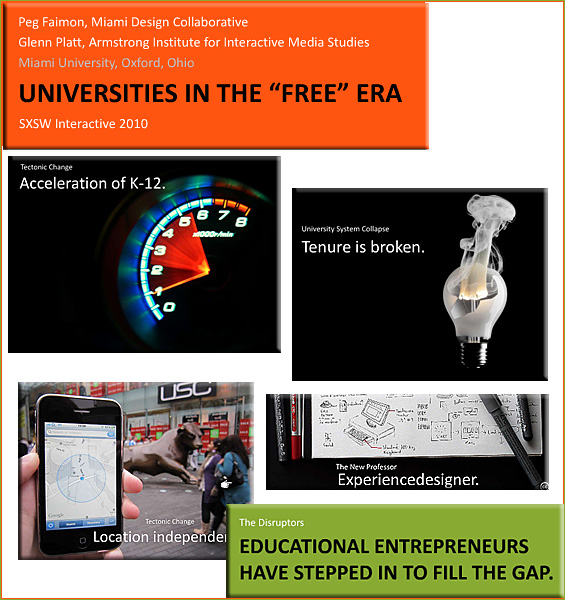
http://www.slideshare.net/glenn.platt/universities-in-the-free-era-sxsw-2010-presentation
Also see:
Links for SXSW 2010 Presentatation: Universities in the “Free” Era
Glenn Platt, Armstrong Institute for Interactive Media Studies
Peg Faimon, Miami Design Collaborative — Miami University
- Chris Anderson’s “Free” Article in Wired
- DIYU Blog
- Spence’s Signaling Paper
- Zeigert’s Study of Personality Types of Professors and Students
- HigherEd Infographic
- Ohio’s Senior to Sophomore Program
- MIT OpenCourseware
- iTunesU
- Youtube EDU
- Open Courseware Consortium
- Open Content
- OpenEd
- LectureFox
- NPR Forum Network
- TED
- Open Culture
- Research Channel
- Google Books
- Flatworld Knowledge
- Textbook Revolution
- CourseSmart
- Cramster
- GradeGuru
- ShareNotes
- Sloan-C
- Ning
- Singularity University
- Academic Earth
- Ohio Learning Network
- University of the People
- The Open University
- University of Phoenix
- Experience Designer
- IDEO’s T-Person
- Liz Coleman’s TED Talk
- OER Commons
Other food for thought:
- http://mashable.com/2009/07/24/education-social-media/
- http://www.nytimes.com/2009/01/25/technology/25iht-university.4.19660731.html?_r=1
- http://www.insidehighered.com/news/2009/06/29/ccplan
- http://mashable.com/2009/07/15/social-media-public-affairs/
- http://online.wsj.com/article/SB123923520520403259.html
- http://chronicle.com/article/Students-Find-Free-Online/48776/
- http://chronicle.com/article/College-20-More-Professors/64521/
On 03/16/2010,
in future of higher education, internet, K-12 related, open courseware and systems, platforms, policy,
by Daniel Christian
From DSC:
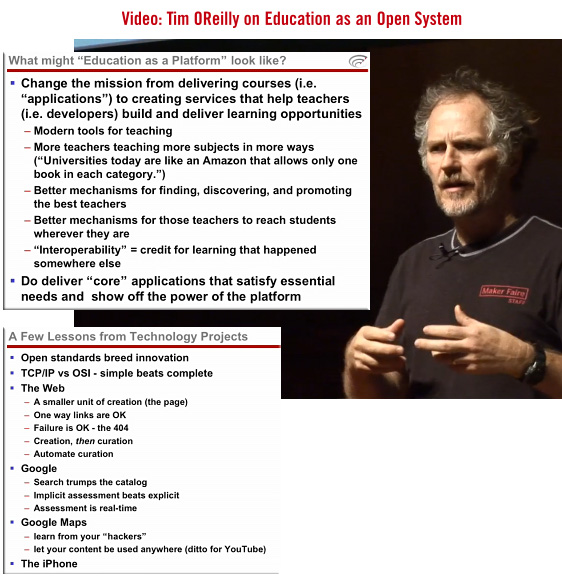
This idea of creating platforms is key. Apple let people develop their own apps for the iPhone, and look what happened. Innovation skyrockets when people can contribute.
Where is innovation happening within your organization? In your face-to-face learning environment? In your online learning environment? In your hybrid/blended spaces? How can we open things up more to allow for:
- More creativity
- The pursuit of students’ passions
- Increased flexibility in our offerings
- More innovation
- A greater reach/impact?
Community College Consortium for Open Educational Resources
Also see:
- Academic Earth
- AMSER
- Capetown Declaration
- CCCOER Networking
- CCCOER Video
- Collaborative Statistics
- College Open Textbooks
- Connexions
- Digital Alliance Foundation
- Digital Marketplace
- Folksemantic
- Hewlett Foundation OER
- HippoCampus
- Make Textbooks Affordable
- MITE
- OER Center for CA
- OER Commons
- OER Foundation
- OER Project
- Open Textbook Catalog
- OpenLearn
- Orange Grove
- SOFIA Opencourseware
- Teachers w/out Borders
- UCCP Open Access
- USG Share
On 03/15/2010,
in accessibility / UDL, education technology, higher education, K-12 related, online learning, online media, online tutoring, open courseware and systems,
by Daniel Christian
1. Education for All – Unfinished Business
2. Seeking a Silver Bullet
3. Technology is the Answer – What is the Question?
4. Open Schools and Mega-Schools
5. Teacher Education at Scale
6. Strategies for Success
Appendix 1: Profiles – Selected Open Schools and Mega-Schools
Appendix 2: Programmes and Mechanisms for Expanding Teacher Supply
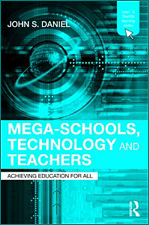
Mega-Schools, Technology and Teachers [VIDEO] addresses the new challenges created by both the successes and the failures of the EFA campaign. This book advocates new approaches for providing access to secondary education for today’s rapidly growing population of children and young adults and examines:
- The creation and expansion of Mega-Schools, which combine distance learning and community support and have a proven track record of increasing access at scale.
- How to prepare the 10 million new teachers that are required to achieve Education for All by 2015 (emphasis DSC) by focusing on classroom-based in-service training.
- Strategies for using technology to scale up distance education cost-effectively (emphasis DSC).
- The creation of a 21st century educational ecosystem (emphasis DSC) that integrates open schooling and teacher education with communities and their school systems.
- Successful examples of open schools and teacher education programmes operating at scale around the world.
On 03/07/2010,
in blended learning, hybrid learning, intelligent tutoring, open courseware and systems,
by Daniel Christian
Carnegie Mellon’s Open Learning Initiative — learningonlineinfo.org — March 7, 2010
“What a wonderful initiative! Carnegie Mellon’s Open Learning Initiative: Using intelligent tutoring systems, virtual laboratories, simulations, and frequent opportunities for assessment and feedback, the Open Learning Initiative (OLI) builds courses that are intended to enact instruction – or, more precisely, to enact the kind of dynamic, flexible, and responsive instruction that fosters learning.”
And from:
http://oli.web.cmu.edu/openlearning/
Hybrid Education 2.0
[…] the researchers seem more excited by a hybrid application of the open-learning program that, instead of replacing professors, tries to use them more effectively. By combining the open-learning software with two weekly 50-minute class sessions in an intro-level statistics course, they found that they could get students to learn the same amount of material in half the time (emphasis DSC).
“If they’re all getting that baseline information, [faculty] can spend that class time going deeper and doing something much more interesting, so they can really leverage that you’re an expert,” says Candace Thille, director of the Open Learning Initiative, “because right now, oftentimes the faculty expertise is wasted.” (emphasis DSC).
On 03/05/2010,
in open courseware and systems, Uncategorized,
by Daniel Christian
On 03/03/2010,
in open courseware and systems,
by Daniel Christian
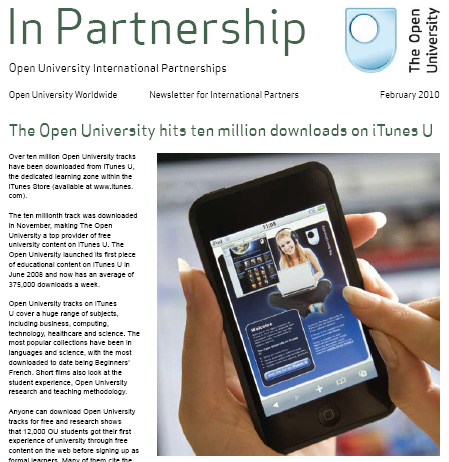
Open University UK major provider on iTunes U — Tony Bates
On 03/02/2010,
in future of higher education, game-changing environment, learning ecosystem, legislatures / government / legal, mobile learning, new business models, online learning, online media, online tutoring, open courseware and systems, strategy, student-related, teaching & learning, teaching online, web-based collaboration,
by Daniel Christian
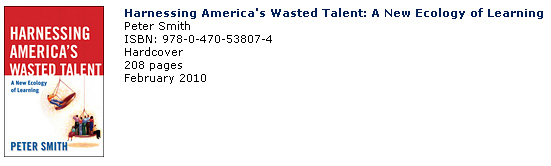
Harnessing America’s Wasted Talent — from Peter Smith
“President Obama offered America and the world renewed hope for a better tomorrow. With decades of experience in alternative forms of higher education, Peter Smith grabs that optimistic spirit and seizes the moment to reveal to us the exciting age of Web-based teaching and learning, which is opening access to untold numbers of learners while harnessing the previously wasted talents of millions of people in America and billions around the world. Those seeking insights, a vision of the future, and a chance to join this educational revolution should look forward to Harnessing America’s Wasted Talent.”
—Curtis J. Bonk, professor, Indiana University, and author, The World Is Open: How Web Technology Is Revolutionizing Education
“Anyone who wants to understand where American higher education is headed should read Harnessing America’s Wasted Talent. Peter Smith’s vision of the future of higher education is based on several decades of experience—at the national, state, and international levels. He brings a rare perspective that will interest students, educators, politicians, and those American business leaders who are worried about the future of our workforce and the health of our democracy.”
—Charles Kolb, president, The Committee for Economic Development
“Harnessing America’s Wasted Talent is a must-read for those of us concerned about the increasing economic and education gaps in our country. Peter Smith takes on an important American disconnect: the need for an educated workforce and the fact that most working Americans lack a college degree. Drawing upon his experience in higher education and politics, Smith dissects the problem and presents a contemporary, practical plan to enhance the learning capacity of our country.”
—Joseph B. Moore, president, Lesley University
Table of Contents
Part One: The Law of Thirds.
1 Wasted Talent.
2 Maxed Out: Why Colleges Can’t Meet This Challenge.
3 The Paradox of Personal Learning.
Part Two: Dangerous Conceits.
4 Different Strokes for Different Folks.
5 Learning Is More Than “Strictly Academic”.
6 You Can’t Get There from Here.
Part Three: From Access to Success: A New Ecology of Learning.
7 The End of Scarcity: Education’s Emerging Long Tail.
8 Game Changers: New Media and the Open Education Resource Movement.
9 Reaching the Middle Third: Talent-Friendly Colleges for the Twenty-First Century (C21Cs).
Conclusion: A New Ecology of Learning.
On 02/15/2010,
in Canada, open courseware and systems,
by Daniel Christian
On 02/11/2010,
in changing business models, game-changing environment, online learning, online media, open courseware and systems,
by Daniel Christian
University finds free online learning classes don’t hurt enrollment – Jacqui Cheng, ars technica — resource and quote below from Ray Schroeder
Free online courses aren’t sapping enrollment numbers—in fact, they’re actually helping to spread the word. Those are the preliminary findings out of Brigham Young University, which experimented recently by granting free access to a selection of its distance learning courses. Though further study is needed in order to see whether there’s a significant impact, educators are beginning to see that offering free materials isn’t the end of the world after all.
On 02/09/2010,
in dangers of the status quo, disruption, engagement / engaging students, open courseware and systems,
by Daniel Christian
Web 2.0 in Hardcover: A recommended reading list on 2.0 and education — from Steve Hargadon and the School Library Journal (2/1/10)
On 02/08/2010,
in blogs / blogging / vlogging, CMS/LMS, open courseware and systems,
by Daniel Christian
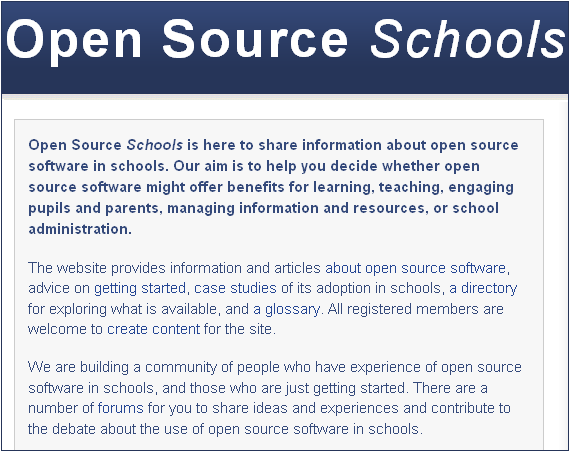
From Richard Wyles, Eduforge
Please be aware that the current Eduforge website will be decommissioned on the 31st March 2010. We’re planning an exciting new stage for the Eduforge community including a brand new website – currently hosted at http://staging.eduforge.org
The new site offers resources and a showcase area for open source projects. You are most welcome to establish a new project space or transfer your existing project to the new Eduforge. Simply register now on http://staging.eduforge.org
Our mission has also changed to support the Open Source Learning Laboratory — short e-learning based education courses focused on open source. See http://staging.eduforge.com for the courses we’re starting with. The courses are being delivered in association with Flexible Learning Network and Catalyst IT of Wellington, New Zealand, and are fully recognised by the Open Polytechnic of New Zealand.