California State University to license content from major college publishers — from TeleRead: Bring the E-Books Home by Paul Biba

The Digital Marketplace, an initiative of the California State University Office of the Chancellor, announced plans today to launch a pilot to license digital course content from Bedford/Freeman/Worth, Cengage Learning, McGraw-Hill Education, Pearson, and John Wiley & Sons, Inc.

Using VoiceThread to give students a voice outside the classroom — from The Chronicle by Shannon Polchow, an assistant professor of Spanish at the University of South Carolina Upstate.

Leveraging digital media across the higher education campus
Phil Ice, Ed.D., Dir. of Course Design, R&D, American Public University System
Sebastian Diaz, Ph.D., J.D., Assoc.Professor, Technology, Learning and Culture, West Virginia University
Ellen Wagner, Ph.D., Executive Director, WCET

Note: This webinar from earlier today was sponsored by Adobe. This is the white paper from that webinar, which contains the below excerpts:

The Multimedia Landscape in Higher Education
In higher education, the effective integration of rich multimedia assets and platforms (and the requisite design and development skills demanded for their effective use) has become an expectation from schools of design, art, and communications. Engineering and journalism programs have recognized that as technology transforms industries, students with design and development proficiencies are in high demand. The obvious value of improving analytical and digital communications for teachers is now being addressed through initiatives such as the i3 Fund. Relatively less attention has typically been given to the integration and use of multimedia in other disciplines.

Emerging New Media Literacy in Academia
This paper has thus far explored the implications that collaborative, creative software solutions have on how we evaluate academic work. Just as importantly, one needs to consider the changing nature of how we communicate that work within the Academy. As the prices for video cameras continue to fall, the expectations for manifesting our work in new media formats will continue to rise. Given the availability of software such as Adobe Premiere Pro, we are finding that it is increasingly quite reasonable to expect that students possess the tools and skills necessary to produce representations of their work in dynamic visual formats, as is evidenced by www.YouTube.com. Although for a while it was believed that YouTube was an online version of America’s Favorite Home Videos, it is dangerous to assume that this phenomenon is merely a fad among the younger generation. Today’s YouTube is a marketing machine used by commercial and nonprofit entities alike, an online school and a news portal as well. YouTube serves as an accurate indicator of how newer generations will express themselves personally, artistically, and academically through what is commonly referred to as new media literacy.

Conclusion
Members of the Academy should anticipate that in the future conventionally printed papers will be replaced by much more dynamic multimedia representations of academic work. This applies not only to student assignments, examinations, and theses; it also applies to faculty work. Even as we begin to struggle with the fundamental shift from paper-based publication of work to electronic formats on the Internet, we also need to anticipate that in the near future, this research will take on new media formats. To help our faculty prepare for these changes, academic institutions must develop formal and informal faculty development initiatives to address the changes. In anticipation of these changes, it is imperative that academic departments and colleges begin to embrace technologies like Adobe Creative Suite such that we continue to develop our own intellectual capital as well as that of our respective institutions and the Academy.

From DSC:
I appreciated this well-done webinar. I also appreciate the work Adobe has done in the past and is currently doing.

I must say though, I struggle with how much we can load onto 1 person’s plate — i.e. the faculty member. We need a more team-oriented approach I think…as the bar continues to get higher and higher…and 1 person just can’t do it all anymore.

.
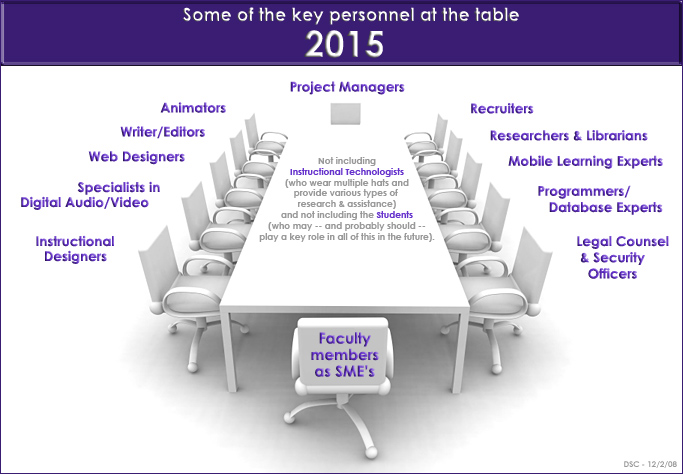
Daniel Christian -- higher ed needs to move towards the use of team-created and delivered content


iTunes Texas education channel launched — from news.yahoo.com by Sarah Portlock

HOUSTON – Texas students can now download podcasts, videos and other multimedia lessons directly from iTunes through a new online program aimed at providing free, supplementary coursework that can be accessed anywhere, state officials announced Tuesday.

The Texas Education iTunes U channel allows teachers to upload material from their classes to help students understand new concepts or do more research in a specific subject area. Students and parents can access the material through home or school computers, and those with iPods can download the information to the handheld devices.

The state first met with Apple Inc. about three years ago. The governor’s office and the Texas Education Agency began working on the project in November, finding and culling existing teacher training videos and programs for students, said agency spokeswoman Debbie Ratcliffe.

Tagged with: • • • • •  

Digital Storytelling with the iPad — by Apple Distinguished Educators Cindy Huson, Karen Bosch, Sherri Clemens, Jerome Burg, Jim Harmon, Paul Devoto

Digital Storytelling with the iPad

Digital Storytelling can transform your students’ writing into a visual masterpiece that is filled with voice and emotion, while enhancing critical thinking skills. The iPad takes digital storytelling to a new level by making the process easier, and even more engaging for students of all grade levels as well as for their teachers. This site will help guide you in what you need for success in the iPad Digital Storytelling classroom.

Resources

Storytelling Articles:

Web 2.0 Resources

Miscellaneous Resources

  • Apple iPad Connection Kit ($29.00) Gives two ways to import photos and videos from a digital camera: using the camera’s USB cable or using the included SD card reader.
  • SoundPaper ($4.99) A great app to repurpose for digital storytelling!! Record the brainstorming process, take notes, and draw. Miss something? Click a word and SoundPaper automatically jumps to that portion of the audio.

General Digital Storytelling Sites


Digital Storytelling and iTunes U

With its color screen and ability to run multiple=

.

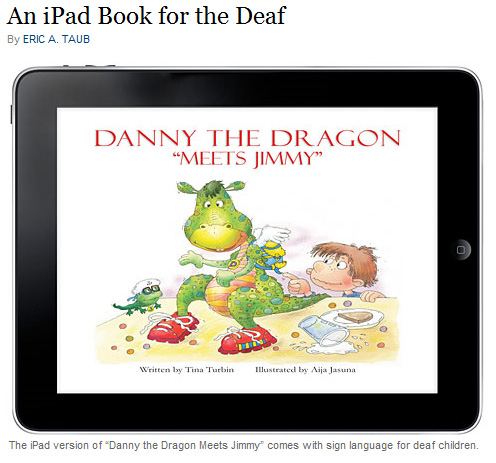
With its color screen and ability to run multiple applications, Apple’s iPad holds great promise for creating multimedia work that can redefine the nature of a book.

One new attempt to do so is “Danny the Dragon Meets Jimmy,” an iPad version of the well-received children’s book that brings to it what the publisher, iStoryTime, says is a first: an iPad book complete with sign language for deaf children.

The $3 app offers three versions of this charmingly illustrated work: one that children can read themselves, one that would be read to them and one signed by a woman who stands off to the side of the screen, with the reduced-size book running next to her.

Digital Learning Council press release — from EdReformer.com

Tallahassee, Florida and Washington, D.C. August 18, 2010 – Jeb Bush, governor of Florida 1999 – 2007, and Bob Wise, governor of West Virginia 2001 – 2005, today launched the Digital Learning Council to identify policies that will integrate current and future technological innovations into public education. The Digital Learning Council unites a diverse group of more than 50 leaders from education, government, philanthropy, business, technology, and think tanks to develop the roadmap of reform for local, state and federal lawmakers and policymakers.

“Technology has the power to customize education for every student in America,” said Jeb Bush, co-chair of the Digital Learning Council. “Providing a customized, personalized education for students was a dream just a decade ago. Technology can turn that dream into reality today. The Digital Learning Council will develop the roadmap to achieve that ultimate goal.”

Online collaboration: New innovations pave the way for convergence — from prnewswire.com
Merger of television and computer takes giant step closer as innovative online tool suite is released

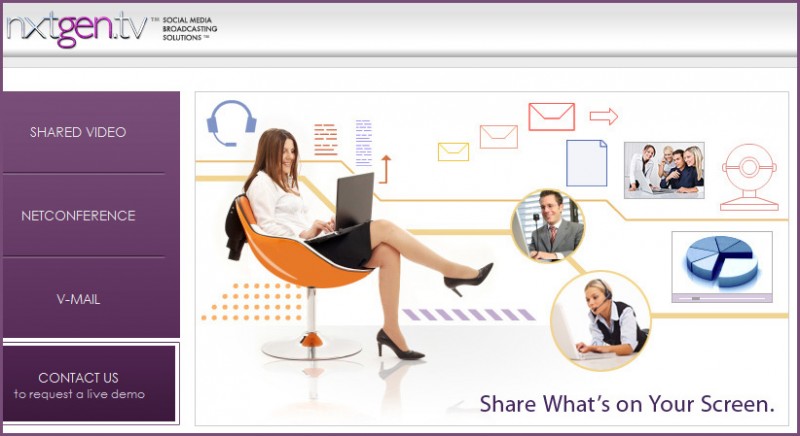
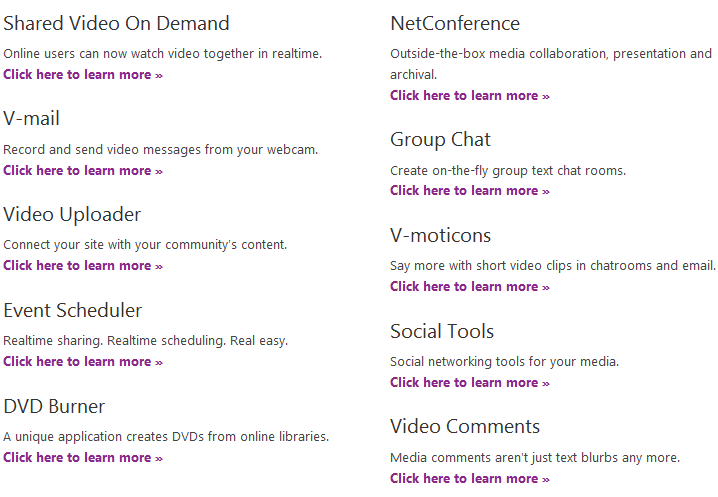
CALABASAS, Calif., Aug. 16 /PRNewswire/ — Anticipating the coming paradigm shift that will merge your television and your computer, NxtGenTV has just released the most cohesive system of online tools to facilitate the ultimate interactive communication platform. Four years of innovating has resulted in NetConference.com, an elegant, easy-to-use online meeting system that supports the diverse requirements of single users, small and medium size businesses as well as enterprise and nonprofit organizations. Creating a new opportunity for the global audience to interact online in even greater and more efficient ways is only one of the many benefits of building a social media broadcasting system that facilitates Communication, Collaboration, Presentation and Education.

An industry leader in online games, apps, widgets, banners and rich media development for major entertainment brands, The Illusion Factory created a new company, NxtGenTV to develop and patent cutting-edge online technologies such as shared synchronized visual media and other key innovations that will further blur the lines between computers and television. “We have been passionate about creating the cumulative new systems that will drive Convergence,” shares Brian Weiner, CEO of The Illusion Factory, “our creation of NxtGenTV will lead the push for truly interactive television.”

nxtgen.tv

.nxtgen.tv/products

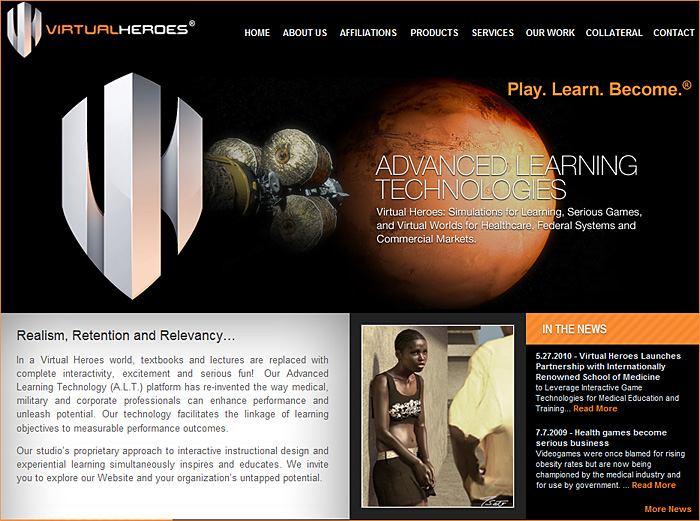
The type of learning materials that can be produced by an organization such as Virtual Heroes is the type/quality of material that will be produced in a vision that I have been calling “The Forthcoming Walmart of Education.”

.

http://virtualheroes.com/index.asp

.

Also see:

From DSC:
This is why I would encourage the U.S. government to see if they can get 1-2 billion — from the billionaires who are donating much of their wealth to charitable causes — in order to create such professionally-done, interactive, engaging, team-created learning materials.
Then make those materials available — free of charge — throughout the world.


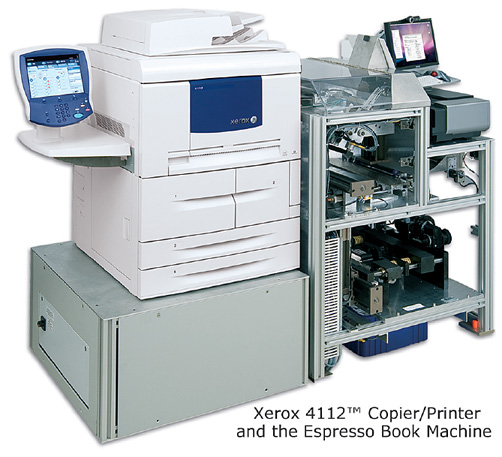
on demand books dot com

.

Also see:

.

— from Teleread.com by Paul Biba

Podcasting: Ideas for teachers — from Learning Objects Community — posted by Nancy Rubin

What is a podcast and how can I teach with it? If you are wondering what a podcast is, that might be a good place to start. Podcasts are basically audio files that can be produced with a standard computer, a microphone, software, and a web site where you will post your completed podcasts. Audio podcasts are usually an MP3 file and are the most common types of podcasts. Enhanced podcasts can have images to go along with the audio. They can also have chapter markers, making it easier to skip to different portions of an episode. Enhanced podcasts are not necessarily supported by all devices. Video podcasts are movies, complete with sound. Video podcasts can be in a variety of formats, but MPEG-4 is the most popular and the only format that will play on iPod and iPad.

Some classroom ideas for podcasting:

  • Record directions for students
  • Record lessons
  • Record supplemental materials
  • Record instructions for a substitute teacher
  • Record classroom rules
  • Interview people at your school
  • Create a news show and discuss current events
  • Record a speech
  • Record student readings so they can hear what they sound like

Also see:

© 2025 | Daniel Christian