Augmented Learning — from Kirsten Winkler at bigthink.com
Excerpt:

A technology that keeps me excited for a while now is augmented reality in combination with QR codes and geo tagging. One start-up that caught my attention early on was StickBits.

From DSC:
I’m thinking of a related application here — it involves Geology courses. That is, what if the rocks or other types of materials (that students were trying to learn about) were assigned their own QR codes? Then the students could walk around the room, scan in the QR codes, and the relevant information about that rock/material would appear on their device.


There’s an app for that class at Va. universities — from timesdispatch.com by Karin Kapsidelis

VCU App

VCU and other universities are exploring the uses of
smartphones and mobile applications in and outside classrooms.


With the help of his smartphone, D. Kirk Richardson taught a class last summer on Edgar Allan Poe’s last hours in Richmond. The walking tour took on a different dimension for his Virginia Commonwealth University students when he augmented his lesson with vintage images from the poet’s day. On his iPhone, they could see Poe haunts that no longer exist and even a menu from a restaurant where he dined during his last 30 hours here in 1849. For Richardson, who teaches focused inquiry classes at VCU’s University College, it was a way of adding context to Poe’s life and “moving history out of books.” He has since adapted that mobile lesson plan to a mytourguide.com application and is showing his students this semester how to use the app to create their own walking tours. Later this month, the class will set out to digitally explore the Civil War prison camp on Belle Isle, famous hotels and the last days of Jefferson Davis.


http://mytourguide.com/

Originally saw this at
Ray Schroeder’s Online Learning Update blog

Awesome augmented reality app could save librarians hours — from ReadWriteWeb.com by Audrey Watters

6 smart augmented reality apps — from Hack Education by Audrey Waters

Tagged with:  

Augmented reality: A travel essential — from wired.co.uk by David Rowan

.

It’s 2011, and you’re standing by the Brandenburg Gate in Germany’s capital examining the cracks and graffitied slogans of the vast and intimidating Berlin Wall. Sure, the physical wall fell back in 1989 — but now it’s back to add context to your journey, thanks to creative use of smartphone technology. Point your iPhone or your Android phone towards the wall’s original location, and superimposed on the phone’s camera image is an intricate 3D representation of the wall where it originally stood. City discovery just became augmented.

Until recently, “augmented reality” was an awkward and generally disappointing technology that involved downloading special software, holding strange symbols up to computer webcams, and waiting with fingers crossed for your movements to yield some sort of interactive movement on the screen. But the latest GPS-enabled, high-resolution-camera smartphones have given “AR” (as it’s known) a new and often very engaging life. So if you download a free app from a Dutch company called Layar, you can select layers of real-world information that will be displayed on your phone’s screen according to your location. When I travel, I now use these layers to learn the history of Rome or Red Square, or simply which way to walk to the nearest subway station. Just point your camera and follow the virtual signs.

.

.

.

Also see:

.

.

.

From Total Immersion’s site:

Virtualmob is a leading and a growing firm with in Mobile Marketing Media. We are the first company with in UAE and EU, which focuses exclusively on Full-service with in the Mobile Ecosystem; that is from displaying and capturing digital image in to reality, advertising & marketing, consulting and helping businesses to understand the potential of the mobile space

We merely specialise in Augmented Reality solutions for businesses, helping industries to display their digital image in to the Real World! Our offerings are unique, as we boast to provide customised solutions for businesses on various platforms with in the Mobile Marketing space, such as Augmented Reality, Location based Advertising, Geo-Fencing, Behaviourial ad targeting and so on…http://virtualmob.co.uk/

The 2011 Horizon Report — from the New Media Consortium; via Educause

.

The 2011 Horizon Report -- from the New Media Consortium

.

Time-to-Adoption: One Year or Less

  • Electronic Books
  • Mobiles

Time-to-Adoption: Two to Three Years

  • Augmented Reality
  • Game-Based Learning

Time-to-Adoption: Four to Five Years

  • Gesture-Based Computing
  • Learning Analytics


Also see:

Tagged with:  

2011 Market Trends: Brain Candy — from sparxoo.com by Ethan Lyon

Innovative companies are leveraging augmented reality to teach astronomy, combining food with learning, developing adaptive algorithms that understand individual learning preferences and expanding upon Mrs. Frizzle’s Magic Schoolbus. New education initiatives are helping children, high-schoolers, college students and graduates learn in ways that are most conducive their individual learning patterns. It’s about injecting creativity into education, whether manifested in technology or more traditional, person-to-person environments.

Check out Paul Simbeck-Hampson’s posting:
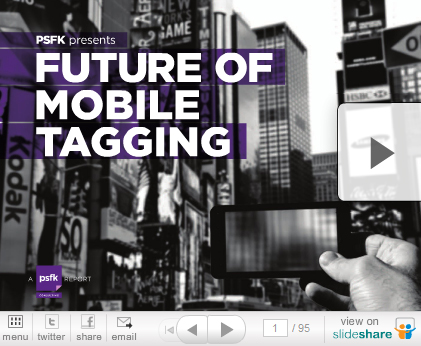
The Future of Mobile Tagging

.

The future of mobile tagging

From DSC:
How might this impact education? Hmmm…

Tagged with: • • •  
Tagged with:  

New iPhone app takes augmented reality to next level — from forbes.com by Parmy Olson

If you haven’t seen it already, Word Lens is a new iPhone app that instantly translates Spanish text into English and vice versa, via the medium of augmented reality. Watch the demo here…

From DSC:
This is one of the most useful, beneficial applications of augmented reality that I’ve seen! Very slick. If I were a world traveler, especially amongst Spanish-speaking countries, I’d have this app on my iPhone for sure.


Tagged with: •  


.

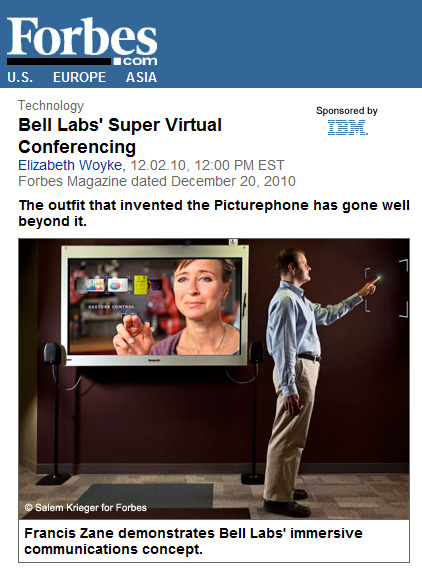
Gee Rittenhouse sees a future in which an executive running late for a meeting pulls his car to the side of the road and calls into a videoconference. He sets his phone on the dash and adjusts the settings so his image appears to the others as if he were in the same boardroom with everyone else. He chats with the people onscreen and pulls up a virtual PowerPoint, flipping through slides with a gestural swipe through the air. When it’s over, these people separated by thousands of miles go back to their physical surroundings having spent the last half hour feeling like they were a few feet apart in a conference room.

This vision is becoming reality at Bell Labs, where Rittenhouse is research chief. Alcatel-Lucent’s innovation shop, the same one that brought you the Picturephone in the 1960s under AT&T,  recently unveiled its great-grandchild, an application called immersive communications. It combines all the “realities” into one: physical, virtual and augmented (reality superimposed with sound or graphics).

© 2025 | Daniel Christian