What we’ve learned about e-learning and Generation Z –– from indigomultimedia.com with thanks to Mayra Aixa Villar for the Scoop on this

Excerpts/key points:

  1. Online is as important as offline to Gen Z
  2. Playing = Learning
  3. Digital DNA


FlixMaster changes model; becomes Rapt — from bcbr.com by Joshua Lindenstein

Excerpts:

BOULDER – Highlighting a shift toward a new model for its interactive online video platform, Boulder-based FlixMaster Inc. this week announced that it is changing its name to Rapt Media Inc.

…

“When we founded FlixMaster, we set out to create the best toolset for video creators wanting to build interactive videos, and we succeeded in doing that that,” Rapt co-founder and chief executive Erika Trautman said in an email.  “But as we partnered with really sophisticated companies (like HBO and Maybelline), we realized that our platform and the opportunity it posed was bigger than just interactive video. It was about improving online communication and storytelling through interactivity of all kinds, with video as the central component. Our company had already transitioned to this bigger vision, and we wanted a name that could reflect that vision.
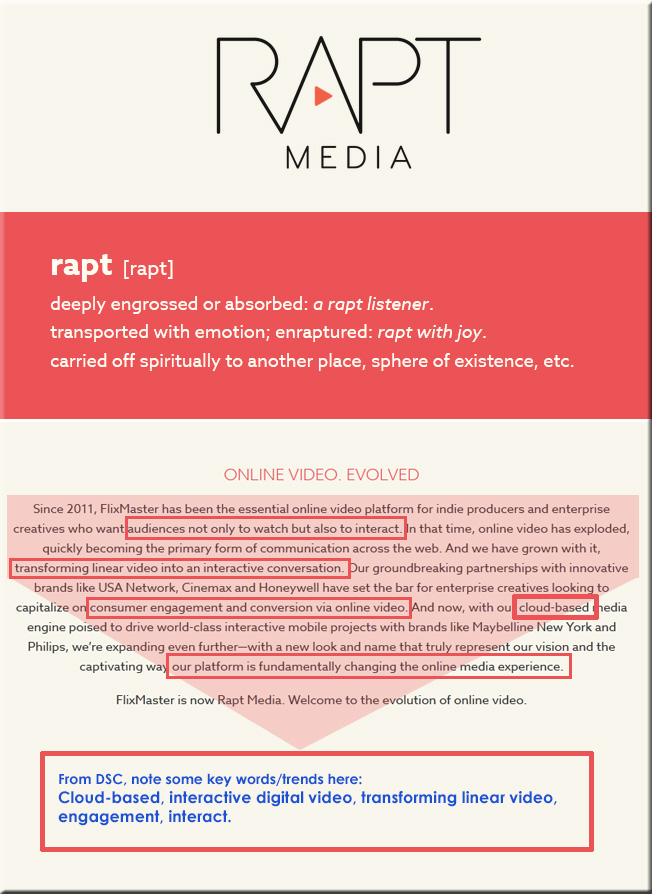
 

FlixMasterBecomingRapt-August2013


Additional thought from DSC:
This item relates to the convergence of the television, the computer, and the telephone that I’m pulse-checking. I’m hopeful that such a convergence will provide students in the future with 24×7, highly-engaging, interactive, customized/personalized content:

.

More choice. More control.


‘Shake Up’ for Higher Ed — from insidehighered.com by Scott Jaschik

Excerpt:

President Obama vowed Wednesday that he would soon unveil a plan to promote significant reform in higher education — with an emphasis on controlling what colleges charge students and families.

“[I]n the coming months, I will lay out an aggressive strategy to shake up the system, tackle rising costs, and improve value for middle-class students and their families. It is critical that we make sure that college is affordable for every single American who’s willing to work for it,” said Obama, in a speech at Knox College.

…

“Families and taxpayers can’t just keep paying more and more and more into an undisciplined system where costs just keep on going up and up and up. We’ll never have enough loan money, we’ll never have enough grant money, to keep up with costs that are going up 5, 6, 7 percent a year. We’ve got to get more out of what we pay for,” Obama said.

From DSC:
At a $175 billion per year support for postsecondary education, if the Federal Government starts redirecting this flow of $$$…I’ll bet we’ll see some change…and rather quickly I might add. 

The Walmart of Education (as predicted back in December 2008) is now here, but I don’t think we’ve seen anything yet. To what will we change? At least one major piece of the answer to that question is that we will see the continued — but increasing — use of teams of specialists that will be commissioned to create low-cost, highly-engaging content. Though expensive to create originally, such teams will more than make their money back because of the massive number of students such “courses” will serve.


From the Walmart of Education page on 4/11/09:

…I wanted to offer another idea that might help fund engaging, multimedia-based, online-based learning materials:
(NOTE: The figures I use are not accurate, but rather, they are used for illustration purposes only.)

Let’s reallocate funds towards course development, and then let’s leverage those learning materials throughout the world!

Reallocate funds to course development, and bring costs WAAAAYYYY down and ACCESS WAAAYYY  UP!

.

For students: Bring costs waaaayyyyy down and access waaayyy up!

Plus, no more defaulted loans, students could experience richer content, students wouldn’t have to wait as much on financial aid decisions. There would be fewer financial aid headaches; and the resources devoted to figuring out & processing financial aid could be reduced. The issue will be how an institution can differentiate itself in such a new world…but that issue will have to be dealt with in the future anyway.


How to make online courses massively personal — from scientificamerican.com by Peter Norvig
How thousands of online students can get the effect of one-on-one tutoring

Excerpt (emphasis DSC):

Educators have known for 30 years that students perform better when given one-on-one tutoring and mastery learning—working on a subject until it is mastered, not just until a test is scheduled. Success also requires motivation, whether from an inner drive or from parents, mentors or peers.

Will the rise of massive open online courses (MOOCs) quash these success factors? Not at all. In fact, digital tools offer our best path to cost-effective, personalized learning.

I know because I have taught both ways.

…

Inspired by Nobel laureate Herbert Simon’s comment that “learning results from what the student does and thinks and only from what the student does and thinks,” we created a course centered on the students doing things and getting frequent feedback. Our “lectures” were short (two- to six-minute) videos designed to prime the attendees for doing the next exercise. Some problems required the application of mathematical techniques described in the videos. Others were open-ended questions that gave students a chance to think on their own and then to hash out ideas in online discussion forums.

…

That is why a properly designed automated intelligent tutoring system can foster learning outcomes as well as human instructors can, as Kurt van Lehn found in a 2011 meta-analysis in Educational Psychologist.


From DSC:
A potential learning scenario in the future:

  1. “Learning Agent, go find me a MOOC (or what the MOOC will morph into) about ________.”
    Similar to a Google Alert, the Learning Agent returns some potential choices.  I select one.
    .
  2. Once there… “System,  let’s begin.”  I begin taking the online-based course — which is stocked full of a variety of media, some interactive, that I get to choose from for each module/item based upon my personal preferences — and the intelligent tutoring system kicks in and responses at relevant points based upon my questions, answers, responses. The system uses AI, data mining, learning analytics, to see how I’m doing. It tracks this for each student.  Humans regularly review the data to begin noticing patterns and to tweak the algorithms based upon these patterns.
    .
  3. If at any time I find the responses from the automated intelligent tutoring system confusing or weak, I will:
    • Make note of why I’m confused or disagree with the response (via an online-based form entry on the page; this feedback gets instantly sent to the Team of Specialists in charge of the “course.” They will use it to tweak the course/algorithms.)
    • Ask to speak with a person, at which point I am asked to choose whether my inquiry would best be handled by a Subject Matter Expert (SME) at $___/hour/request (more expensive price) or by an entry-level tutor (at a lower $___/hour/request).  I then enter into a videoconference-based tutoring session with them, and they can access my records and even take over my screen (if I let them).  Once I get my questions answered, I return to the course and continue.


From DSC:
A twist on the above scenario would be if a cohorted group of people — not age-based — met in a physical place/room and were able to bounce ideas off of each other before anyone ante’d up for additional expenses by contacting a tutor and/or an SME. They could even share the expenses of the “call” (so-to-speak).


From DSC:
I love multimedia because it enables me to craft a message using audio, video, text, graphics, and even animations.  The Internet extends the power of this communication by allowing that message to go forth 24 x 7 x 365 in multi-directional ways — even allowing others to join in the conversations and participate.

The following item made me reflect upon on how important this is becoming to business:

Excerpt:

How (and why) is Marketing Changing?
The first thing to understand about marketing today is that it’s all about shared experience. Consumer behavior is radically changing with respect to content consumption. No longer are people consuming most of their content on the TV, a newspaper, or even their computer. Rather, they are using a combination of channels:


From DSC:

  • Won’t this trend also impact students’ expectations/hopes/engagement?
  • What do we need to do to help youth build these skillsets?


Also related/see:

  • The rise, implications & benefits of the second screen — from newsworks.org.uk by Mark Challinor
    Telegraph Media Group’s director of mobile Mark Challinor says in this new era of second screens, news companies must create content that helps consumers to multi-task on multiple platforms with multiple devices.

Excerpt:
Watching television – or even reading a newspaper – with a smartphone and/or tablet device is becoming one of the most popular leisure activities of this “mobile age”. In turn, publishers such as ourselves are trying to find ways to capitalise on this somewhat new consumer behaviour of real-time interaction, which, more often than not, includes social media. This type of interaction, referred to as “the second screen” or “the companion device”, has become not just a latest hot topic of discussion all over social media blogs; it is a huge development for the mobile app industry and a target-rich environment for our advertisers.

  • Emerging markets’ second-screen boost with 1BN smart devices by 2014 — from rapidtvnews.com by Joseph O’Halloran
    Excerpt:
    New research by IDC has revealed that it won’t just be Western Europe and North America forming happy hunting grounds for second-screen services and applications. The analyst says it is clear that demand for smart connected devices is quickly shifting from developed to emerging markets and that by the end of 2014, global shipments of smart connected devices such as PCs, tablets, and smartphones will exceed surpass 1.7 billion units, with roughly one billion units delivered to emerging markets. The emerging markets are expected to grow at a compound annual growth rate (CAGR) of 17% over the 2012-2017 forecast period, compared to the 7% CAGR expected in developed markets.
 

Exploring curation as a core competency in digital and media literacy education — from the Journal of Interactive Media in Education (jime.open.ac.uk); with thanks to Robin Good for the Scoop

Paul Mihailidis
Department of Marketing Communication, Emerson College, United States

James N Cohen
School of Communication, Hofstra University, United States

Abstract:

In today’s hypermedia landscape, youth and young adults are increasingly using social media platforms, online aggregators and mobile applications for daily information use. Communication educators, armed with a host of free, easy-to-use online tools, have the ability to create dynamic approaches to teaching and learning about information and communication flow online. In this paper we explore the concept of curation as a student- and creation-driven pedagogical tool to enhance digital and media literacy education. We present a theoretical justification for curation and present six key ways that curation can be used to teach about critical thinking, analysis and expression online. We utilize a case study of the digital curation platform Storify to explore how curation works in the classroom, and present a framework that integrates curation pedagogy into core media literacy education learning outcomes.

From DSC:
The way we interact with digital video may never be the same again.  Consider the following developments/items:


.
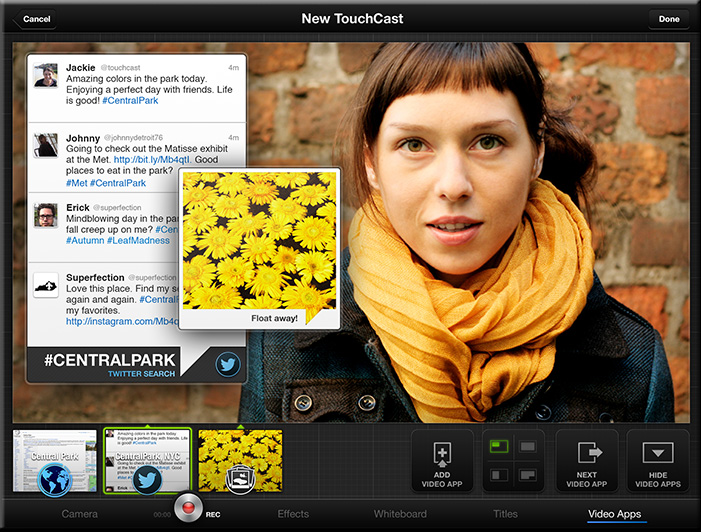
Touchcast2-July2013

Touchcast.com

.

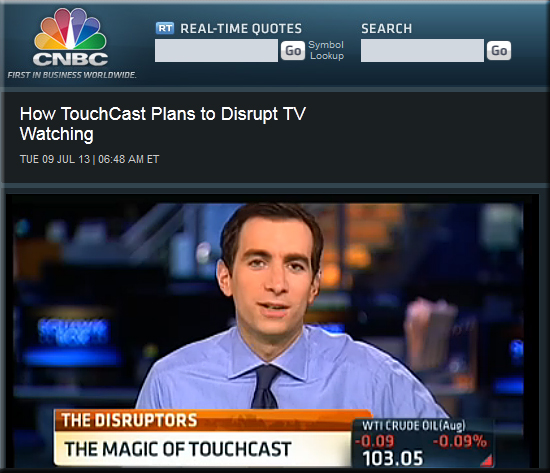
TouchcastDisruptsTVWatching-July2013

How TouchCast plans to disrupt TV watching

.

TouchCast: a television studio in your iPad — from agbeat.com by Jennifer Walpole .


Interlude2-July2013


interlude.fm

.

Interlude-July2013

.

Interactive video startup Interlude raises $16m from Intel, Sequoia and other big names — from thenextweb.com by Robin Wauters

.


FlixMaster2-July2013

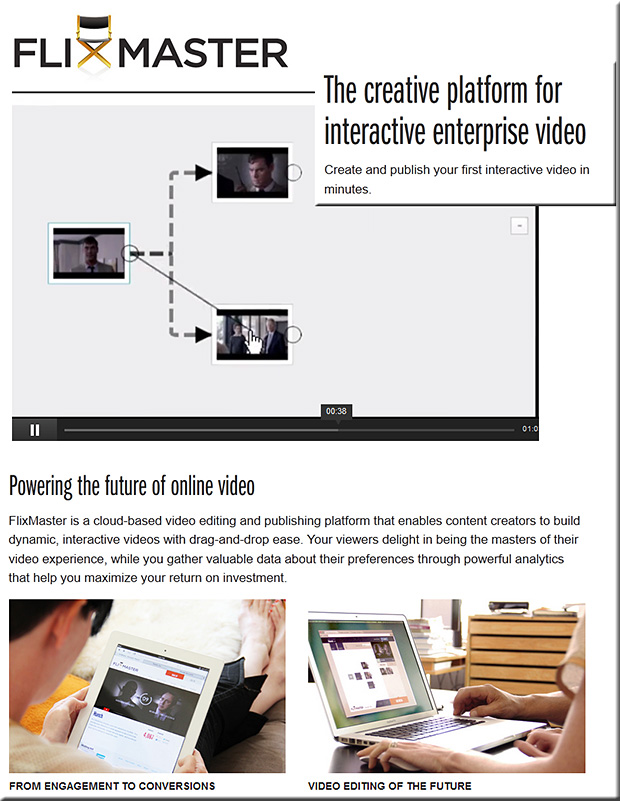
Flixmaster.com


.
  • What is MTEVIDEO?
    The Motion Touch Enabled Video platform allows you touch on the things that interest you as they move within video, adding them to your personal boutique so you can learn, shop, and share from any MTEVIDEO whenever you want.


With Cinematique’s ‘touch-enabled’, shoppable videos, product placement might not be so bad — from techcrunch.com by Anthony Ha


From DSC:
I sure hope that we can use these sorts of tools, concepts, and technologies within the educational/training-related realms! More choice. More control. Participation. Interactivity. Engagement.


From DSC:
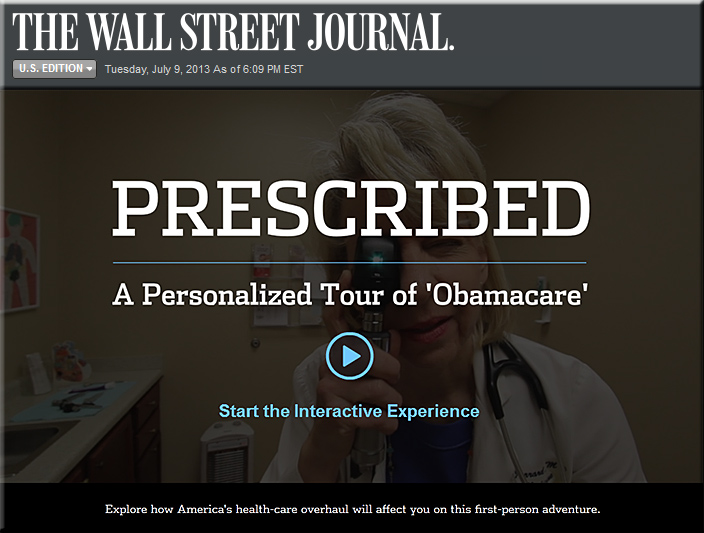
First, take a look at this interactive video from the Wall Street Journal:

.
WSJ-interactive-video-Obamacare-7-9-13


For further information on that video, you can also see:

  • ‘Obamacare’ Made Easy to Understand — from /live.wsj.com
    David Wessel discusses a new WSJ.com interactive video that helps viewers better understand the Affordable Health Care Act as well as its slate of rules and penalties.


WSJ-interactive-video-Obamacare2-7-9-13

.

From DSC:

Excellent, creative use of technology!   Lifelong learners of the world, let me hear some noise!  Your learning futures just got much more interesting, dynamic, and interactive! 

You will be given more choice and more control than you’ve ever had before. You will be able to interact with digital videos, drill down, take some rights turns and come back again, and more.

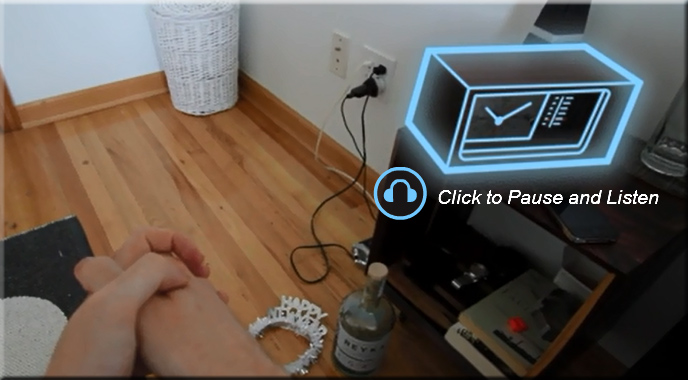
For example, during the WSJ video, you can click on the radio within the digital video in order to “drill down” and listen to more about a certain topic — while the main presentation “holds on”…
 

WSJ-interactive-video-Obamacare3-7-9-13


…you can jump ahead to the next marker…pause…rewind…click to get some further text-based information/details on a topic of interest:
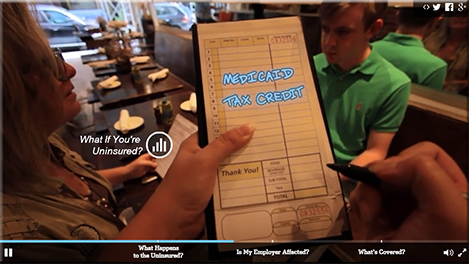
 

WSJ-interactive-video-Obamacare4-7-9-13


…and more. In other words, you have more choice, more control in your learning experience. This, at minimum, is a piece of online learning’s — and digital video’s — future.

But I hear you saying, so what? Flash has been doing this for a while now.  And that, my friends, is the only downside I see in this implementation from the WSJ — it was done using Flash. 

As Flash won’t fly on iOS-based devices, an HTML5-based solution needs to come into the picture…and this is where Touchcast shines!

.
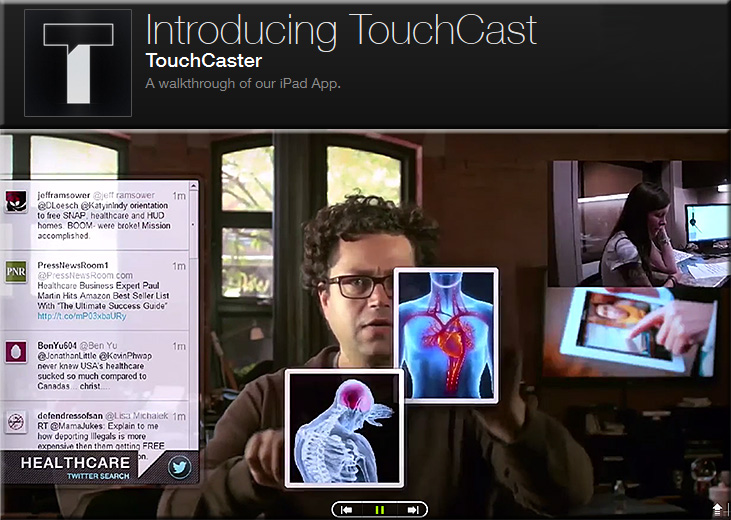
 

Touchcast-July2013


As Paul Sawers explains, you can add interactive, browsable layers onto your video and deliver it in an HTML5-based format.


d11 730x547 TouchCast for iPad brings the future of the Web to video authoring with interactive browsable layers

.

An excerpt from Paul’s article:

Things start to get really interesting with video apps (vApps). TouchCast lets you create videos that are layered with live Web pages, video clips, maps, Twitter streams and other facets of the digital world. “We’re actually claiming that this is the future of the Web,” says Segal, TouchCasts’s CEO.

Indeed, TouchCast’s vApp library is ‘open’, so developers can create and customize their own vApps.


Bottom line:
“Digital textbooks” will never be the same again (not to mention learning modules, transmedia, ads, presentations, digital storytelling, and more)!


Also see:


iPad still dominates in latest tablet web usage numbers — from ipadinsight.com by Patrick Jordan

From DSC:
This is especially important data given the ever increasing trend towards mobility as well as when you are considering which ecosystem(s) to build up and around (i.e. consider things such as BYOD, what apps and platforms your students are going to develop for, digital textbooks, smartphone/tablet-based “clickers,” etc.)


Here’s why the TV apps economy will be a $14 billion business [Wolf]

Here’s why the TV apps economy will be a $14 billion business — from forbes.com by Michael Wolf


.

Excerpt:

According to new research published this week, the TV apps economy is forecasted to reach $14 billion by 2017.

…

Take for example today’s news that Apple will begin selling video advertisements served by iAd through iTunes Radio loaded on Apple TVs. This is only the first move for Apple in this space, and others like Samsung and Google  are already investing heavily in connected TV app advertising.


From DSC:
Why post this? Because:

  • It lays out future directions/careers related to Programming, Computer Science, Data Mining, Analytics, Marketing, Telecommunications, User Experience Design, Digital and Transmedia Storytelling, and more
    .
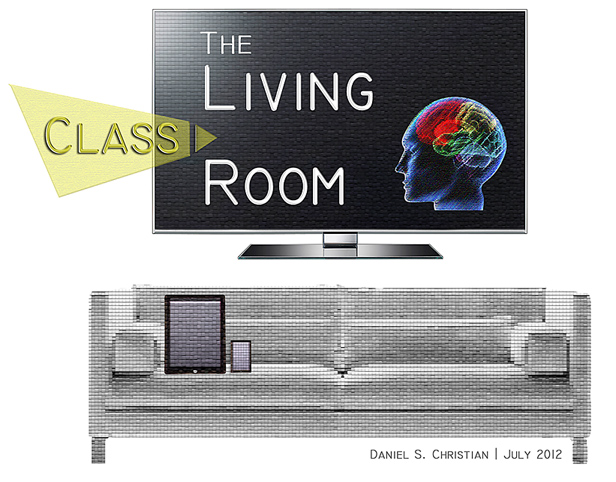
  • It leads to “Learning from the Living [Class] Room”

.


The Living [Class] Room -- by Daniel Christian -- July 2012 -- a second device used in conjunction with a Smart/Connected TV


From DSC:
And if this does take off,
$14 billion won’t begin to capture the profits from this new industry.

It will be far larger than that.


Relevant addendum on 6/27/13:

  • The future of cinema is on demand — from bitrebels.com by Ben Warner (From DSC: Having just paid $32 for 4 people — 3 of whom were kids — to see Monsters U, I believe it!)
    .

future-of-cinema-on-demand

Via: [The Verge] Image Credits: [Venture Beat] [Home Theater]


From DSC:

  • What if you want to allow some remote students to come on into your face-to-face classroom?
    .
  • What if you want to allow those remote students to be seen and communicated with at eye level?
    .
  • What if you want Remote Student A to join Group 1, and Remote Student B to join Group 2?
    .

Well…how about using one of these devices  in order to do so!


New video collaboration robot: TelePresence gets moving — from cisco.com by Dave Evans

Excerpt:

That is why Cisco’s new joint effort with iRobot—demonstrated publicly this week for the first time—is so exciting: We’ve created a mobile Cisco TelePresence unit that brings collaboration to you—or, conversely, brings you to wherever you need to collaborate. Called iRobot Ava 500, this high-definition video collaboration robot combines Cisco TelePresence with iRobot’s mobility and self-navigation capabilities, enabling freedom of movement and spontaneous interactions with people thousands of miles away.

.
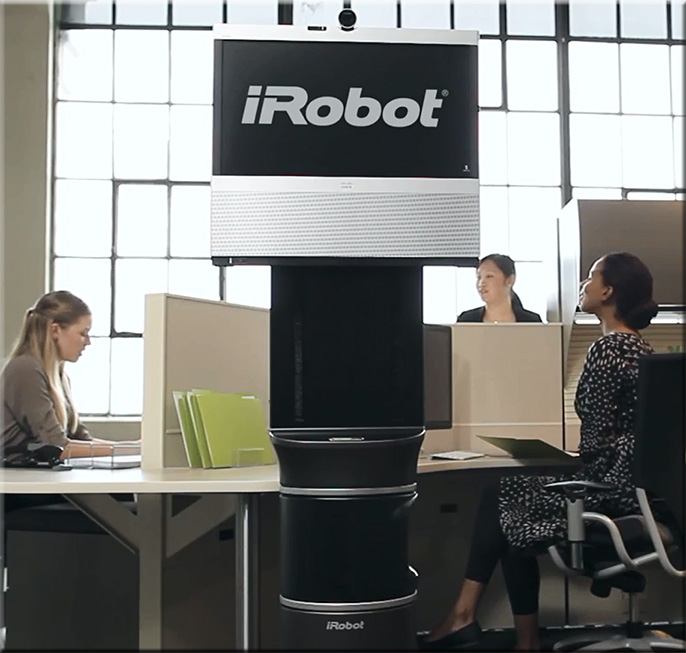
irobot-june-10-2013
.

iRobot Ava™ 500 Video Collaboration Robot — published on Jun 10, 2013
iRobot and Cisco have teamed to bring the Ava 500 video collaboration robot to market. The robot blends iRobot’s autonomous navigation with Cisco’s TelePresence to enable people working off-site to participate in meetings and presentations where movement and location spontaneity are important. The new robot is also designed to enable mobile visual access to manufacturing facilities, laboratories, customer experience centers and other remote facilities.


.

Double Robotics Double

http://www.doublerobotics.com/img/use-office.jpg


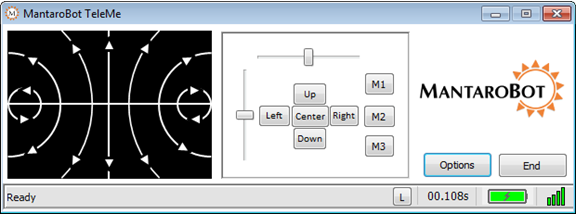
MantaroBot™ TeleMe


From Attack of the Telepresence Robots! — from BYTE  by Rick Lehrbaum

.

Kubi

http://twimgs.com/informationweek/byte/reviews/2013-Jan/robotic-telepresence/kubi.jpg


MantaroBot “TeleMe” VGo Communications “VGo” Anybots “QB” Suitable Technologies “Beam”


.

RP-7i ROBOT

RP-7i Remote Presence Robot


Also see:


The New Storytelling Frontier — from huffingtonpost.ca by Katherine Brodsky

Excerpts (emphasis DSC):

Long gone are the days of static content. Consumers are looking for more and transmedia storytelling offers an increasingly popular approach for creating property-based universes. Transmedia content itself is also evolving. It’s becoming more dynamic, more interactive, offering greater opportunities to engage audiences with creative user-generated content that adds to the storytelling experience. It is becoming more communal.

…

Although traditional models allow for greater control of content, strategies that can engage fans more actively and allow them to express themselves and even contribute to the development of a show, get them more involved and, ultimately, more willing to buy in.


From DSC:
As the use of storytelling is a powerful tool for learning, I can’t help but wonder…

  • What might be some creative possibilities arising from the developing world of transmedia that students and/or educational organizations could develop?
  • In what ways could we build more interactivity and social networking into our “digital textbooks” and mobile-based applications?
  • Would transmedia-based content help maintain interest, engagement, attention?
  • Would it help establish longer term memories/recall?
  • How might it help build students creativity and foster more experimentation/play/participation?
  • What roles might students play? (Writer, videographer, sound designer, actress, programmer, game designer, project manager, entrepreneur, etc.)
  • What tools and skills would students need to create their own transmedia-based experiences?
  • What new forms of storytelling might evolve from these efforts?
  • Could transmedia work its way into blended learning models?
  • Are new opportunities for immersing oneself in a particular subject matter becoming more available through transmedia-based experiences?
  • Could streams of content be wrapped in transmedia-based experiences?


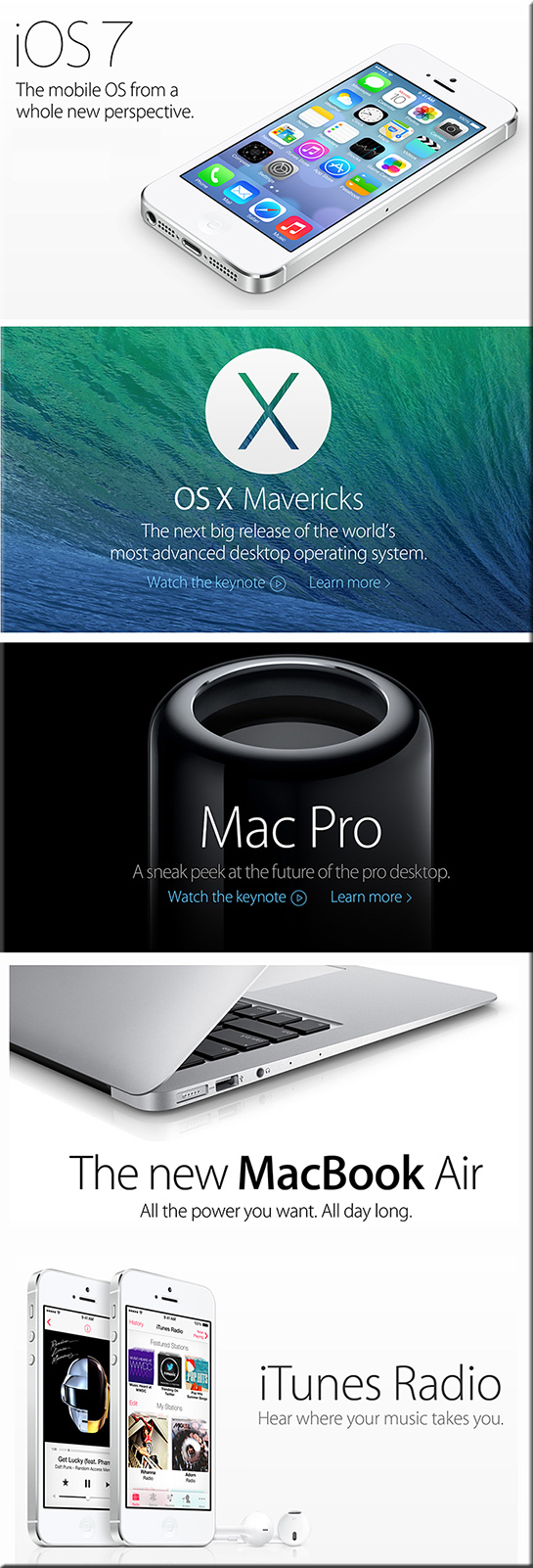
AppleWWDC-June10-2013


Also see:


  • The Best Features Of iOS 7 — from techcrunch.com by Sarah Perez
    .
  • Everything You Need to Know about iOS 7 — from hongkiat.com
    Excerpts:
    iBooks is now available on the Mac, giving users access to 1.8 million books including interactive textbooks.
    .
    AirDrop Sharing Between iOS Devices <– potential uses in the Smart Classrooms…?
    AirDrop is now available for transfers between iOS devices via peer-to-peer WiFI connection. Turning on the Share Sheet on an app, you can find users who are nearby and tap items to share. A notification will appear on their device and when they open it, it will open to the relevent app and show the content that you shared.
    .
  • Apple’s WWDC 2013 Keynote: Highlights, Summary & History — from hongkiat.com by Singyin Lee
    Excerpt:
    Multiple Display <– potential uses in the Smart Classrooms…?
    Multiple Display support allow you to work on, multiple screens, even though only one device is physically connected, even if it means you are using Apple TV as one of your screens. Full screen spaces can be pulled from one display to the next and the dock and other menus will be displayed on each connected screen as well.
    .


.


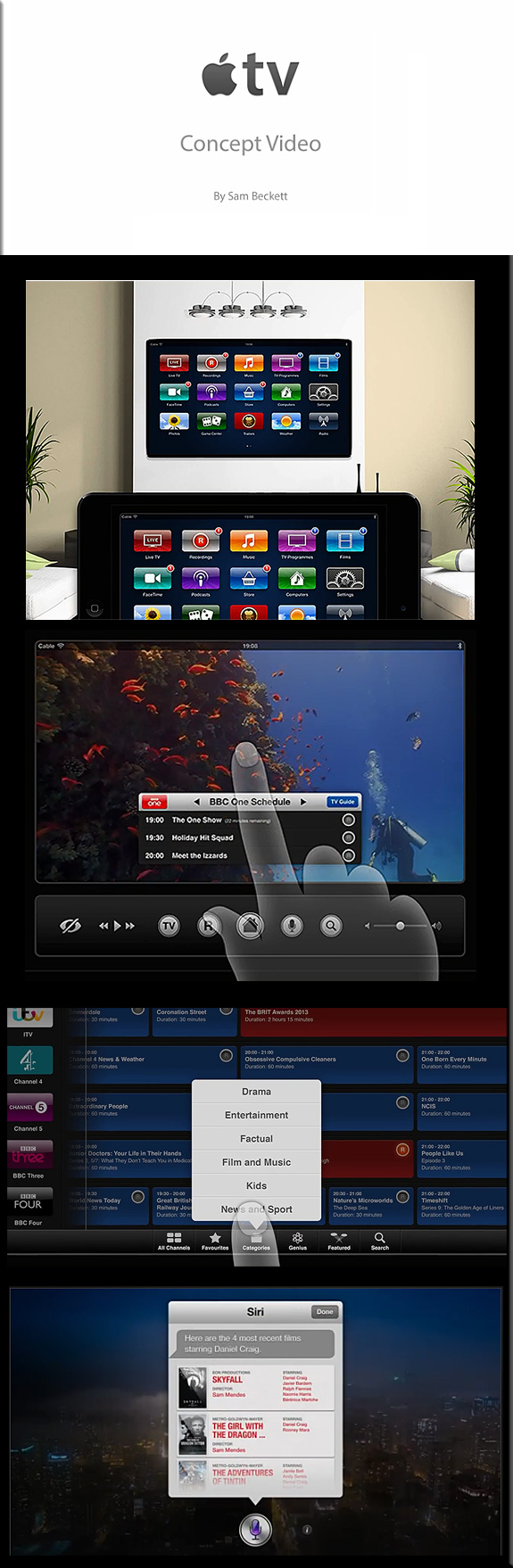
Heads up Jony Ive! You need to see this brilliant concept for the Apple TV! Superb work by Sam Beckett!

BrilliantTVConceptBySamBeckett-May2013


.

From DSC:
Now picture this from the educational standpoint — and what MOOCs could morph into.  The foundation for some serious learning power (from the living room) seems to be developing!

Streams of content/learning channels/cloud-based applications that each of us can create and make available.

Voice recognition, learning analytics, machine-to-machine communications, transmedia and more!  Wow!


.
 

The Living [Class] Room -- by Daniel Christian -- July 2012 -- a second device used in conjunction with a Smart/Connected TV


© 2025 | Daniel Christian