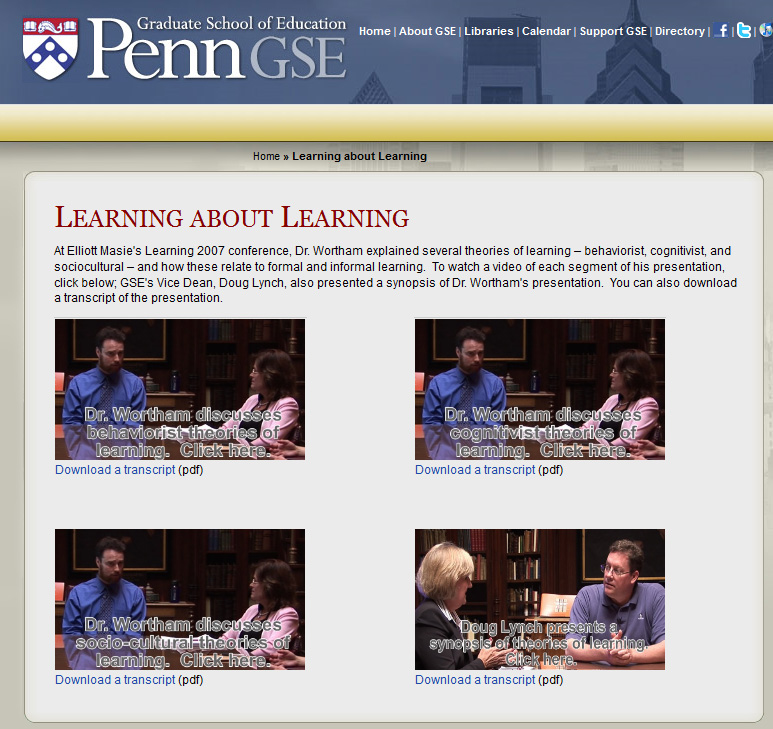
Excellent resource for understanding the basics of a various learning theories!

From DSC:
I’d like to thank:

  • Doug Lynch, Dr. Stanton Wortham, and Elliott Masie for recording these videos and for sharing their insights/expertise
  • The University of Pennsylvania for making these items available
  • Capella University for including the above resource in a course that I’m currently taking from Dr. Katherine Emmons entitled, “Learning Theory and the Educational Process.”

2/8/11:
Note/correction from my original posting:

Doug Lynch and Stanton Wortham are not at Penn State, but rather they are at the University of Pennsylvania; Elliot Masie is an Adjunct Faculty Member at the University of Pennsylvania.
eLearning predictions for 2011 and beyond — from Web Courseworks.com by Jon Aleckson

Excerpts:

This summer I attended the 2010 Distance Teaching and Learning Conference in Madison, Wisconsin. Some very interesting topics came up in the facilitated Think Tanks, and I wanted to share some of the predictions that were developed from these active group discussions regarding where eLearning will go in the next ten years.

Below you will find a table that summarizes the different opportunities and challenges that were predicted to arise in the next ten years by the participants in the conference Think Tanks and by [Jon Aleckson].

Opportunities Challenges
Learner
  1. Bridging informal and formal education
  2. Movement between schools to obtain courses needed for custom degrees
  3. Increase in shared knowledge among students and learners
  4. Networking and learning from each other
  5. Resumes will include informal and formal learning experiences acquired via the Internet
  1. Developing standards to gauge education and competency from multiple sources
  2. Providing an authoritative, reliable source for information (e.g. not just Wikipedia)
  3. Physical and psychological distance from other learners and instructors.
  4. Quality measures for informal and formal professional development attained on the Internet.
K-12 Instruction
  1. Reducing barriers to funding, certification, credit and accreditation
  2. Increase access to quality education for all students
  3. Open “course” concept to new blends of delivery and teaching
  4. Providing for more game-based learning experiences and techniques for a variety of learning styles
  5. Using new technology in the classroom
  1. Defining online and blended education
  2. Development of technical infrastructure, internet access and equipment
  3. Maintaining the custodial function of school
  4. Acquiring funding for bold Internet delivered experiences for the classroom
  5. Allowing use of new technology in the classroom
Corporate Training
  1. Just-in-time learning
  2. Greater access to information
  3. Peer coaching
  4. Cloud training
  5. Ability to reach those previously unreachable
  1. Intellectual property rights
  2. Resistance to using open content
  3. Peer review of resources
  4. Unknown impact of open universities
  5. Technical challenges related to size of offerings and rapidly changing technology
Content
  1. Tools allowing for easier collaboration and interaction
  2. Richer media experience (videos and simulations)
  3. Content repositories & Learning Object distribution and searchability
  4. Movement away from static textbooks as primary resource
  1. Growing tension between standard core content and differentiation of content
  2. Where will content for curriculum come from?
  3. What part will student-generated content play?
  4. More copyright issues
Learning Environment
  1. Customized learning spaces, i.e. personal learning environments (PLEs)
  2. Customization of content presentation and access
  3. eReaders and eBooks providing better and more interactive content (just in time)
  4. Changing paradigm of “bounded courses” to unbounded courses where learning is a continuous process that can occur anywhere and at any time
  1. Determining fit and purpose of new tools and pedagogical approaches
  2. Standards for smart phones/mobile apps
  3. Issues with accreditation, privacy and copyrights
  4. Universal access to technology, equipment, and the internet
Faculty
  1. More involvement and collaboration with online and distance learning initiatives
  2. More part-time faculty teaching for several institutions
  3. Faculty practices and entrepreneurs
  4. Changing role of faculty and PD instructors
  1. What will the primary role of faculty be?
  2. Faculty segmentation into master teachers, mentors, researchers, tutors, etc.
  3. Changing of promotion and tenure to accommodate different roles
  4. Changing pay structure
Administration
&
Management
  1. Continued growth of open education with some program stabilization
  2. Improved learner focus
  3. Increased blending/blurring of traditional on-campus with online options
  4. More collaboration with other administrators to influence policy makers
  1. Managing and maintaining growth
  2. How to blend on and off campus learner programs
  3. Regulatory and accreditation issues
  4. Student accountability issues (plagiarism/doctoring)
  5. Improving faculty/ instructor readiness
International Perspectives
  1. Providing access to education even to remote, rural, and developing areas
  2. Promote intercultural mixing and diversity through education
  3. Improving educational access in segregated societies
  4. Sharing resources and co-producing content to reduce cost
  5. Serve new growing customer groups
  6. Informal learning, sharing own learning with others via internet (e.g. blogs, wiki)
  1. Technological infrastructure of societies
  2. Understanding of different people and places
  3. Eliminating the “we and they” thinking
  4. Illiterate audiences
  5. International/cultural conflicts
  6. Developing culturally aware curricula
  7. Differences in cost of education and fees
  8. Selecting suitable types of content delivery
  9. Refiguring content for different learner communities

Corporate Learning’s focus — from Harold Jarche

Q1) Close to 80% of learning happens informally and 20% formally, yet we spend most of our time and money on the 20%. How could we better support this and shift our time and money?

There are a few ways to address this imbalance…

Q2) Novices and experts have very different needs (curve from formal to informal). What needs to be in place to better support those differences? How can we support these differences across diverse business units (sales, service and specialized functions)?

Jay Cross and Clark Quinn have used this to explain the formal/informal mix by level of experience…

Q3) How can we shift from teaching content to developing search & find skills, critical thinking skills, creative thinking skills, analytical skills, networking skills, people skills, and reasoning and argument skills?

Organizations should start with…

Learning 2010 -- free ebook from the Masie Center.

Part I: New Learning Frameworks
Part II: Under30 Perspectives
Part III: Learning in Action
Part IV: Learning Changes

From Elliott Masie:

We are pleased to announce a free, Open-Source, eBook for and by Learning Professionals:

“Learning Perspectives: 2010” | Contributions by 40 Global Learning Leaders | http://www.learning2010.com/ebook

The articles in this eBook cover the wide range of viewpoints and perspectives on the changing nature of Learning.  It includes articles from our 30 Under 30 Learning Leaders.  Contributors from Google, Intel, Lockheed Martin, Accenture, Alliance Pipeline, Farmers Insurance, Veterans Administration, Cleveland Clinic, CNN, Liberty Mutual, CIA, Luxotica and many more.

“Learning Perspectives: 2010” is published by The MASIE Center as an Open Source ebook and will also be distributed in hard copy format to every attendee at the upcoming Learning 2010 event to be held in Orlando, starting on October 24th. Note: “Last Minute” Registration Rates available for Learning 2010 – http://www.learning2010.com

Download your copy of “Learning Perspectives: 2010” at http://www.learning2010.com/ebook

5 Stages of Workplace Learning — from Jane Hart

I interrupt my series of postings on Collaboration Platforms, to talk a little about the stages of Workplace Learnng

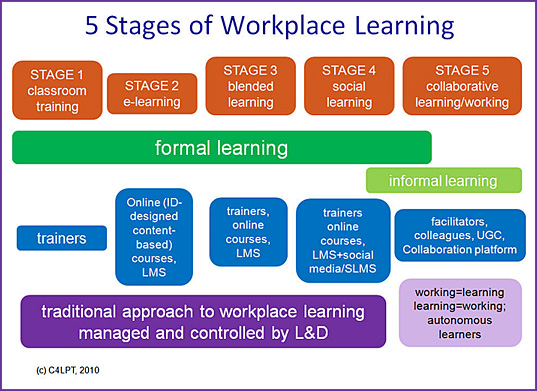
As I have read the comments on my recent postings as well as tweets and postings on other blogs,  I’ve identified what I think are 5 main stages of workplace learning.  I’ve tried to capture these,  in a very rough and ready way, in the diagram below.

5 Stages of Workplace Learning

But some of the key mindset changes that will move organisations into Stage 5 are:

  • recognising that working=learning; learning=working
  • understanding that informal learning needs to be enabled, supported and encouraged – but not designed or managed
  • “letting go”, so that there is a move from learner control to learner autonomy
  • realising that autonomous, independent and inter-dependent, self-directed learners are essential  in an agile organisation

More here…

© 2025 | Daniel Christian