From DSC:
I love multimedia because it enables me to craft a message using audio, video, text, graphics, and even animations.  The Internet extends the power of this communication by allowing that message to go forth 24 x 7 x 365 in multi-directional ways — even allowing others to join in the conversations and participate.

The following item made me reflect upon on how important this is becoming to business:

Excerpt:

How (and why) is Marketing Changing?
The first thing to understand about marketing today is that it’s all about shared experience. Consumer behavior is radically changing with respect to content consumption. No longer are people consuming most of their content on the TV, a newspaper, or even their computer. Rather, they are using a combination of channels:


From DSC:

  • Won’t this trend also impact students’ expectations/hopes/engagement?
  • What do we need to do to help youth build these skillsets?


Also related/see:

  • The rise, implications & benefits of the second screen — from newsworks.org.uk by Mark Challinor
    Telegraph Media Group’s director of mobile Mark Challinor says in this new era of second screens, news companies must create content that helps consumers to multi-task on multiple platforms with multiple devices.

Excerpt:
Watching television – or even reading a newspaper – with a smartphone and/or tablet device is becoming one of the most popular leisure activities of this “mobile age”. In turn, publishers such as ourselves are trying to find ways to capitalise on this somewhat new consumer behaviour of real-time interaction, which, more often than not, includes social media. This type of interaction, referred to as “the second screen” or “the companion device”, has become not just a latest hot topic of discussion all over social media blogs; it is a huge development for the mobile app industry and a target-rich environment for our advertisers.

  • Emerging markets’ second-screen boost with 1BN smart devices by 2014 — from rapidtvnews.com by Joseph O’Halloran
    Excerpt:
    New research by IDC has revealed that it won’t just be Western Europe and North America forming happy hunting grounds for second-screen services and applications. The analyst says it is clear that demand for smart connected devices is quickly shifting from developed to emerging markets and that by the end of 2014, global shipments of smart connected devices such as PCs, tablets, and smartphones will exceed surpass 1.7 billion units, with roughly one billion units delivered to emerging markets. The emerging markets are expected to grow at a compound annual growth rate (CAGR) of 17% over the 2012-2017 forecast period, compared to the 7% CAGR expected in developed markets.
 

From DSC:
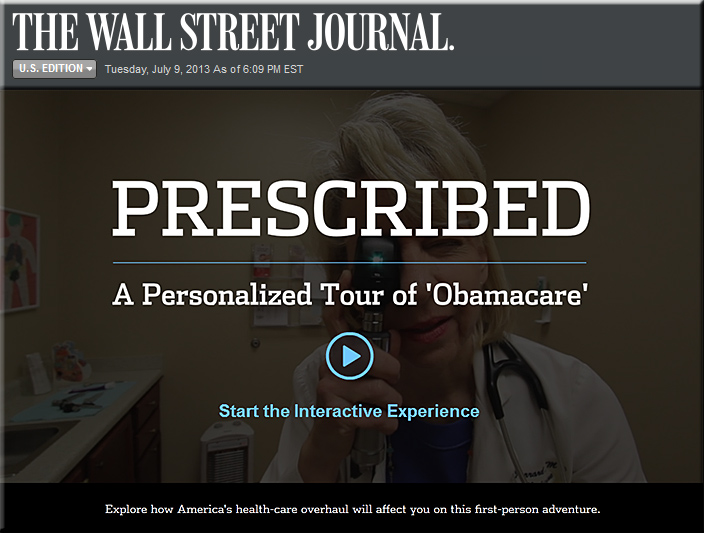
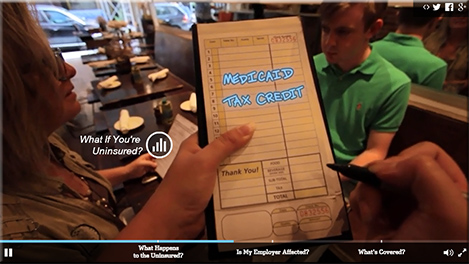
First, take a look at this interactive video from the Wall Street Journal:

.

WSJ-interactive-video-Obamacare-7-9-13


For further information on that video, you can also see:

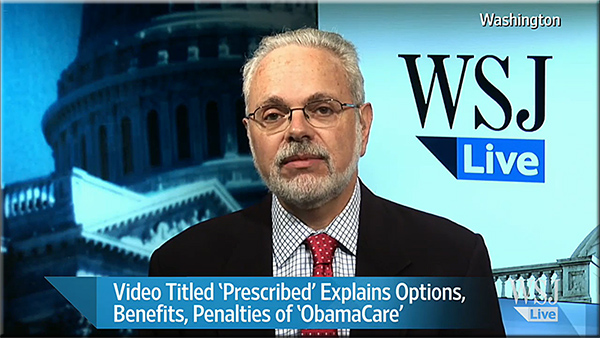
  • ‘Obamacare’ Made Easy to Understand — from /live.wsj.com
    David Wessel discusses a new WSJ.com interactive video that helps viewers better understand the Affordable Health Care Act as well as its slate of rules and penalties.


WSJ-interactive-video-Obamacare2-7-9-13

.

From DSC:

Excellent, creative use of technology!   Lifelong learners of the world, let me hear some noise!  Your learning futures just got much more interesting, dynamic, and interactive! 

You will be given more choice and more control than you’ve ever had before. You will be able to interact with digital videos, drill down, take some rights turns and come back again, and more.

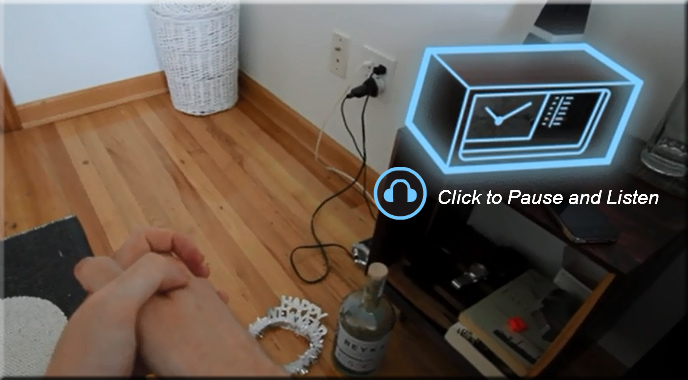
For example, during the WSJ video, you can click on the radio within the digital video in order to “drill down” and listen to more about a certain topic — while the main presentation “holds on”…


WSJ-interactive-video-Obamacare3-7-9-13


…you can jump ahead to the next marker…pause…rewind…click to get some further text-based information/details on a topic of interest:


WSJ-interactive-video-Obamacare4-7-9-13


…and more. In other words, you have more choice, more control in your learning experience. This, at minimum, is a piece of online learning’s — and digital video’s — future.

But I hear you saying, so what? Flash has been doing this for a while now.  And that, my friends, is the only downside I see in this implementation from the WSJ — it was done using Flash. 

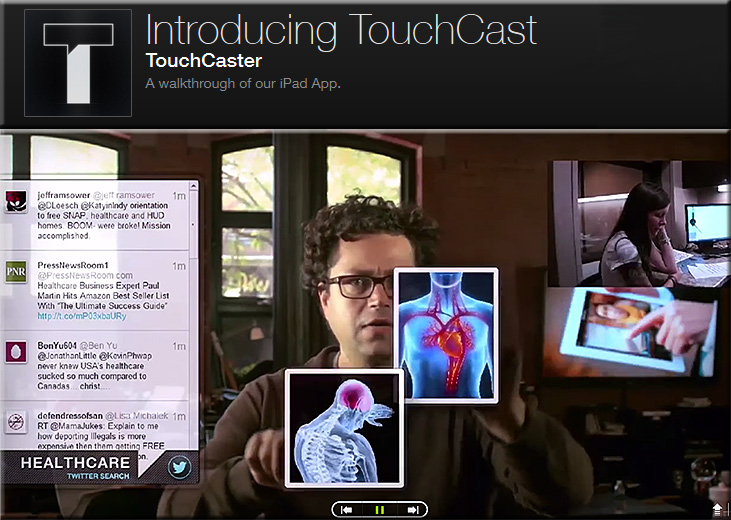
As Flash won’t fly on iOS-based devices, an HTML5-based solution needs to come into the picture…and this is where Touchcast shines!

.


Touchcast-July2013


As Paul Sawers explains, you can add interactive, browsable layers onto your video and deliver it in an HTML5-based format.


d11 730x547 TouchCast for iPad brings the future of the Web to video authoring with interactive browsable layers

.

An excerpt from Paul’s article:

Things start to get really interesting with video apps (vApps). TouchCast lets you create videos that are layered with live Web pages, video clips, maps, Twitter streams and other facets of the digital world. “We’re actually claiming that this is the future of the Web,” says Segal, TouchCasts’s CEO.

Indeed, TouchCast’s vApp library is ‘open’, so developers can create and customize their own vApps.


Bottom line:
“Digital textbooks” will never be the same again (not to mention learning modules, transmedia, ads, presentations, digital storytelling, and more)!


Also see:


ISTE keynote: Gaming has huge educational potential — from eschoolnews.com by Laura Devaney
Speaker Jane McGonigal outlined gaming’s engagement-boosting qualities during ISTE 2013’s opening session
Excerpt:

But what is it that gamers get out of gaming that makes the hobby so appealing, and how can we give that to students in classrooms? In McGonigal’s 12 years of gaming research, she said, 10 emotions are regularly associated with gaming: joy, relief, love, surprise, pride, curiosity, excitement, awe and wonder, contentment, and, most of all, creativity.


ISTE 2013: How will MOOCs affect your K-12 classroom? — from eschoolnews.com by Meris Stansbury
Experts say high schools are about to get a MOOC awakening
Excerpt:

According to Garrigan, last summer (2012) high school teens completed more than 15,000 courses from Udacity, a MOOC platform.

“Clayton Christensen also predicted in his book, Disrupting Class, that by 2019, 50 percent of all high school courses will be online. I believe it,” he emphasized.

Many factors contribute to MOOC success, explained Garrigan, with the basic understanding that people want to learn.

“Lots of people want to learn if they think it’s interesting and there’s no risk,” he said.


Technologies that are changing and will change the world — from eschoolnews.com by Laura Devaney


Harnessing the power of tablets and apps for young students — from eschoolnews.com by Laura Devaney


10 engaging ed-tech booths at ISTE 2013 — from eschoolnews.com by Meris Stansbury


International Society for Technology in Education (ISTE) 2013


Using the iPad with a Projector — from palomar.edu by Terry Gray; note that this is from 8/24/12

For a wireless solution:


.

AppleTV Diagram


or for a wired solution:


VGA Adapter


Also see:

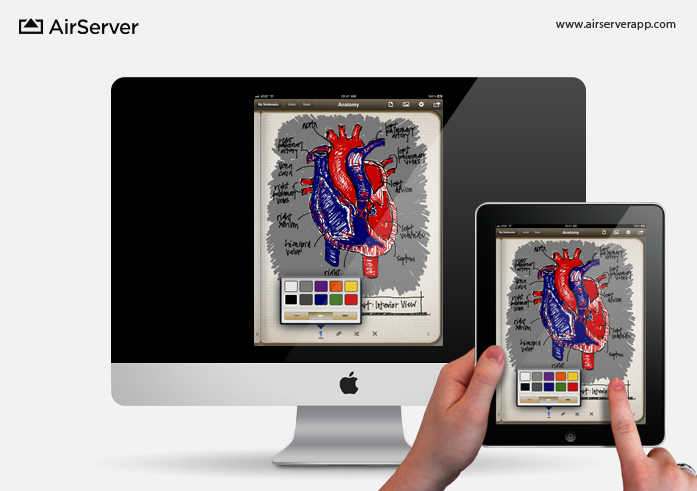
AirServer


AirServer: iPad in the classroom


Education

There are times when you need to show content to your class to engage your audience, using an iPad. With AirServer you can wirelessly beam your iPad display to your Mac or PC and from there to your projector, smartboard or HDTV. This gives you the freedom to move around the class with your iPad in hand. AirServer also supports multiple simultaneous connections, so one or more students could mirror their iPads to share their ideas and their work with the rest of the class.

Educational environments vary, not just in size and lighting but in network security and access. To solve these issues we’ve added features such as picture enhancement settings and password protection.

Summary

  • Beam your iPad or iPhone screen to HDMI or VGA projector, smartboard or HDTV via a Mac or PC
  • True full screen display
  • Picture enhancement settings
  • Secure password protection
  • Collaborate with students using simultaneous connections


From DSC:
Wouldn’t it be great if students could “beam up” their content from any device, from anywhere?  i.e. Whether they be in a face-to-face classroom, at a remote location, or out traveling?


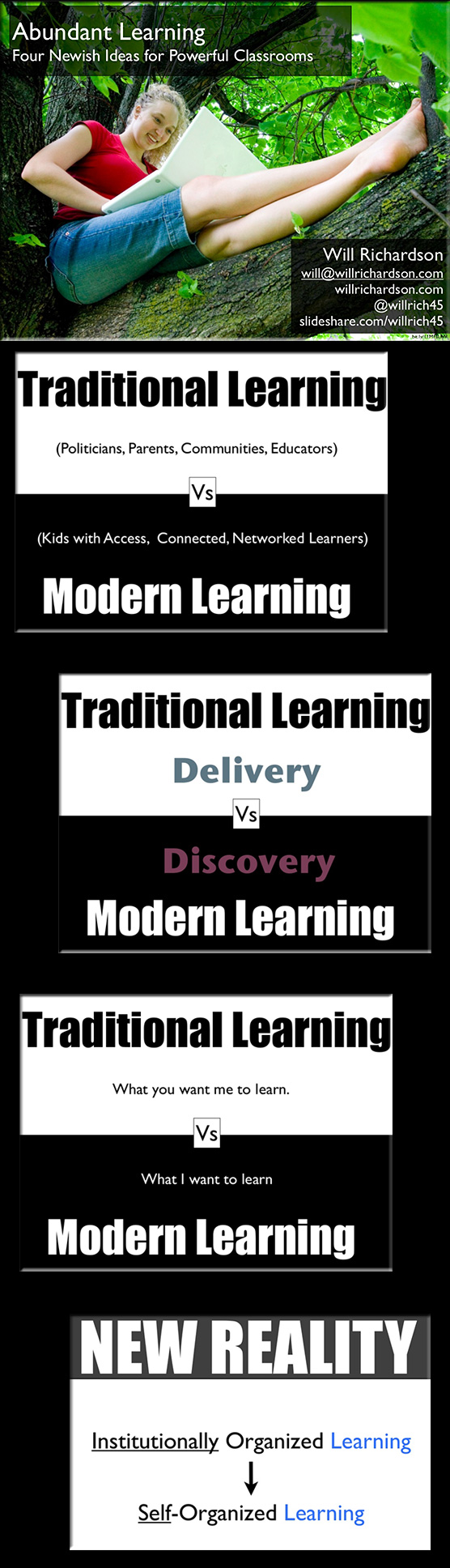
Example slides from
Will Richardson’s solid presentation at ISTE 2013, entitled ” Abundant Learning: Four newish ideas for powerful classrooms”


AbundantLearning-WillRichardson-June2013


From DSC:
This idea of self-directed/owned learning is spot on — and not just for those in K-12, but also for those in higher education and for those in the corporate world as well! It unleashes an enormous amount of intrinsic energy, motivation, drive, grit.

Each person needs to own and build their learning ecosystem — identifying one’s gifts, talents, passions, interests and then going out and developing those things.  If we each do what we do best, the whole world benefits.  As we will need others along the way — a team-based approach, communities of practice, and several of the other things/skills Will alluded to will be very important as well.


iPad still dominates in latest tablet web usage numbers — from ipadinsight.com by Patrick Jordan

From DSC:
This is especially important data given the ever increasing trend towards mobility as well as when you are considering which ecosystem(s) to build up and around (i.e. consider things such as BYOD, what apps and platforms your students are going to develop for, digital textbooks, smartphone/tablet-based “clickers,” etc.)


Here’s why the TV apps economy will be a $14 billion business [Wolf]

Here’s why the TV apps economy will be a $14 billion business — from forbes.com by Michael Wolf


.

Excerpt:

According to new research published this week, the TV apps economy is forecasted to reach $14 billion by 2017.

Take for example today’s news that Apple will begin selling video advertisements served by iAd through iTunes Radio loaded on Apple TVs. This is only the first move for Apple in this space, and others like Samsung and Google  are already investing heavily in connected TV app advertising.


From DSC:
Why post this? Because:

  • It lays out future directions/careers related to Programming, Computer Science, Data Mining, Analytics, Marketing, Telecommunications, User Experience Design, Digital and Transmedia Storytelling, and more
    .
  • It leads to “Learning from the Living [Class] Room”

.


The Living [Class] Room -- by Daniel Christian -- July 2012 -- a second device used in conjunction with a Smart/Connected TV


From DSC:
And if this does take off,
$14 billion won’t begin to capture the profits from this new industry.

It will be far larger than that.


Relevant addendum on 6/27/13:

  • The future of cinema is on demand — from bitrebels.com by Ben Warner (From DSC: Having just paid $32 for 4 people — 3 of whom were kids — to see Monsters U, I believe it!)
    .

future-of-cinema-on-demand

Via: [The Verge] Image Credits: [Venture Beat] [Home Theater]


From DSC:

  • What if you want to allow some remote students to come on into your face-to-face classroom?
    .
  • What if you want to allow those remote students to be seen and communicated with at eye level?
    .
  • What if you want Remote Student A to join Group 1, and Remote Student B to join Group 2?
    .

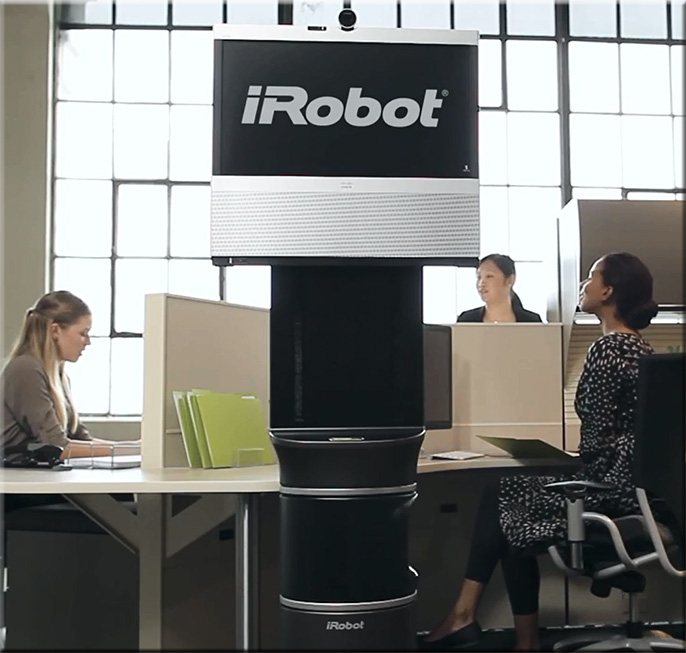
Well…how about using one of these devices  in order to do so!


New video collaboration robot: TelePresence gets moving — from cisco.com by Dave Evans

Excerpt:

That is why Cisco’s new joint effort with iRobot—demonstrated publicly this week for the first time—is so exciting: We’ve created a mobile Cisco TelePresence unit that brings collaboration to you—or, conversely, brings you to wherever you need to collaborate. Called iRobot Ava 500, this high-definition video collaboration robot combines Cisco TelePresence with iRobot’s mobility and self-navigation capabilities, enabling freedom of movement and spontaneous interactions with people thousands of miles away.

.

irobot-june-10-2013
.

iRobot Ava™ 500 Video Collaboration Robot — published on Jun 10, 2013
iRobot and Cisco have teamed to bring the Ava 500 video collaboration robot to market. The robot blends iRobot’s autonomous navigation with Cisco’s TelePresence to enable people working off-site to participate in meetings and presentations where movement and location spontaneity are important. The new robot is also designed to enable mobile visual access to manufacturing facilities, laboratories, customer experience centers and other remote facilities.


.

Double Robotics Double

http://www.doublerobotics.com/img/use-office.jpg


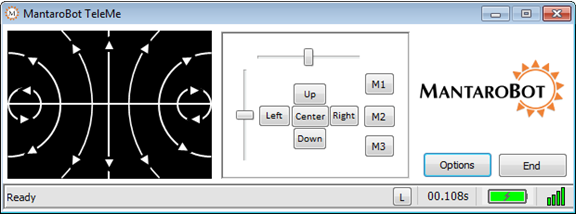
MantaroBot™ TeleMe


From Attack of the Telepresence Robots! — from BYTE  by Rick Lehrbaum

.

Kubi

http://twimgs.com/informationweek/byte/reviews/2013-Jan/robotic-telepresence/kubi.jpg


MantaroBot “TeleMe” VGo Communications “VGo” Anybots “QB” Suitable Technologies “Beam”


.

RP-7i ROBOT

RP-7i Remote Presence Robot


Also see:


The New Storytelling Frontier — from huffingtonpost.ca by Katherine Brodsky

Excerpts (emphasis DSC):

Long gone are the days of static content. Consumers are looking for more and transmedia storytelling offers an increasingly popular approach for creating property-based universes. Transmedia content itself is also evolving. It’s becoming more dynamic, more interactive, offering greater opportunities to engage audiences with creative user-generated content that adds to the storytelling experience. It is becoming more communal.

Although traditional models allow for greater control of content, strategies that can engage fans more actively and allow them to express themselves and even contribute to the development of a show, get them more involved and, ultimately, more willing to buy in.


From DSC:
As the use of storytelling is a powerful tool for learning, I can’t help but wonder…

  • What might be some creative possibilities arising from the developing world of transmedia that students and/or educational organizations could develop?
  • In what ways could we build more interactivity and social networking into our “digital textbooks” and mobile-based applications?
  • Would transmedia-based content help maintain interest, engagement, attention?
  • Would it help establish longer term memories/recall?
  • How might it help build students creativity and foster more experimentation/play/participation?
  • What roles might students play? (Writer, videographer, sound designer, actress, programmer, game designer, project manager, entrepreneur, etc.)
  • What tools and skills would students need to create their own transmedia-based experiences?
  • What new forms of storytelling might evolve from these efforts?
  • Could transmedia work its way into blended learning models?
  • Are new opportunities for immersing oneself in a particular subject matter becoming more available through transmedia-based experiences?
  • Could streams of content be wrapped in transmedia-based experiences?


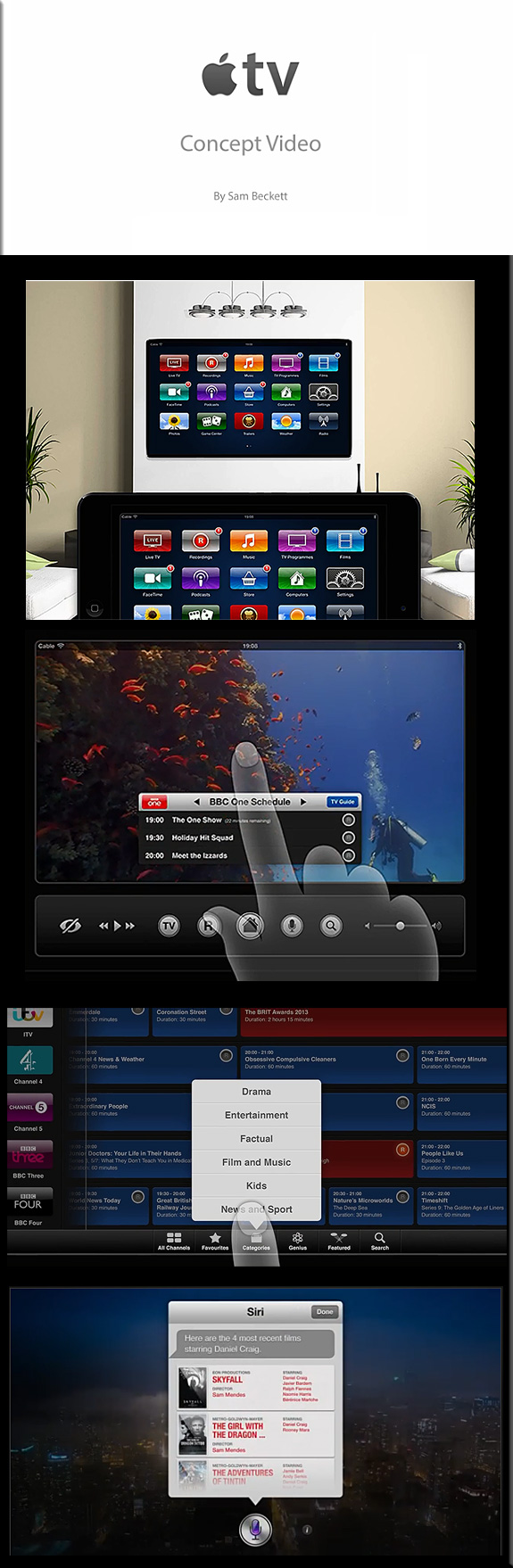
Heads up Jony Ive! You need to see this brilliant concept for the Apple TV! Superb work by Sam Beckett!

BrilliantTVConceptBySamBeckett-May2013


.

From DSC:
Now picture this from the educational standpoint — and what MOOCs could morph into.  The foundation for some serious learning power (from the living room) seems to be developing!

Streams of content/learning channels/cloud-based applications that each of us can create and make available.

Voice recognition, learning analytics, machine-to-machine communications, transmedia and more!  Wow!


.


The Living [Class] Room -- by Daniel Christian -- July 2012 -- a second device used in conjunction with a Smart/Connected TV


Below are some great resources re: creating your own e-books / streams of content — with thanks to Mr. Michael Haan, Technology Integration Specialist/Purchasing at Calvin College, for these resources
.

.
From DSC:

You might also want to check out Lynda.com for the relevant training materials.
.
.

Let’s create our own streams of content — always up-to-date — plus we could help our students save big $$!  And, as Michael pointed out, such tools could also be used internally for training-related and communications-related purposes.

Thanks Michael!!!

What's the best way to deal with ever-changing streams of content? When information has shrinking half-lives?


openSAP-May2013

.

SAP launches MOOC style online courseware — from technorati.com by Adi Gaskell

Excerpt:

Last year I looked at the impact of Massive Online Open Courses and other forms of online learning were having on learning in the workplace.

So it’s interesting to read that software giant SAP are to launch their own MOOC style platform.

The site, called Open.SAP.com, aims to offer employees and other people interested in the SAP environment, a range of courses on topics that the company believe are key to success in the SAP world.

For instance, the first module available is an introduction to software development on SAP HANA.  SAP recommend that people spend around 5 hours per week for six weeks on the course, which has thus far attracted around 20,000 students.

.

Mapping with Google

Excerpt (emphasis DSC):

Discover new ways to navigate the world around you with Google Maps and Google Earth.

Improve your use of new and existing features of Google’s mapping tools.

Choose your own path. Complete a project using Google Maps, Google Earth, or both, and earn a certificate of completion.

Open learning pioneer heads west  — from insidehighered.com by Doug Lederman

Excerpt:

Since long before the advent of massive open online courses, Candace Thille’s project to fuse learning science with open educational delivery, developed at Carnegie Mellon University, has been heralded as one of higher education’s most significant and promising developments.

Friday, Thille essentially launched stage two of her research-based effort to expand the reach and improve the quality of technology-enabled education, with word that she (and at least part of her Open Learning Initiative) would move to Stanford University.

Thille and Stanford officials alike believe that by merging her experience in building high-quality, data-driven, open online courses with Stanford’s expertise in research on teaching and learning – notably its focus on how different types of students learn in differing environments – the university can become a center of research and practice in the efficacy of digital education.

Netflix CEO: ‘TV in the future will be like a giant iPad’ [Ligaya ]

Netflix CEO: ‘TV in the future will be like a giant iPad — from business.financialpost.com by Armina Ligaya

Excerpt (emphasis DSC):

Q: What do you think is going to happen over the next five or 10 years in internet video?

A: Well, you know, the fundamental thing is the internet has been getting faster. And now it’s video capable, which is really a last-five-years phenomenon. And, internet video will be very transformative across all societies for telemedicine, for online learning, for education. For communication of various sorts. And it brings, whether it’s person to person, or a recorded video like a movie or a TV show, to a person it will be very transformative.

And, TV in the future will be like a giant iPad. It will have a bunch of apps on it, each app will have a unique experience.

So we’re getting beyond just a stream of video, which is all broadcast technology can do, to really try to be innovative about the interaction.

.

The Living [Class] Room -- by Daniel Christian -- July 2012 -- a second device used in conjunction with a Smart/Connected TV

 
© 2025 | Daniel Christian