Transmedia stories and games explained — from splash.abc.net.au by Dr. Christy Dena; with thanks to The Digital Rocking Chair for Scooping this onto Transmedia: Storytelling for the Digital Age Opportunity abounds in the area of ‘transmedia projects’, or stories and games that span more than one medium or artform. Dr Christy Dena explains this evolving area of education. This is Part 1 in her blog series.
Excerpt:
One of the areas I work in is ‘transmedia’ or ‘cross-media’ writing and design. I work in the area as a practitioner, and also as an educator for industry professionals and undergraduate students. Transmedia or cross-media fundamentally refers to projects that span more than one medium; for example, a book and computer. I work in creating transmedia stories and games, and so also teach students about making their own. Over my two articles for ABC Splash, I share some of the approaches I use when giving students the opportunity to make their own transmedia stories and games.
Opening the door to transmedia projects— from splash.abc.net.au by Dr. Christy Dena In her second article on transmedia projects, Dr Christy Dena shares the guidelines she’s created to open the door to this form of education in schools.
Excerpt:
It is important that students are given at least two media locations to work with, such as a website and poster. I always include a live event of some kind as well.
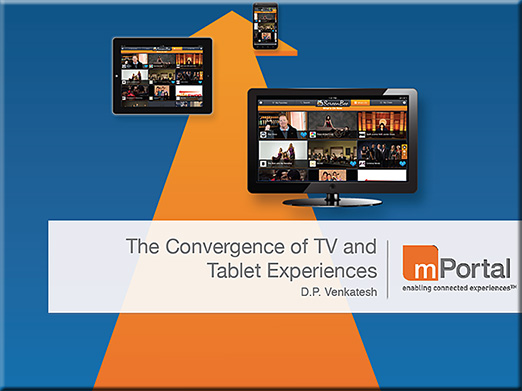
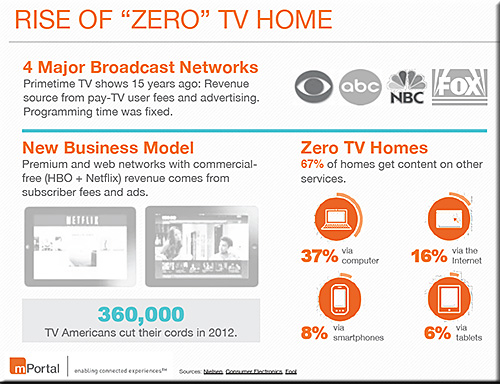
From DSC: The massive convergence of the telephone, the television, and the computer continues. How that media gets to us is also changing (i.e. the cord cutting continues).
What types of innovative learning experiences can be crafted as “TV” becomes more interactive, participatory, and engaging? What happens if technologies like WebRTC make their way into our browsers and we can videoconference with each other without having to download anything?
What doors open for for us when Google, Apple, or an Amazon.com delivers your “shows” vs. NBC/ABC/CBS/etc.?
The items below cause me to reflect on those questions…
Here’s a fun combination to ponder: The world’s most powerful media company and America’s most popular sport.
That could happen if Google buys the rights to the NFL’s Sunday Ticket package, the all-you-can-eat subscription-TV service currently owned by DirecTV.
Netflix inks exclusive deal for first-run Weinstein films— from cnet.comThe Internet’s biggest on-demand video service will stream movies from the indie film studio before any other pay-TV providers starting in 2016, the same year it kicks off a similar Disney deal.
Turn education into a lifelong experience — from clomedia.com by Caroline Mol and Nick Van Dam MOOCs ensure development remains relevant. The future of work depends on people’s ability to build intellectual capital.
Excerpt (emphasis DSC):
Most of the discussions about MOOCs focus on the experience and potential impact on higher education, which we will not discuss here. Rather, we will talk about their impact on the 21st century workforce and corporations. It is very exciting that, according to edX, more than 50 percent of enrollments in such courses are professionals from all over the world.
Looking at market dynamics, increasing globalization, rapid advancements in technology and the continuously changing business environment, it becomes increasingly important that people up their game and continue to invest in their development to stay relevant in the workforce.
…
In addition to employing people with the right skills, corporations are looking more and more for specialized expertise in the so-called human cloud — the virtual, on-demand workforce. Success for a 21st century workforce is leaders’ ability to predict which competencies will be valued in the future and to accelerate mastery of those competencies.
.
From DSC: While I might take some different viewpoints on a couple of things in the article, the importance of reinventing oneself — i.e. staying relevant — is key; and what MOOCs morph into might be a key ingredient for the corporate world.
The new learning dashboard is your personal homepage on Khan Academy. The dashboard gives you an easy way to find the best next things for you to do. It has a bunch of really cool things designed to help you learn math, and soon other subjects, really well on your own or with a coach.
From DSC: This is the type of innovation that makes online/blended learning even more powerful/useful.
The New York Times has now opened a channel at the website If This, Then That (IFTTT). For journalism hackers and tinkering readers, this is fine news.
IFTTT is elegantly useful and usefully elegant. For a variety of sites and services (Evernote! Instagram! Dropbox!), IFTTT combines “triggers” and “actions,” so that when one thing happens on one service, something else happens on another.You can say,if I take a picture on Instagram, then automatically save it to Dropbox.
From DSC: How might this concept be used in conjunction with digital playlists/learning? If I finished the XYZ module over here at U of X, then start ABC over here at ___.
Apple gears up for the video discovery wars — from fastcolabs.com by Michael Grothaus Think Apple’s Matcha.tv acquisition was about its programming guide service? You’re probably wrong. There’s a new war brewing in online video: helping users find the stuff they want.
From DSC: Instead of discovering videos only, how about discovering items along the lines of what you are trying to learn more about? i.e. Matcha.tv meets Google Alerts meets IBM’s Watson.
The Coming Big Data Education Revolution — from by Doug Guthrie Big data, not MOOCS, will give institutions the predictive tools they need to improve outcomes for individual students
Excerpt (emphasis):
Don’t get me wrong, online learning will fundamentally transform higher education, bridging distances and creating access in ways that have not been possible before. But, in this arena, MOOCs are not a transformative innovation that will forever remake academia. That honor belongs to a more disruptive and far-reaching innovation – “big data.” A catchall phrase that refers to the vast numbers of data sets that are collected daily, big data promises to revolutionize online learning and, in doing so, higher education.
Big data in the online learning space will give institutions the predictive tools they need to improve learning outcomes for individual students. By designing a curriculum that collects data at every step of the student learning process, universities can address student needs with customized modules, assignments, feedback and learning trees in the curriculum that will promote better and richer learning.
YOUNGSTOWN, OH – August 7, 2013 – Turning Technologies and eInstruction announced today that the companies have completed a process where Turning Technologies has acquired eInstruction. eInstruction develops educational technology, including classroom instruction systems, student response systems, interactive whiteboards and assessment software that complement Turning’s existing product portfolio which enhances learning and presentation environments. The acquisition will further Turning Technologies’ leading market position in the response system industry, providing a greater depth of products and technologies to more market segments.
The MOOC Business Plan — from campustechnology.com by David Raths With millions of students taking high-quality MOOCs for free, schools and course providers are now searching for a viable business model.
Excerpt:
Name a product sold in stores for thousands of dollars that can be obtained for free online. If you’re struggling for an answer, don’t be surprised–no company would last very long under those circumstances. Yet that’s exactly the predicament in which higher education finds itself as MOOCs begin to disrupt the traditional post-secondary model. Schools are giving away what was once their most valued treasure–the intellectual property of their faculty–for nothing.
Obviously, it’s not a sustainable business model, so what’s next? Where will the money come from? While it may seem surprising, no one really seems to know. For many colleges and universities, the current environment more closely resembles a high-stakes game of musical chairs–everyone is terrified of being left without a chair when the music stops. But the game is being played by more than just schools. From a business standpoint, higher education is ripe for reinvention, and it has attracted a slew of companies–both old and new–that smell significant profit.
…
For Coursera, this task is already under way. “Some business models are becoming clear,” says Andrew Ng, cofounder of the for-profit company. “Some we are confident will work; others we are still experimenting with.”
“You could have a certificate of a course completed at Duke University [NC]–that could be a valuable credential,” adds Ng. “We have projected that this alone will lead us to sustainability. In the first quarter of the signature track, we brought in $220,000, and in the second quarter, which hasn’t ended yet, we roughly doubled that amount. So we project that by itself that will make us sustainable.”
David McNew/Getty Images – The Washington Post Co. has agreed to sell its flagship newspaper
to Amazon.com founder and chief executive Jeff Bezos for $250 million August 5, 2013.
Excerpt of comments:
The Internet is transforming almost every element of the news business: shortening news cycles, eroding long-reliable revenue sources, and enabling new kinds of competition, some of which bear little or no news-gathering costs. There is no map, and charting a path ahead will not be easy. We will need to invent, which means we will need to experiment.Our touchstone will be readers, understanding what they care about – government, local leaders, restaurant openings, scout troops, businesses, charities, governors, sports – and working backwards from there. I’m excited and optimistic about the opportunity for invention.
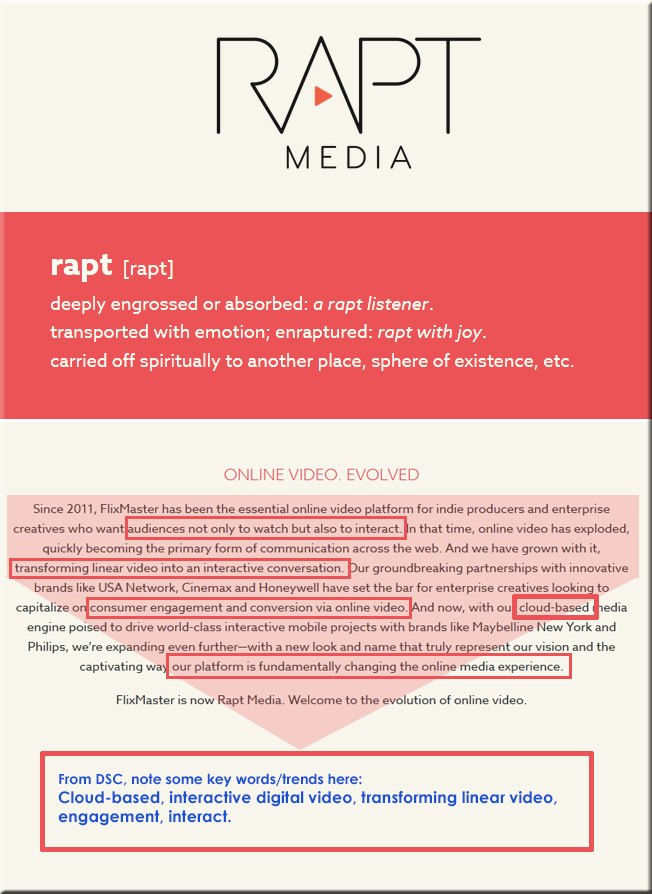
BOULDER – Highlighting a shift toward a new model for its interactive online video platform, Boulder-based FlixMaster Inc. this week announced that it is changing its name to Rapt Media Inc.
…
“When we founded FlixMaster, we set out to create the best toolset for video creators wanting to build interactive videos, and we succeeded in doing that that,” Rapt co-founder and chief executive Erika Trautman said in an email. “But as we partnered with really sophisticated companies (like HBO and Maybelline), we realized that our platform and the opportunity it posed wasbigger than just interactive video. It was about improving online communication and storytelling through interactivity of all kinds, with video as the central component.Our company had already transitioned to this bigger vision, and we wanted a name that could reflect that vision.
Additional thought from DSC: This item relates to the convergence of the television, the computer, and the telephone that I’m pulse-checking. I’m hopeful that such a convergence will provide students in the future with 24×7, highly-engaging, interactive, customized/personalized content:
Nathan Weber for The New York Times Listeners use a Bible app during a sermon at Fellowship Missionary Baptist Church in Chicago.
Excerpt (emphasis DSC):
EDMOND, Okla. — More than 500 years after Gutenberg, the Bible is having its i-moment.
For millions of readers around the world, a wildly successful free Bible app, YouVersion, is changing how, where and when they read the Bible.
Built by LifeChurch.tv, one of the nation’s largest and most technologically advanced evangelical churches, YouVersion is part of what the church calls its “digital missions.” They include a platform for online church services and prepackaged worship videos that the church distributes free. A digital tithing system and an interactive children’s Bible are in the works.
…
This month, the app reached 100 million downloads, placing it in the company of technology start-ups like Instagram and Dropbox.
Educators have known for 30 years that students perform better when given one-on-one tutoring and mastery learning—working on a subject until it is mastered, not just until a test is scheduled. Success also requires motivation, whether from an inner drive or from parents, mentors or peers.
Will the rise of massive open online courses (MOOCs) quash these success factors? Not at all. In fact, digital tools offer our best path to cost-effective, personalized learning.
I know because I have taught both ways.
…
Inspired by Nobel laureate Herbert Simon’s comment that “learning results from what the student does and thinks and only from what the student does and thinks,” we created a course centered on the students doing things and getting frequent feedback. Our “lectures” were short (two- to six-minute) videos designed to prime the attendees for doing the next exercise. Some problems required the application of mathematical techniques described in the videos. Others were open-ended questions that gave students a chance to think on their own and then to hash out ideas in online discussion forums.
…
That is why a properly designed automated intelligent tutoring system can foster learning outcomes as well as human instructors can, as Kurt van Lehn found in a 2011 meta-analysis in Educational Psychologist.
From DSC:
A potential learning scenario in the future:
“Learning Agent, go find me a MOOC (or what the MOOC will morph into) about ________.” Similar to a Google Alert, the Learning Agent returns some potential choices. I select one. .
Once there… “System, let’s begin.” I begin taking the online-based course — which is stocked full of a variety of media, some interactive, that I get to choose from for each module/item based upon my personal preferences — and the intelligent tutoring system kicks in and responses at relevant points based upon my questions, answers, responses. The system uses AI, data mining, learning analytics, to see how I’m doing. It tracks this for each student. Humans regularly review the data to begin noticing patterns and to tweak the algorithms based upon these patterns. .
If at any time I find the responses from the automated intelligent tutoring system confusing or weak, I will:
Make note of why I’m confused or disagree with the response (via an online-based form entry on the page; this feedback gets instantly sent to the Team of Specialists in charge of the “course.” They will use it to tweak the course/algorithms.)
Ask to speak with a person, at which point I am asked to choose whether my inquiry would best be handled by a Subject Matter Expert (SME) at $___/hour/request (more expensive price) or by an entry-level tutor (at a lower $___/hour/request). I then enter into a videoconference-based tutoring session with them, and they can access my records and even take over my screen (if I let them). Once I get my questions answered, I return to the course and continue.
From DSC: A twist on the above scenario would be if a cohorted group of people — not age-based — met in a physical place/room and were able to bounce ideas off of each other before anyone ante’d up for additional expenses by contacting a tutor and/or an SME. They could even share the expenses of the “call” (so-to-speak).
Our eBook for Learning Pulse Survey gathered 445 responses from a broad cross section of organizations based on size and industry in June and July 2013. Here is what we found out…