Mezzanine-from-Oblong-May2013


.

Mezzanine2-from-Oblong-May2013

.

.

From the Oblong.com website:

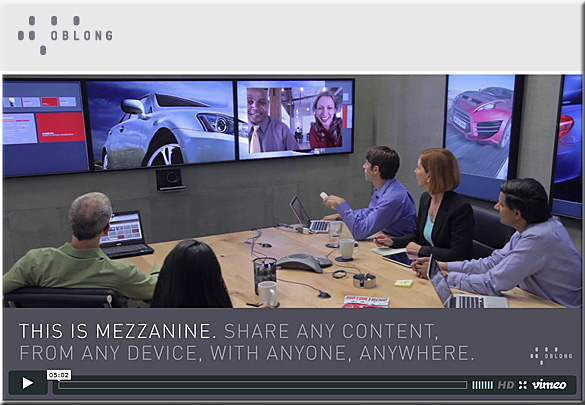
Mezzanine™ is a collaborative conference room solution that introduces multi-user, multi-screen, multi-device collaboration. This is next-generation communication: share any content from any device with anyone, anywhere.

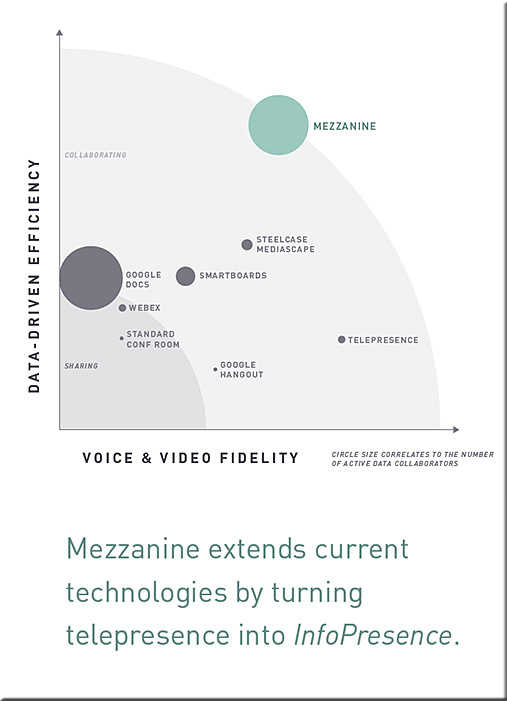
Mezzanine transforms creative teamwork, executive meetings, and sales presentations into real-time, collaborative work sessions. Mezzanine expands on existing telepresence technology by providing what we call InfoPresence™—the incorporation of multiple users, multiple devices, and multiple streams of information in the collaboration environment. The future of conference room collaboration is here.

A Mezzanine workspace lets any person on a network bring their own device and share content and applications with any colleague, anywhere in the world, interactively. Mezzanine is a collaborative conference room solution combining presentation design and delivery, application sharing, whiteboard capture, and video conferencing, all within a framework of multi-participant control.

.

Also see:

  • Oblong Technovates with LA High School
    .
  • Oblong at OME
    Oblong Industries recently participated at OME, a summit hosted by UC San Francisco.  The two-day summit focused on charting the future of precision medicine—an emerging field combining big data with clinical research and patient care to deliver insights and advances in treatment that is more targeted and enables improved patient outcomes.


Interactive whiteboards are front and center in college classrooms — from edtechmagazine.com
A look at whiteboards at New York’s Touro College.

.

From DSC:
We currently have 3 types of Interactive WhiteBoards (IWB’s) on our campus:  Epson BrightLinks, SMART Boards, and/or an Eno Board from PolyVision.

However, the idea of using mobile interactive whiteboards is becoming increasingly popular — i.e. being able to annotate on an iPad, for example, and having everyone in the class see these annotations.  I’ve seen some K-12 folks use Apple TV for this type of thing, but Apple’s multi-cast wireless protocol doesn’t work as well for us in a campus environment.  I’ve also seen/heard of people using one of the following solutions listed below as well. (I wish I had more time to check each of them out, but I’ll simply list them for you here.)


IT does not love iPads — from by Michelle Fredette
Students and faculty may love them, but IT personnel get a major headache when they try to integrate Apple tablets–and the company’s TV technology–in an enterprise setting.

.

From DSC:
The Bring Your Own Device (BYOD) train has arrived.   As such, this is a huge issue and as you can tell from reading Michelle’s article, there is no silver bullet out there (at least not as of 5/9/13).  I sure wish all of the relevant vendors could get behind a secure, efficient, reliable standard here…or at least have Apple come up with something that would get past the multi-cast issues for wireless networks (i.e. what works great for the consumer at home doesn’t work well on a campus or throughout an enterprise). It also adds to the already difficult job we in IT have when the targets are constantly moving — and moving faster than ever.  Add to that the need to consider entire ecosystems/platforms these days.


Tagged with:  

The folks needed to create the next generation of learning: Computers can’t touch this. [Christian]

From DSC:
What we need is a major hackathon — or an organization with deep pockets — that can bring together folks from a variety of disciplines including:

  • Subject Matter Experts
  • Instructional Designers
  • Cognitive Psychologists
  • Computer Scientists and/or those exerienced with learning analytics/data mining, Artificial Intelligence (AI)
  • Those gifted in film/media/videography/photography
  • Great storytellers/writers (including writing for transmedia-based learning experiences)
  • Folks who can create engaging, educational games
  • Designers
    • Web
    • Graphic
    • Interface
    • User experience
    • User interaction
    • Those gifted in creating multimedia-based content
  • Musicians
  • Human Computer Interaction (HCI) experts
  • Mobile learning experts
  • Those knowledgeable with second screens/M2M communications
  • Animators
  • Illustrators
  • Social media experts
  • Accessibility experts
  • Researchers
  • Those gifted in creating augmented reality-based apps
  • Legal/copyright experts
  • & others

We need for these specialists to collaborate in order to create the next generation of learning.  Anyone who can bring these skillsets together and experiment with creating materials will have significantly contributed something to the current generations and to future generations! 

And, in the words of M.C. Hammer,  computers “can’t touch this!”  Why? Because “learning is messy!”

What fields did I miss?
Please leave your thoughts and
feedback in the comments section.


Beyond the Page: Transmedia Storytelling — from macict.edu.au by Cathie Howe


Below are some excerpted slides from:
Rethinking literacy through transmedia storytelling final from Cathie Howe and Katy Lumkin

.

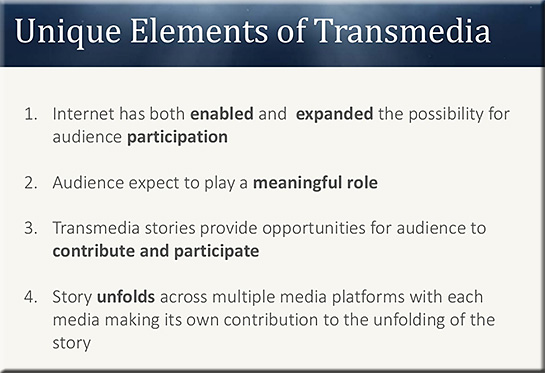
TransmediaStorytellingLumkinHowe-April2013

.

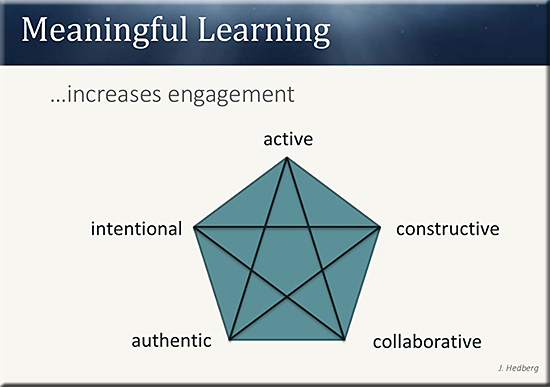
TransmediaStorytellingLumkinHowe1-April2013

.

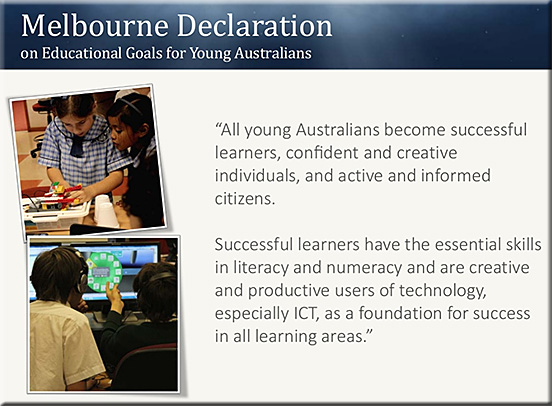
TransmediaStorytellingLumkinHowe2-April2013

.

TransmediaStorytellingLumkinHowe3-April2013


From DSC:
Transmedia storytelling ties in very nicely with my thoughts re: Learning from the Living [Class] Room!

.

The Living [Class] Room -- by Daniel Christian -- July 2012 -- a second device used in conjunction with a Smart/Connected TV


Notes from DSC:

  • Some of the material in this presentation or the website may not be appropriate for a younger audience.
  • Notice how many potential jobs/roles/positions/skillsets can be explored here!

.


TransmediaStoryProductionIntro-April2013

.

TransmediaStoryProduction-April2013

From DSC:
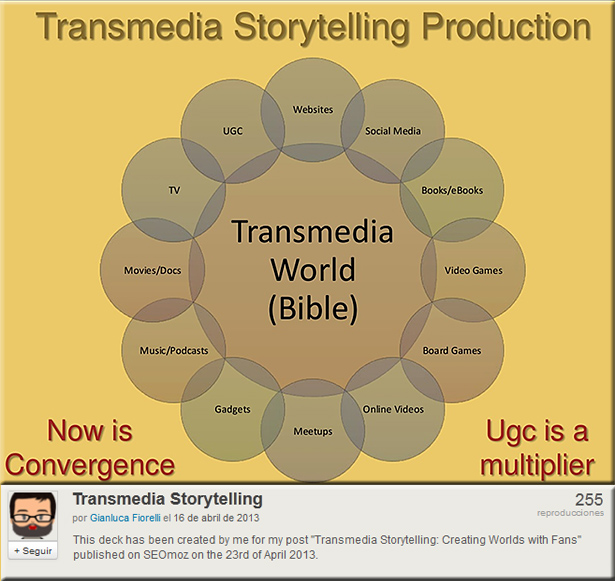
The word Bible is here not quite I think of as the Bible…but you’ll get the point if you review Gianluca’s presentation.
.

TransmediaStoryProduction2-April2013

.

TransmediaStoryProduction3-April2013

.


Questions from DSC:

  • What opportunities might be presented by this type of trend within the worlds of education/training? (i.e. within K-12, higher ed, the corporate world)
  • What sorts of streams of contents could be created for educational/training-related purposes?
  • What sorts of open doors are now present within the world of communications? For a church, a school, a college, a business?
  • How can we incorporate the use of story more effectively in our teaching and learning environments? (If we could do this, we could greatly increase our students’ ROI.)


How to publish an e-book: Resources for authors by Jane Friedman
.

E-Book Publishing 101

.

Lynda.com
http://www.lynda.com/eBooks-training-tutorials/1310-0.html

UpsideLearning.com
http://www.upsidelearning.com/free-elearning-ebooks.asp

TOC 2013, Matt MacInnis, “Unbound”
https://www.youtube.com/watch?v=pnSvEz8oqpI

McGraw-Hill to Debut Adaptive E-Book for Students
http://blogs.wsj.com/digits/2013/01/07/mcgraw-hill-to-debut-adaptive-e-book-for-students/

The object formerly known as the textbook — from The Chronicle by Jeff Young
http://chronicle.com/article/Dont-Call-Them-Textbooks/136835/

The Professor as Digital Author and Publisher: Creating and Delivering E-Textbooks with iBooks Author and iTunes U – Room design and furniture provided by Herman Miller
http://www.educause.edu/eli/events/eli-annual-meeting/2013/professor-digital-author-and-publisher-creating-and-delivering-e-textbooks-ibooks-author-a

McGraw-Hill & Kno offer a peek into the future of textbooks: They’re dynamic, vocal, adaptive & bring stats to studying – from techcrunch.com by Rip Empson
http://techcrunch.com/2013/01/08/mcgraw-hill-kno-offer-a-peek-into-the-future-of-textbooks-theyre-dynamic-vocal-adaptive-bring-stats-to-studying/


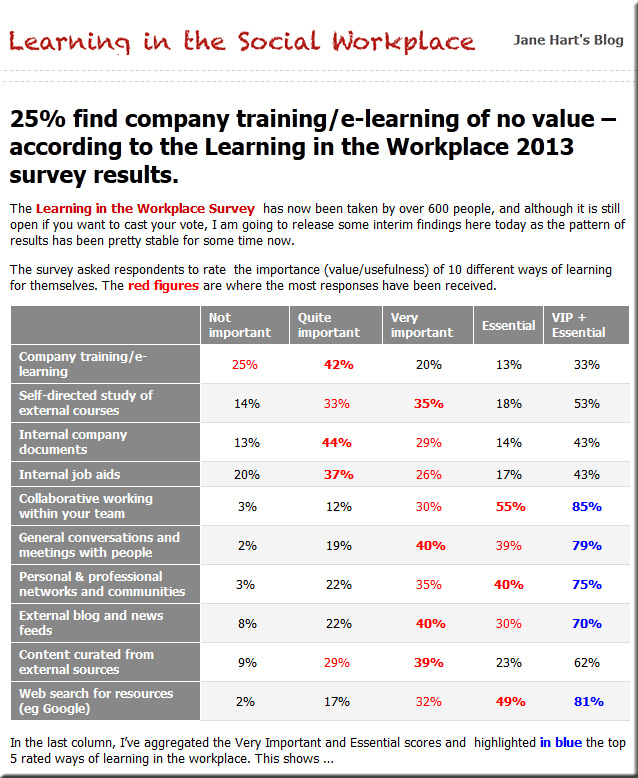
25PercentCompanyTrainingNoValue-Hart-April2013


From DSC:
This data further supports my thoughts on helping people build their own learning ecosystems — something Jane points out as well when she states that “workers find other (self-organised and self-managed) ways of learning at work far more valuable – with team collaboration being the highest rated.”

I recommend helping folks learn how to create their own blogs and learn how to subscribe to others’ blogs, access relevant wikis, use Twitter, employ Google Alerts, etc.  

Provide each employee with some relevant names/blogs/websites/etc. to get employees started (i.e. of some knowledgeable accountants, legal counsel, product designers, engineers, digital marketing experts, cloud computing strategists, programmers for mobile computing apps, etc.).  I realize this presents issues with companies’ sensitive information such as patents and/or intellectual property.   But if Harold Jarche is correct in saying that we live in a post-jobs world, what we know of the modern corporation may be very different in just a few years anyway.  (i.e. You’re on your own. You are your own corporation/business; so build your own brand and expertise. Build your own valuable network of peers/colleagues — who you can contribute to as well as to learn from.)

Admittedly, this changes some of the roles of the training department from creating e-learning modules to becoming excellent researchers, social media experts, quasi-librarians, etc.

(Come to think of it, I wonder if that might happen in higher ed as well — i.e. provide students with the relevant/key experts, important thinkers, streams of content, etc.)


streams-of-content-blue-overlay


BII REPORT: Here’s why the “second screen” industry is set to explode — BusinessInsider.com

BII REPORT: Here’s why the “second screen” industry is set to explode — BusinessInsider.com

Excerpt:

Here’s why the second screen industry will ultimately succeed:

  • Usage is growing rapidly
  • And mass acceptance isn’t even necessary
  • Second screen isn’t really a new activity
  • Second screen apps and sites are bridges


From DSC:
As this article alludes to, I wouldn’t rule the living room out in terms of where interactive, multimedia-based, educationally-related, second screen-based applications will turn up (apps backed up by data mining, AI, and opportunities for social learning). This area is poised for some serious growth. 


The Living [Class] Room -- by Daniel Christian -- July 2012 -- a second device used in conjunction with a Smart/Connected TV


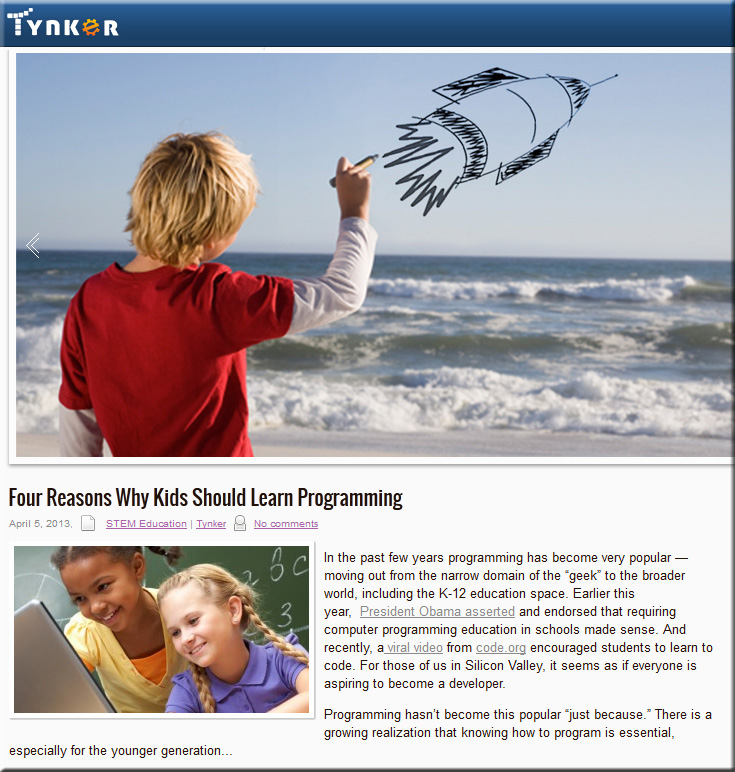
DSC’s comments on “Four Reasons Why Kids Should Learn Programming” — from tynker.com by Jolie O’Dell

.I like this blog posting and others have discussed this topic before…but I respectively disagree with one of the assertions: Programming is not easy — at least it wasn’t for me.  I think that’s true for others, as why else is it so hard to find good programmers and why are they paid so well?  Most people I know do not think like programmers do — it’s a different way of thinking. I’ve tried a couple different languages (albeit at a beginning level!), and while I greatly appreciate what programmers do, I am the first to tell you that I am not a programmer.   At least within web design and development types of tasks/careers, people tend to either gravitate towards the front end OR the back end — though there are exceptions to this rule of thumb who can do both types of tasks well.

So while I agree that students should learn some type of coding, we need more tools/services like this that aim to make programming fun, enjoyable, understandable, and relevant.


Tynker-April2013

.

About
Tynker is a new computing platform designed specifically to teach children computational learning and programming skills in a fun and imaginative way. Tynker is inspired by Scratch from MIT. It is a completely browser-based implementation written using Open Web standards such as Javascript, HTML5, CSS3 and does not use Flash.
.

Also see:

The connected TVs are here… interactive programming & native apps will follow— from venturebeat.com by Habib Kairouz


The connected TVs are here… interactive programming & native apps will follow
.

Excerpt:

Innovative devices have always fueled new application ecosystems. The software industry was enabled by the WinTel PC platform; and hundreds of thousands of websites were built once the PCs became “connected.” In the last few years, we have witnessed the same trend in mobile; more than 700,000 apps have been created for Web-enabled phones. We’ll soon see connected TVs fueling a similar ecosystem of interactive programming and native apps. With nearly a quarter of all U.S. households currently using connected TVs (according to eMarketer), we have reached the tipping point of mass adoption.

As opposed to the disastrous impact the Internet had on the print industry, I see the innovation of the connected TV market as a tremendous, yet accretive, evolution as opposed to a threat. Here’s why:

My reflections on “MOOCs of Hazard” – a well-thought out, balanced article by Andrew Delbanco


From DSC: Below are my reflections on MOOCs of Hazard — from newrepublic.com by Andrew Delbanco — who asks:  Will online education dampen the college experience? Yes. Will it be worth it? Well…


.
While I’m not sure that I agree with the idea that online education will dampen the college experience — and while I could point to some amazing capabilities that online education brings to the table in terms of true global exchanges — I’ll instead focus my comments on the following items:


1) Massively Open Online Courses (MOOCs) are recent experiments — ones that will continue to change/morph into something else.
They are half-baked at best, but they should not be taken lightly. Christensen, Horn, Johnson are spot on with their theories of disruption here, especially as they relate to innovations occurring within the virtual/digital realm.  For example, the technologies behind IBM’s Watson could be mixed into the list of ingredients that will be used to develop MOOCs in the future.  It would be a very powerful, effective MOOC indeed if you could get the following parties/functionalities to the table:

  • IBM — to provide Watson like auto-curation/filtering capabilities, artificial intelligence (AI) capabilities, as well as data mining/learning analytics expertise, joined by
  • Several highly-creative firms from the film/media/novel/storytelling industry, who would be further joined by
  • Experts from Human Computer Interaction (HCI)/user interface/user experience design teams, who would be further joined by
  • Programmers and interaction specialists from educational gaming endeavors (and from those who can design simulations), joined by
  • Instructional designers, joined by
  • The appropriate Subject Matter Experts who can be reached by the students as necessary, joined by
  • Those skilled in research and library services, joined by
  • Legal experts to assist with copyright issues, joined by
  • Other specialists in mobile learning,  3D, web development, database administration, animation, graphic design, musicians, etc.

It won’t be long before this type of powerful team gets pulled together — from some organizations(s) with deep pockets — and the content is interacted with and presented to us within our living rooms via connected/Smart TVs and via second screen devices/applications.

2) The benefits of MOOCs
  • For colleges/universities:
    • MOOCs offer some serious marketing horsepower (rather than sound pedagogical tools, at this point in time at least)
    • They are forcing higher ed to become much more innovative
    • They provide great opportunities to build one’s personalized learning networks, as they bring forth those colleagues who are interested in topic A, B, or C
    • They move us closer to team-based content creation and delivery
      .
  • For students:
    • They offer a much less expensive option to go exploring disciplines for themselves…to see if they enjoy (and/or are gifted in) topic A, B or C
    • They provide great opportunities to build one’s personalized learning networks, as they bring forth those colleagues who are interested in topic A, B, or C
    • They provide a chance to see what it’s like to learn about something in a digital/virtual manner

3)  The drawbacks of MOOCs:
  • MOOCs are not nearly the same thing as what has come to be known as “online learning” — at least in the higher ed industry. MOOCs do not yet offer what more “traditional” (can I say that?) online learning provides: Far more support and pedagogical/instructional design, instructor presence and dialog, student academic support services, advising, more student-to-student and student-to-faculty interaction, etc.
    .
  • MOOCs are like drinking from a firehose — there are too many blogs/RSS feeds, twitter feeds, websites, and other resources to review.

4) It would be wise for all of us to be involved with such experiments and have at least a subset of one’s college or university become much more nimble/responsive.


Also see:

Dual screen: The evolution of the second screen — from blog.brightcove.com by Albert Lai

Excerpt (emphasis DSC):

Educational Gamification
In a previous post, we asked readers to suggest their ideas for dual screen applications. One of the more intriguing responses was the suggestion to create companion educational games to accompany associated video content.

In a dual screen experience, as video content is displayed on the television, the application can engage the viewer with relevant and education activities, from content reinforcement to spelling to trivia to memory “games.” One can imagine an interactive amalgamation of Dora the Explorer, Where in the World Is Carmen Sandiego?, and Schoolhouse Rock!


.


.


The Living [Class] Room -- by Daniel Christian -- July 2012 -- a second device used in conjunction with a Smart/Connected TV


Addendum on 4/8/13:

New test for computers: Grading essays at college level — from nytimes.com by John Markoff
.

Gretchen Ertl for The New York Times
EdX, a nonprofit enterprise founded by Harvard and the Massachusetts Institute of Technology,
will release automated software that uses artificial intelligence to grade student essays and short written answers.


Excerpt:

EdX, the nonprofit enterprise founded by Harvard and the Massachusetts Institute of Technology to offer courses on the Internet, has just introduced such a system and will make its automated software available free on the Web to any institution that wants to use it. The software uses artificial intelligence to grade student essays and short written answers, freeing professors for other tasks.

© 2025 | Daniel Christian