.

Concept, graphics, idea from Daniel S. Christian:
But free for your taking and implementing!

.

What:

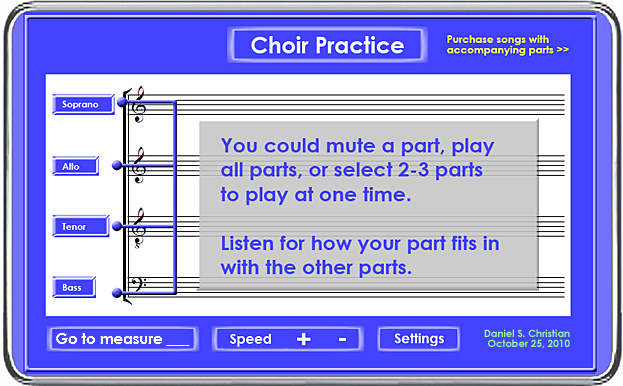
  • Choir Practice: A mobile-based method of practicing one’s part

Features

  • The ability for the choir member to go directly to measure ____
  • The ability for the choir member to highlight measures ____ through ____ (like highlighting text in Microsoft Word), then click on the play button to loop through those measures
  • One could speed up a song up or slow it down (without affecting pitch)
  • The application would allow for all of the vocal parts to begin playing upon downloading a pre-packaged song or the application could always start playing with a certain part (i.e. 1st or 2nd soprano, alto, tenor, or bass)
  • The musical notes could be the same color or one could choose to display the notes in different colors
  • Bonus features might include a video of a director directing this song

Why:

  • This type of thing would be a great cross-disciplinary assignment for your institution’s curriculum — Music and Computer Science come to mind for this application
  • Your institution could sell this application on Apple’s App Store to develop a new revenue stream
  • Your choirs could produce the packaged songs / tracks
  • Plus, such an app would help choir members learn their parts — 24x7x365 — in the car, on the road, in the gym, etc.
  • Enhances one’s ability to listen to other parts as well
  • Aids your marketing departments as you point to this as a solid deliverable from your programs
  • Creates “study aids” for your own school’s choirs/students as well as for choirs at smaller churches and institutions (worldwide)
  • Helps those choir members who don’t have access to a piano or don’t know how to play a piano

Have fun whomever takes this idea and runs with it! The choirs of the world will appreciate you — and so will their audiences!   🙂

Along these lines…another win-win here includes:

That students in the future (I hope) will be able to choose from a multitude of potential roles when presented with multi-disciplinary projects/assignments/courses:
  • Vocalists, pianists, and other type of musicians
  • Composers
  • Programmers
  • Graphic artists
  • Videographers / video editors
  • Audio specialists
  • Writers
  • Project Managers
  • Actresses/Actors
  • etc.
As such, students could:
  • Learn to appreciate other disciplines
  • Participate in/contribute to projects that could be published on the web
  • Exercise their creativity
  • Practice being innovative


Daniel Christian

Google ‘Code-In’ calls on K-12 students to become open source developers — from The Journal by John K. Waters

Google wants to get middle and high school students interested in open source software, and the company is betting that a new “outreach contest” that includes cash prizes and a grand-prize trip to the Googleplex in California will appeal to budding programmers.

Google’s new “Code-In” competition, which gets underway Nov. 22, presents 13- to 18-year-olds with eight tasks, ranging from refactoring code and interface design to such not-so-techie jobs as writing and editing software documentation and developing marketing materials. For every three tasks they complete, the students earn $100, up to a maximum of $500. Ten grand prize winners will get an all-expenses-paid trip with a family member to Google’s Mountain View, CA headquarters. The trip includes a tour of the sprawling Googleplex facility and meetings with some of the company’s engineers.

Tagged with: • • •  

Symposium on Progress in Information and Communication Technology (SPICT’10)

Conference date: 12-13 Dec,2010
Conference venue:
The Royale Bintang, Kuala Lumpur
Conference country:
Malaysia

SPICT’10 aims to bring together scientists, industry practitioners and students to exchange the latest fundamental advances and trends, and identify emerging research topics in the field of information and communication technology.

Activities:

* Agent & Multi-agent Systems
* Antennas & Propagation
* Artificial Intelligence
* Bioinformatics & Scientific Computing
* Business Intelligence
* Communication Systems and Networks
* Complex Systems: Modeling and Simulation
* Computer Vision
* Database and Application
* Geographical Information Systems
* Grid and Utility Computing
* Image Processing
* Information indexing & retrieval
* Information Systems
* Intelligent Systems
* Internet Technology
* Knowledge Management
* Mobile Communication Services
* Multimedia Technology and Systems
* Natural Language Processing
* Network Management and services
* Ontology and Web Semantic
* Optical Communications and Networks
* Parallel and Distributed Computing
* Pattern Recognition
* Pervasive Computing
* Real-Time and Embedded Systems
* Remote Sensing
* Robotic Technologies
* Security and Cryptography
* Sensor Networks
* Service Computing
* Signal Processing
* Software Engineering
* Strategic Information Systems

Job Vacancy – Mobile Programmer (Closing 26 October 2010) — from HITLab New Zealand News

Research Associate – Mobile Programmer
HIT Lab NZ is looking for a Mobile Programmer (Fixed-term until April 2011)

An exciting opportunity has now opened up in the HIT Lab NZ for a Research Associate to work on improving and extending our current software platform. The successful candidate will work in collaboration with the current HIT Lab Team and receive access to different advanced technology currently developed at the HIT Lab NZ.

To be successful in this role you will need to be able to take responsibility for:

  • Enhancing the 3D graphics engine with new functionalities
  • Integrating other commercial and open source 3D graphics engines into the mobile AR framework
  • Developing specific features for the architecture/urban planning area,
  • Developing specific features for the cultural heritage/tourism area,
  • Integrating new multimedia functionalities to the platform (audio, 3D audio, video, etc).

Ideally, our successful candidate will have:

  • Strong knowledge of Computer Graphics, Visualization, Mobile architecture & programming
  • Robust software engineering and software architecture understanding
  • Strong maths (3D Algebra), problem solving and analytical skills
  • Excellent Java programming skills
  • Proficiency in Computer Graphics Programming (OpenGL)
  • Experience with Android and Mobile Programming
  • Familiarity of OpenGL ES will be a plus
  • Familiarity with 3D graphics engines
  • Ability to work in a small team environment
  • Excellent communication skills

Hottest jobs and skills in cloud, mobile app development — from pcworld.com by Meridith Levinson, CIO

Want to lock in some job security in IT over the next five years? Then make sure you’re poised to move into cloud computing or mobile application development. That’s where the IT jobs are expected to be, according to 2,000 IT professionals recently surveyed by IBM.

IBM’s annual global Tech Trends survey identified cloud computing and mobile application development as the hottest tech trends and most sought-after IT skills for the next five years. An overwhelming majority of survey respondents (91 percent) expect cloud computing to overtake on-premise computing as the primary IT delivery model by 2015. More than half (55 percent) of survey respondents believe that in the same amount of time, the need to develop applications for mobile devices (such as Android, iPhone, iPad and PlayBook) will far surpass the need to develop software for traditional PCs and servers. These trends will impact IT jobs and the skills needed to do them.

IBM survey says mobile apps will dominate enterprise — from WSJ.com by Timonthy Hay

Consumers love tablet computers and smartphones and are finding novel uses for the many applications that run on them. But the devices are catching on in a significant way in the business world as well, according to a new survey from International Business Machines Corp., the company responsible for building and running much of the country’s enterprise computing systems.

After surveying 2,000 information-technology professionals in 87 countries, IBM found that more than half believe that within the next five years, more developers will be working on mobile applications and cloud-based architecture than traditional computing platforms for enterprise.

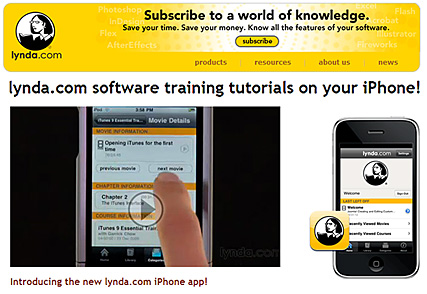
We use Lynda.com and the feedback has been excellent. Back in 1997, I took a 1-day seminar from Lynda Weinman out at SFSU’s Multimedia Studies Program. I learned more from her in a few hours then I have in many courses. She knows how to make things very understandable…and she’s a great teacher. If she doesn’t know the topic, she selects people who know how to explain that topic in easy-to-understand terms.

So when I saw this item — Connect@NMC: Panel Discussion Led By Laurie Burruss of Lynda.com – Implementing Lynda.com Campus-Wide — I felt that I should pass it along.

.

Rise of the ‘Apps Culture’ — Pew Research Center Publications

Cell phone use in the U.S. has increased dramatically over the past decade. Fully eight-in-10 adults today (82%) are cell phone users, and about one-quarter of adults (23%) now live in a household that has a cell phone but no landline phone.

Along with the widespread embrace of mobile technology has come the development of an “apps culture.” As the mobile phone has morphed from a voice device to a multi-channel device to an internet-accessing mini-computer, a large market of mobile-software applications, or “apps,” has arisen.

Among the most popular are apps that provide some form of entertainment (games, music, food, travel and sports) as well as those that help people find information they need and accomplish tasks (maps and navigation, weather, news, banking). With the advent of the mobile phone, the term “app” has become popular parlance for software applications designed to run on mobile phone operating systems, yet a standard, industry-wide definition of what is, and is not, an “app” does not currently exist. For the purpose of this report, apps are defined as end-user software applications that are designed for a cell phone operating system and which extend the phone’s capabilities by enabling users to perform particular tasks.

The most recent Pew Internet & American Life Project survey asked a national sample of 1,917 cell phone-using adults if they use apps and how they use them. Broadly, the results indicate that while apps are popular among a segment of the adult cell phone-using population, a notable number of cell owners are not yet part of the emerging apps culture.

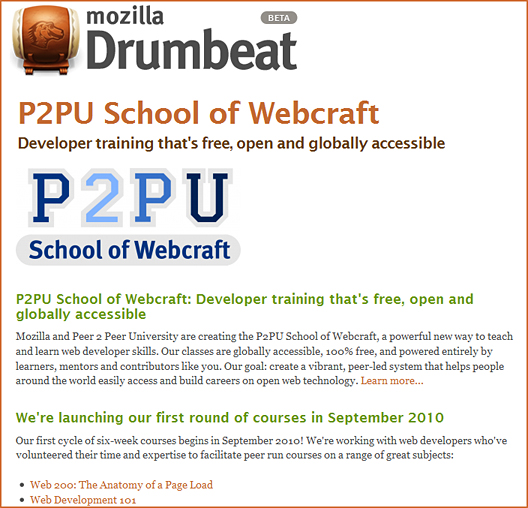
P2PU's World of Webcraft -- free courses re: web development

Resource from reganmian.net

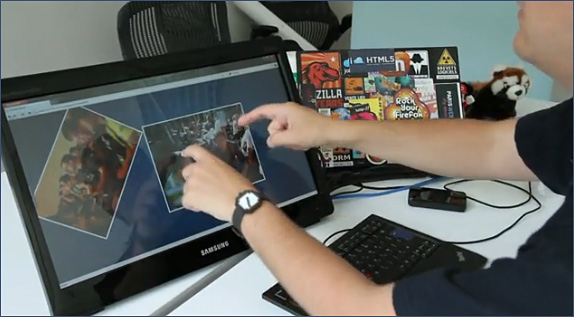
Next Firefox 4 Beta arrives, now with multi-touch — from WebMonkey.com by Michael Calore

Mozilla has released the latest beta version of its Firefox 4 browser. You can grab Firefox 4 beta 3 for all major operating systems and over 30 languages from Mozilla’s beta download site.

.

Next Firefox 4 beta arrive -- now with multi-touch

.

From DSC:
I post this because when this type of functionality makes its way across all browsers (and operating systems), we will have a very interesting way of interacting with applications via the web browsers.

U Michigan iPhone app grows from student project — from CampusTechnology.com by Dian Schaffhauser

An iPhone app conceived by two students at the University of Michigan in Ann Arbor, built as a computer science class project, and purchased by the school’s IT organization has made its public debut in the Apple iTunes store. Formerly named iWolverine, now called “University of Michigan,” the app allows users to track buses in real time through the popular Magic Bus Web application, listen to the school’s fight song, check dining hall menus, and search for buildings, among other features.

Emerging Technology: APIs and Mashups and eLearning — from interactyx.com by Jeff Roth

Also see the following API and mashup directories

Tagged with: • •  

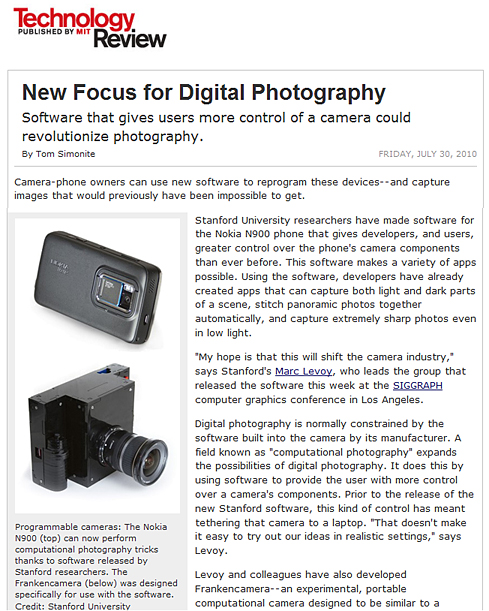
New focus for digital photography -- possibly a game-changer

Design Boost is a four day bootcamp for prototyping digital learning products.

We’re looking for promising young innovators, to bring learning into the 21st century, to create digital products that excite and engage kids in meaningful learning. In partnership with IDEO, Startl is offering a multi-day immersion for designers and creators, hackers and coders, builders and entrepreneurs.

Boost isn’t about sitting around dreaming up pie-in-the-sky ideas. Its an intense whirlwind of activity, with lots of hands-on, real-world involvement in the design and product development process. You’ll be taking the seed of an idea and seeing whether you can grow it into an effective and marketable learning product. Along the way, you’ll be steeped in how to create user-centered, learning-rich and market-smart designs and learn the tricks that seasoned entrepreneurs use to generate new products quickly and cheaply. But you won’t be doing this on your own. You’ll be surrounded by inspiring peers and collaborating with them to amp up your creativity and rigor.

Startl’s first series of Design Boost will focus on the design of mobile applications for learning, targeting these primary platforms: Android, iPhone, Symbian and BlackBerry. We’re making this the focus because there’s a serious lack of high-quality mobile applications for learning and education on the market, so there’s a massive opportunity to make a difference and make your mark.

The Boot Camp will be a launching pad for participants to make their next entrepreneurial move, be it with Startl, IDEO, local firms, national brands or beyond.

Apply for the November 2010 Mobile Design Boost to be held in San Francisco November 11-14, 2010.  (Application deadline – September 17, 2010)

The Basics – What You Need to Know Before Applying
A primer on what Startl is seeking in teams.

Design Boost FAQ’s

Mobile Design Boost Schedule & Agenda

…

From DSC:
Are there many college-level courses out there like this? This is a very interesting, real-world, engaging, hands-on approach — while offering numerous opportunities to collaborate.

Media:Scape-based setups would work well here.


All Our Ideas

— original posting from FastCompany.com

Also see:
Computers intersect with sociology to sift through ‘all our ideas’ (from News at Princeton)

Fortunately, an acquaintance referred Moles to Matthew Salganik. An assistant professor of sociology at Princeton, Salganik has teamed up with Princeton computer scientists to develop a new way for organizations to solicit ideas from large groups of people and simultaneously have those same people vote on the merit of the ideas generated by the group.

Called “All Our Ideas,” the survey tool melds concepts from sociology and computer science to allow an organization to quickly set up a free website where large numbers of people can contribute and rank ideas. The system could help governments tap into public opinion and provide sociologists with a new research tool.

© 2025 | Daniel Christian