On 04/22/2013,
in blogs / blogging / vlogging, business, collaboration, corporate / business world, corporate universities / corporate training, Daniel S. Christian, digital learning, elearning, face-to-face, streams of content, training / L&D, ubiquitous learning, using teams, videoconferencing, web-based collaboration, workplace,
by Daniel Christian
From DSC:
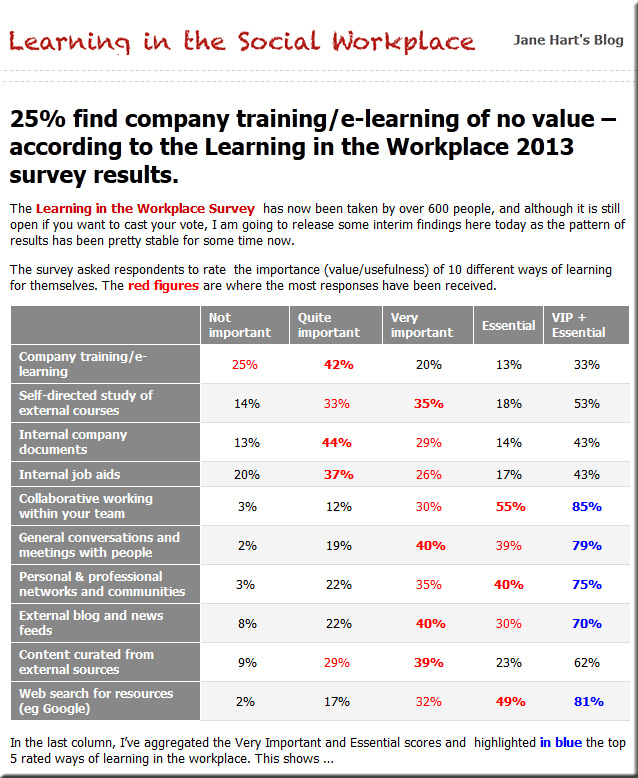
This data further supports my thoughts on helping people build their own learning ecosystems — something Jane points out as well when she states that “workers find other (self-organised and self-managed) ways of learning at work far more valuable – with team collaboration being the highest rated.”
I recommend helping folks learn how to create their own blogs and learn how to subscribe to others’ blogs, access relevant wikis, use Twitter, employ Google Alerts, etc.
Provide each employee with some relevant names/blogs/websites/etc. to get employees started (i.e. of some knowledgeable accountants, legal counsel, product designers, engineers, digital marketing experts, cloud computing strategists, programmers for mobile computing apps, etc.). I realize this presents issues with companies’ sensitive information such as patents and/or intellectual property. But if Harold Jarche is correct in saying that we live in a post-jobs world, what we know of the modern corporation may be very different in just a few years anyway. (i.e. You’re on your own. You are your own corporation/business; so build your own brand and expertise. Build your own valuable network of peers/colleagues — who you can contribute to as well as to learn from.)
Admittedly, this changes some of the roles of the training department from creating e-learning modules to becoming excellent researchers, social media experts, quasi-librarians, etc.
(Come to think of it, I wonder if that might happen in higher ed as well — i.e. provide students with the relevant/key experts, important thinkers, streams of content, etc.)

On 03/14/2013,
in blogs / blogging / vlogging, cloud-based computing / apps / other cloud-related, Google, strategy, Uncategorized,
by Daniel Christian
Google is retiring Google Reader as of July 1, 2013.
Excerpt:
We launched Google Reader in 2005 in an effort to make it easy for people to discover and keep tabs on their favorite websites. While the product has a loyal following, over the years usage has declined. So, on July 1, 2013, we will retire Google Reader. Users and developers interested in RSS alternatives can export their data, including their subscriptions, with Google Takeout over the course of the next four months.
From DSC:
To Google (and others) —
You should know that when you do this sort of thing, it creates a great deal of nervousness and uncertainty in K-12 and in higher ed. We ask, well if we go with (Google Docs, Google Drive, Google ___) will they pull it in the future? What would we do at that point? It also causes us to pause in moving things to the cloud…
Below, I will be adding some alternatives that I’ve seen people mentioning:
Addendum on 3/15/13 and in defense of Google…
As Google stated, usage is low and RSS didn’t hit the mainstream in the current form. Which is too bad, because it’s a very promising technology! Also from this page, here’s a solid graphic that shows the decline in usage:
.


On 01/30/2013,
in blended learning, blogs / blogging / vlogging, communities of practice, corporate universities / corporate training, Daniel S. Christian, face-to-face, hearts -- matters of the heart, higher education, hybrid learning, innovation, learning ecosystem, more voice more choice more control, online learning, open courseware and systems, passions, personalized/customized learning, social learning / networks, strategy, tools, workplace,
by Daniel Christian
Excerpt from Beyond school choice — from Michael Horn
With the rapid growth in online and mobile learning, students everywhere at all levels are increasingly having educational choices—regardless of where they live and even regardless of the policies that regulate schools.
What’s so exciting about this movement beyond school choice is the customization that it allows students to have. Given that each student has different learning needs at different times and different passions and interests, there is likely no school, no matter how great, that can single-handedly cater to all of these needs just by using its own resources contained within the four walls of its classrooms.
…
With the choices available, students increasingly don’t need to make the tradeoff between attending a large school with lots of choices but perhaps lots of anonymity or a small school with limited choices but a deeply developed personal support structure.
Excerpt from Cooperating in the open — from Harold Jarche
I think one of the problems today is that many online social networks are trying to be communities of practice. But to be a community of practice, there has to be something to practice. One social network, mine, is enough for me. How I manage the connections is also up to me. In some cases I will follow a blogger, in others I will connect via Google Plus or Twitter, but from my perspective it is one network, with varying types of connections. Jumping into someone else’s bounded social network/community only makes sense if I have an objective. If not, I’ll keep cooperating out in the open.
From DSC:
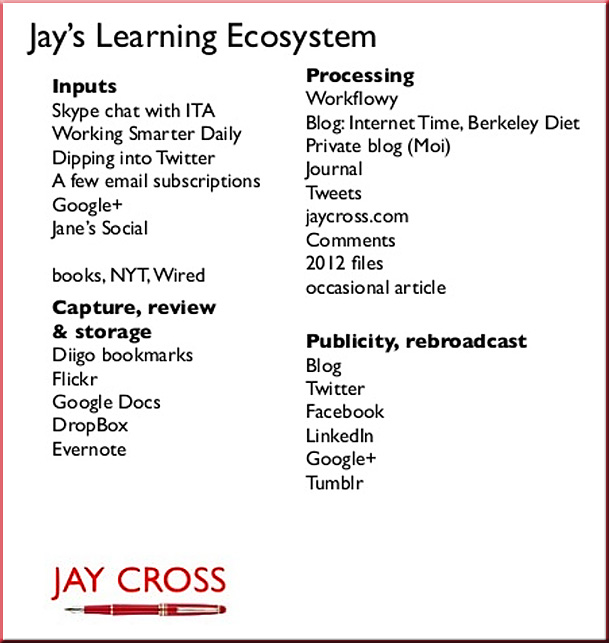
Perhaps helping folks build their own learning ecosystems — based upon one’s gifts/abilities/passions — should be an objective for teachers, professors, instructional designers, trainers, and consultants alike. No matter whether we’re talking K-12, higher ed, or corporate training, these ever-changing networks/tools/strategies will help keep us marketable and able to contribute in a variety of areas to society.
Addendum on 2/5/13:
.
On 01/22/2013,
in blogs / blogging / vlogging, Daniel S. Christian, informal learning, innovation, learning, learning ecosystem, learning theories, pace of change, productivity / tips and tricks, social learning / networks, social media, staying relevant, training / L&D,
by Daniel Christian
Less is more — from Harold Jarche
Excerpts:
If you were to sum up the psychology of learning in three words, it would be ‘less is more’. – Donald Clark
In FrogDesign’s presentation on Design is Hacking How we Learn, slide #27 clearly shows where the emphasis of our learning efforts should be, and where organizations should place the most support and resources: practice.
.

From DSC:
In the corporate world, my thought is to provide the training as to where and how employees can get/stay in the know — especially by encouraging the use and ownership of blogs, social media, and developing/leveraging their personal learning networks. But also to provide the infrastructure and tools — the plumbing if you will — to allow for people to quickly connect with each other and to easily share information with each other (i.e. to develop their own learning ecosystems). Formal classes won’t cut it. As Harold and other members of the Internet Alliance have long been saying, it’s about informal learning. (Speaking of his Internet Alliance colleagues, Charles Jennings recently discussed how the pace of change is affecting the corporate world big time; and, just as in higher ed, being able to adapt is key to staying relevant.)
As a relevant aside…my issue with my Master’s Program in Instructional Design for Online Learning was that there was too much emphasis on theory and not enough emphasis on practice.
On 12/14/2012,
in blogs / blogging / vlogging, writing,
by Daniel Christian
How blogging can improve student writing — from edweek.org by Ben Curran
On 12/13/2012,
in 21st century, A/V -- audio/visual, blogs / blogging / vlogging, career development, Daniel S. Christian, digital audio, digital learning, digital video, education technology, emerging technologies, engagement / engaging students, game-changing environment, global, homeschooling/homeschoolers, human-computer interaction (HCI), ideas, innovation, learning ecosystem, machine-to-machine communications, metacognition / metacognitive skills, mobile learning, mobile technologies, more voice more choice more control, multimedia, online learning, participation, passions, personalized/customized learning, professional development, real-world assignments, robotics, student-related, videoconferencing, web-based collaboration,
by Daniel Christian
“Mom! Check out what I did at school today!”
If you’re a parent, don’t you love to hear the excitement in your son’s or daughter’s voice when they bring home something from school that really peaked their interest? Their passions?
I woke up last night with several ideas and thoughts on how technology could help students become — and stay — engaged, while passing over more control and choice to the students in order for them to pursue their own interests and passions. The idea would enable students to efficiently gain some exposure to a variety of things to see if those things were interesting to them — perhaps opening a way for a future internship or, eventually, a career.
The device I pictured in my mind was the sort of device that I saw a while back out at Double Robotics and/or at Suitable Technologies:
.
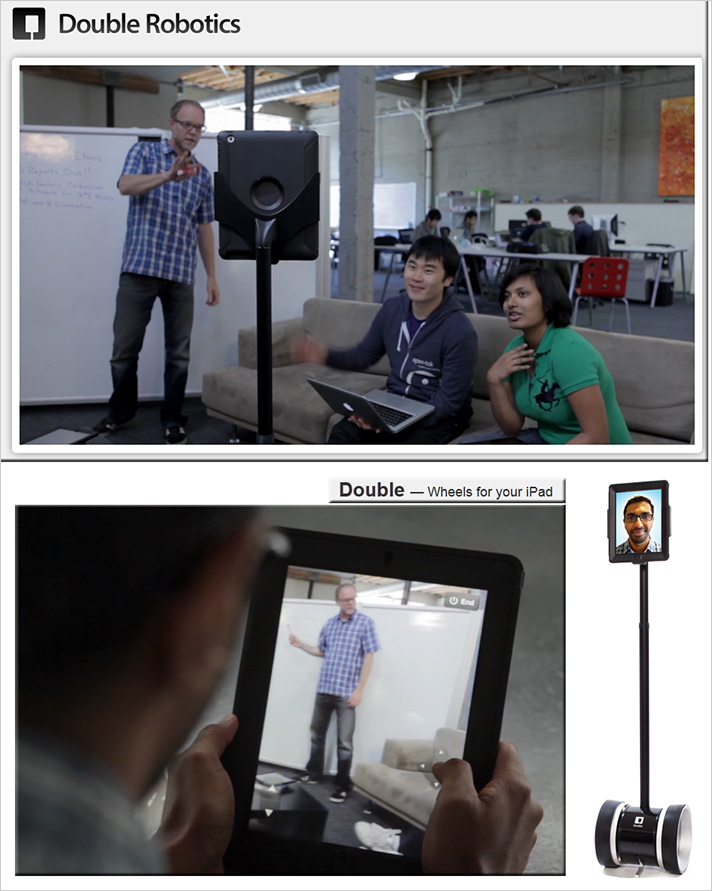
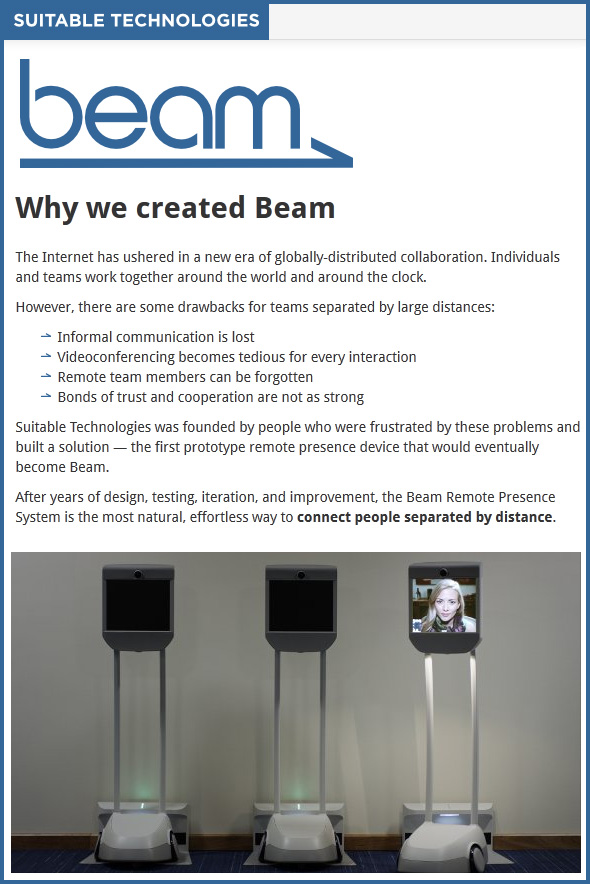
The thoughts centered on implementing a growing network of such remote-controlled, mobile, videoconferencing-based sorts of devices, that were hooked up to voice translation engines. Students could control such devices to pursue things that they wanted to know more about, such as:
- Touring the Louvre in Paris
- Being backstage at a Broadway musical or checking out a live performance of Macbeth
- Watching a filming of a National Geographic Special in the Fiji Islands
- Attending an IEEE International Conference in Taiwan
- Attending an Educause Conference or a Sloan C event to get further knowledge about how to maximize your time studying online or within a hybrid environment
- Touring The Exploratorium in San Francisco
- Touring the Museum of Science & Industry in Chicago
- Being a fly on the wall during a Senate hearing/debate
- Seeing how changes are made in the assembly lines at a Ford plant
- Or perhaps, when a student wheels their device to a particular area — such as the front row of a conference, the signal automatically switches to the main speaker/event (keynote speakers, panel, etc. via machine-to-machine communications)
- Inviting guest speakers into a class: pastors, authors, poets, composers, etc.
- Work with local/virtual teams on how to heighten public awareness re: a project that deals with sustainability
- Virtually head to another country to immerse themselves in another country’s language — and, vice versa, help them learn the students’ native languages
For accountability — as well as for setting aside intentional time to process the information — students would update their own blogs about what they experienced, heard, and saw. They would need to include at least one image, along with the text they write about their experience. Or perhaps a brief/edited piece of digital video or audio of some of the statements that they heard that really resonated with them, or that they had further questions on. The default setting on such postings would be to be kept private, but if the teacher and the student felt that a posting could/should be made public, a quick setting could be checked to publish it out there for others to see/experience.
Real world. Engaging. Passing over more choice and control to the students so that they can pursue what they are passionate about.

On 09/22/2012,
in blogs / blogging / vlogging, mobile learning,
by Daniel Christian
See this posting from onlinecolleges.com re: 20 solid blogs about mobile learning
On 09/04/2012,
in blogs / blogging / vlogging, education technology,
by Daniel Christian

On 08/15/2012,
in blogs / blogging / vlogging, collaboration, education technology, instructional design, pedagogy, podcasting, social learning / networks, tools, vendors, web-based collaboration,
by Daniel Christian
.
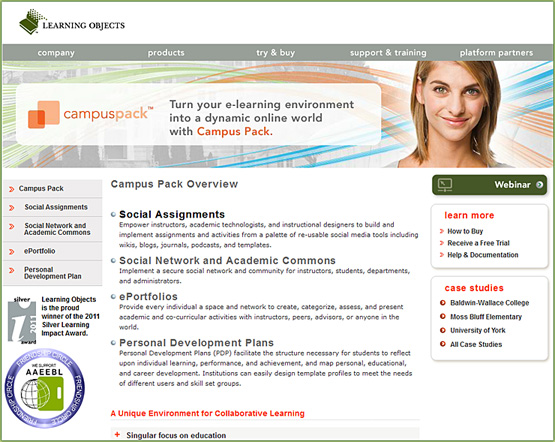
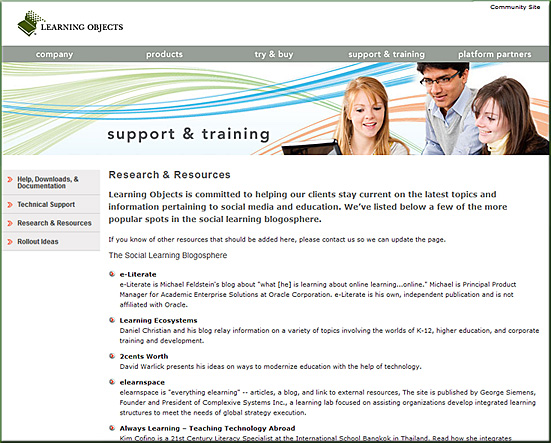
While on their website, be sure to see information concerning Campus Pack from Learning Objects:
.