The Fed’s Evolution Is Coming to a Computer Screen Near You — from nytimes.com by Jeanna Smialek
The 2020 version of the Federal Reserve’s loftiest annual meeting will be webcast this week, allowing the public to tune in for the first time. It could be the stage for an important policy shift.

Jerome Powell at the Fed

Excerpt (emphasis DSC):

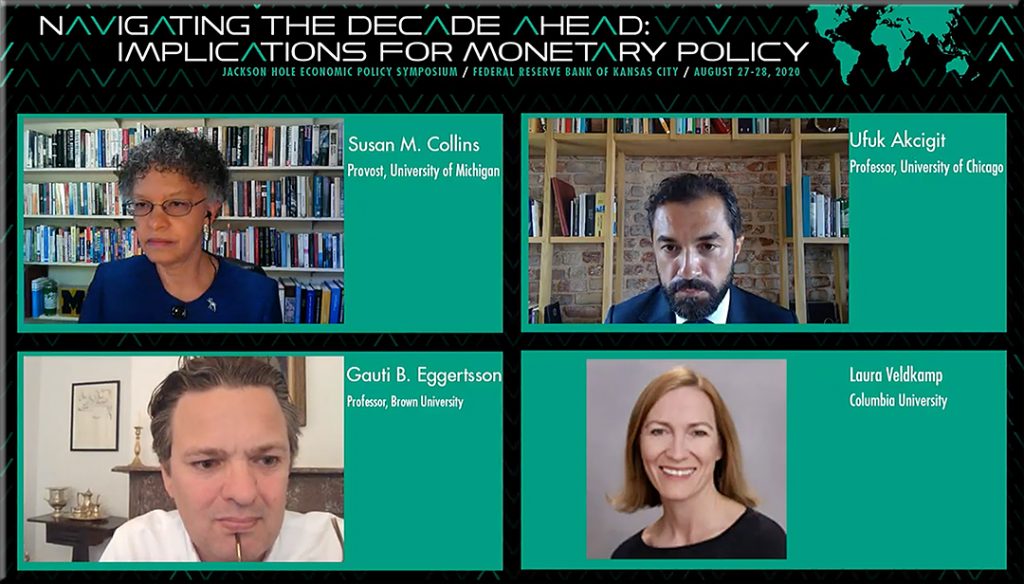
On Thursday, Chair Jerome H. Powell will have a chance to update America on the central bank’s soon-to-conclude framework review, in which it has revisited its policy tools for good and bad times, in a speech at the Kansas City Fed’s annual conference. The storied gathering of elite economists has been held behind closed doors in Jackson Hole, Wyo., since 1982. Because of the coronavirus pandemic, the event will be held remotely and streamed on the Kansas City Fed’s YouTube page this year, allowing the public to tune in for the first time ever.


From DSC:
May this be the start of something new!!! How cool/rewarding would it have been for our economics-related courses to be able to tap into this from a remote distance…then discuss (and track) things afterward!


Addendum:


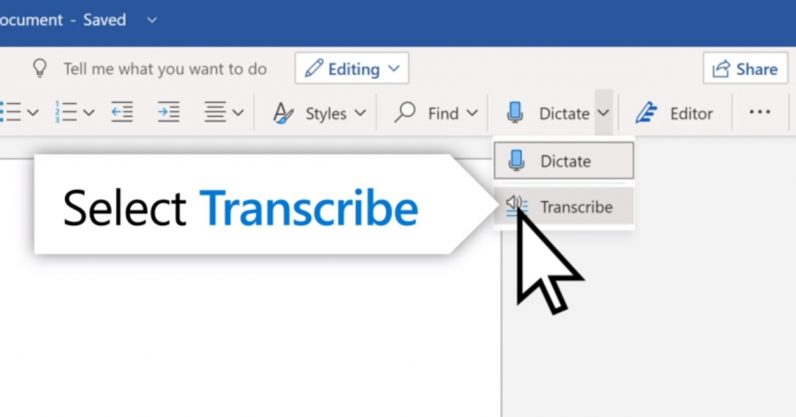
How to use Microsoft Word’s new ‘Transcribe’ tool — from thenextweb.com by Rachel Kaser; with thanks to Tim Holt for publishing this on his blog

Here is how to use Microsoft's new Transcribe feature in Word

Excerpt:

At the moment, the Transcribe tool is only available on the online version of Word, and only to Microsoft 365 subscribers. There are plans to bring it to Word mobile at some point in the future. It also only supports English, but that’s also likely to change.

So how do you actually use the Transcribe tool? Here’s how.


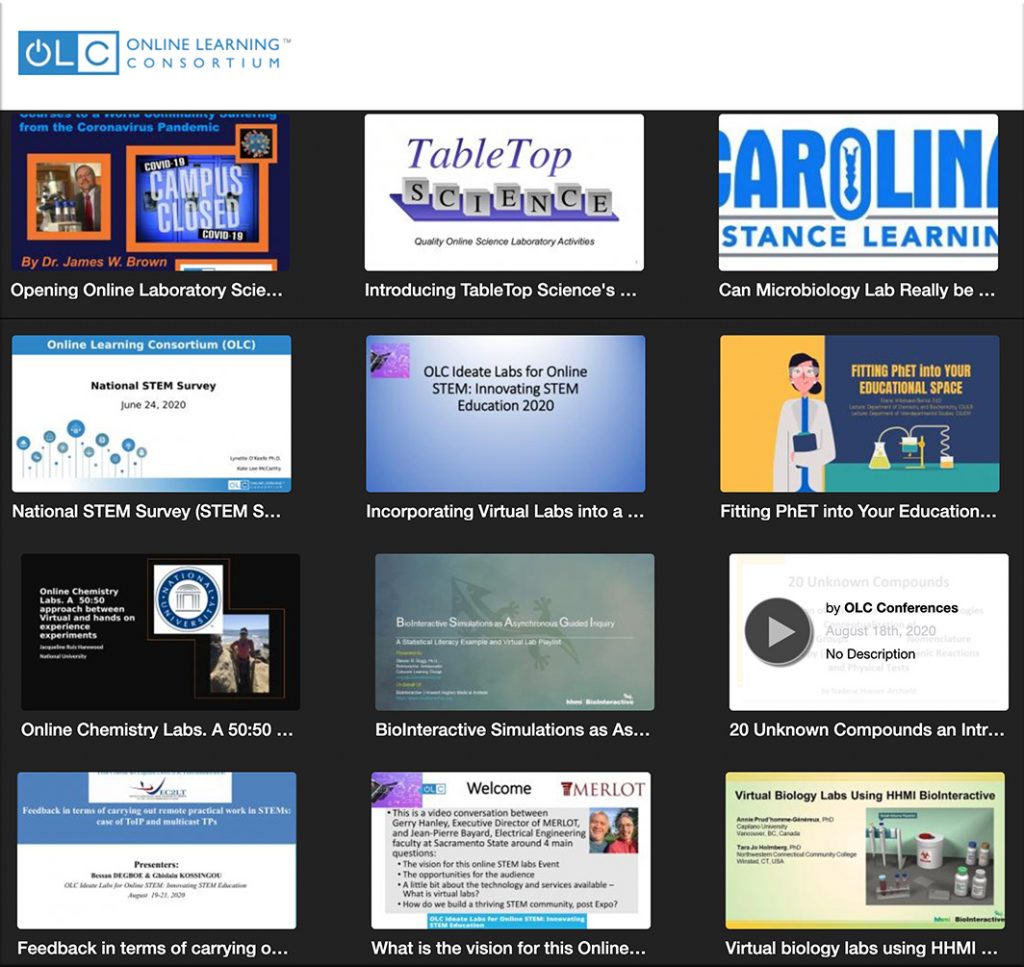
Information re: virtual labs from the Online Learning Consortium


 7 Things You Should Know About Virtual Labs — from library.educause.edu

Excerpt:

Virtual labs are interactive, digital simulations of activities that typically take place in physical laboratory settings. Virtual labs simulate the tools, equipment, tests, and procedures used in chemistry, biochemistry, physics, biology, and other disciplines. Virtual labs allow students to participate in lab-based learning exercises without the costs and limitations of a physical lab. Virtual labs can be an important element in institutional efforts to expand access to lab-based courses to more and different groups of students, as well as efforts to establish contingency plans for natural disasters or other interruptions of campus activities.


Addendum on 8/27/20:


The Digital Experience and the Analog Institution — from evoLLLution.com by Adrian Haugabrook | Executive Vice President and Managing Director of the Horizon Group, Southern New Hampshire University

For decades, higher education had to follow a more rigid structure built for the traditional student—now the minority of the higher ed learner population. Institutions need to rethink their infrastructures to fit non-traditional students, who look for a more flexible and customized digital experience. In this interview, Adrian Haugabrook discusses key elements to redesigning the student experience, higher ed’s responsibility to their consumer and how to create this high-quality experience as we head into a recession.

Excerpt:

The second element would be options and choices. We typically think of the educational process as linear—from point A to point B to point C. But what if it was a cyclical process, one where students are coming in and out of your learning ecosystem in different ways. This is especially true for adult learners. Their demands are very different than those we heard from traditional students. So, how do you provide the right options that allow for positive decision-making and progression?


From DSC:
Check out the thread for some solid advice for 1L’s.


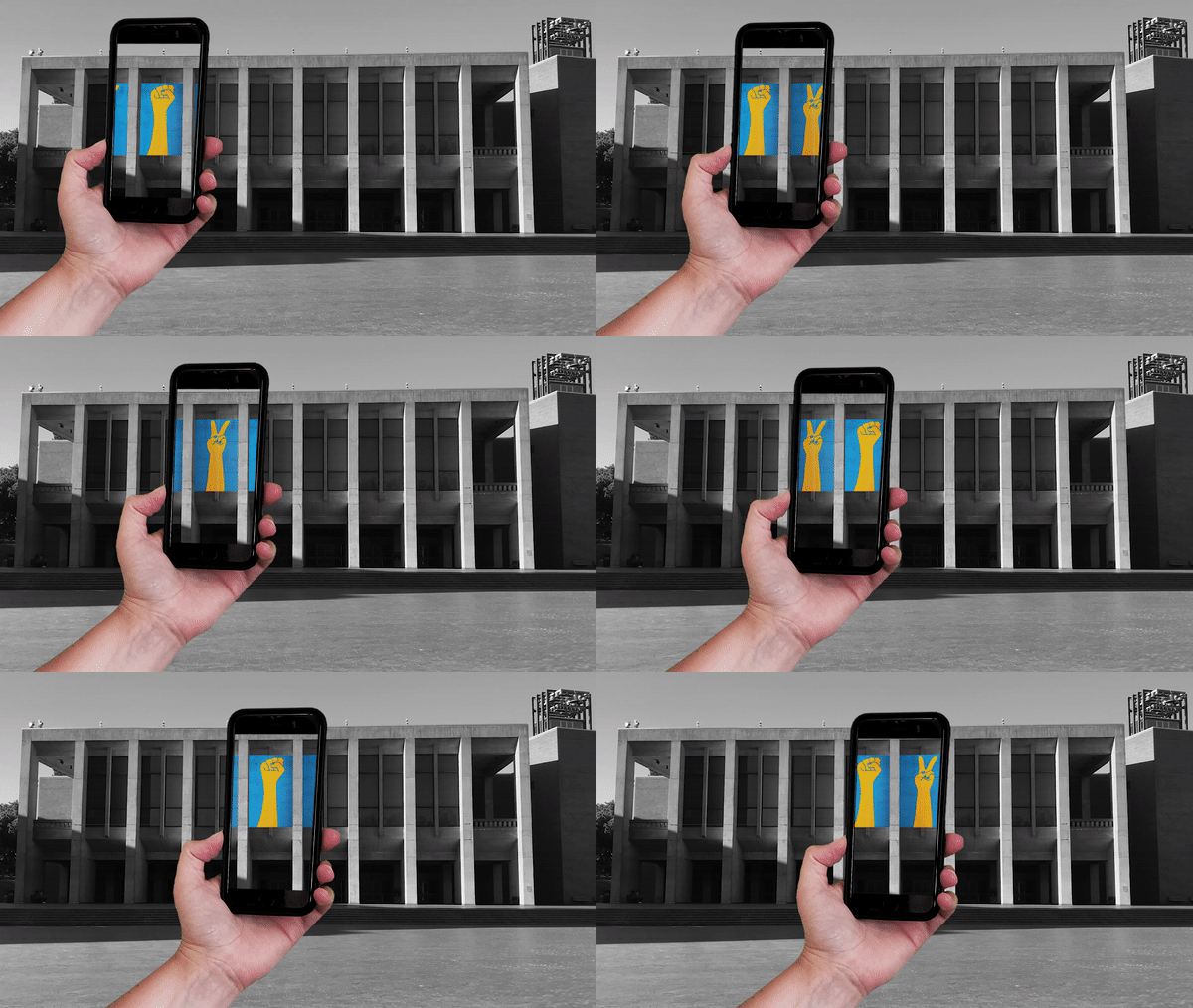
Preserving The Art Of Black Lives Matter Using AR — from vrscout.com by Kyle Melnick

Excerpt:

A city-wide digital art show celebrates the street art of BLM.

Designers at the architecture and design firm GGLO have created an augmented reality art show aimed at paying homage to the eclectic lineup of street paintings created as part of the Black Lives Matter movement. Not only does the project serve to preserve these impactful works of art, but to enhance them as well using modern immersive technology.


Do we have the “situational awareness” to navigate into the future? — from bigquestions.institute by Homa Tavangar and Will Richardson

Excerpt:

In our work with leaders over the past six months, we’ve been deeply focused on one particular aspect of “situational awareness,” namely building the skill of “reading the signs” in this moment more effectively to make better decisions about the future for students and school communities. One of the “big questions” we’re asking is what are we seeing happening now that gives us strong clues as to what’s coming around the corner?

Obviously, we can’t predict the future with 100% certainty. And actually, as situations can change in a heartbeat, that shouldn’t be the goal. What we can do, however, is get a clearer sense of where we’re going by being more fully aware of where we are.

In an education context, many of the signs are pointing to some big changes that require a greater sense of awareness in this moment.

From DSC:
Readers of this blog know that I’m big on pulse-checking the relevant landscapes around us. The ability to do this continues to become a critically important skill and habit for most of us these days. Along these lines, when the world is moving at 180mph, we need to be looking into the horizons…developing potential scenarios, and the plans to address those potential scenarios. I think of these graphics:
.


Alternative Credentials, Scaled Degrees, and the New Higher Ed Matthew Effect — from insidehighered.com by Joshua Kim
The potential impact of elite-branded affordable online certificates and degrees on regionally-branded tuition-dependent colleges and universities.

Excerpt:

I pulled those quotes from the 8/10/20 IHE article At Home, Workers Seek Alternative Credentials. Given the crazy times, I’m not sure if that article is getting the attention across higher ed that it deserves. Everyone is entirely focused on the near-term challenges of academic continuity during the pandemic. And that is the right place to be focusing. You can’t plan for the long-term when the short-term is so unstable.

But today, I’m going to ask you to do just that. If you can, step back from thinking about COVID-19 and what is happening to your school in the fall, and give some thought to the medium-to-long-term impact of the rise of alternative credentials and scaled degrees to your institution.

First, let me ask you a question. How does your school balance its books? Where does the money come from?


From edsurge.com today:

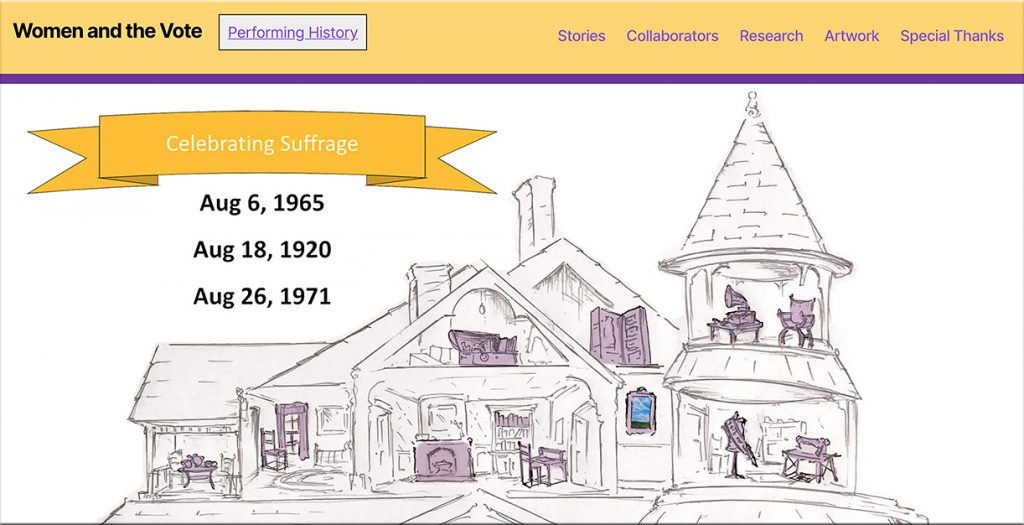
THOROUGHLY MODERN MEDIA: This spring, a college theater course about women’s voting rights aimed to produce a new play about the suffrage struggle. When the pandemic scuttled those plans, professors devised a new way to share suffragist stories by creating an interactive, online performance set in a virtual Victorian mansion. And their students were not the only ones exploring women’s voting rights as the country marks the 100th anniversary of the Nineteenth Amendment.

…which linked to:

The Pandemic Made Their Women’s Suffrage Play Impossible. But the Show Went on— Virtually — from edsurge.com by Rebecca Koenig

Excerpts:

Then the pandemic hit. Students left Radford and Virginia Tech. Live theater was canceled.

But the class wasn’t.

“Neither of us ever said, ‘Forget it,’” Hood says. “Our students, they all wanted to know, ‘What are we doing?’ We came to them with this insane idea.”

They would create an interactive, online production staged in a virtual Victorian mansion.

“Stage performance is different than film or audio. If you just have audio, you only have your voice. Clarity, landing sentences, really paying attention to the structure of a sentence, becomes important,” Nelson says. “Students got a broader sense of the skills and approaches to different mediums—a crash course.”


From DSC:
Talk about opportunities for interdisciplinary learning/projects!!!  Playwrights, directors, actors/actresses, set designers, graphic designers, fine artists, web designers and developers, interactivity/interface designers, audio designers, video editors, 3D animators, and more!!!


The performance website, “Women and the Vote,” premiered on May 18, 2020


#lifelonglearning #stayingrelevant #reinvent #learning #surviving


Speaking of career-related items…also see the powerful commentary out at:

From DSC:
That article reminded me that there are a variety of people working on the “front lines” of this pandemic. 


Coronavirus weaves uncertainty in pre-K — from educationdive.com
Early childhood programs were particularly hard-hit by the coronavirus pandemic, from the immediacy of school closures to future state funding.

Excerpt (emphasis DSC):

In a school year disrupted by the coronavirus pandemic, early childhood was particularly impacted. Forced to close their doors, preschool centers struggled to adapt and survive. And state budget cuts due to the recession exacerbated by the pandemic may also impact these programs for years to come.

Now, as many children prepare to start school for the first time, they’ll be doing so without the physical school.

To help you get up to speed on the issues, we’ve gathered our recent coverage on coronavirus’ impact on early childhood ed in one place.


Using the TV as a key tool in our learning ecosystems

From DSC:

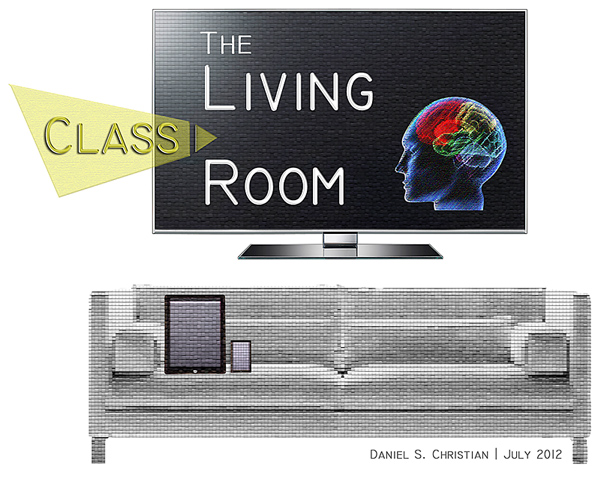
  • If one doesn’t have access to the Internet, a computer, or any such mobile technology as seen in the image above…could TV become the medium through which one could be educated during this next year of the Coronavirus situation? That is, until we can develop better and more equitable policies, plans, funding, systems, infrastructures, and connectivity for all students!
  • After that, could we see more televisions morph into smart/connected TVs?
  • Could PBS, ABC, CBS, NBC, Fox, and other major networks collaborate with the U.S. Department of Education to help us educate all students? 
  • Could the largest internet company of 2030 be an online school as Thomas Frey predicts?

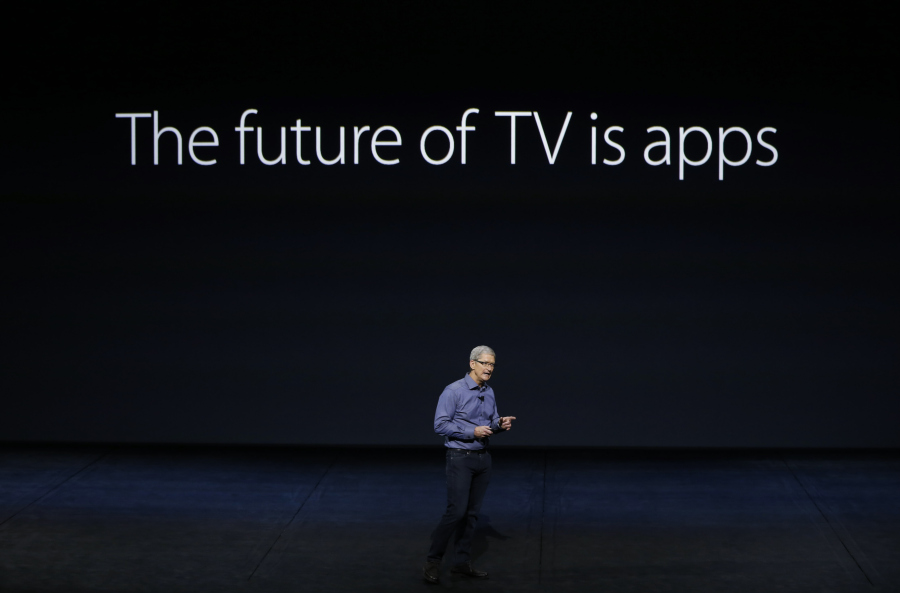
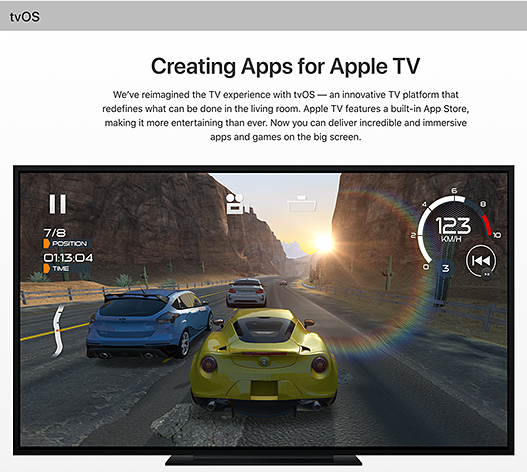
A few years ago, I had hoped that Apple was going to go all-in with their tvOS platform.

SAN FRANCISCO, CA – SEPTEMBER 9: Apple CEO Tim Cook introduces the New Apple TV during a Special Event; 9/9/15.


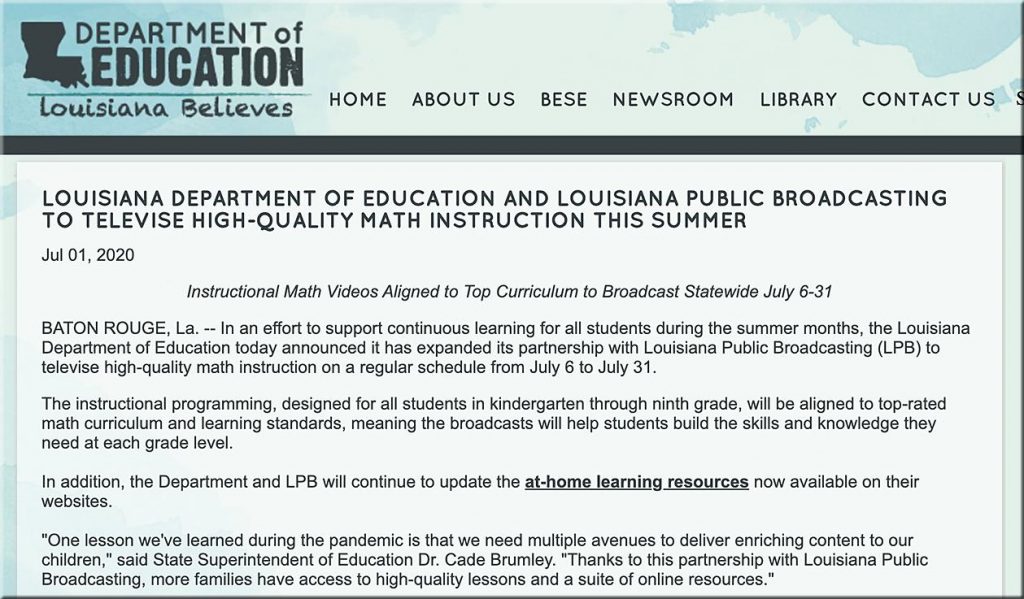
Though it’s still early in the game, that really hasn’t happened to the extent that I had hoped. That said, more recently, I was encouraged to see this article from back in July:

LOUISIANA DEPARTMENT OF EDUCATION AND LOUISIANA PUBLIC BROADCASTING TO TELEVISE HIGH-QUALITY MATH INSTRUCTION THIS SUMMER


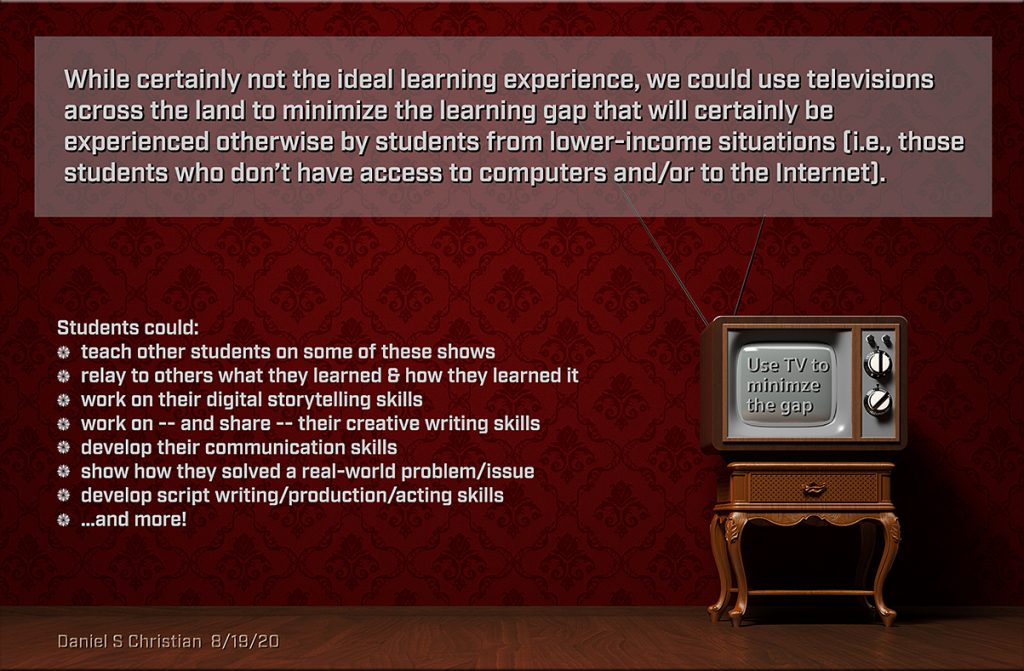
Let’s ask the employees of PBS, ABC, CBS, NBC, Fox, and other networks if they would be willing to work with the U.S. Department of Education to help educate ALL students! Though educational TV is not new, I’m talking about taking things to a *whole* new level.

With that in mind, I created the following graphic:

Let's use television to minimize the learning gaps that will otherwise be experienced by many students this next year!

(One might ask why I used an old television in the above graphic. I was trying to get at the idea that one might not have a lot of resources to work with.)

 
© 2025 | Daniel Christian