From DSC:
I’ve heard many people mention that what we did throughout K-16 in the spring of 2020 was remote teaching — an emergency response to the Coronavirus. And I would agree with that assessment and verbiage — that was/is very true. It wasn’t online-based learning as many of us have come to know it over the last 20+ years. It didn’t offer a lot of the things that organizations like the Online Learning Consortium (OLC) and Quality Matters have been trying to promote and get us to achieve for years.

But then I hear the expectation that everything has been vastly improved over the summer and suddenly, almost overnight, all teachers, professors, trainers, adjunct faculty members, etc. have become highly proficient in matters involving online-based teaching and learning. In other words, the expectations say that:

  • Students should expect a top-notch experience now that summer is over.
  • Suddenly, Rome was built in a day!

But it wasn’t, and it isn’t.

It takes time and practice to become proficient in how to teach online. That’s the truth. It also takes a great deal of time and investments in hardware, software, tools, training/education/professional development, networking and telecommunications infrastructure, and more. It takes numerous skillsets to do it well. (By the way, that’s why I like to think in terms of team-based content creation and delivery.)

Also, often times, it takes MORE time to teach online than it does to teach in a face-to-face classroom. That is certainly the case for the first time that you will be teaching online. You need to know that going into it. You have to put your course together PLUS learn how to deliver it effectively in an online-based format. You need to learn a variety of tools and related ecosystems. Not a simple, overnight kind of task, I can assure you.

So students, don’t expect your faculty members to become professional online-based teachers overnight Again, it takes time and practice…just like anything we set out to do.

And for you student teachers and Education Departments/Programs out there, keep at it. Don’t dismiss this time as a brief period/phenomenon that will simply go away and we’ll get back to “normal.” Make the necessary adjustments to your curriculum, toolsets, “teacher placements,” and more. Let’s get prepared for the future, come what may.

For higher ed, if you want to continue to use adjunct faculty members to handle a significant amount of the teaching load out there, you will need to better address the training and the $$/reimbursements that you provide to them.

And for all of the teachers, trainers, faculty members — and now even parents and/or guardians — out there, cut yourself some slack, give yourself some grace, and keep trying. One step at a time. Don’t get discouraged.

Also relevant/see:

Build and accelerate beyond the pandemic: Consciously deliver a great online experience for lifelong learners — from evoLLLution.com by Philip Regier

Excerpt:

Today’s learners have high expectations as expert consumers in all aspects of their lives. Higher education needs to create an infrastructure that meets the needs of this tech-savvy demographic. Institutions need to recognize that the online environment is here to stay and is in need of a rebuild in order to deliver the best student experience possible, even post-pandemic. In this interview, Phil Regier discusses the today’s learners’ expectations, scaling a high-quality online environment, and how to build the right infrastructure to support learners in this new and digitized normal.


 

7 things you should know about podcasting — from library.educause.edu

Excerpt:

What is it?
In its most basic sense, a podcast is an audio file. When the term was introduced in 2004—derived from the Apple iPod, at the time still a novel portable music player—podcast referred to audio content that employed RSS technology to allow users to subscribe to serialized content that is automatically downloaded and synchronized whenever it is updated. Purists would insist that those requirements still apply—that a podcast must be serialized content available through an RSS feed. In common usage, however, the term has become much looser and is now often used to describe essentially any audio file, whether it is part of a program or a one-off, and even audio content available on a website but not syndicated. It can replace or augment written material, such as textbooks or similar resources. Other podcasts consist of poetry or fiction or are venues for entertainment. Podcasting is enjoying a resurgence, in part because of the penetration of smartphones. People can listen to podcasts during their commutes, while exercising or washing the dishes, or in countless other times and places.


Watch out for these 3 mistakes you’re making during distance teaching — from edsurge.com by Paul Emerich France

Excerpt:

Distance teaching also shone a light on problematic practices that were never effective in person, either. And trying to re-create them in a virtual environment didn’t make them any better. As many schools resume remote instruction this fall, watch out for these three mistakes you may be making. More importantly, give yourself the liberty to try out some of the alternative approaches that can help make distance teaching more sustainable and effective.


Google achieves first quantum simulation of a chemical reaction — from interestingengineering.com by Loukia Papadopoulos

Excerpt:

Now, researchers at Google have taken a step forward in quantum computing practicality by using one such computer to simulate a chemical reaction, albeit a simple one, reported New Scientist. The company used its Sycamore computer to achieve this lofty task.

Also see:

This Taiwanese Lecturer Draws Stunning Anatomical Drawings on the Chalkboard — from interestingengineering.com by Utku Kucukduner
His paintings are temporary, just like the mortal flesh we bear.

This Taiwanese Lecturer Draws Stunning Anatomical Drawings on the Chalkboard


The new workplace -- August 2020


“……hotels and restaurants, in the absence of their traditional clientele, are repurposing their spaces as rentable offices.”

Emily Safian-Demers (source)


Best Content Awards 2020 — from elearninfo247.com by Craig Weiss

Excerpts:

Judging Areas

  • Video
  • Animation
  • Audio Quality
  • One that is very important, but way too many vendors lacked it…ADA508 or similar (depending on the country, but most countries have it) support.
  • Usefulness
  • Interactivity (Quality and Usability)
  • Engagement
  • Scenarios (if applicable)
  • Description
  • Objectives

What was excluded

  • Assessments

And now… the awards.


Moody’s: Coronavirus is accelerating shift to online education — from educationdive.com by Natalie Schwartz

Dive Brief:

  • The pandemic will hasten a transformation of higher education business models, according to a new Moody’s Investors Service report.
  • The crisis will accelerate many colleges’ plans to grow their online footprints, though not all schools have the resources to invest in digital infrastructure, the report notes. They will also likely expand non-degree and certificate programs.
  • Analysts predict that once the pandemic subsides, some colleges will struggle if they haven’t established a strong online presence.

“Some universities previously resistant to change will have to take more expansive steps to adapt to this transformation,” Pranav Sharma, assistant vice president at Moody’s, said in a statement. “Not all universities, however, have the resources or culture to move quickly and the coronavirus will expedite existential threats for some.”

Also see:

Active Learning while Physically Distant — from blogs.acu.edu

Excerpt:

  • Use a Google Form as an entrance or exit ticket. Upon entering class, a quick google form can engage students with a couple of quick questions. A google form as an exit ticket can provide good insight into student learning that day.
 

ROSS Chrome Extension For Legal Research — from artificiallawyer.com

Excerpt:

ROSS Intelligence, the legal research pioneer, has launched a free Chrome extension to find case law support for text found anywhere on the web.

In this latest AL TV Product Walk ThroughMaya Bielinski, Head of Product at ROSS, explains how it works and what its capabilities are in this 8-minute overview.

As Maya explains, all you have to do is highlight the text you are interested in, right click, and find decisions that express the concept you’ve searched.

The application uses ROSS’s Find Similar Language tool, which uses semantic search.


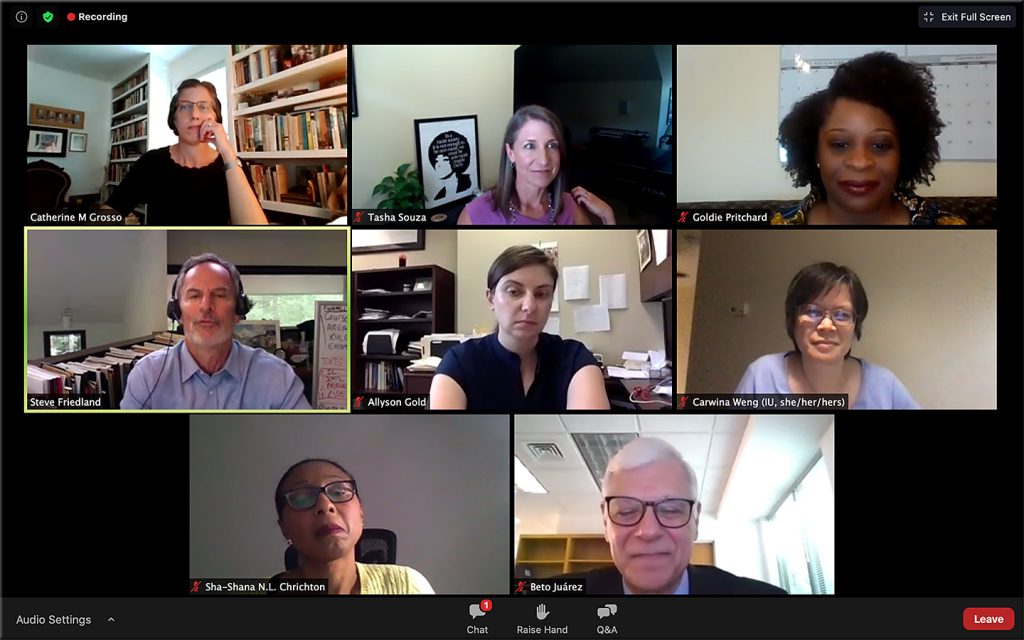
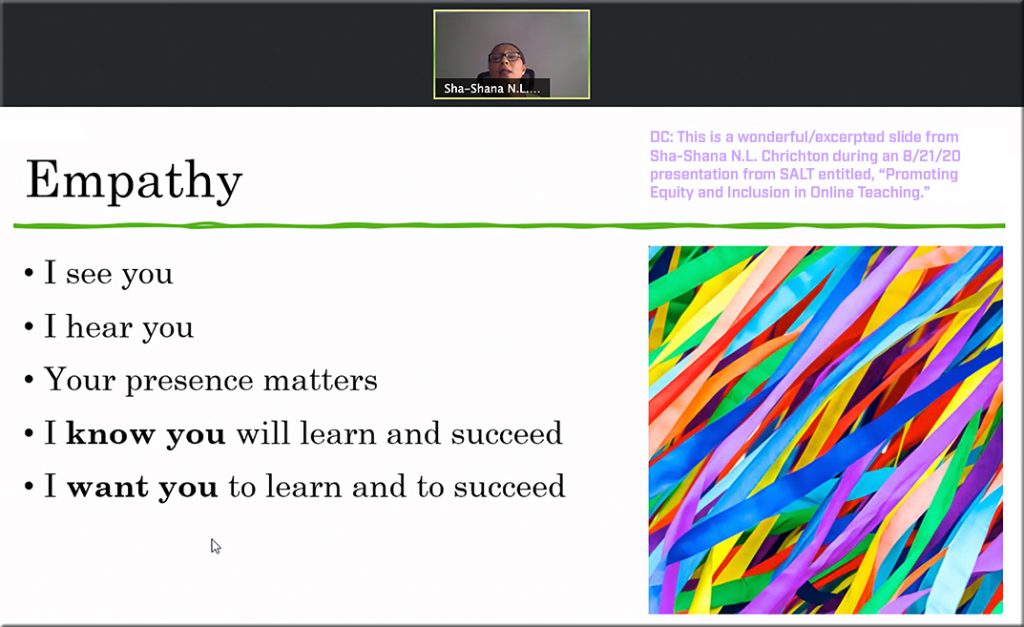
SALT Social Justice Series Promoting Equity Online (21 Aug 2020) — from saltlaw.org with a special thanks to Catherine M. Grosso for these resources (Catherine is a Professor of Law at Michigan State University, Co-President, Society of American Law Teachers, and an Associate Editor for the National Registry of Exonerations.)

From DSC:
To me, that last bullet point says:

“I’m on your team and I’m here to help you become the best lawyer, litigator, judge, legislator, etc. that you can be.”

Other resources Catherine and Dr. Tasha Souza mentioned:


Big 4 as the next legal disruptor: Is it game over? — from legaltechmonitor.com by Stephen Embry

Excerpt:

One of the more fascinating keynotes at this week’s ILTA virtual conference was a panel discussion among three representatives of the big four accounting firms: Peter Krakaur, Managing Director of EY Law, Mark Ross, Principal, Deloitte, and Juan Crosby, PWC NewLaw Services Leader. The title of the talk was Legal’s Next Disruptor? Demystifying the Big 4. Or as I put it before, is the Big 4 the proverbial big bad wolf?

Also see:

Friday happenings at the ILTA-ON* Virtual Conference: eDiscovery Trends — from

Excerpt:

As I discussed last week (and have discussed all this week as well), the International Legal Technology Association’s (ILTA) annual conference has gone virtual this year and ILTA>ON has been running throughout the week.

ILTA > ON Legal Tech Conference


The Pandemic May Drive Principals to Quit — from blogs.edweek.org by Lesli A. Maxwell and Denisa R. Superville

Excerpt:

The physical and emotional strain of the coronavirus pandemic is taking a steep toll on America’s principals, with a large share saying they are speeding up plans to retire or otherwise leave the profession.

Forty-five percent of principals said that pandemic conditions are prompting them to leave the job sooner than they had previously planned, according to a new survey from the National Association of Secondary School Principals. A slightly larger share—46 percent—said the pandemic has not changed their plans to stay in or leave the profession.

From DSC:
Stressful times, indeed. What will the pandemic ultimately do to the learning ecosystems related to the school systems, families, and youth within K-12 within the U.S.? It’s hard to say at this point, but time will tell.


Artificial Intelligence (AI) for beginners  — from enterprisersproject.com by Stephanie Overby
Artificial intelligence can seem daunting as you start work. Let’s break down how AI works, common types of AI, how it improves big data insights, and strategy essentials.

Excerpt:

“The use of AI and machine learning (ML) is occurring in a wide range of solutions and applications, from ERP and manufacturing software to content management, collaboration, and user productivity. Artificial intelligence and machine learning are top of mind for most organizations today,” David Schubmehl, research director of Cognitive/Artificial Intelligence Systems at IDC said in conjunction with the guide, noting that AI will be the disrupting influence reshaping entire industries over the next decade.

It’s clear that AI will be on everyone’s roadmap soon. As Enterprisers Project noted in our Harvard Business Review Analytic Services report, An Executive’s Guide to Real-World AI, “Hype in tech is nothing new. What’s different this time is the degree to which reasonable and knowledgeable people believe that there is, indeed, a real urgency to get going with AI now.”

Addendum on 8/28/90


From Beth McMurtrie in this week’s “Teaching” over at The Chronicle:

  • Examples of innovative assessment strategies
  • An instructor’s request to help students engage with digital textbooks
  • Some resources for effective online, equitable, & antiracist teaching

Teaching -- over at The Chronicle

From DSC:
I especially appreciated the item re: the creation/use of multimedia-based content in place of a more traditional assessment. This type of assignment/assessment allows more choice and it opens up opportunities for more creativity and expression.


The Great Online Migration and Curricular Materials Product-Market Fit — from eliterate.us by Michael Feldstein

Excerpts:

Third, COVID-19 will accelerate the need of colleges and universities to find ways of continuing to serve their graduates for 20 or 40 years rather than for two or four. Quite simply, they will need revenue at a time when the pace and breadth of reskilling needs in the workplace is accelerating. These students will need online or blended educational experience, which will mean that more instructors will be called upon to teach using new modalities.

Major changes in the market
This shift online will drastically shift approaches to curricular materials at both the individual instructor and the institutional levels.

Meanwhile, institutions will face two pedagogy-related challenges. First, they will have to work very hard to retain students who are under increased financial stress and may struggle in an online environment more than they would in a residential program. Since the colleges will also be under financial stress, they will need to retain every student possible. They will no longer have the luxury of simply letting faculty teach however they like and accepting that some of them are not good at helping their students to succeed.


© 2025 | Daniel Christian