Radar trends to watch: October 2020 — from oreilly.com

Excerpt:

This month, the big surprise is that there’s no significant technology news about COVID. And there is more news than ever about legislation and regulation. I suspect that the legal system will be a big driver for technology over the next year. Another trend that doesn’t quite count as technology news but that definitely bears watching is that college enrollment in the US is down. Grad schools are up, 4 year colleges are down slightly; the big hit is in 2 year colleges. COVID is probably the biggest contributing factor, but regardless of the cause, this is an inauspicious trend.


Pay attention! Attention is a necessary condition for learning experience design, but poorly understood… — from donaldclarkplanb.blogspot.com by Donald Clark

Excerpts:

Attention is to selectively focus your mind and effort on that which has to be learned. Attention matters as it is what manages new data that has to be processed in working memory. Focused attention narrows down input from sensory memory and your recall knowledge from long-term memory. At any moment in time attention is what determines what is processed. We must always be aware that attention is the bottleneck through which everything must go in learning, first into working memory, then if you successfully learn, into long-term memory. The selective nature of attention is what regulates and limits cognitive overload.

So, over a century of research has shown that attention is not one thing but a very complex phenomena. We select inputs, interpretations of those inputs, then select plans of action and actions themselves. Attention is tied up with motivation, interest, feelings and ultimately action. It is the basecamp for understanding how learning experiences should be designed.


From DSC:
Interest…motivation…this is why I’m a big fan of offering learners more choice. More control.


Transfer – why is it ignored? Here’s how to fix it… — from donaldclarkplanb.blogspot.com by Donald Clark

Excerpt:

You must design with transfer in mind and blends or learning journeys must move learning forward towards action, towards doing, towards practice and performance. No matter how much training you deliver, it can be illusory in the sense of not leading to transfer from cognitive change to actual performance, which in turn has impact on the organisation.

Doing and Practice are experiences. In fact without doing or practice it is unlikely to be retained long-term. Your design must move from experiences that match whatever type of learning you need, cognitive, psychomotor and affective, but practice and application experiences also matter. Your design should provide transfer pathways towards mastery, through actual doing and practice in the formal learning as well as practice and extension activities beyond the initial learning experiences.


The shift online has colleges looking to share courses — from educationdive.com by Alia Wong
Dozens of institutions have joined consortia for exchanging online classes since the pandemic began, and new options have sprung up.

Excerpts:

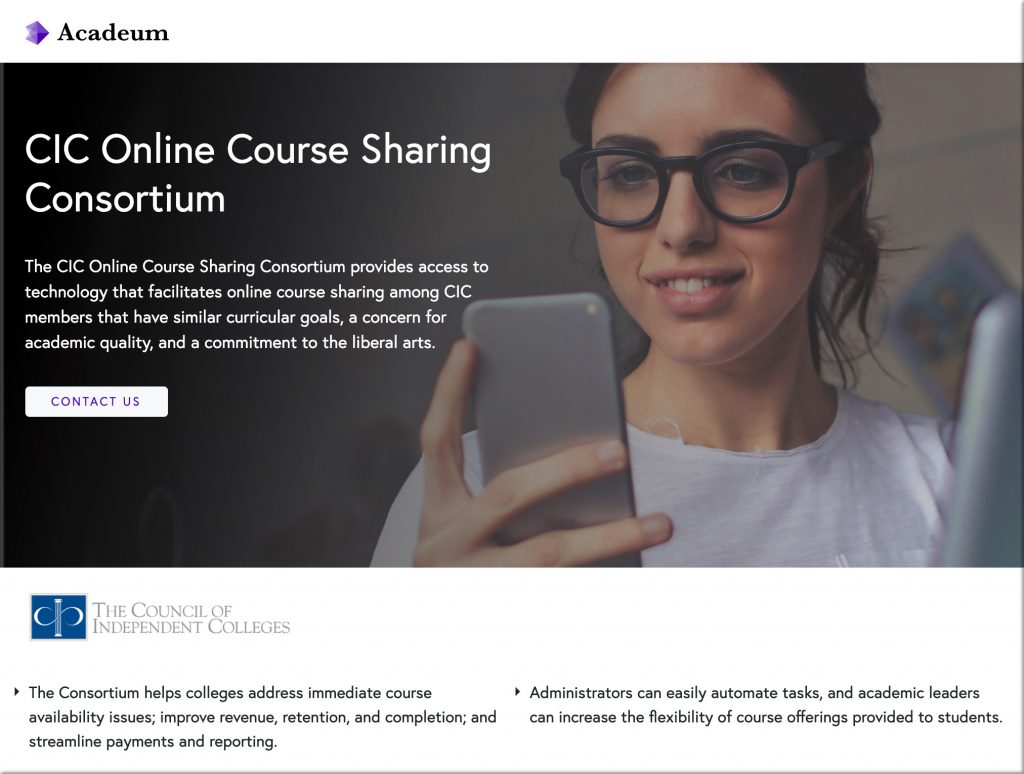
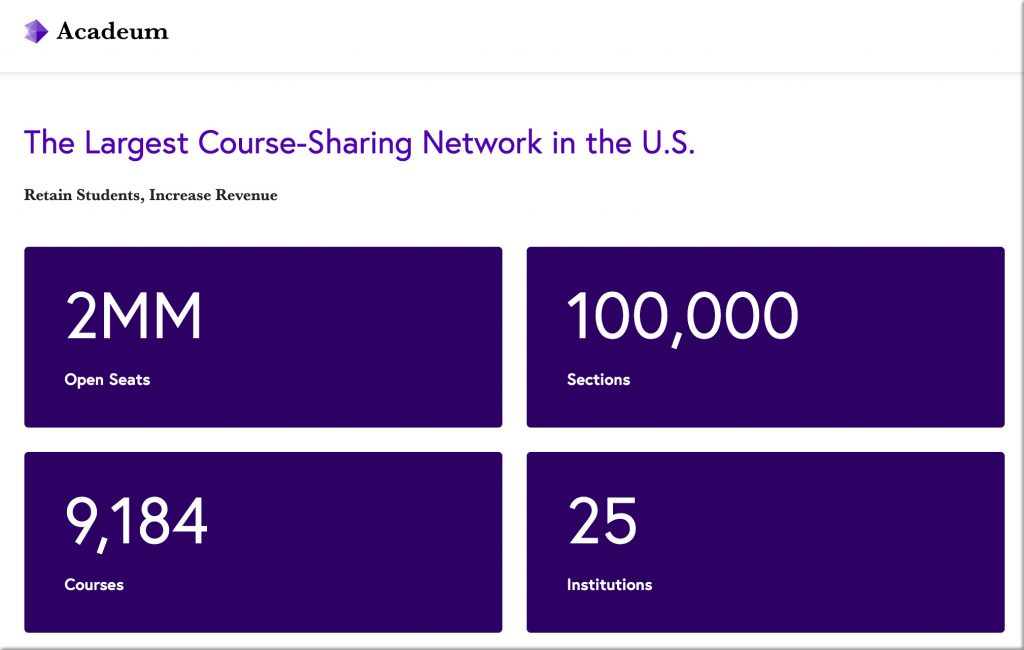
Dozens of other small, private institutions followed thanks to the Council of Independent Colleges’ (CIC’s) Online Course Sharing Consortium, which was formed in late 2018 and today is the largest of the dozen or so networks on Acadeum.

CIC Online Course Sharing Consortium


Course recovery consortium


Legalweek Announces a New Virtual Experience for 2021 named Legalweek(year) — from prnewswire.com
Legalweek originally to be held in-person on February 1-4 will now be a series of 5 interactive virtual events held throughout the year to guide legal leaders through the new legal landscape.

Excerpt:

NEW YORKOct. 1, 2020 /PRNewswire/ — Beginning on February 2-4, 2021, Legalweek(year) will bring together thousands of legal professionals for a series of 5 innovative virtual legal events that tackle the changing legal landscape and provide actionable insights to help legal leaders restructure, rebuild and reinvigorate today’s law firms and legal departments. The Legalweek(year) virtual series aims to serve as the anchor for the legal community during an unprecedented time, as well as a guide throughout the coming year to inform legal professionals of emerging trends, cutting edge legal technology and expert analysis of the tectonic shifts in the industry.


Let the morning bring me word of your unfailing love,
    for I have put my trust in you.
Show me the way I should go,
    for to you I entrust my life.

10 Teach me to do your will,
    for you are my God;
may your good Spirit
    lead me on level ground.


Progress in the time of COVID-19: Reconsidering gender equity in the legal profession — from abovethelaw.com by Amanda M. Fisher
Here are five ideas to advance gender equity in the profession.

Excerpt:

Law is steeped in tradition, but COVID-19 ravaged several pillars to which the legal profession was moored. For example, time at the office was the highest currency before the pandemic, despite many lawyers, often parents — usually mothers — requesting flexible schedules and remote options. Yet during COVID-19, employers were forced to reassess whether time in the office is worth more than the safety of their employees. So, if we can make changes to keep the profession running during a pandemic, we can also reimagine the profession in a less-gendered way. Here are five ideas to advance gender equity in the profession:


3 winners for the GSV Cup: Abwaab, Prepmedians, and Ringbeller! Congratulations!! These three exceptional companies won out of over 550 applications.

First Place Winner – Watch the pitch below from Abwaab

Second Place Winner – Watch the pitch below from Prepmedians

Third Place Winner – Watch the pitch below from Ringbeller


WMU-Cooley Innocence Project helps earn release of Lacino Hamilton after 26 years in prison — from cooley.edu and WMU-Cooley Law School’s Innocence Project

Excerpt:

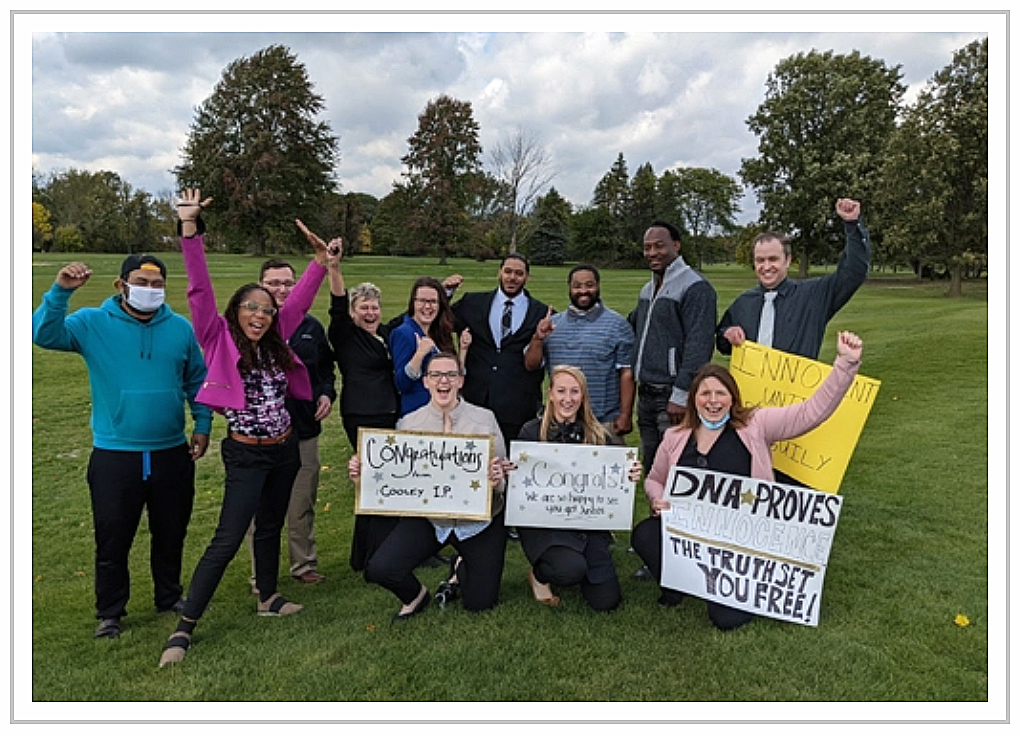
Today, Wayne County Judge Tracy Green set aside the conviction of Lacino Hamilton who was wrongfully convicted of second degree murder and felony firearms in 1994. DNA testing facilitated by the Western Michigan University Cooley Law School Innocence Project was used to help win Hamilton’s release. Assistant Prosecutor Valerie Newman, director of the Wayne County Prosecutor Office’s Conviction Integrity Unit, moved to have Hamilton’s conviction vacated and requested dismissal of all charges. The motion was joined by Hamilton’s legal counsel, Mary Chartier (Johnson Class, 2002) and Takura Nyamfukudza (Moore Class, 2013) of CN Defenders. Both are WMU-Cooley law graduates and well-respected defense attorneys.


Academia needs a reality check: Life is not back to normal — from sciencemag.org by June Gruber, Jay J. Van Bavel , William A. Cunningham, Leah H. Somerville, Neil A. Lewis, Jr.; with special thanks to Dr. Kate Byerwalter for this resource

Excerpts:

The problems don’t end there. Many academics are also grappling with ongoing racial injustices and associated protests, wildfires, and hurricanes. We continue to see widespread effects on mental health, with roughly one-third of Americans reporting symptoms of clinical depression or anxiety. June and her colleague recently described the escalating mental health crisis as the next biggest coronavirus challenge.

We have struggled with our own mental and physical well-being—as well as challenges associated with canceled vacations, lack of child care, the illnesses and death of people close to us, and the mental weight of difficult conversations about racial injustices. We’ve also been worrying about our trainees and the undergraduate students in our classes. The academic and non-academic job markets have cratered, and some of our colleagues and students have lost internships and job offers as organizations have been forced to cut expenses.

Expecting the same output as in previous years, even though many people have less time and more stress than ever, is not a sustainable or humane solution. The world is not normal—so the way we do science cannot be normal either.


From DSC:
Along these lines…

Sometimes, I think we need to be very careful with Artificial Intelligence (#AI) — which elements of it and which applications of it that we use in our society and which we don’t move forward with. But in the case of cloud-based learning profiles (some might say competency profiles), AI makes sense. Algorithms could make sense. Data mining could make sense.

A cloud-based learning profile might not make sense always to us — as it could be very large indeed. But AI-based algorithms could assist with finding appropriate matches between jobs, competencies, passions, skills, and candidates.

Such services will likely be part of a next-gen learning platform.


Arc, Spiral, and Curve Bookshelves — from theawesomer.com by Brianna Kufa

Arc, Spiral, and Curve Bookshelves -- from theawesomer.com by Brianna Kufa


Heatherwick Studio designs flood-resilient park The Cove for San Francisco — from dezeen.com by Eleanor Gibson

Heatherwick Studio designs flood-resilient park The Cove for San Francisco -- from dezeen.com by Eleanor Gibson

Excerpt:

Slated for completion in 2026, The Cove is intended to provide a new hub of activity while addressing rising sea levels threatening the waterfront site and also consideration [of] its history.

From DSC:
Many years ago, my wife and I spent several years out in the San Francisco Bay area. I was there to go through SFSU’s Multimedia Studies Program. I have many good memories from our time out there. I hope to be able to take that road trip in 2026!


Livestreamed Chemistry Labs Keep Learning Real — Mistakes, Spills and All — from campustechnology.com by Dian Schaffhauser

Excerpt:

To keep students engaged, the synchronous sessions include small-group breakout sessions and on-the-spot activities like having students name compounds; balance chemical equations; predict the outcomes of experiments; and calculate masses, amounts and concentrations for the chemicals used.


Civil Justice for All — from amacad.org

Excerpts:

This report calls for the legal profession, the courts, law schools, tech professionals, and partners from many other fields and disciplines to coordinate their efforts to provide necessary legal assistance to many more people in need. Past efforts to improve access to justice offer strong evidence that such an effort would have a profound effect on American society—measured in financial savings, greater trust in law and social institutions, and the safety and security of families and communities.

THE PROJECT’S SEVEN RECOMMENDATIONS ARE:

First, and above all, dedicate a consequential infusion of financial and human resources to closing the civil justice gap, and seek a significant shift in mindset—extending beyond lawyers the duty and capacity to assist those with legal need—to make genuine strides toward “justice for all”;

Secondincrease the number of legal services lawyers who focus on the needs of low-income Americans;

Thirdincrease the number of lawyers providing pro bono and other volunteer assistance, to supplement the corps of legal services lawyers;

Fourthbring many new advocates—service providers who are not lawyers—into the effort to solve civil justice problems;

Fifthfoster greater collaboration among legal services providers and other trusted professionalssuch as doctors, nurses, and social workers;

Sixthexpand efforts to make legal systems easier to understand and use through the simplification of language, forms, and procedures and the wider use of technology; and

Seventhcreate a national team, or even a new national organization, to coordinate the efforts listed above, collect much-needed data on the state of civil justice, and help identify and publicize effective innovations that improve access.


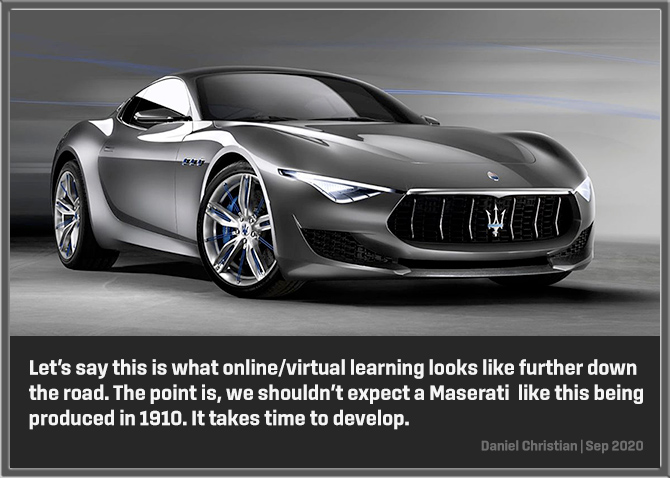
[Re: online-based learning] The Ford Model T from 1910 didn’t start out looking like a Maserati Gran Turismo from 2021! [Christian]

From DSC:
Per Wikipedia, this is a 1910 Model T that was photographed in Salt Lake City:

The Ford Model T didn't start out looking like a Maserati from 2021!


This is what online/virtual learning looks like further down the road. Our journey has just begun.

From DSC:
The Ford Model T didn’t start out looking like a Maserati Gran Turismo from 2021! Inventions take time to develop…to be improved…for new and further innovations and experiments to take place.

Thinking of this in terms of online-based learning, please don’t think we’ve reached the end of the road for online-based learning. 

The truth is, we’ve barely begun our journey.


Two last thoughts here


1 ) It took *teams* of people to get us to the point of producing a Maserati like this. It will take *teams* of people to produce the Maserati of online-based learning.

2) In terms of online-based learning, it’s hard to say how close to the Maserati that we have come because I/we don’t know how far things will go. But this I do know: We have come a looooonnnnnggggg ways from the late 1990s! If that’s what happened in the last 20 years — with many denying the value of online-based learning — what might the next 5, 10, or 20 years look like when further interest, needs, investments, etc. are added? Then add to all of that the momentum from emerging technologies like 5G, Augmented Reality, Mixed Reality, Virtual Reality, Artificial Intelligence, bots, algorithms, and more!


From DSC:
To drive the point home, here’s an addendum on late 9/29/20:

Mercedes-Benz Shares Video of Avatar Electric Car Prototype

 
© 2025 | Daniel Christian