


Creating a split-screen music video – The Dos and Don’ts — from global-edtech.com by Levent Erdogan
Levent Erdogan shares his experience producing split-screen music videos.
On 10/10/2020,
in 21st century, Access to Justice (A2J), innovation, law schools, leadership, Legal operations, legal reform, legal technologies, legislatures / government / legal, Michigan, society, United States,
by Daniel Christian
The justice gap in the United States is striking. It ranks 103rd out of 126 countries in accessibility and affordability of civil legal services, according to a World Justice Project survey. More than 80% of those in poverty, as well as a majority of middle-income Americans, receive inadequate civil legal assistance, the nonprofit Legal Services Corporation found.
From DSC:
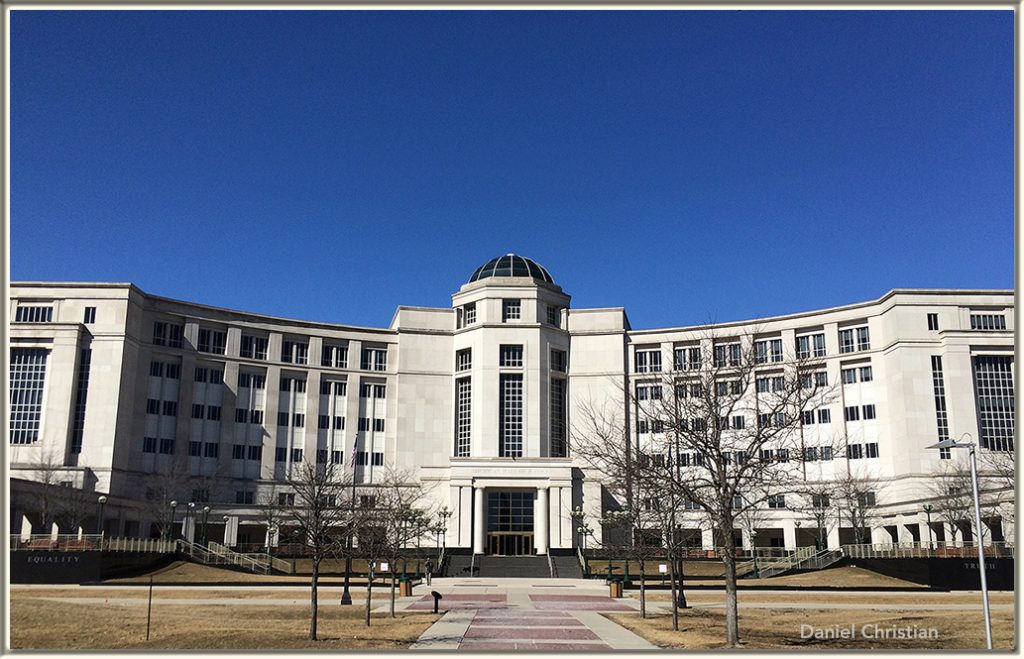
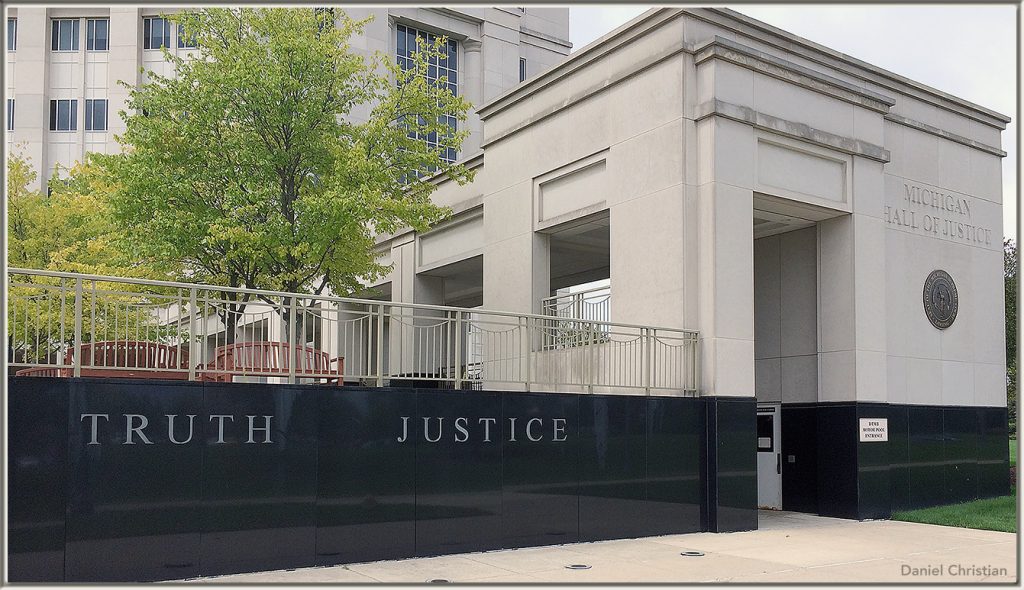
If the public doesn’t have access to justice — and the majority of those involved with civil-based law cases (vs. criminal law cases) don’t — the system has failed. Throughout the last several years, I have thought about the topic of access to justice (#A2J) many times on my walks past the Michigan Hall of Justice building in Lansing, Michigan.
I am hoping that a variety of technologies can help address this problem — at least in part. The impact of the Covid19 pandemic is pushing us in the right direction, but it never should have taken that horrendous event to occur in order for such innovations and changes to take root.

6 “Do not deny justice to your poor people in their lawsuits.
Also see:
- Scripture passages dealing with the topic of justice — from BibleGateway.com
- Measuring the Justice Gap — from worldjusticeproject.org
- Legal Technology and Access to Justice — from cicerosoftware.com
- The “Access to Justice” category on this blog, Learning Ecosystems
On 10/10/2020,
in 21st century, business, corporate / business world, education, global / globalization, health, hearts -- matters of the heart, higher education, homeschooling/homeschoolers, ideas, K-12 related, law schools, leadership, media/film, parents/guardians, relationships, society, student teaching/teacher education, student-related, teachers, UK, United States, workplace, youth,
by Daniel Christian
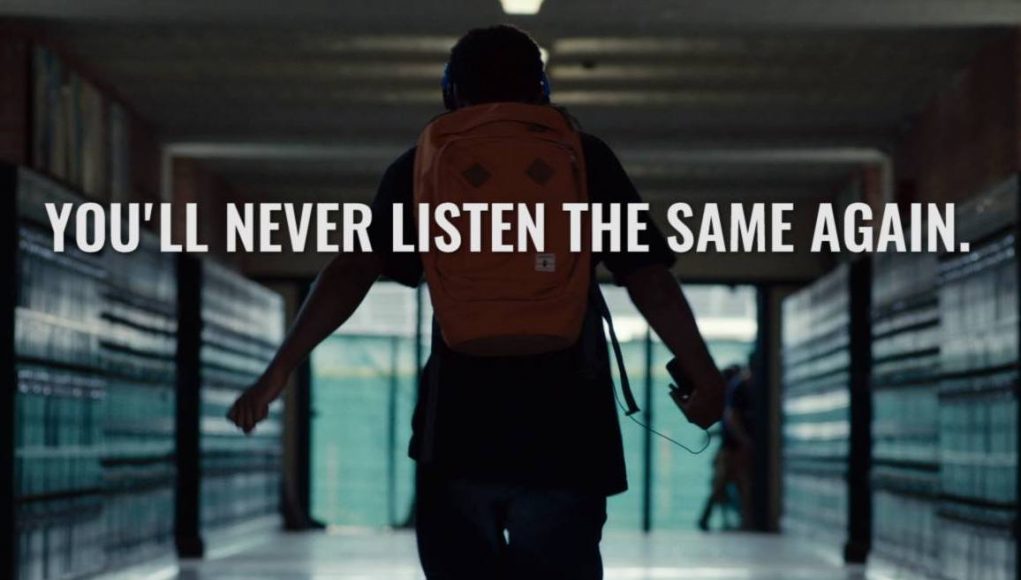
New Film Addresses Mental Health By Challenging Us To ‘Listen’ To Our Youth Voice — from gettingsmart.com by Michael Niehoff
Also see:
IW Official Guide: World Mental Health Day Supporting the workplace during the pandemic & beyond — from inspiring-workplaces.com by Aimee O’Leary
For World Mental Health Day 2020, we have created a quick guide of 10 top tips for you. It has been compiled from experts around the world on how to support the mental health of your people during these challenging times.
It includes:
- How to do your part to break the stigma
- How to create functional routines
- How to look out for colleagues without being invasive
- How to stay connected
- and more
Lastly, before reading the guide, reach out to someone you know today, who you have haven’t spoken with in a while and simply ask… How are you, really? It will make a huge difference.
*****************
Addendum on 10/13/20:
As the Pandemic Grinds On, Here Are 5 Big Worries of College Presidents — from chronicle.com by Michael Vasquez
Excerpt:
Campus mental health is the No. 1 worry. The college leaders were asked to select their five top concerns from a list of 19 Covid-related issues. Fifty-three percent of presidents listed student mental health, and 42 percent pointed to faculty and staff mental health as being among their biggest worries. Anxiety, uncertainty, depression, and grief — compounded by the isolation of the pandemic — have exacted an often invisible toll on people who study and work in higher education.
AP Style Rules: Correct Uses for Race-Related Terms, Gender-Neutral Words, and Election Lingo — from mediablog.prnewswire.com
We know journalists are busy, and it can be difficult to keep up with recent AP Stylebook changes. So we’ve done the work for you, rounding up a few of the recent significant — and just plain interesting — updates to the AP Stylebook.
Excerpt:
It’s hard to believe it’s only been a few months since our last AP Style roundup. So much has happened since then.
Let’s recap some of the recent AP Style rule reminders. And with the presidential election quickly approaching, we’ll review some of the writing rules on that topic as well.
On 10/10/2020,
in 21st century, 24x7x365 access, A/V -- audio/visual, adjunct faculty, career development, cloud-based computing / apps / other cloud-related, collaboration, colleges, communications, community colleges, digital audio, digital learning, digital video, distance education, engineering, experimentation, faculty/staff, higher education, homeschooling/homeschoolers, human-computer interaction (HCI), ideas, innovation, instructional design, K-12 related, learning, learning ecosystem, Learning Experience Design, Learning from the Living [Class] Room, online learning, online tutoring, platforms, presentations, productivity / tips and tricks, science, STEAM-related, student-related, teachers, teaching & learning, teaching online, technologies for your home, television, tools, user experience (UX), vendors, videoconferencing, virtual field trips, virtual tutoring, web-based collaboration,
by Daniel Christian
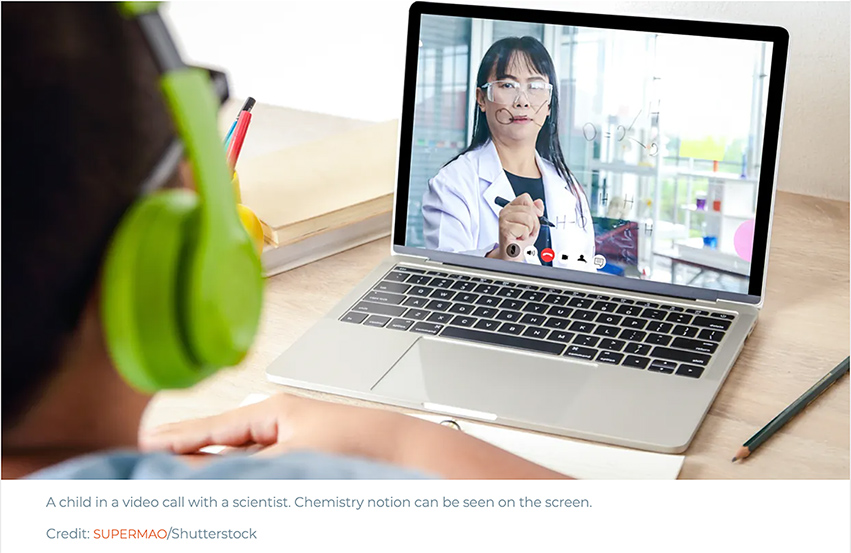
Got science questions? Skype A Scientist can help — from bigthink.com by Scotty Hendricks
A non-profit dedicated to science communication offers to connect learners with over 11,000 scientists.
On 10/10/2020,
in faith, global / globalization, hearts -- matters of the heart, relationships,
by Daniel Christian
Psalm 103:1-18 — from biblegateway.com
Of David.
1 Praise the Lord, my soul;
all my inmost being, praise his holy name.
2 Praise the Lord, my soul,
and forget not all his benefits—
3 who forgives all your sins
and heals all your diseases,
4 who redeems your life from the pit
and crowns you with love and compassion,
5 who satisfies your desires with good things
so that your youth is renewed like the eagle’s.
6 The Lord works righteousness
and justice for all the oppressed.
7 He made known his ways to Moses,
his deeds to the people of Israel:
8 The Lord is compassionate and gracious,
slow to anger, abounding in love.
9 He will not always accuse,
nor will he harbor his anger forever;
10 he does not treat us as our sins deserve
or repay us according to our iniquities.
11 For as high as the heavens are above the earth,
so great is his love for those who fear him;
12 as far as the east is from the west,
so far has he removed our transgressions from us.
13 As a father has compassion on his children,
so the Lord has compassion on those who fear him;
14 for he knows how we are formed,
he remembers that we are dust.
15 The life of mortals is like grass,
they flourish like a flower of the field;
16 the wind blows over it and it is gone,
and its place remembers it no more.
17 But from everlasting to everlasting
the Lord’s love is with those who fear him,
and his righteousness with their children’s children—
18 with those who keep his covenant
and remember to obey his precepts.
On 10/09/2020,
in 21st century, 24x7x365 access, A/V -- audio/visual, colleges, community colleges, distance education, education technology, entrepreneurship, experimentation, higher education, human-computer interaction (HCI), innovation, learning, learning ecosystem, Learning Experience Design, Learning from the Living [Class] Room, learning hubs & pods & microschooling, online learning, participation, platforms, remote teaching and learning, United States, universities, vendors, videoconferencing, web-based collaboration,
by Daniel Christian
On 10/08/2020,
in 24x7x365 access, A/V -- audio/visual, adjunct faculty, adult learning, cloud-based computing / apps / other cloud-related, collaboration, colleges, communications, communities of practice, community colleges, corporate / business world, corporate universities / corporate training, digital audio, digital learning, digital video, distance education, education, education technology, engagement / engaging students, experimentation, faculty/staff, future of higher education, global / globalization, higher education, homeschooling/homeschoolers, ideas, K-12 related, law schools, learning, learning ecosystem, Learning Experience Design, Learning from the Living [Class] Room, learning spaces, liberal arts, mobile learning, multimedia, online learning, platforms, productivity / tips and tricks, professional development, smart classrooms, social learning / networks, society, student teaching/teacher education, student-related, teachers, teaching & learning, teaching online, technologies for your home, telelegal, telemedicine / telehealth / virtual health, tools, training / L&D, trends, TVs, United States, universities, using teams, vendors, videoconferencing, web-based collaboration,
by Daniel Christian

On 10/08/2020,
in 24x7x365 access, adjunct faculty, adult learning, CMS/LMS, colleges, communities of practice, community colleges, content development, aggregation, repositories, corporate universities / corporate training, Daniel S. Christian, digital learning, distance education, education technology, faculty/staff, higher education, human-computer interaction (HCI), ideas, instructional design, K-12 related, law schools, Learning Experience Design, Learning from the Living [Class] Room, online learning, productivity / tips and tricks, remote teaching and learning, streams of content, student teaching/teacher education, student-related, teachers, teaching & learning, teaching online, tools, universities, usability, user experience (UX), user interface design, vendors,
by Daniel Christian
From DSC:
Put yourself in the place of the conscientious/thorough learner. If you come into a course on Canvas & see Quizzes, Assignments, Discussion Boards, as well as other items listed on the Course Navigation Bar — in addition to the Modules selection — you might find yourself going to check many of those selections Every. Single. Day.
Graphically speaking:
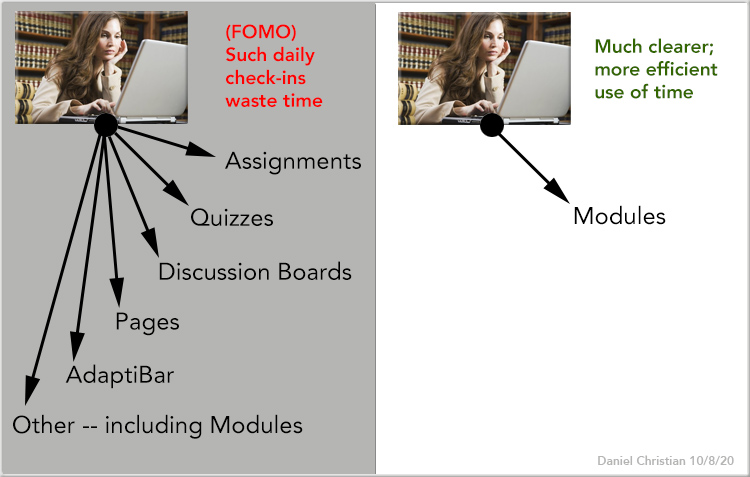
(DSC purchased this image from Getty Images)
From DSC:
By the way, this is why RSS feeds and feed aggregators were implemented. Have updates/content flow to the person, instead of the person wasting time trying to find what’s been updated on 100+ websites.
On 10/08/2020,
in faith, global / globalization, hearts -- matters of the heart, relationships, religion,
by Daniel Christian
Proverbs 29:25-26 New International Version (NIV)
25 Fear of man will prove to be a snare,
but whoever trusts in the Lord is kept safe.
26 Many seek an audience with a ruler,
but it is from the Lord that one gets justice.
On 10/07/2020,
in 21st century, adjunct faculty, adult learning, business side of he, career development, colleges, community colleges, cost of getting a degree, dangers of the status quo, faculty/staff, future, future of higher education, generational differences, higher education, learning, learning ecosystem, lifelong learning, United States, universities, vendors,
by Daniel Christian
Some resources mentioned by Goldie Blumenstyk out at “The Edge” — in her posting entitled “How to Keep Old Debts From Deterring Returning Students“
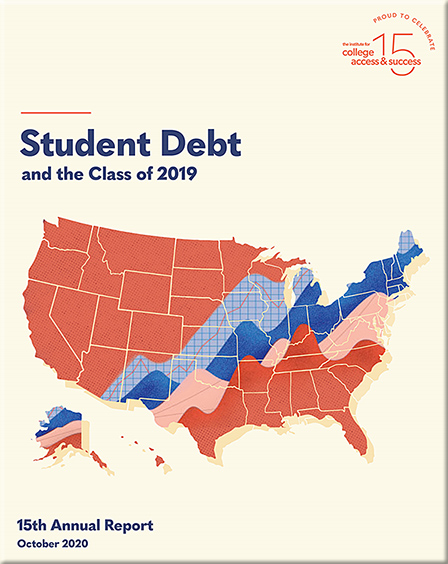
- Institute for College Access & Success (Ticas) has just released its annual report on what college graduates owe in student debt.
Excerpt:
Student Debt and the Class of 2019 is TICAS’ fifteenth annual report on the student loan debt of recent graduates from four-year colleges, documenting changes and variation in student debt across states and colleges. Unless otherwise noted, the figures in this report are only for public and private nonprofit colleges because virtually no for-profit colleges report what their graduates owe.Nationally, more than six in ten (62%) college seniors who graduated from public and nonprofit colleges in 2019 had student loan debt, down from the Class of 2018 (65%). Borrowers from the Class of 2019 owed an average of $28,950, a 0.9 percent decline from the average of $29,200 in 2018, continuing a trend of relatively flat student debt levels in recent years.
Solving Stranded Credits: Assessing the Scope and Effects of Transcript Withholding on Students, States, and Institutions — from sr.ithaka.org by Julia Karon, James Dean Ward, Catharine Bond Hill, & Martin Kurzweil
Excerpt:
Attention to the burden of U.S. educational debt, now at $1.7 trillion, has grown in recent years.[1] For too many former postsecondary students—especially Black students—debt they took on to improve their lives and career prospects has instead become a financial hindrance, delaying or undermining their efforts to buy homes, build savings, or provide for their families.[2] The debt burden is especially severe for those who never completed their postsecondary program and therefore did not receive the credentials that might have boosted their careers and incomes enough to justify taking on the debt.
Also see:
- The pandemic has pushed hundreds of thousands of workers out of higher education — from chronicle.com by Dan Bauman
Excerpt:
The work-force that serves much of higher education in America has shrunk by at least 7 percent since Covid-19 arrived on American shores — a staggering, unprecedented contraction, according to federal data. And like the national economic downturn that is running parallel to this unprecedented viral outbreak, much also remains uncertain about what a “recovery” will actually look like for higher education.
If your collaboration tool allows it, try this “Virtual ‘4 Corners’ Activity” [Honeycutt & Robinson]
On 10/06/2020,
in active learning, adjunct faculty, attention, collaboration, colleges, communications, communities of practice, community colleges, digital learning, distance education, engagement / engaging students, faculty/staff, more voice more choice more control, motivation, online learning, pedagogy, platforms, teachers, teaching & learning, teaching online, tools, universities, videoconferencing,
by Daniel Christian
From Honeycutt & Robinson:
Dr. Sheila Robinson shares how she uses the "4 Corners" activity in a virtual environment to break up long lectures & increase student engagement. https://t.co/MaLqEYybj0— Daniel Christian (@dchristian5) October 6, 2020
Per Dr. Honeycutt, also see: