White House Summit touches on K-12, college link — from edweek.org by Caralee Adams

Buoyed by White House attention to the importance—and needs—of community colleges, some in the K-12 community are waiting to see if that spotlight will generate momentum for improved college readiness and better alignment of high schools with higher education.

This week’s White House Community College Summit was largely a symbolic event drawing about 150 leaders in education, business, and philanthropy and aimed at focusing attention on what is often labeled an undervalued sector of higher education.

But while the summit produced no big policy recommendations, the issues of high school preparation and college access hovered in the background as participants broke up into working groups after opening remarks by President Barack Obama.

More here…

.

From DSC:
Some might look at what I cover in the Learning Ecosystem blog and comment, “What the heck is he doing? He can’t know everything about the teaching and learning worlds within the K-12, college, and the corporate training spaces!”  And they would be right. But I don’t base my work here on myself.  As a regular follower of this blog would know, I look to the expertise of others.  While I will often interject my own thoughts and contributions here, I try to aggregate the valuable experiences and insights of others.

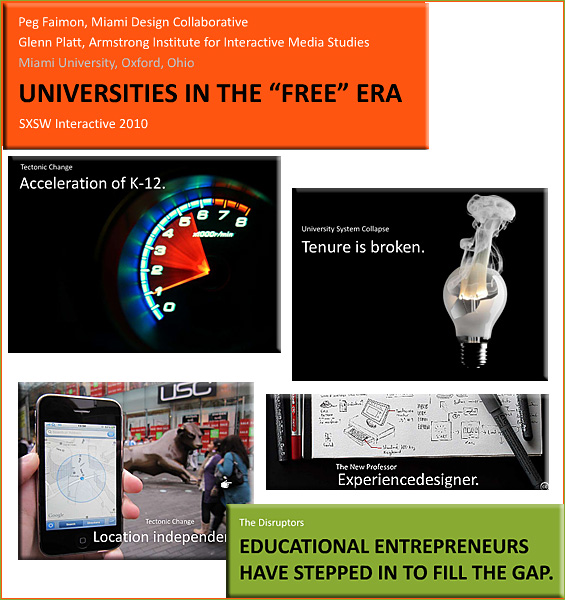
Along these lines, I want to interject that those of us in higher ed need to be very aware of what’s happening in K-12. Students’ expectations are the key items to note here. Graduates from high school will come to our doors (physical and virtual) with a set of expectations and skill sets. To me, these expectations seem to be changing. We must meet them where they are at.

So this item caught my attention. More later…

Web collaboration trends — from The Webinar blog by Ken Molay

Intercall put out a press release today summarizing results from a survey of college students about watching webcast courses. I have to admit I was surprised by how widespread some of the behavior characteristics are… I knew that streaming courses over the web was done, but I didn’t realize how many students relied on it.

Consider that 48 percent of students said they take multiple classes scheduled for the same time! That’s a far cry from my college days, when I would painstakingly juggle which classes to sign up for based on whether I could get from one side of campus to the other in time. 78 percent of students said that professors had made courses available online, either live or on demand. What do you think these students are going to expect of communications when they enter the workforce? Will they agree to attend multiple product briefings or team meetings scheduled for the same time because they figure they can watch the webcast recording later?

Excerpt:
The survey polled college students ages 18 to 25 about their attitudes and behaviors towards streamed video content of their college courses. Additional findings from the survey include:

  • Use of streaming is on the rise — Eight in ten students (78 percent) report that professors have made lectures available either by live video feed or posting a videotaped lecture for students to access online. Nearly a third (30 percent) say their professors use web streaming frequently.
  • In two places at once — Almost half (48 percent) of students take multiple classes scheduled for the same time which was virtually impossible before streaming. Also, 63 percent “attend” classes even though they are in reality, out of town.
  • Juggling jobs and studies — Streaming helps those students who are working their way through school: 47 percent say having content available to view at a later time allows them to work more hours at their job.
  • Students are taking control over the way they learn — Nearly 60 percent say streaming video allows them to spend more time studying by themselves and grasp concepts better because they can go at their own pace (44 percent).
  • We want our streaming! — More than two-thirds (67 percent) of students said they wish more of their professors used streaming and the majority (85 percent) say they would find it helpful to have their classes live streamed or video posted online.
  • Parents just don’t understand — A third of U.S. students say that their parents or guardians would be very upset to know how often they actually attend classes in person because they “attend” by watching video of their course online. However, the majority of respondents report that streaming improves students’ performance and helps them balance school with work.

Learning amongst the riches: Students in the cloud — from CampusTechnology.com by Trent Batson

The cloud is where new learning conversations and related innovations are happening. Learning itself is becoming virtualized. Universities have a new role, but are as essential as ever: They are guiding learners in the process of learning amongst the riches.

Online collaboration: New innovations pave the way for convergence — from prnewswire.com
Merger of television and computer takes giant step closer as innovative online tool suite is released

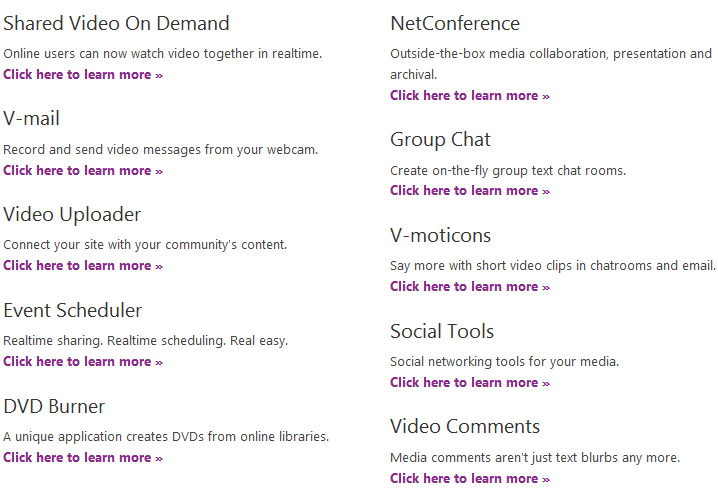
CALABASAS, Calif., Aug. 16 /PRNewswire/ — Anticipating the coming paradigm shift that will merge your television and your computer, NxtGenTV has just released the most cohesive system of online tools to facilitate the ultimate interactive communication platform. Four years of innovating has resulted in NetConference.com, an elegant, easy-to-use online meeting system that supports the diverse requirements of single users, small and medium size businesses as well as enterprise and nonprofit organizations. Creating a new opportunity for the global audience to interact online in even greater and more efficient ways is only one of the many benefits of building a social media broadcasting system that facilitates Communication, Collaboration, Presentation and Education.

An industry leader in online games, apps, widgets, banners and rich media development for major entertainment brands, The Illusion Factory created a new company, NxtGenTV to develop and patent cutting-edge online technologies such as shared synchronized visual media and other key innovations that will further blur the lines between computers and television. “We have been passionate about creating the cumulative new systems that will drive Convergence,” shares Brian Weiner, CEO of The Illusion Factory, “our creation of NxtGenTV will lead the push for truly interactive television.”

nxtgen.tv

.nxtgen.tv/products

Innovate to Educate: [Re]Design for Personalize Learning — from mobl21.com/blog

The Symposium on [Re]Design for Personalized Learning has begun.

An initiative of the SIIA (Software & Information Industry Association) with ASCD (formerly the Association for Supervision and Curriculum Development) and the Council of Chief State School Officers (CCSSO), this collaborative effort asserts that the education system can more efficiently and effectively meet the needs of all students through a true paradigm shift from a mass production to a mass customization learning system.

An excerpt from the SIIA-ASCD-CCSSO Symposium Primer:
Some education leaders are becoming more focused on personalizing learning as critical to meeting the needs of all students.  They understand that changing student outcomes requires transforming their experience and our current education system.  They recognize the definition of educational insanity:  offering the same type of education model over and over again, and expecting a different result.  These leaders also see that educational equity is not simply about equal access and inputs, but as importantly requires that a student’s educational path, curriculum, instruction and schedule be personalized to meet her unique needs.  Reform efforts that continue to focus on the factory model, one-size fits all approach to learning are unlikely to make a sufficient difference for too many students in this knowledge-age when expectations are higher than ever.

In contrast to trends in other industries to personalize products, services, and the user experience – in part by leveraging continually evolving technologies – education has only scratched the surface on the potential to personalize the learner experience.  Such efforts continue to be the exception rather than the rule and often represent a “tweaking” of the traditional model rather than the necessary systemic redesign of how we educate our children.  Similarly, students have come to expect personalization in every other aspect of their lives, including through services like Facebook, Netflix and iTunes, to name a few.  If Google and Amazon can thoughtfully leverage customer data and virtual communities to better serve each person’s unique preferences and interests from afar, then education can do so for each student from a near — to understand each one’s performance level, learning style and learning preferences and then adjust instructional strategies and content to meet those needs.

Read the full primer here: http://www.siia.net/pli/primer.doc

.

From DSC:
Eventually, we will have to deal with some major changing student expectations. Perhaps that’s this year..? Next year? 5 years down the line…? I’m not sure. But with the storm brewing, we don’t want to discount changing student expectations. We need to adapt and deliver and meet changing expectations.

Screencasts and Education by Paul McGovern

Screencasts to support learning

I believe there are a number of reasons why screencasts are extremely effective as educational tools and I have outlined these below:

1. Time-flexible learning

2. Support Web 2.0 expectations of learners

3. Enhancement of the learning process

4. Enhancement of learning engagement

Let’s take a look at these one by one….

July 7 –> EDUCAUSE Live Web Seminar: What do newer generation faculty want from IT services?

Speakers: Bruce Maas, Chief Information Officer, University of Wisconsin-Milwaukee, and Michael Zimmer, Assistant Professor, University of Wisconsin-Milwaukee
Date: July 7, 2010
Time: 1:00 p.m. ET (12:00 p.m. CT, 11:00 a.m. MT, 10:00 a.m. PT).

In this free, hour-long web seminar, “What Do Newer Generation Faculty Want from IT Services?,” Bruce Maas and Michael Zimmer join host Steve Worona to talk about how former Net Gen and late Gen X students are becoming our colleagues and bringing the attitudes, aptitudes, expectations, and learning styles of their generation with them. Tune in to hear a discussion on the inherent tensions and opportunities in both supporting and getting out of the way of faculty who are “digital natives.”

From DSC:
I would propose that it’s not necessarily just “getting out of their way”, but rather teaming up with them to make innovation continue to occur on our campuses. We need team-developed / relayed courses. Gen X or not, no one can do it all anymore.

Tagged with: • • • •  

From DSC:
First of all, here is a mere handful of the items that I could have selected — but it is representative of the financial pressures taking place and the resulting changes that are and may be occurring to many more universities and colleges this year:

UMaine could eliminate 16 majors as part of cuts
Board of Trustees will have final say
ORONO, Maine —
The University of Maine could eliminate a number of undergraduate and graduate majors as a way to trim more than $12 million in a three-year period.

Auxiliary programs face large cuts [University of Georgia] — from redandblack.com

California college crisis causing students to apply out of state — California College News Blog

Montgomery College [Maryland] faces ‘devastating’ cuts — from WashingtonPost.com

College cuts draw protests [California] — from the spokeman.com

Michigan college tuition could rise under possible budget cut — from lsj.com

From DSC:
So…what do you suppose will happen if resources/funding continue to shrink, programs are cut, staff and faculty are laid off, etc.?

Some very possible resulting directions here are that students will:

  • Go to where they can finish their degrees
  • Go to where they can find the degrees that they want to pursue
  • Search for — and utilize — less expensive alternatives.

In each of these cases, the word “online” jumps to my mind.


Colleges embrace MP4 technology for delivering instruction — from eSchoolNews.com by Dennis Carter

University Alliance promotes live chats, streaming lecture video, and message boards through students’ mobile devices

Four universities are giving students the chance to complete certificate and degree programs by downloading class material to mobile devices like iPhones and iPods in a distance-learning initiative that one day could be commonplace in higher education. The University Alliance, one of the country’s largest online education facilitators, announced earlier this month that students enrolled in web-based courses at Villanova University, the University of San Francisco, Tulane University, and the University of Notre Dame will be able to watch course lectures in MP4 video format on their mobile devices.

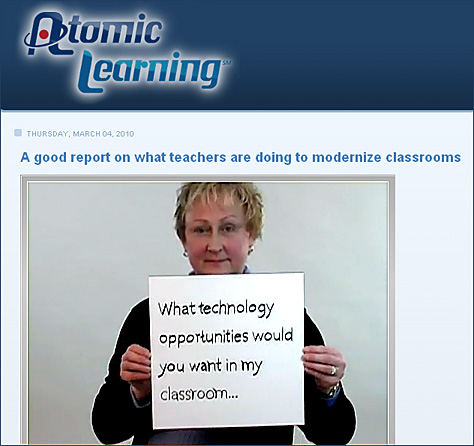
Moderning classrooms

From DSC:
For those of us in higher education, what occurs in K-12 affects us, as it affects our incoming students’ expectations. We need to prepare now for our students of tomorrow! And congratulations to those of you in K-12 who are working hard to keep your students engaged, growing, challenged, participating, and learning!


From DSC:
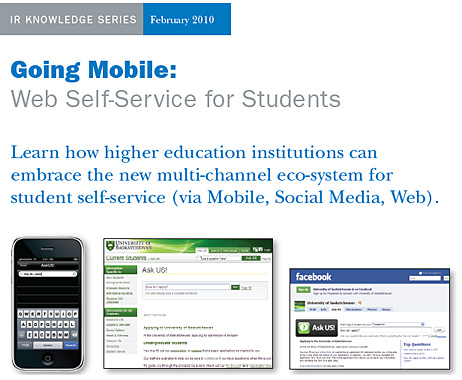
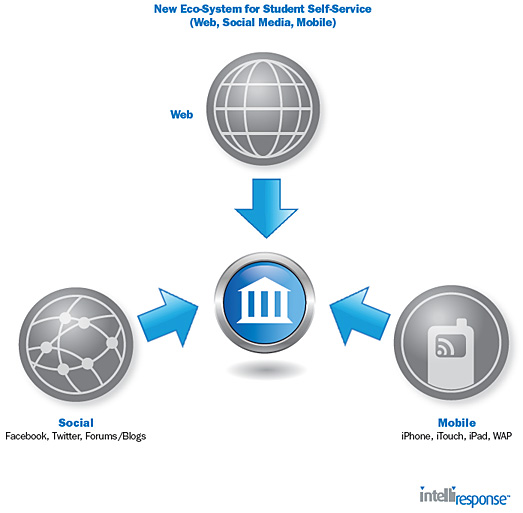
I signed up and downloaded a whitepaper from intelliresponse.com entitled, “Going Mobile: Web Self-Service for Students — Learn how higher education institutions can embrace the new multi-channel eco-system for student self-service (via Mobile, Social Media, Web)”.

I thought it was interesting how the term eco-system weaved its way through this company’s marketing literature. But it also relayed some more data on the increasing amount of mobile devices out there (now and expected in the near future).  If we were to substitute the word “learning” in place of the words “self-service”, this topic becomes very relevant to this blog.

Here are a couple graphics from the paper:

Going Mobile: Web Self-Service for Students Learn how higher education institutions can embrace the new multi-channel eco-system for student self-service (via Mobile, Social Media, Web)

Mobile self-service

The Future of Higher Education: Beyond the Campus — from iangardnergb.blogspot.com

“Lots and lots at the time being on the future of HE, especially in the UK due to the funding cuts, imminent election, etc. One of the latest reports is a joint one from JISC, SERF, EDUCAUSE and CAUDIT, showing many issues are not just affecting the UK. “

Abstract:
Higher education’s purpose is to equip students for success in life—in the workplace, in communities, and in their personal lives. While this purpose may have remained constant for centuries, the world around colleges and universities is undergoing significant change. Higher education is under pressure to meet greater expectations, whether for student numbers, educational preparation, workforce needs, or economic development. Meanwhile, the resources available are likely to decline. New models, an intense focus on the student experience, and a drive for innovation and entrepreneurism will ensure that higher education continues to meet society’s needs. Information technology supports virtually every aspect of higher education, including finances, learning, research, security, and sustainability, and IT professionals need to understand the range of problems their institutions face so they apply IT where it brings greatest value. Creating this future will require collaboration across organizational and national boundaries, bringing together the collective intelligence of people from backgrounds including education, corporations, and government.

From DSC:
Many quotes jumped off of the pages of the report, but here’s one of them:

Higher education represents a complex, adaptive system that is influenced by larger societal trends and information technology. If higher education is adaptive, what will its future be?

How can liberal education prepare students for the future? — NITLE

We conclude our blog conversation series on the future of liberal education, elicited by the recent AAC&U conference, with an appropriate nod to the future.

One panel* addressed an intriguing topic: how do we prepare students for a future that doesn’t yet exist?

Discussion hit on a series of topics, which we can abstract and summarize here:

There are two ways to prepare for events, reactive and creative (shaping new things).  What learning attributes do we associate with both of these?

  • Adaptability of beliefs, behaviors, assumptions
  • Imagination
  • Innovation (implementing new ideas) <– From DSC: There’s that word again

NITLE.org

Tagged with: • • •  

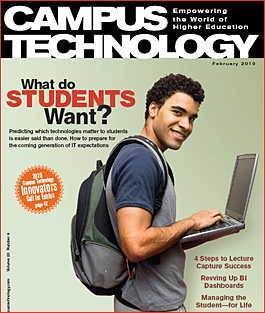
From Campus Technology’s latest edition — quote below from Geoff Fletcher, Editorial Director

What do students want? -- from Campus Technology's February 2010 Ed.

Per Geoff: Innovation is in. Innovation has always been in, but it really is in these days: According to economists, innovation will be America’s [or substitute any nation — per DSC] hedge in an increasingly-competitive global economy, but only if our education system is good enough — is innovative enough — to foster the same creativity and inventiveness in our students.

Per DSC:
Wow…do we have our work cut out for us. From so many of the articles and postings I’ve seen over the last few years, innovation and change comes hard to those of us in the world of education. Are we giving the students the chances to be innovative and creative? Are we encouraging those traits in them? If not, what will it take to turn the tides here?

Also, I’d like to comment on students’ expectations — in that we should not underrate them! (Particularly in light of the higher costs of obtaining an education and the movement towards a more consumer-based mindset of our students.) I wonder how long will it be before prospective students take a good, long, hard look at what assistance/training/education an institution of higher education will offer them in developing their learning networks? What technologies does that institution support? What philosophies does that school have concerning how open to be here? Hmmm…

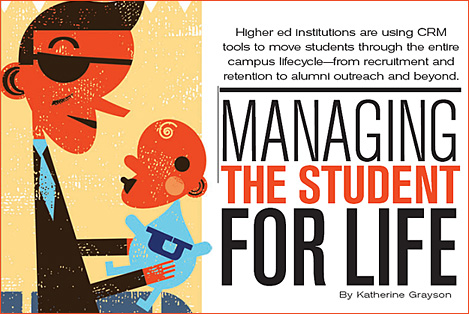
Finally, this edition sports a great article (starting on page 23) entitled, “Managing the Student for Life” — I’ve often thought that more colleges and universities should focus more heavily on lifelong learning possibilities, and then to market themselves as being able to assist a person from age 18 – until “death-do-we-part”.  🙂

Managing the student for life


© 2025 | Daniel Christian