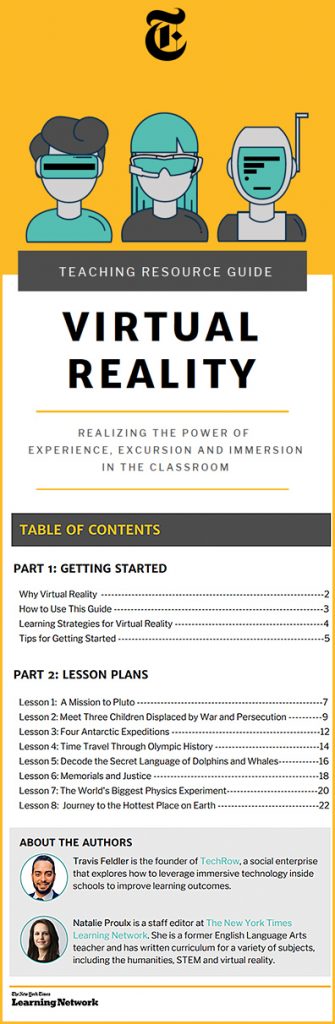
Virtual Reality: Realizing the Power of Experience, Excursion and Immersion in the Classroom — from nytimes.com
A framework for teaching with New York Times 360 V.R. videos, plus eight lesson plans for STEM and the humanities.

A Guide for Using NYT VR With Students

  • Getting Started With V.R. in the Classroom
  • Lesson 1: A Mission to Pluto
  • Lesson 2: Meet Three Children Displaced by War and Persecution
  • Lesson 3: Four Antarctic Expeditions
  • Lesson 4: Time Travel Through Olympic History
  • Lesson 5: Decode the Secret Language of Dolphins and Whales
  • Lesson 6: Memorials and Justice
  • Lesson 7: The World’s Biggest Physics Experiment
  • Lesson 8: Journey to the Hottest Place on Earth


Many students complain that online-based learning doesn’t engage them. Well, check this idea out! [Christian]


From DSC…by the way, another title for this blog could have been:

WIN-WIN situations all around! The Theatre Departments out there could collaborate with other depts/disciplines to develop highly engaging, digitally-based learning experiences! 


The future of drama and the theatre — as well as opera, symphonies, and more — will likely include a significant virtual/digital component to them. While it’s too early to say that theatre needs to completely reinvent itself and move “the stage” completely online, below is an idea that creates a variety of WIN-WIN situations for actors, actresses, stage designers, digital audio/video editors, fine artists, graphic designers, programmers, writers, journalists, web designers, and many others as well — including the relevant faculty members!

A new world of creative, engaging, active learning could open up if those involved with the Theatre Department could work collaboratively with students/faculty members from other disciplines. And in the end, the learning experiences and content developed would be highly engaging — and perhaps even profitable for the institutions themselves!
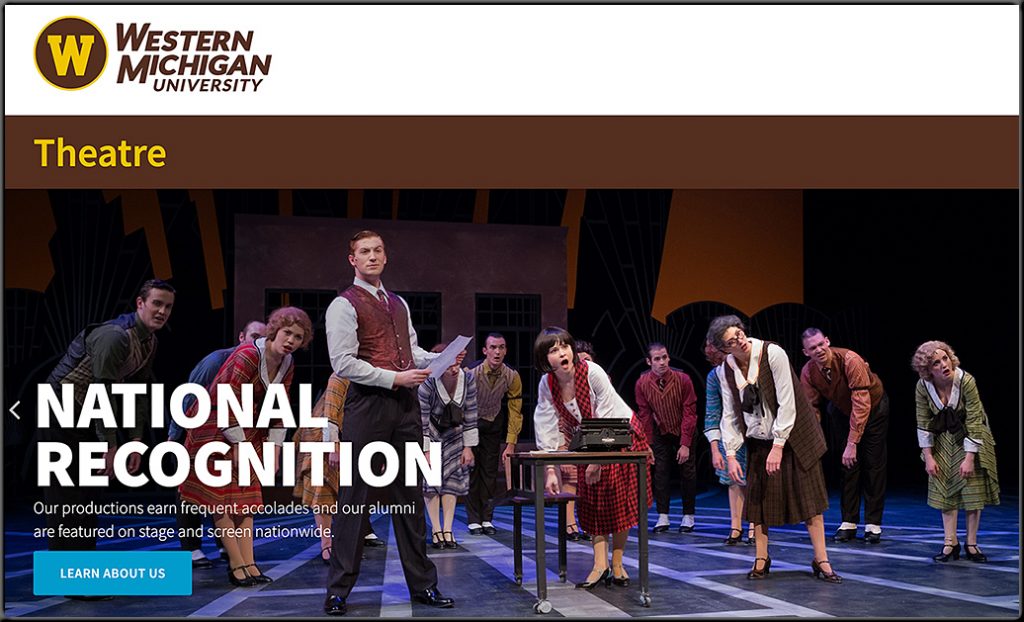
A WIN-WIN situation all around! The Theatre Department could collaborate with other depts/disciplines to develop highly engaging learning experiences!

[DC: I only slightly edited the above image from the Theatre Department at WMU]


Though the integration of acting with online-based learning materials is not a new idea, this post encourages a far more significant interdisciplinary collaboration between the Theatre Department and other departments/disciplines.

Consider a “Dealing with Bias in Journalism” type of topic, per a class in the Digital Media and Journalism Major.

  • Students from the Theatre Department work collaboratively with the students from the most appropriate class(es?) from the Communications Department to write the script, as per the faculty members’ 30,000-foot instructions (not 1000-foot level/detailed instructions)
  • Writing the script would entail skills involved with research, collaboration, persuasion, creativity, communication, writing, and more
  • The Theatre students would ultimately act out the script — backed up by those learning about sound design, stage design, lighting design, costume design, etc.
  • Example scene: A woman is sitting around the kitchen table, eating breakfast and reading a posting — aloud — from a website that includes some serious bias in it that offends the reader. She threatens to cancel her subscription, contact the editor, and more. She calls out to her partner why she’s so mad about the article. 
  • Perhaps there could be two or more before/after scenes, given some changes in the way the article was written.
  • Once the scenes were shot, the digital video editors, programmers, web designers, and more could take that material and work with the faculty members to integrate those materials into an engaging, interactive, branching type of learning experience. 
  • From there, the finished product would be deployed by the relevant faculty members.
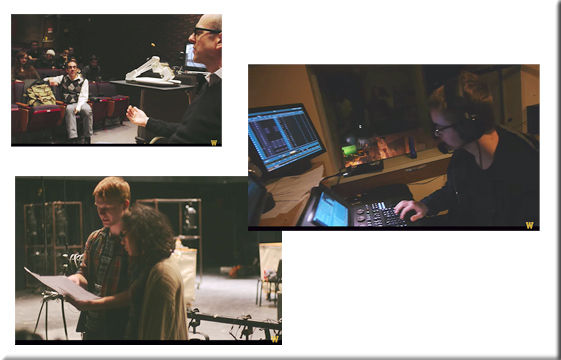
Scenes from WMU's Theatre Department

[DC: Above images from the Theatre Department at WMU]


Colleges and universities could share content with each other and/or charge others for their products/content/learning experiences. In the future, I could easily see a marketplace for buying and selling such engaging content. This could create a needed new source of revenue — especially given that those large auditoriums and theaters are likely not bringing in as much revenue as they typically do. 

Colleges and universities could also try to reach out to local acting groups to get them involved and continue to create feeders into the world of work.

Other tags/categories could include:

  • MOOCs
  • Learning from the Living[Class]Room
  • Multimedia / digital literacy — tools from Adobe, Apple, and others.
  • Passions, participation, engagement, attention.
  • XR: Creating immersive, Virtual Reality (VR)-based experiences
  • Learning Experience Design
  • Interaction Design
  • Interface Design
  • …and more

Also see:

What improv taught me about failure: As a teacher and academic — from scholarlyteacher.com by Katharine Hubbard

what improv taught me about failure -as a teacher and academic

In improv, the only way to “fail” is to overthink and not have fun, which reframed what failure was on a grand scale and made me start looking at academia through the same lens. What I learned about failure through improv comes back to those same two core concepts: have fun and stop overthinking.

Students are more engaged when the professor is having fun with the materials (Keller, Hoy, Goetz, & Frenzel, 2016), and teaching is more enjoyable when we are having fun ourselves.


From DSC:
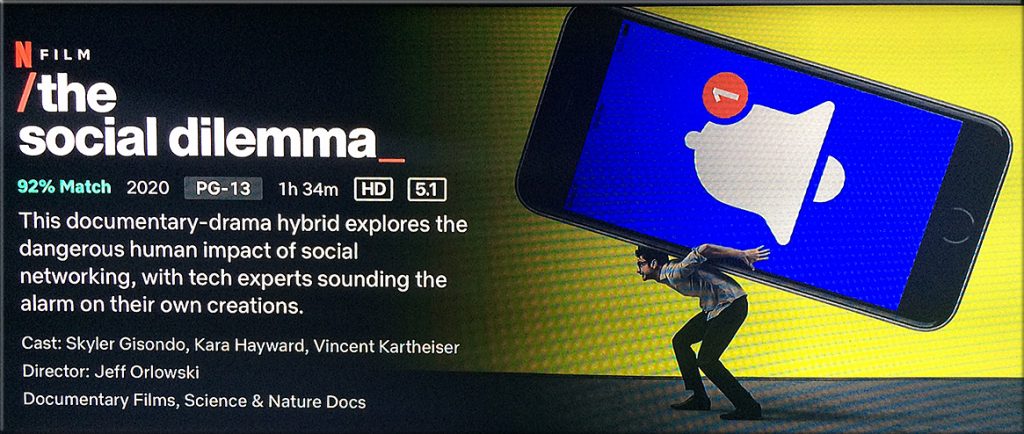
Who needs to be discussing/debating “The Social Dilemma” movie? Whether one agrees with the perspectives put forth therein or not, the discussion boards out there should be lighting up in the undergraduate areas of Computer Science (especially Programming), Engineering, Business, Economics, Mathematics, Statistics, Philosophy, Religion, Political Science, Sociology, and perhaps other disciplines as well. 

To those starting out the relevant careers here…just because we can, doesn’t mean we should. Ask yourself not whether something CAN be developed, but *whether it SHOULD be developed* and what the potential implications of a technology/invention/etc. might be. I’m not aiming to take a position here. Rather, I’m trying to promote some serious reflection for those developing our new, emerging technologies and our new products/services out there.

Who needs to be discussing/debating The Social Dilemna movie?


Fostering Student Creativity with Green-Screen Videos — from teachingprofessor.com by Jason Webb and Jeff Mangram

Excerpt:

Educators have come to realize that videos are highly effective and engaging ways to create online course content. One of the most engaging forms uses a green-screen backdrop to project images or videos behind or next to the speaker. Barbara Oakley used this technique in her famous course Learning How to Learn, where she brought in images to illustrate and amplify her message during course videos. Take a look at this example and consider the fact that Oakley shot the videos in her basement using only a couple hundred dollars’ worth of supplies. Today most colleges already have green-screen studios set up for marketing or other uses.


Per Dr. Honeycutt, also see:


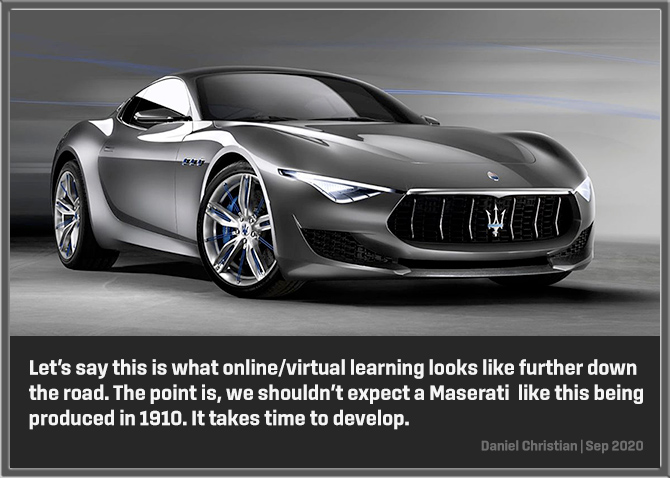
[Re: online-based learning] The Ford Model T from 1910 didn’t start out looking like a Maserati Gran Turismo from 2021! [Christian]

From DSC:
Per Wikipedia, this is a 1910 Model T that was photographed in Salt Lake City:

The Ford Model T didn't start out looking like a Maserati from 2021!


This is what online/virtual learning looks like further down the road. Our journey has just begun.

From DSC:
The Ford Model T didn’t start out looking like a Maserati Gran Turismo from 2021! Inventions take time to develop…to be improved…for new and further innovations and experiments to take place.

Thinking of this in terms of online-based learning, please don’t think we’ve reached the end of the road for online-based learning. 

The truth is, we’ve barely begun our journey.


Two last thoughts here


1 ) It took *teams* of people to get us to the point of producing a Maserati like this. It will take *teams* of people to produce the Maserati of online-based learning.

2) In terms of online-based learning, it’s hard to say how close to the Maserati that we have come because I/we don’t know how far things will go. But this I do know: We have come a looooonnnnnggggg ways from the late 1990s! If that’s what happened in the last 20 years — with many denying the value of online-based learning — what might the next 5, 10, or 20 years look like when further interest, needs, investments, etc. are added? Then add to all of that the momentum from emerging technologies like 5G, Augmented Reality, Mixed Reality, Virtual Reality, Artificial Intelligence, bots, algorithms, and more!


From DSC:
To drive the point home, here’s an addendum on late 9/29/20:

Mercedes-Benz Shares Video of Avatar Electric Car Prototype


How to Engage Students (and Identify Them) — from thejournal.com by Dian Schaffhauser

Excerpt (emphasis DSC):

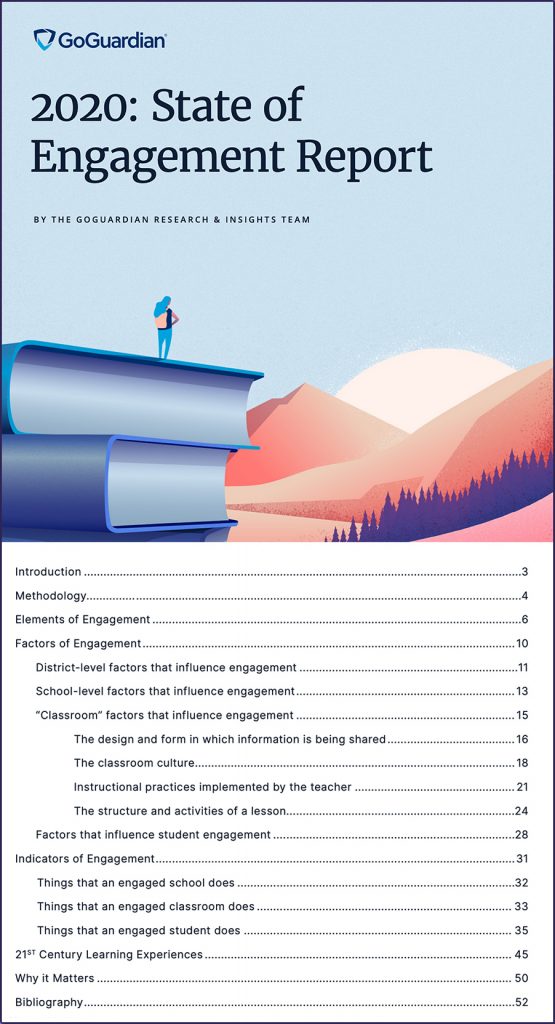
“The lessons that created the most engaging experiences for students often were a combination of opportunities that encouraged discussion, gave students learning choices and allowed students to create. These elements are immensely transferable both in the online and in-person classroom and can facilitate a positive learning environment, whether in a synchronous or asynchronous setting.”

The report is available with an email address through the GoGuardian website.

Go Guardian's 2020: State of Engagement Report


Zoom, but for X: How startups are building for our new video normal  — from protocol.com by Biz Carson
Meet the startups building the next take on video.

Excerpt (emphasis DSC):

Trying to liven up the monotony of Zoom meetings, Phil Libin hung up a green towel behind his desk and started projecting images onto it, like Dr. Anthony Fauci hovering over his shoulder, just to make his team laugh. At first, it was a bit of a performance and a way to break up the monotony as Zoom fatigue set in a few months into the pandemic at the end of May. But then Libin, the former CEO of Evernote and founder of startup studio All Turtles, realized the “Weekend Update” style could be more than just a gimmick.

A bit of coding and a fantastic demo later, Libin closed a seed round of $4.5 million to launch his new company, Mmhmm. His big belief is that we’re moving to a hybrid world where things don’t fit neatly into boxes like in-person or online or live or recorded. Instead, it’s all going to be a mix.

Also see:


Best Practices for Teaching Online -- K12 -- Laurel Springs School

[K12] Best Practices for Teaching Online — from Laurel Springs School; with thanks to The Journal for their article on this entitled, “While Schools Go Online, Here’s How Teachers Can Turn Uncertainty Into Opportunity” by Megan O’Reilly Palevich

Excerpt:

As I was reflecting on the magnitude of what is happening in K-12 education, I wanted to figure out a way to help the teaching community. It dawned on me that Laurel Springs has just over 150 teachers and almost 30 years of distance learning experience as a school. So, I asked our expert teaching faculty—what are your best practices for teaching online? I was overwhelmed by the responses and goodwill from my team. I am excited to share with you a guide to help with working remotely, communicating with students and families, and the best tips and resources for lower, middle, and upper school.

I hope that you find this information useful and share it with your colleagues. Feel free to pass it on and share—we are all in this together. As a parent, teacher, and leader, I appreciate you and all of the wonderfully creative things you are doing to do what you do best: TEACHING.

Please feel free to contact me for any additional support!

Warmest regards,

Best Practices for Teaching Online -- from Laurel Springs School by Megan O'Reilly Palevich

PDF file here.


Also see:


Best Content Awards 2020 — from elearninfo247.com by Craig Weiss

Excerpts:

Judging Areas

  • Video
  • Animation
  • Audio Quality
  • One that is very important, but way too many vendors lacked it…ADA508 or similar (depending on the country, but most countries have it) support.
  • Usefulness
  • Interactivity (Quality and Usability)
  • Engagement
  • Scenarios (if applicable)
  • Description
  • Objectives

What was excluded

  • Assessments

And now… the awards.


From edsurge.com today:

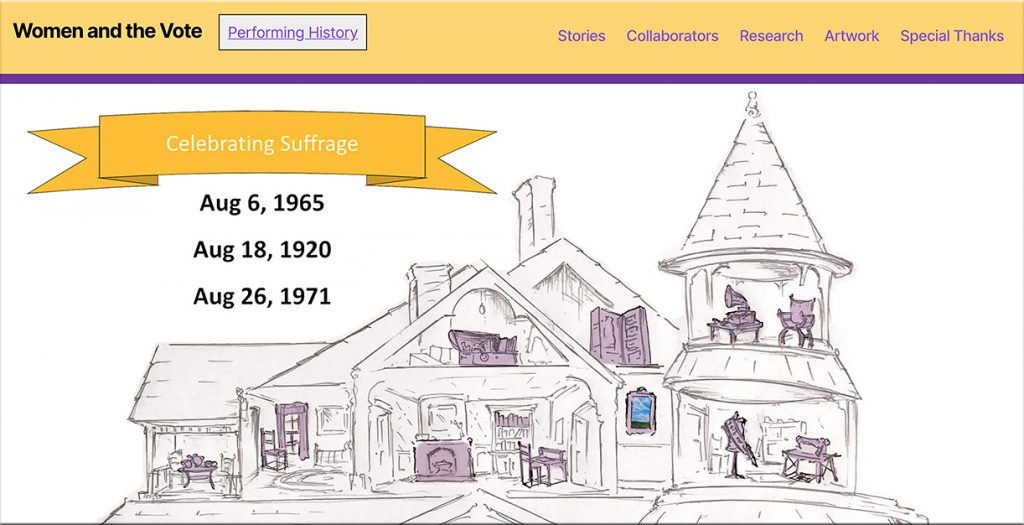
THOROUGHLY MODERN MEDIA: This spring, a college theater course about women’s voting rights aimed to produce a new play about the suffrage struggle. When the pandemic scuttled those plans, professors devised a new way to share suffragist stories by creating an interactive, online performance set in a virtual Victorian mansion. And their students were not the only ones exploring women’s voting rights as the country marks the 100th anniversary of the Nineteenth Amendment.

…which linked to:

The Pandemic Made Their Women’s Suffrage Play Impossible. But the Show Went on— Virtually — from edsurge.com by Rebecca Koenig

Excerpts:

Then the pandemic hit. Students left Radford and Virginia Tech. Live theater was canceled.

But the class wasn’t.

“Neither of us ever said, ‘Forget it,’” Hood says. “Our students, they all wanted to know, ‘What are we doing?’ We came to them with this insane idea.”

They would create an interactive, online production staged in a virtual Victorian mansion.

“Stage performance is different than film or audio. If you just have audio, you only have your voice. Clarity, landing sentences, really paying attention to the structure of a sentence, becomes important,” Nelson says. “Students got a broader sense of the skills and approaches to different mediums—a crash course.”


From DSC:
Talk about opportunities for interdisciplinary learning/projects!!!  Playwrights, directors, actors/actresses, set designers, graphic designers, fine artists, web designers and developers, interactivity/interface designers, audio designers, video editors, 3D animators, and more!!!


The performance website, “Women and the Vote,” premiered on May 18, 2020


With an eye towards the future…what questions should we be asking about learning experience design (#LXD)? [Christian]

From DSC:
Some of the following questions came to my mind recently:

  • In this age of the Coronavirus, how can we think differently about learning experience design (#LXD)?
  • How can *teams* of people come together to reimagine what learning could look like in the future? Who might be some new players at the table? More students? Artists? Actors? More animators? More technicians and people from A/V? Specialists in XR? Corporate trainers coming together with Instructional Designers from higher ed and from K-12? #learningecosystems #future
  • How can we better tighten up the alignment between K-12, higher ed / vocational programs, and the corporate world?
  • How can we make self-directed learning more prevalent (which would release an enormous amount of energy & creativity)? #heutagogy

Maybe those aren’t even the right questions…

If not, what do you think? What questions should we be asking about learning these days?

#LXD #learningecosystems #future #lifelonglearning #onlinelearning #highereducation #K12 #corporatelearning #heutagogy


The main thing we need to remember is that this space no longer serves as an accessory to face-to-face teaching. It is now our main contact point with learners, so it needs to play different roles: communication channel, learning path, interaction platform and community space. Teachers therefore need a certain degree of freedom to design this space in the best way that suits their teaching style and philosophy as well as their course content and learning objectives.

What became obvious in the past months is that when it comes to teaching and learning
 fully online, the learning experience design aspect, including look, feel and logic of the platform from the users’ perspective- be it teachers or students-, are at least as important as the content.

(source)


Pedagogical considerations for instructional videoconferencing sessions — from onlinelearningconsortium.org by Amanda Major

Excerpt:

Presented here are recommendations and strategies to support educators.

We hope you find these pedagogical considerations for faculty holding a synchronous class session via a video conferencing tool as timely, practical, and rewarding. The intent is to allay your anxieties about offering quality instruction to your students; thereby, helping you to adapt quickly to this new situation.

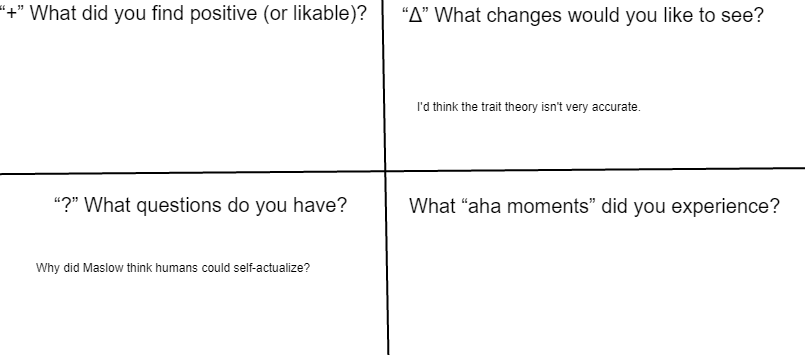
The ending points of your content delivery should make a lasting impression. Try these ideas:

    • Wrap-up your session with a Parking Lot designed as a quadrant (see below), use a shared document and include the following quadrant headings/questions so students can respond in real time:


Also see the idea of a learning journal here.

Have the students keep a learning journal, while answering these questions each week


Tips for managing remote culture fatigue — from trainingmag.com by Jo Deal, Chief Human Resources Officer, LogMeIn
Making sure employees know which virtual meetings/social gatherings are mandatory, giving them the freedom to prioritize other tasks, and learning from those who already have experience working remotely are all important lessons for finding the right cultural fit.

Excerpts:

1. Be clear about what is and isn’t mandatory.
2. Reinforce a healthy work/life balance.
3. Overhaul your meetings.
4. Learn from remote employees with experience.

 
© 2025 | Daniel Christian