15+ YouTube Shorts Ideas For Your Next Video — from buffer.com by Tamilore Oladipo If you’re looking for inspiration for your next short video, here are 18 YouTube Shorts ideas to help your content stand out and engage viewers in bite-sized bursts.
With more than 50 billion daily views, YouTube Shorts offers a unique opportunity for content creators to reach a wider audience, promote longer videos, and even increase subscribers.
For content creators and small businesses, Shorts can be a game-changer. Whether you’re repurposing old content, sharing clips from live streams, promoting exclusive content, or hopping on the latest trend, Shorts provide a versatile medium to engage viewers and potentially go viral.
From DSC: Perhaps there are a few ideas in here for your students — as they continue to develop their skills in creating multimedia-based communications and presentations.
Also relevant/see:
11 YouTube Shorts Creators to Inspire Your Next Viral Video — from buffer.com by Kirsti Lang A curated list of YouTube Shorts creators worth watching — both at the top of their game and on the rise — and how their content helps them stand out.
Short-form video is still thoroughly enjoying its heyday, due in no small part to YouTube Shorts.
The introduction of vertical, short-form videos to YouTube was a bold move for the Google-owned platform, and it’s paying off for both them and creators — 50 billion daily views is really nothing to be sneezed at.
It’s also ushered in a new wave of short-form video stars, many of whom are prioritizing Shorts over the likes of Facebook and Instagram Reels, and TikTok, with subscriber counts quickly dwarfing what it took years to amass on other platforms.
Calculus is a critical on-ramp to careers in science, technology, engineering and mathematics (STEM). But getting to those careers means surviving the academic journey.
While there’s been progress of late, it’s been “uneven” and Black, Hispanic and women workers are still underrepresented in some STEM fields. Traditional methods of calculus instruction may be knocking students off the path to these vital occupations, which is why advocates warn that getting diverse students into these careers may require instructional models more responsive to students. Meanwhile, the country is struggling to fill vacancies in related fields like semiconductor manufacturing, despite sizable investments — a feat that may require stabilizing the pipeline.
Good news: There’s mounting evidence that changing calculus instruction works for the groups usually pushed out of STEM. At least, that’s according to a randomized study recently published in the peer-reviewed journal Science.
Time management can be a challenge for learners at all levels. Generally, the farther along you are in your educational journey, the less your time is managed for you. You are given more independence and autonomy to set your own priorities and manage your own time – and it is assumed that you develop time management skills along the way. I think many people also assume that time management skills are somewhat static. That once you find a system you just have to stick to that system. However, there are many reasons why you may need to develop, update, or revise your approach to time management. As we go through different phases in our educations, careers, and life we experience different time pressures and shifting priorities.
This digest provides some resources for calendaring and scheduling. Whether you prefer online calendars and tools or pen and paper, I’ve gathered some resources from around the web to help you get the most out of your calendar system.
Student Use Cases for AI: Start by Sharing These Guidelines with Your Class — from hbsp.harvard.edu by Ethan Mollick and Lilach Mollick
To help you explore some of the ways students can use this disruptive new technology to improve their learning—while making your job easier and more effective—we’ve written a series of articles that examine the following student use cases:
Earlier this week, CETL and AIG hosted a discussion among UM faculty and other instructors about teaching and AI this fall semester. We wanted to know what was working when it came to policies and assignments that responded to generative AI technologies like ChatGPT, Google Bard, Midjourney, DALL-E, and more. We were also interested in hearing what wasn’t working, as well as questions and concerns that the university community had about teaching and AI.
Then, in class he put them into groups where they worked together to generate a 500-word essay on “Why I Write” entirely through ChatGPT. Each group had complete freedom in how they chose to use the tool. The key: They were asked to evaluate their essay on how well it offered a personal perspective and demonstrated a critical reading of the piece. Weiss also graded each ChatGPT-written essay and included an explanation of why he came up with that particular grade.
After that, the students were asked to record their observations on the experiment on the discussion board. Then they came together again as a class to discuss the experiment.
Weiss shared some of his students’ comments with me (with their approval). Here are a few:
Asked to describe the state of generative AI that they would like to see in higher education 10 years from now, panelists collaboratively constructed their preferred future. .
Julie York, a computer science and media teacher at South Portland High School in Maine, was scouring the internet for discussion tools for her class when she found TeachFX. An AI tool that takes recorded audio from a classroom and turns it into data about who talked and for how long, it seemed like a cool way for York to discuss issues of data privacy, consent and bias with her students. But York soon realized that TeachFX was meant for much more.
York found that TeachFX listened to her very carefully, and generated a detailed feedback report on her specific teaching style. York was hooked, in part because she says her school administration simply doesn’t have the time to observe teachers while tending to several other pressing concerns.
“I rarely ever get feedback on my teaching style. This was giving me 100 percent quantifiable data on how many questions I asked and how often I asked them in a 90-minute class,” York says. “It’s not a rubric. It’s a reflection.”
TeachFX is easy to use, York says. It’s as simple as switching on a recording device.
…
But TeachFX, she adds, is focused not on her students’ achievements, but instead on her performance as a teacher.
ChatGPT Is Landing Kids in the Principal’s Office, Survey Finds — from the74million.org by Mark Keierleber While educators worry that students are using generative AI to cheat, a new report finds students are turning to the tool more for personal problems.
Indeed, 58% of students, and 72% of those in special education, said they’ve used generative AI during the 2022-23 academic year, just not primarily for the reasons that teachers fear most. Among youth who completed the nationally representative survey, just 23% said they used it for academic purposes and 19% said they’ve used the tools to help them write and submit a paper. Instead, 29% reported having used it to deal with anxiety or mental health issues, 22% for issues with friends and 16% for family conflicts.
Part of the disconnect dividing teachers and students, researchers found, may come down to gray areas. Just 40% of parents said they or their child were given guidance on ways they can use generative AI without running afoul of school rules. Only 24% of teachers say they’ve been trained on how to respond if they suspect a student used generative AI to cheat.
The prospect of AI-powered, tailored, on-demand learning and performance support is exhilarating: It starts with traditional digital learning made into fully adaptive learning experiences, which would adjust to strengths and weaknesses for each individual learner. The possibilities extend all the way through to simulations and augmented reality, an environment to put into practice knowledge and skills, whether as individuals or working in a team simulation. The possibilities are immense.
Thanks to generative AI, such visions are transitioning from fiction to reality.
Video: Unleashing the Power of AI in L&D — from drphilippahardman.substack.com by Dr. Philippa Hardman An exclusive video walkthrough of my keynote at Sweden’s national L&D conference this week
Highlights
The wicked problem of L&D: last year, $371 billion was spent on workplace training globally, but only 12% of employees apply what they learn in the workplace
An innovative approach to L&D: when Mastery Learning is used to design & deliver workplace training, the rate of “transfer” (i.e. behaviour change & application) is 67%
AI 101: quick summary of classification, generative and interactive AI and its uses in L&D
The impact of AI: my initial research shows that AI has the potential to scale Mastery Learning and, in the process:
reduce the “time to training design” by 94% > faster
reduce the cost of training design by 92% > cheaper
increase the quality of learning design & delivery by 96% > better
Research also shows that the vast majority of workplaces are using AI only to “oil the machine” rather than innovate and improve our processes & practices
Practical tips: how to get started on your AI journey in your company, and a glimpse of what L&D roles might look like in a post-AI world
ChatGPT can now see, hear, and speak — from openai.com We are beginning to roll out new voice and image capabilities in ChatGPT. They offer a new, more intuitive type of interface by allowing you to have a voice conversation or show ChatGPT what you’re talking about.
Voice and image give you more ways to use ChatGPT in your life. Snap a picture of a landmark while traveling and have a live conversation about what’s interesting about it. When you’re home, snap pictures of your fridge and pantry to figure out what’s for dinner (and ask follow up questions for a step by step recipe). After dinner, help your child with a math problem by taking a photo, circling the problem set, and having it share hints with both of you.
We’re rolling out voice and images in ChatGPT to Plus and Enterprise users over the next two weeks. Voice is coming on iOS and Android (opt-in in your settings) and images will be available on all platforms.
Use your voice to engage in a back-and-forth conversation with ChatGPT. Speak with it on the go, request a bedtime story, or settle a dinner table debate.
ChatGPT can now browse the internet to provide you with current and authoritative information, complete with direct links to sources. It is no longer limited to data before September 2021. pic.twitter.com/pyj8a9HWkB
Because it’s the first-ever on Earth, it’s hard to label what kind of entertainment Hypercinema is. While it’s marketed as a “live AI experience” that blends “theatre, film and digital technology”, Dr. Gregory made it clear that it’s not here to make movies and TV extinct.
Your face and personality are how HyperCinema sets itself apart from the art forms of old. You get 15 photos of your face taken from different angles, then answer a questionnaire – mine started by asking what my fave vegetable was and ended by demanding to know what I thought the biggest threat to humanity was. Deep stuff, but the questions are always changing, cos that’s how AI rolls.
All of this information is stored on your cube – a green, glowing accessory that you carry around for the whole experience and insert into different sockets to transfer your info onto whatever screen is in front of you. Upon inserting your cube, the “live AI experience” starts.
The AI has taken your photos and superimposed your face on a variety of made-up characters in different situations.
We are entering a new era of AI, one that is fundamentally changing how we relate to and benefit from technology. With the convergence of chat interfaces and large language models you can now ask for what you want in natural language and the technology is smart enough to answer, create it or take action. At Microsoft, we think about this as having a copilot to help navigate any task. We have been building AI-powered copilots into our most used and loved products – making coding more efficient with GitHub, transforming productivity at work with Microsoft 365, redefining search with Bing and Edge and delivering contextual value that works across your apps and PC with Windows.
Today we take the next step to unify these capabilities into a single experience we call Microsoft Copilot, your everyday AI companion. Copilot will uniquely incorporate the context and intelligence of the web, your work data and what you are doing in the moment on your PC to provide better assistance – with your privacy and security at the forefront.
DALL·E 3 understands significantly more nuance and detail than our previous systems, allowing you to easily translate your ideas into exceptionally accurate images. DALL·E 3 is now in research preview, and will be available to ChatGPT Plus and Enterprise customers in October, via the API and in Labs later this fall.
The idea was simple: ask sixty community leaders to fan across the city’s public schools, follow in the footsteps of its youngest citizens, and report back on what they saw.
Fifty-nine said yes. What they found, Pickering says, “were kids with dead eyes. Kids not engaged. And kids who knew that school was a game – and the game was rigged.”
So the Billy Madison team used its findings to design a prospective high school that would actually produce what its participants said they wanted to see:
Let kids pursue their passions. Give them real work to do. And get them out of the school building, and in the community.
This thought-provoking discussion delves into the topic of system replacement in education. Is school transformation possible without replacing the existing education system? Joining [Michael] to discuss the question are Thomas Arnett of the Christensen Institute and Kelly Young of Education Reimagined.
In an educational landscape that constantly seeks marginal improvements, [Michael’s] guests speak to the importance of embracing new value networks that support innovative approaches to learning. They bring to light the issue of programs that remain niche solutions, rather than robust, learner-centered alternatives. In exploring the concept of value networks, [Michael’s] guests challenge the notion of transforming individual schools or districts alone. They argue for the creation of a new value network to truly revolutionize the education system. Of course, they admit that achieving this is no small feat, as it requires a paradigm shift in mindset and a careful balance between innovation and existing structures. In this conversation, we wrestle with the full implications of their findings and more.
From DSC: This reminds me of the importance of TrimTab Groups who invent or test out something new apart from the mothership.
The 2023 GEM Report on technology and education explores these debates, examining education challenges to which appropriate use of technology can offer solutions (access, equity and inclusion; quality; technology advancement; system management), while recognizing that many solutions proposed may also be detrimental.
The report also explores three system-wide conditions (access to technology, governance regulation, and teacher preparation) that need to be met for any technology in education to reach its full potential.
Bloom Academy is the first and only self-directed learning center in Las Vegas – microschooling as true, nontraditional and permissionless education alternative. 5 Questions with Microschool Founders Sarah & Yamila.https://t.co/RvxtwGXvkZ
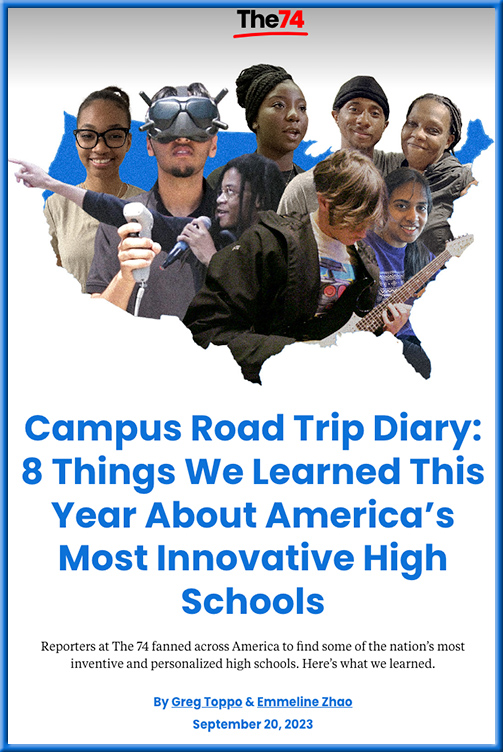
Since last spring, journalists at The 74 have been crossing the U.S. as part of our 2023 High School Road Trip. It has embraced both emerging and established high school models, taking us to 13 schools from Rhode Island to California, Arizona to South Carolina, and in between.
It has brought us face-to-face with innovation, with programs that promote everything from nursing to aerospace to maritime-themed careers.
At each school, educators seem to be asking one key question: What if we could start over and try something totally new?
What we’ve found represents just a small sample of the incredible diversity that U.S. high schools now offer, but we’re noticing a few striking similarities that educators in these schools, free to experiment with new models, now share. Here are the top eight: .
What does it take to empower parents and decentralize schooling? Why is a diversity of school models important to parents? Are we at a tipping point? .
Several meta-analyses, which summarize the evidence from many studies, have found higher achievement when students take quizzes instead of, say, reviewing notes or rereading a book chapter. “There’s decades and decades of research showing that taking practice tests will actually improve your learning,” said David Shanks, a professor of psychology and deputy dean of the Faculty of Brain Sciences at University College London.
Still, many students get overwhelmed during tests. Shanks and a team of four researchers wanted to find out whether quizzes exacerbate test anxiety. The team collected 24 studies that measured students’ test anxiety and found that, on average, practice tests and quizzes not only improved academic achievement, but also ended up reducing test anxiety. Their meta-analysis was published in Educational Psychology Review in August 2023.
The End of Scantron Tests— from theatlantic.com by Matteo Wong Machine-graded bubble sheets are the defining feature of American schools. Today’s kindergartners may never have to fill one out.
There are several possible reasons why pretesting worked in this study.
Students paid more attention to the pretested material during the lecture.
The pretest activated prior knowledge (some of them are clearly doing a lot of prework), and allowed them to encode the new information more deeply.
They were doing a lot of studying of the pretested information outside of class.
There are some great spaced retrieval effects going on. That is, students saw the material before lecture, they took a quiz on it during the pretest, then later they reviewed or quizzed themselves on that same material again during self-study.
OECS’s articles will not only establish a shared understanding of foundational concepts, but also showcase cutting-edge debates and introduce core subfields, central concepts, significant phenomena, and key methodologies.
The overall job growth included 20,524 White workers. The other 302,570 jobs — or 94% of the headcount increase — went to people of color.
…
But the trend continued up the job ladder in top, high-paid jobs, too: Companies increased their racial diversity among executives, managers and professionals.
For another item relevant to career development, see:
I dwell on this story not merely because the irony of defending the role of research by ignoring the research on the topic is exquisite, but because it is emblematic of a widespread problem within higher education. The resistance to anything like serious change is profound. By “change” I don’t mean the addition of yet another program or the alteration of a graduation requirement, but something that is transformational and affects the way we do our work on a deep level.
If maintenance of the status quo is the goal, higher education has managed to create the ideal system.
…
Cut through all the graphs and economic data and the problem is straightforward: When the service you provide costs more than people are willing and able to pay for it, when you are unable to lower the cost of that service, and when the number of your potential customers is shrinking, you have what one might describe as an unsustainable financial model.
…
“College teaching has probably seen less change than almost any other American institutional practice since the days of Henry Adams.”
Edsoma is an app that uses an AI reading assistant to help people learn or improve their reading and communication.
…
For now, the company is targeting users in grades kindergarten to fourth grade based on the content that it has today. Wallgren noted that the Edsoma’s technology will work right through into university and he has ambitions to become the No. 1 literacy resource in the United States.
Outschool, the online learning platform that offers kid-friendly academic and interest-based classes, announced today the launch of its AI Teaching Assistant, a tool for tutors to generate progress reports for their students. The platform — mainly popular for its small group class offerings — also revealed that it’s venturing into one-on-one tutoring, putting it in direct competition with companies like Varsity Tutors, Tutor.com and Preply.
Google DeepMind cofounder Mustafa Suleyman thinks that generative is a passing phase, and that interactive AI is the next big thing in AI. Suleyman called the transformation “a profound moment” in the history of technology.
Suleyman divided AI’s evolution into 3 waves:
Classification: Training computers to classify various types of data like images and text.
Generative: The current wave, which takes input data to generate new data. ChatGPT is the best example of this.
Interactive: The next wave, where an AI will be capable of communicating and operating autonomously.
“Think of it as autonomous software that can talk to other apps to get things done.”
From DSC: Though I find this a generally positive thing, the above sentence makes me exclaim, “No, nothing could possibly go wrong there.”
Be glad, people of Zion, rejoice in the Lord your God, for he has given you the autumn rains because he is faithful. He sends you abundant showers, both autumn and spring rains, as before.
From DSC: As I sit here with our youngest daughter, waiting for her choir practice/class to start, I’m thinking how fitting it is that I read this Verse of the Day from BibleGateway.com this morning. To get here, we went through several miles of farmland. Even before getting here, I had been reflecting (once again) upon what it would be like to be a farmer…hoping for a good harvest/crop year after year….depending upon God to send enough rain and sunshine and for the crops to do what they were created and designed to do.
I think we have lost much of our dependence upon God as many of us have moved off the farms through the last many decades now. Sitting behind computers is very different then tilling the soil, feeding the livestock, etc.
Anyway, I’m grateful for all of the farmers out there. Thank you for the work that you do. And I’m also grateful to the LORD for the good harvests. I thank Him often as I pass by the fields of corn, hay, wheat, soybeans, and more — or as I pass by the blueberry fields, the apple orchards, and even the few vineyards in the area. The older I get, the more I’m drawn to the soil. To working in the yard. To planting things. To taking joy when the flowering plant brings out new flowers again.
A new planetarium project in the UK has the potential to revolutionise education and entertainment. Reece Webb reports.
Many integrators will work on a career defining project, and for Amir Khosh, a new, one-of-a-kind planetarium project nestled in the heart of Nottinghamshire, UK, has sat at the centre of his world.
A project more than five years in the making, ST Engineering Antycip will be part of the large-scale developmemt that is the Sherwood Observatory, which aims to drive education enrichment and visitor attraction in marginalised communities.
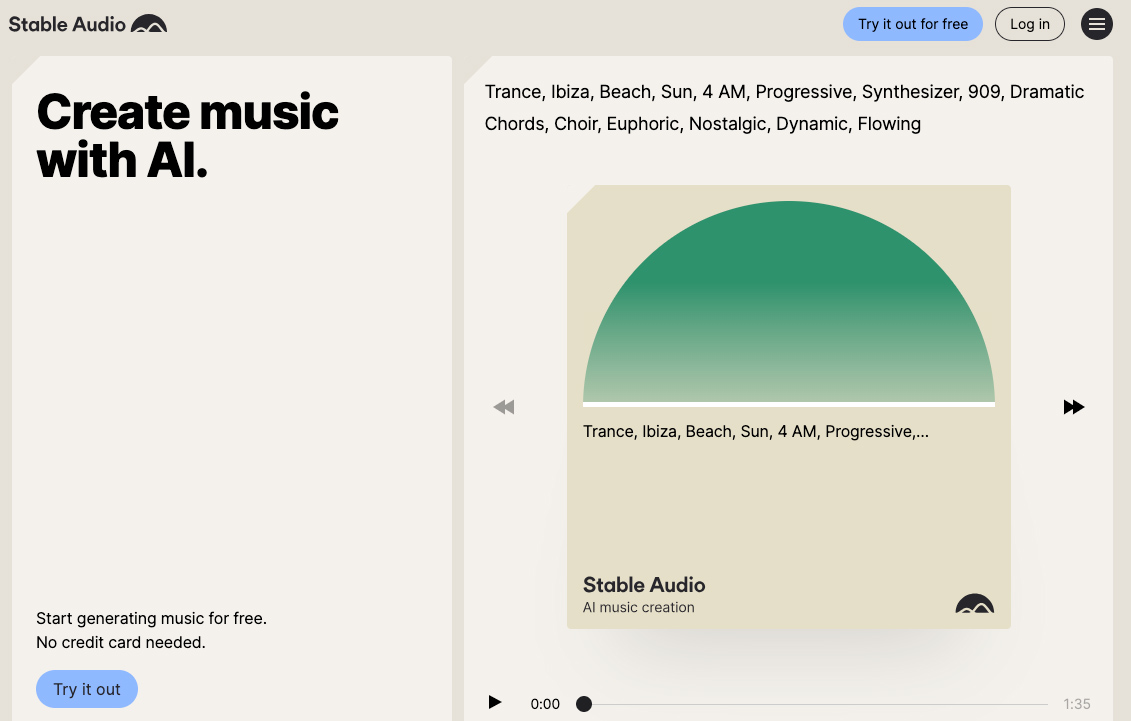
The ChatGPT of music?— from joinsuperhuman.ai by Zain Kahn ALSO: EY releases new AI platform after $1.4B investment
Here’s what you need to know:
You can feed the app prompts for both music (like classical rock) and sounds (like raindrops on a window).
The platform can generate sounds across any genre and can mix and produce sounds from multiple genres too.
The output can be used for personal entertainment and commercial purposes, like audio content for an ad.
There’s a free version where you can generate 20 tracks of up to 45 seconds for non-commercial use. And the paid version comes with 500 tracks of up to 90 seconds and can be used for commercial purposes.
Stability AI, the world’s leading open generative AI company, today announced the launch of Stable Audio, the company’s first AI product for music and sound generation.
On the topic of AI, also see:
Generative AI and intellectual property — from ben-evans.com by Benedict Evans If you put all the world’s knowledge into an AI model and use it to make something new, who owns that and who gets paid? This is a completely new problem that we’ve been arguing about for 500 years.
Boosting Your Productivity: 5 ChatGPT Prompts That Work Wonders — from wireprompt.substack.com To truly harness the power of ChatGPT, we need prompts that are crystal clear, specific to our needs, and tailored to our unique situations. Here are five ChatGPT prompts that have proven to be productivity powerhouses, no matter your role or goals…
But this fall, a few educators are quietly charting a different course they believe could change everything: At least two groups are pushing to create new AI chatbots that would offer teachers unlimited access to sometimes confusing and often paywalled peer-reviewed research on the topics that most bedevil them.
Their aspiration is to offer new tools that are more focused and helpful than wide-ranging ones like ChatGPT, which tends to stumble over research questions with competing findings. Like many juveniles faced with questions they can’t answer, it has a frustrating tendency to make things up.
Then, I turned Custom Instructions on and gave it the same starting prompt. Here are a few of the responses (emphases are mine):
“Purpose:What’s the primary goal of the course? Is it to augment your existing offerings at Every, serve as a standalone product, or something else?”
“Content Depth: Given your love for detailed, intellectual writing, how in-depth will you go on each topic?”
“Guest Contributions: Do you plan to involve guest experts, perhaps even some of your writing heroes or team members like Kate Lee and Evan Armstrong?”
“Time Investment: Given that you’re already grappling with being too opportunistic and dutiful, how will you allocate time for this without sidelining your creative work or burdening yourself?”
AI for comics— from aiandacademia.substack.com by Bryan Alexander Exploring an entertaining new Hugging Face application
As generative AI grows, more uses appear. Beyond text and images, other domains for creation pop up as companies, groups, and individuals try out new functions.
Today’s case in point is AI Comic Factory from Hugging Face.* This service will generate a couple of comic book pages based on your text input. It gives you choices of comic style and page layout as well.
Items from Tom Barrett’ Promptcraft: AI for a better learning ecosystem
How many languages do you speak? Thanks to AI, that number could be as many as seven. Los Angeles-based AI video platform HeyGen has launched a new tool that clones your voice from a video and translates what you’re saying into seven different languages. If that wasn’t enough, it also syncs your lips to your new voice so the final clip looks (and sounds) as realistic as possible.
Microsoft and Project Gutenberg have used AI technologies to create more than 5,000 free audiobooks with high-quality synthetic voices.
For the project, the researchers combined advances in machine learning, automatic text selection (which texts are read aloud, which are not), and natural-sounding speech synthesis systems.
Thanks for dropping by my Learning Ecosystems blog!
My name is Daniel Christian and this blog seeks to cover the teaching and learning environments within the K-12 (including homeschooling, learning pods/micro-schools), collegiate, and corporate training spaces -- whether those environments be face-to-face, blended, hyflex, or 100% online.
Just as the organizations that we work for have their own learning ecosystems, each of us has our own learning ecosystem. We need to be very intentional about enhancing those learning ecosystems -- as we all need to be lifelong learners in order to remain marketable and employed. It's no longer about running sprints (i.e., getting a 4-year degree or going to a vocational school and then calling it quits), but rather, we are all running marathons now (i.e., we are into lifelong learning these days).