AI Meets Med School— from insidehighered.com by Lauren Coffey
Adding to academia’s AI embrace, two institutions in the University of Texas system are jointly offering a medical degree paired with a master’s in artificial intelligence.

Doctor AI

The University of Texas at San Antonio has launched a dual-degree program combining medical school with a master’s in artificial intelligence.

Several universities across the nation have begun integrating AI into medical practice. Medical schools at the University of Florida, the University of Illinois, the University of Alabama at Birmingham and Stanford and Harvard Universities all offer variations of a certificate in AI in medicine that is largely geared toward existing professionals.

“I think schools are looking at, ‘How do we integrate and teach the uses of AI?’” Dr. Whelan said. “And in general, when there is an innovation, you want to integrate it into the curriculum at the right pace.”

Speaking of emerging technologies and med school, also see:


Though not necessarily edu-related, this was interesting to me and hopefully will be to some profs and/or students out there:


How to stop AI deepfakes from sinking society — and science — from nature.com by Nicola Jones; via The Neuron
Deceptive videos and images created using generative AI could sway elections, crash stock markets and ruin reputations. Researchers are developing methods to limit their harm.



Exploring the Impact of AI in Education with PowerSchool’s CEO & Chief Product Officer — from michaelbhorn.substack.com by Michael B. Horn

With just under 10 acquisitions in the last 5 years, PowerSchool has been active in transforming itself from a student information systems company to an integrated education company that works across the day and lifecycle of K–12 students and educators. What’s more, the company turned heads in June with its announcement that it was partnering with Microsoft to integrate AI into its PowerSchool Performance Matters and PowerSchool LearningNav products to empower educators in delivering transformative personalized-learning pathways for students.


AI Learning Design Workshop: The Trickiness of AI Bootcamps and the Digital Divide — from eliterate.usby Michael Feldstein

As readers of this series know, I’ve developed a six-session design/build workshop series for learning design teams to create an AI Learning Design Assistant (ALDA). In my last post in this series, I provided an elaborate ChatGPT prompt that can be used as a rapid prototype that everyone can try out and experiment with.1 In this post, I’d like to focus on how to address the challenges of AI literacy effectively and equitably.


Global AI Legislation Tracker— from iapp.org; via Tom Barrett

Countries worldwide are designing and implementing AI governance legislation commensurate to the velocity and variety of proliferating AI-powered technologies. Legislative efforts include the development of comprehensive legislation, focused legislation for specific use cases, and voluntary guidelines and standards.

This tracker identifies legislative policy and related developments in a subset of jurisdictions. It is not globally comprehensive, nor does it include all AI initiatives within each jurisdiction, given the rapid and widespread policymaking in this space. This tracker offers brief commentary on the wider AI context in specific jurisdictions, and lists index rankings provided by Tortoise Media, the first index to benchmark nations on their levels of investment, innovation and implementation of AI.


Diving Deep into AI: Navigating the L&D Landscape — from learningguild.com by Markus Bernhardt

The prospect of AI-powered, tailored, on-demand learning and performance support is exhilarating: It starts with traditional digital learning made into fully adaptive learning experiences, which would adjust to strengths and weaknesses for each individual learner. The possibilities extend all the way through to simulations and augmented reality, an environment to put into practice knowledge and skills, whether as individuals or working in a team simulation. The possibilities are immense.


Learning Lab | ChatGPT in Higher Education: Exploring Use Cases and Designing Prompts — from events.educause.edu; via Robert Gibson on LinkedIn

Part 1: October 16 | 3:00–4:30 p.m. ET
Part 2: October 19 | 3:00–4:30 p.m. ET
Part 3: October 26 | 3:00–4:30 p.m. ET
Part 4: October 30 | 3:00–4:30 p.m. ET


Mapping AI’s Role in Education: Pioneering the Path to the Future — from marketscale.com by Michael B. Horn, Jacob Klein, and Laurence Holt

Welcome to The Future of Education with Michael B. Horn. In this insightful episode, Michael gains perspective on mapping AI’s role in education from Jacob Klein, a Product Consultant at Oko Labs, and Laurence Holt, an Entrepreneur In Residence at the XQ Institute. Together, they peer into the burgeoning world of AI in education, analyzing its potential, risks, and roadmap for integrating it seamlessly into learning environments.


Ten Wild Ways People Are Using ChatGPT’s New Vision Feature — from newsweek.com by Meghan Roos; via Superhuman

Below are 10 creative ways ChatGPT users are making use of this new vision feature.



The Enemy Within: Former College Presidents Offer Warnings — from forbes-com.cdn.ampproject.org by David Rosowsky; via Robert Gibson on LinkedIn

Excerpt (emphasis DSC):

Brian Mitchell, former president of Bucknell University and Washington & Jefferson College, draws on his experience to offer insight in his newest Forbes contribution. He also offers a stern warning: “Boards, administrators, and faculty must wake up to the new realities they now face… the faculty can no longer live in a world that no longer exists… institutional change will happen at a speed to which they are unaccustomed and potentially unwilling to accept.” President Mitchell then goes on to offer some immediate steps that can be taken. Perhaps the most important is to “abandon the approach to governance where trustees are updated in their periodic board meetings.”

Incremental change is possible, but transformational change may not be.

Therein lies the conundrum about which Rosenberg writes in his new book. Higher ed’s own systems are inhibiting needed transformational change.

Also just published was the book, “Whatever It Is, I’m Against It: Resistance to Change in Higher Education” by Brian Rosenberg, former president of Macalester College. Articles on Rosenberg’s observations, analysis, and cautions have appeared this month in both The Chronicle of Higher Education and Inside Higher Ed, the two leading higher education publications in the US.


Addendum on 10/6/23:

Higher Education as Its Own Worst Enemy — from insidehighered.com/ by Susan H. Greenberg
In a wide-ranging discussion about his new book, Brian Rosenberg explains how shared governance, tenure and other practices stifle change on college campuses.

He argues that the institutions designed to foster critical inquiry and the open exchange of ideas are themselves staunchly resistant to both. 

The other would be some serious thinking about pedagogy and how students learn. Because the research is there if people were willing to take it seriously and think about ways of providing an education that is not quite as reliant upon lots of faculty with Ph.D.s. Is that easy to do? No, but it is something that I think there should at least begin to be some serious discussions about.

Shared governance is one of those things that if you ask any college president off the record, they’ll probably express their frustration, then they’ll go back to their campus and wax poetic about the wonders of shared governance, because that’s what they have to do to survive.


Reimagining Hiring and Learning with the Power of AI — from linkedin.com by Hari Srinivasan

That’s why today we’re piloting new tools like our new release of Recruiter 2024 and LinkedIn Learning’s AI-powered coaching experience to help with some of the heavy lifting so HR professionals can focus on what matters most.

“AI is quickly transforming recruitment, training, and many other HR practices,” says Josh Bersin, industry analyst and CEO of The Josh Bersin Company. “LinkedIn’s new features in Recruiter 2024 and LinkedIn Learning can massively improve recruiter productivity and help all employees build the skills they need to grow in their careers.”

By pairing generative AI with our unique insights gained from the more than 950 million professionals, 65 million companies, and 40,000 skills on our platform, we’ve reimagined our Recruiter product to help our customers find that short list of qualified candidates — faster.

From DSC:
While I’m very interested to see how Microsoft’s AI-powered LinkedIn Learning coach will impact peoples’ growth/development, I need to admit that I still approach AI and hiring/finding talent with caution. I’m sure I was weeded out by several Applicant Tracking Systems (ATS) back in 2017 when I was looking for my next position — and I only applied to positions that I had the qualifications for. And if you’ve tried to get a job recently, I bet you were weeded out by an ATS as well. So while this might help recruiters, the jury is still out for me as to whether these developments are good or bad for the rest of society.

Traditional institutions of higher education may want to research these developments to see which SKILLS are in demand.

Also relevant/see:

LinkedIn Launches Exciting Gen AI Features in Recruiter and Learning — from joshbersin.com by Josh Bersin

This week LinkedIn announced some massive Gen AI features in its two flagship products: LinkedIn Recruiter and LinkedIn Learning. Let me give you an overview.

LinkedIn goes big on new AI tools for learning, recruitment, marketing and sales, powered by OpenAI — from techcrunch.com by Ingrid Lunden

LinkedIn Learning will be incorporating AI in the form of a “learning coach” that is essentially built as a chatbot. Initially the advice that it will give will be trained on suggestions and tips, and it will be firmly in the camp of soft skills. One example: “How can I delegate tasks and responsibility effectively?”

The coach might suggest actual courses, but more importantly, it will actually also provide information, and advice, to users. LinkedIn itself has a giant catalogue of learning videos, covering both those soft skills but also actual technical skills and other knowledge needed for specific jobs. It will be interesting to see if LinkedIn extends the coach to covering that material, too.


Shift to Self-assessment — from catlintucker.com by Dr. Catlin Tucker

Who decided that grading and assessment should be the exclusive responsibility of teachers? Why do we sideline students when it comes to assessment?

Self-assessment is a powerful strategy that encourages students to become more invested in their learning journeys. It is a process where students evaluate their work, reflecting on what they’ve learned, how well they’ve understood complex concepts, how much progress they’ve made toward mastering key skills, and where they may need to invest time and energy to improve their concept knowledge and skill set (Siegesmund, 2016). Self-assessment shifts the focus from a grade-centric perspective to a learning-centric one. For those of us who want to encourage students to adopt a growth mindset, believing they can always improve and develop with practice and hard work, self-assessment is a critical piece of that puzzle (Wang, Zepeda, Qin, Del Toro & Binning, 2021).


Proverbs 23:12

Apply your heart to instruction and your ears to words of knowledge.


Isaiah 53:1-6

53 Who has believed our message
and to whom has the arm of the Lord been revealed?
2 He grew up before him like a tender shoot,
and like a root out of dry ground.
He had no beauty or majesty to attract us to him,
nothing in his appearance that we should desire him.
3 He was despised and rejected by mankind,
a man of suffering, and familiar with pain.
Like one from whom people hide their faces
he was despised, and we held him in low esteem.

4 Surely he took up our pain
and bore our suffering,
yet we considered him punished by God,
stricken by him, and afflicted.
5 But he was pierced for our transgressions,
he was crushed for our iniquities;
the punishment that brought us peace was on him,
and by his wounds we are healed.
6 We all, like sheep, have gone astray,
each of us has turned to our own way;
and the Lord has laid on him
the iniquity of us all.


Ephesians 3:12

In him and through faith in him we may approach God with freedom and confidence.


Isaiah 55:6

Seek the LORD while he may be found; call on him while he is near.


Galatians 6:9

Let us not become weary in doing good, for at the proper time we will reap a harvest if we do not give up.


Will Legal Prompt Engineers Replace Lawyers? — from forbes.com by Charles Lew

A woman at the computer

.

From DSC:
I’m not crazy about the click bait nature of the title, but the article lists some ways that AI could/is impacting the legal realm.
For example, here’s an excerpt:

Engineers in this capacity might not be legal experts, but they excel in framing precise questions for these models, drawing out answers that align with legal nuances. Essentially, these experts represent a significant paradigm shift, evolving the role of legal practitioners.

In legal research, an LPE harnesses advanced models to improve comprehension. Specific legal texts, statutes or summaries fed into the AI yield clarifications, contextual insights or succinct summaries. This assists legal professionals in quickly grasping the implications of texts, streamlining the research process.

In legal drafting, AI can suggest relevant clauses, pinpoint angles of an argument and provide recommendations to enhance clarity. It ensures consistency in terminology and references, detects redundant language and verifies the accuracy of legal citations. It flags potential high-risk language, aligns with jurisdictional norms and prioritizes relevance through contextual analysis. The system checks coherence in stipulated timelines and identifies potentially biased or non-inclusive language.

For training and brainstorming, LPEs can present hypothetical situations, formulating questions that unearth potential legal arguments or implications. Not only does it serve as an instructional tool for budding legal professionals, it also exercises a fresh perspective for seasoned attorneys.


12 Thoughts on Promises and Challenges of AI in Legal after Yesterday’s AI Summit at Harvard Law School — from lawnext.com by Bob Ambrogi

  1. Armed with AI, pro se litigants could overwhelm the courts, so the courts need to be prepared to respond in kind.
  2. If AI is to enhance access to justice, it will not be only by increasing lawyer productivity, but also by directly empowering consumers.
  3. Even the AI experts don’t understand AI.
  4. Experts are already striving to make the black box of AI more transparent.
  5. Even as law firms adopt AI, they are finding implementation to be a challenge.
  6. …and more


A three-headed monster — from rtalbert.org by Robert Talbert

The more I look around higher education, the more clearly it seems to me that there are three practices which we carry out every day – which seemed baked right into the very DNA of our current system of higher education – that are inimical to the actual purpose of higher education. Those practices are:

  • Lecturing,
  • Traditional grading, and
  • Student evaluations of teaching.

Before you get upset, let me say: I don’t think any of these practices is “evil”, and my understanding of the history of education says that all three were developed with good intentions, for legitimate reasons, to solve real problems. (With the possible exception of student evaluations of teaching – I’m working on trying to figure out where these came from and why they were invented.) But regardless of the background and intentions, they have taken over higher education like an invasive species.


Americans Value Good Teaching. Do Colleges? — from chronicle.com by Beth McMurtrie

“If you looked at the average person outside of higher education and said, you know, ‘We’ve created a culture in higher ed where our core thing we do isn’t valued,’ that makes absolutely no sense,” says Amy Hawkins, assistant provost for teaching and academic leadership at the University of Central Arkansas, which has been working to change that dynamic on campus. “It would be like saying in a company, ‘Well, customer service isn’t really a big deal to us. We’re about product development. We treat our customers like crap.’ I mean. That’s nonsensical.”

Does the public know this? And does it care?

Surveys show that what the public values most about higher education is good teaching and meaningful learning. 


What makes an effective microcredential programme? — from by Temesgen Kifle
Short, flexible and skills-focused, microcredentials must balance the needs of students and industry. Here are tips on how to develop courses that achieve this

Here are tips for higher education institutions (HEIs) to consider when creating and delivering microcredential programmes so they meet the needs of all stakeholders.

  1. Collaborate with accrediting bodies, employers and other HEIs
  2. Develop curricula with specific learning outcomes
  3. Review and update programmes regularly
  4. …and others mentioned here

An introduction to creating escape rooms — from timeshighereducation.com by Bernardo Pereira Nunes
Bernardo Pereira Nunes offers tips on how to get started on an escape room experience that will boost students’ teamwork, leadership, communication and problem-solving skills


Are you saving enough for college? Here’s what to know — from npr.org by Cory Turner

But I’ve also been hearing one intriguing question, over and over, that isn’t directly about loans or repayment, so much as it is about how to avoid them entirely. And it’s coming from parents of kids who’ve not yet traded in their sticker collections for student loans.

“I’ve got one little guy who’s about six years old,” Caleb Queern, of Austin, Texas, told me recently. “And my questions are, number one: How much should we be saving between now and the time my little guy is ready for college? And number two: What’s the best way to save for it?”


The Power of New Value Networks in Revolutionizing Education Systems — from michaelbhorn.substack.com by Michael B. Horn

Is school transformation possible without replacing the existing education system? In addition to Tom, Kelly Young of Education Reimagined joined me to argue that it’s not. In an educational landscape that constantly seeks marginal improvements, my guests spoke to the importance of embracing new value networks that support innovative approaches to learning. The conversation touched on the issue of programs that remain niche solutions, rather than robust, learner-centered alternatives. In exploring the concept of value networks, they both challenged the notion of transforming individual schools or districts alone. They argue for the creation of a new value network to truly revolutionize the education system. Of course, they admit that achieving this is no small feat, as it requires a paradigm shift in mindset and a careful balance between innovation and existing structures. In this conversation, we wrestle with the full implications of their findings and more.


Adobe video-AI announcements for IBC — from provideocoalition.com by Rich Young

For the IBC 2023 conference, Adobe announced new AI and 3D features to Creative Cloud video tools, including Premiere Pro Enhance Speech for faster dialog cleanup, and filler word detection and removal in Text-Based Editing. There’s also new AI-based rotoscoping and a true 3D workspace in the After Effects beta, as well as new camera-to-cloud integrations and advanced storage options in Frame.io.

Though not really about AI, you might also be interested in this posting:


Airt AI Art Generator (Review) — from hongkiat.com
Turn your creative ideas into masterpieces using Airt’s AI iPad app.

The Airt AI Generator app makes it easy to create art on your iPad. You can pick an art style and a model to make your artwork. It’s simple enough for anyone to use, but it doesn’t have many options for customizing your art.

Even with these limitations, it’s a good starting point for people who want to try making art with AI. Here are the good and bad points we found.

Pros:

  • User-Friendly: The app is simple and easy to use, making it accessible for users of all skill levels.

Cons:

  • Limited Advanced Features: The app lacks options for customization, such as altering image ratios, seeds, and other settings.


Comparing Online and AI-Assisted Learning: A Student’s View — from educationnext.org by Daphne Goldstein
An 8th grader reviews traditional Khan Academy and its AI-powered tutor, Khanmigo

Hi everyone, I’m Daphne, a 13-year-old going into 8th grade.

I’m writing to compare “regular” Khan Academy (no AI) to Khanmigo (powered by GPT4), using three of my own made-up criteria.

They are: efficiency, effectiveness, and enjoyability. Efficiency is how fast I am able to cover a math topic and get basic understanding. Effectiveness is my quality of understanding—the difference between basic and advanced understanding. And the final one—most important to kids and maybe least important to adults who make kids learn math—is enjoyability.


7 Questions on Generative AI in Learning Design — from campustechnology.com by Rhea Kelly
Open LMS Adoption and Education Specialist Michael Vaughn on the challenges and possibilities of using artificial intelligence to move teaching and learning forward.

The potential for artificial intelligence tools to speed up course design could be an attractive prospect for overworked faculty and spread-thin instructional designers. Generative AI can shine, for example, in tasks such as reworking assessment question sets, writing course outlines and learning objectives, and generating subtitles for audio and video clips. The key, says Michael Vaughn, adoption and education specialist at learning platform Open LMS, is treating AI like an intern who can be guided and molded along the way, and whose work is then vetted by a human expert.

We spoke with Vaughn about how best to utilize generative AI in learning design, ethical issues to consider, and how to formulate an institution-wide policy that can guide AI use today and in the future.


First Impressions with GPT-4V(ision) — from blog.roboflow.com by James Gallagher; via Donald Clark on LinkedIn

On September 25th, 2023, OpenAI announced the rollout of two new features that extend how people can interact with its recent and most advanced model, GPT-4: the ability to ask questions about images and to use speech as an input to a query.

This functionality marks GPT-4’s move into being a multimodal model. This means that the model can accept multiple “modalities” of input – text and images – and return results based on those inputs. Bing Chat, developed by Microsoft in partnership with OpenAI, and Google’s Bard model both support images as input, too. Read our comparison post to see how Bard and Bing perform with image inputs.

In this guide, we are going to share our first impressions with the GPT-4V image input feature.


60-Second Strategies for Educators Our popular series of short videos that break down effective classroom practices for every grade level in literally one minute—all in one place. How’s that for a quick win?

.


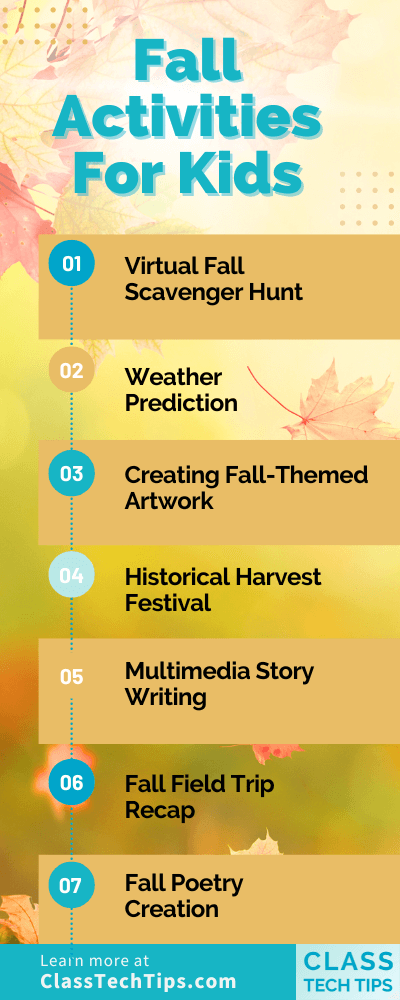
8 Fall Activities for Kids With a Digital Spin — from classtechtips.com


Redefining What High School Is Supposed to Look Like — from edutopia.org by Brittany R. Collins
From restorative grading to paid internships, an equity-centered approach to education creates rich learning opportunities for all students.

We have a networking party with special tables and food, and the students have to stand and mingle. We emulate this sort of a networking party, because they have to learn how to do it. They have to dress the part that day, and I film it so we can watch it back to give them some feedback.


Digital Promise Launches FutureLab to Investigate Transformative Approaches to Teaching and Learning — from digitalpromise.org

Digital Promise announced [on 9/26/23] the launch of the Digital Promise FutureLab. This cutting-edge initiative embodies Digital Promise’s long-standing dedication to innovation in education and aims to not only revolutionize the current state of education, but to reimagine a new world of learning.

FutureLab is funded in part by Digital Promise’s recent gift from MacKenzie Scott.

“Innovation is in Digital Promise’s DNA, and we are reaffirming our commitment to push the boundaries of what’s possible in education,” said Jean-Claude Brizard, President and CEO of Digital Promise. “We believe the Digital Promise FutureLab will be a catalyst for transformative change in education. It’s a significant opportunity to collaborate with visionary educators, technologists, and researchers to create a more equitable future for learners worldwide.”


The next phase of digital whiteboarding for Google Workspace— from workspaceupdates.googleblog.com

What’s changing

In late 2024, we will wind down the Jamboard whiteboarding app as well as continue with the previously planned end of support for Google Jamboard devices. For those who are impacted by this change, we are committed to help you transition:

    • We are integrating whiteboard tools such as FigJam, Lucidspark, and Miro across Google Workspace so you can include them when collaborating in Meet, sharing content in Drive, or scheduling in Calendar.

The Teacher’s Guide for Transitioning from Jamboard to FigJam — from tommullaney.com by Tom Mullaney


Google Tools and Activities for Art Education — from techlearning.com by Eric Curts

Google tools and activities for art education

.

Although there is no replacement for getting your hands dirty with finger paints, technology can offer many ways for students to be creative when making art. In addition to creativity, technology can also allow students to explore and learn about art in new and engaging ways.

Some of the best free digital art tools are those from Google that help educators and students with teaching, learning, exploring, and creating art. The wide range of tools and activities available provide nearly infinite possibilities.

Also relevant/see:

And speaking of tools, also see:

  • Soundtrap: How To Use it to Teach — from techlearning.com by Luke Edwards
    Soundtrap is the recording studio for students and teachers that could help in class and beyond

Soundtrap is a music production tool that is designed for use in education. That means a full-on mixing and sound production studio experience, but one that is accessible for students grade six and up.

Since this is relatively simple to use and is available in app as well as web formats, it is highly accessible for both in-class and personal devices.

This tool offers a way to spark creativity in students and a method to help experiment with music that can inspire those new to this world, or enable more experienced students to create complex and explorative music. 

soundtrap.com -- the recording studio for students and teachers


Also relevant/see:


Instructional Design Careers and Freelancing Presentations — from christytuckerlearning.com by Christy Tucker
A collection of my presentations and podcasts on instructional design careers and freelancing, including transitioning from teaching to ID.

Instructional design careers and freelancing presentations -- from Christy Tucker


Four Scenarios for the Future of Legal Education — from denniskennedy.com by Dennis Kennedy

Scenario 1: Fully Digitalized Law School
Scenario 2: Blended Law School Experience
Scenario 3: Specialized Legal Education
Scenario 4: Decentralized Legal Education

In the decentralized legal education scenario, the traditional model of law schools is disrupted by the emergence of alternative education platforms and micro-credentialing. The concept of a law degree is replaced by a more flexible and personalized approach to legal education. Students can choose from an array of legal courses offered by various providers, including universities, law firms, online platforms, and even government agencies.


How to Handle Unusual Questions Asked During a Job Interview — from hongkiat.com by Singyin Lee
Learn the art of answering unconventional questions in job interviews.

Have you ever been in a job interview where you were thrown off by an unexpected question? Questions like, “Why is a manhole cover round?” or “What’s the most crucial part of a sandwich?” or even “What three items would you want if you were stranded on a deserted island?

Rest assured, it’s unlikely that your job will require you to survive on a deserted island. So, why do interviewers ask such perplexing questions? The truth is, these questions serve a purpose, and it’s not necessarily to hear your answer.

What recruiters are really interested in is what your responses reveal about your character and problem-solving abilities.


Also important and related to one’s career development, see:

 
© 2025 | Daniel Christian