School Guide to Student Financial Literacy: What to Teach and When — from couponchief.com by Linda Phillips; with thanks to Karen Bell for this resource

It’s crucial – for individuals and the larger community – that students and young adults develop a solid foundation of personal finance knowledge, skills and habits in order to thrive. Practicing good money habits means the difference between long-term financial security and serious financial straits.

Financial literacy education is the responsibility of everyone, but most particularly parents and teachers. This guide focuses primarily on teaching financial literacy in elementary, middle and high schools. However, the concepts discussed below – and many of the resources listed – are also helpful for parents and others interested in promoting sound personal finance practices by kids and teens alike. Below you’ll find our suggestions for what concepts should be taught to kids from pre-k through grade 12, and the best times to introduce those concepts. You’ll also find an extensive list of some of the best resources – books, lesson plans, activities, videos, games and more – to supplement financial literacy education in the classroom.


Michigan may lift 9-month wait period, pay retirees amid teacher shortage — from mlive.com by Jordyn Hermani

After barring educators from returning to Michigan schools in any capacity for nine months following their retirement, the state legislature is looking to lift the ban and pay some returnees up to $30,200 in the process.

Under House Bill 4752, lawmakers would amend the state’s public school retirement act to allow retirees to work for schools while continuing to receive their pensions and other retirement benefits, such as health care.


Transforming Legal Landscape: How AI is Becoming The Ultimate Sidekick for Lawyers — from aithority.com

A survey by the American Bar Association found that 47% of lawyers believed that AI-powered chatbots could be a valuable resource for individuals seeking legal advice.

AI is more than just a buzzword—it has the power to automate tasks, analyze massive amounts of data, and provide valuable insights, revolutionizing the way law practices operate. In this blog, we’ll explore the top advantages and disadvantages of using AI in law practices, backed up by real-world examples that showcase its impact.

The Evolution of Legal Tech: Implications and Innovations — from einnews.com by Policy2050.com
A Policy2050.com analysis encapsulates lawyers’ perspectives on digital documents, Legal Tech software, Big Tech’s influence, and the promises and perils of AI.

SAN FRANCISCO, CALIFORNIA, USA, September 10, 2023/EINPresswire.com/ — Tech-focused research and strategy firm Policy2050.com has released a new whitepaper titled “The Virtual Verdict: Evolution of Legal Tech in 2023” in its open-access Quick Insights category.

A vast global population remains underserved in terms of civil legal needs. Legal Tech could bridge this gap, making law firms more efficient and legal services more accessible. But might AI be something of a Pandora’s box, especially given the complexities of justice?

Legal Tech Meets Recruitment: Navigating Tomorrow’s Legal Landscape — from abovethelaw.com by haistack.ai
Discover how the synergy of legal tech and recruitment expertise is shaping the future of legal operations, with insights from Lateral Link and haistack.ai.

Here’s where automation stands as a beacon. The days of tedious document reviews and prolonged recruitment processes are being overshadowed by platforms like haistack.ai. Such tools aren’t mere conveniences; they signify a strategic pivot in legal practices, intertwining data analytics and deep learning to yield unprecedented outcomes.

Legal Tech Artificial Intelligence Market with New Technology Estimate to 2031 — from benzinga.com by The Express Wire

In this report analysis, we thoroughly examine the Legal Tech Artificial Intelligence Market by exploring it into different segments, including size, share, and end-users etc. Furthermore, we present forecasts covering the period from 2023 to 2031. Additionally, we provide insights into the current status of the Compound Annual Growth Rate (CAGR) for the upcoming period, and we shine a spotlight on the top players in the industry.


Isaiah 42:1-4

“Here is my servant, whom I uphold, my chosen one in whom I delight; I will put my Spirit on him, and he will bring justice to the nations. He will not shout or cry out, or raise his voice in the streets. A bruised reed he will not break, and a smoldering wick he will not snuff out. In faithfulness he will bring forth justice; he will not falter or be discouraged till he establishes justice on earth. In his teaching the islands will put their hope.”

Isaiah 38:17

Surely it was for my benefit that I suffered such anguish. In your love you kept me from the pit of destruction; you have put all my sins behind your back.

Isaiah 40:11-14

He tends his flock like a shepherd: He gathers the lambs in his arms and carries them close to his heart; he gently leads those that have young. Who has measured the waters in the hollow of his hand, or with the breadth of his hand marked off the heavens? Who has held the dust of the earth in a basket, or weighed the mountains on the scales and the hills in a balance? Who can fathom the Spirit of the LORD, or instruct the LORD as his counselor? Whom did the LORD consult to enlighten him, and who taught him the right way? Who was it that taught him knowledge, or showed him the path of understanding?

Do nothing out of selfish ambition or vain conceit. Rather, in humility value others above yourselves, not looking to your own interests but each of you to the interests of the others.


Preparing Students for the AI-Enhanced Workforce — from insidehighered.com by Ray Schroeder
Our graduating and certificate-completing students need documented generative AI skills, and they need them now.

The common adage repeated again and again is that AI will not take your job; a person with AI skills will replace you. The learners we are teaching this fall who will be entering, re-entering or seeking advancement in the workforce at the end of the year or in the spring must become demonstrably skilled in using generative AI. The vast majority of white-collar jobs will demand the efficiencies and flexibilities defined by generative AI now and in the future. As higher education institutions, we will be called upon to document and validate generative AI skills.


AI image generators: 10 tools, 10 classroom uses — from ditchthattextbook.com by Matt Miller

AI image generators: 10 tools, 10 classroom uses


A Majority of New Teachers Aren’t Prepared to Teach With Technology. What’s the Fix? — from edweek.org by Alyson Klein

Think all incoming teachers have a natural facility with technology just because most are digital natives? Think again.

Teacher preparation programs have a long way to go in preparing prospective educators to teach with technology, according to a report released September 12 by the International Society for Technology in Education, a nonprofit.

In fact, more than half of incoming teachers—56 percent—lack confidence in using learning technology prior to entering the classroom, according to survey data included with the report.


5 Actual Use Cases of AI in Education: Newsletter #68 — from transcend.substack.com by Alberto Arenaza
What areas has AI truly impacted educators, learners & workers?

  1. AI Copilot for educators, managers and leaders
  2. Flipped Classrooms Chatbots
  3. AI to assess complex answers
  4. AI as a language learning tool
  5. AI to brainstorm ideas

AI-Powered Higher Ed — from drphilippahardman.substack.com by  Dr. Philippa Hardman
What a House of Commons round table discussion tells us about how AI will impact the purpose of higher education

In this week’s blog post I’ll summarise the discussion and share what we agreed would be the most likely new model of assessment in HE in the post-AI world.

But this in turn raises a bigger question: why do people go to university, and what is the role of higher education in the twenty first century? Is it to create the workforce of the future? Or an institution for developing deep and original domain expertise? Can and should it be both?


How To Develop Computational Thinkers — from iste.org by Jorge Valenzuela

In my previous position with Richmond Public Schools, we chose to dive in with computational thinking, programming and coding, in that order. I recommend building computational thinking (CT) competency first by helping students recognize and apply the four elements of CT to familiar problems/situations. Computational thinking should come first because it’s the highest order of problem-solving, is a cross-curricular skill and is understandable to both machines and humans. Here are the four components of CT and how to help students understand them.


Will Generative AI Improve Digital Accessibility? — from boia.org

Generative A.I. could reduce the busywork of accessibility
Most digital accessibility issues can be addressed easily with clean code and thoughtful content creation. However, many “easy” fixes still take time to implement, particularly when humans need to be involved.

The Web Content Accessibility Guidelines (WCAG) function as the international standards of digital accessibility. WCAG includes a number of requirements that require a subjective approach, which can create busywork for developers, designers, and writers.

For example:

  • WCAG requires text alternatives (alt text) for images and other non-text content. Writing alt text takes a few seconds, but if you’re operating a large eCommerce site with thousands of images, you may need to spend days or weeks adding alt text.
  • WCAG requires captions and transcripts for video content. If you don’t plan for those features when drafting your videos, you’ll need to write them after-the-fact — and on a lengthy video, that’s a time-consuming process.
  • WCAG requires content to maintain an appropriate color contrast ratio. Adjusting your website’s CSS (Cascading Style Sheets) isn’t especially difficult, but on a complex website, designers may need to spend hours adjusting each element.

Generative A.I. may be able to address these challenges.


Also relevant/see:


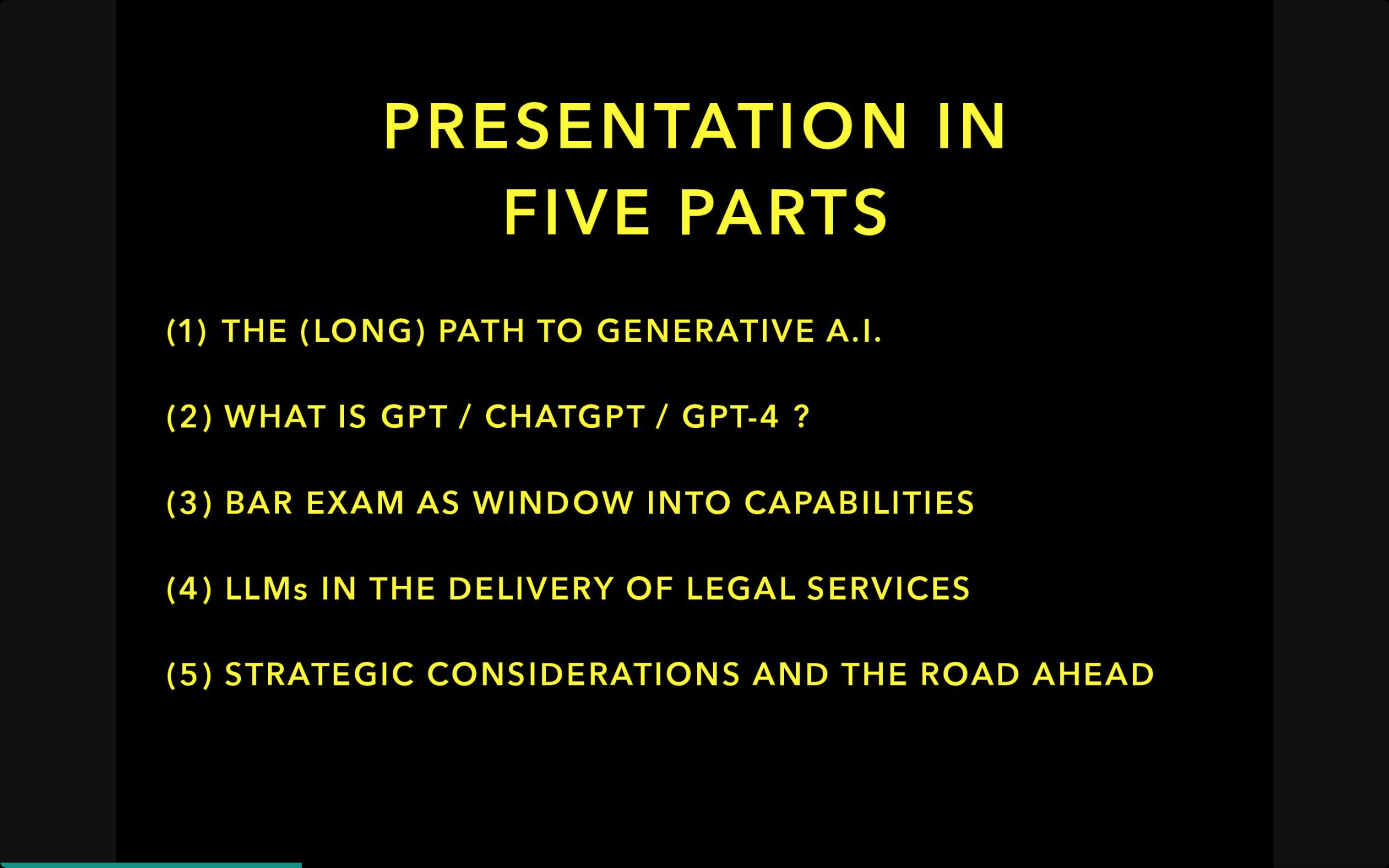
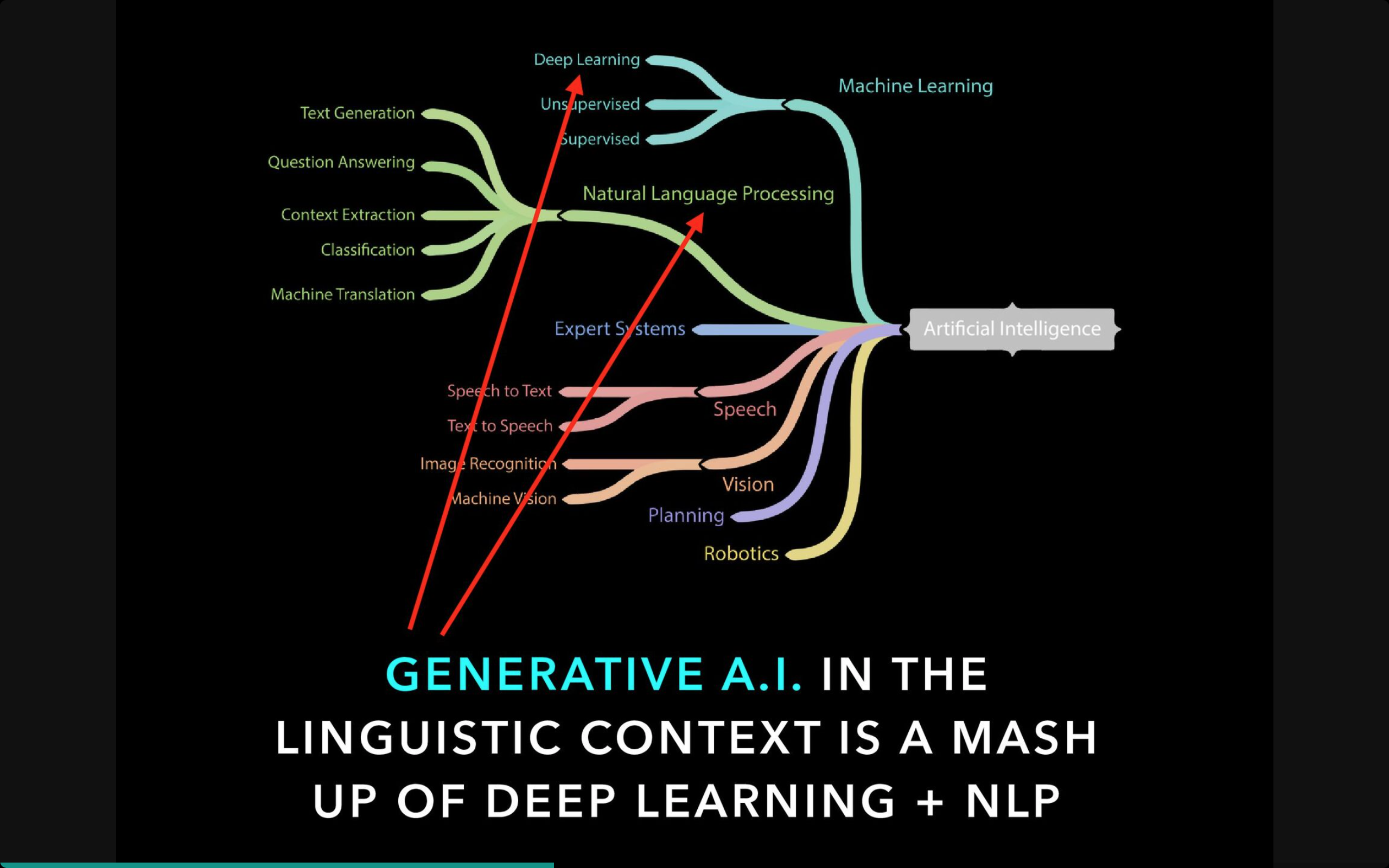
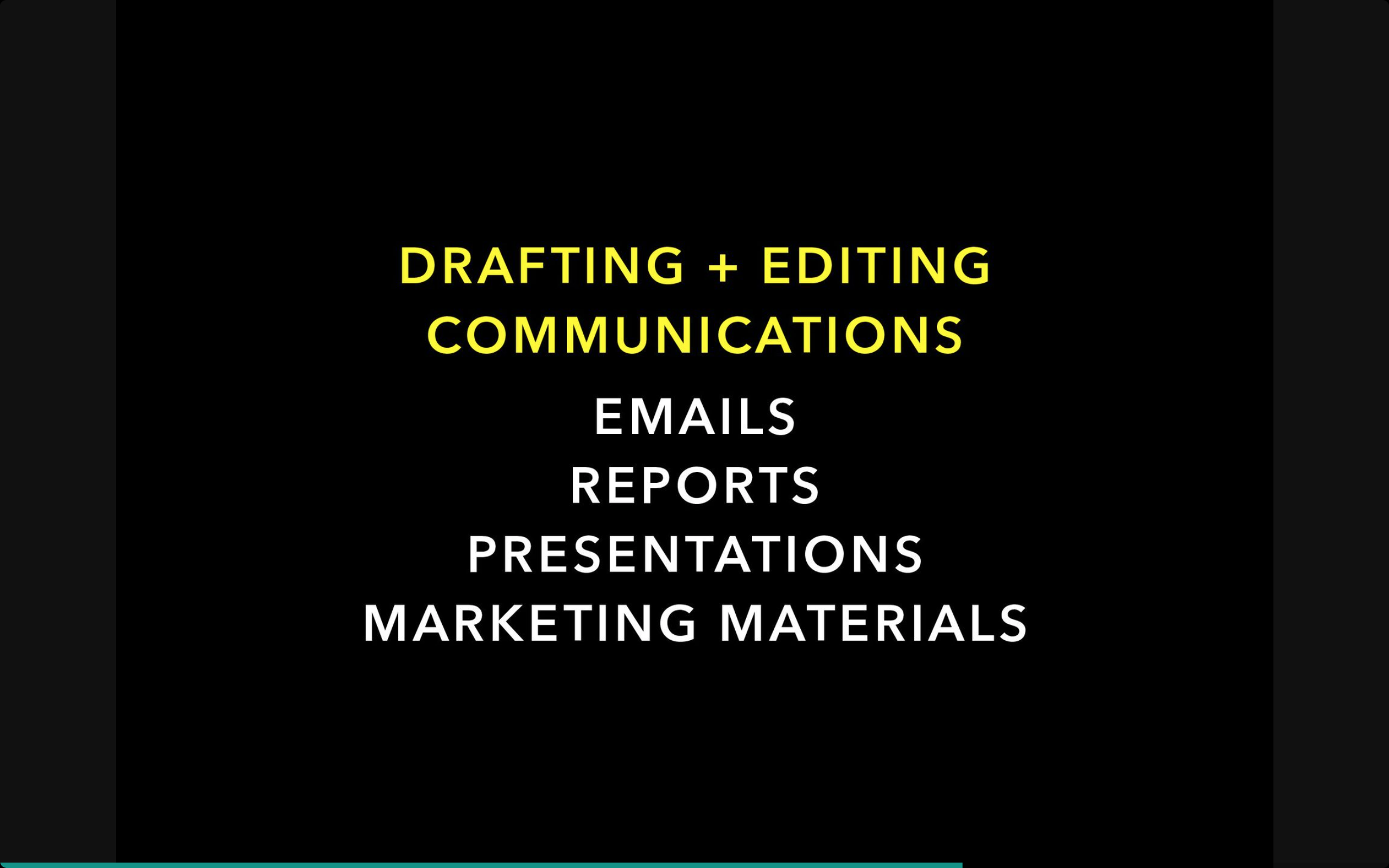
Generative A.I. + Law – Background, Applications and Use Cases Including GPT-4 Passes the Bar Exam – Speaker Deck — from speakerdeck.com by Professor Daniel Martin Katz


Also relevant/see:

AI-Powered Virtual Legal Assistants Transform Client Services — from abovethelaw.com by Olga V. Mack
They can respond more succinctly than ever to answer client questions, triage incoming requests, provide details, and trigger automated workflows that ensure lawyers handle legal issues efficiently and effectively.

Artificial Intelligence in Law: How AI Can Reshape the Legal Industry — from jdsupra.com


Next, The Future of Work is… Intersections — from linkedin.com by Gary A. Bolles; via Roberto Ferraro

So much of the way that we think about education and work is organized into silos. Sure, that’s one way to ensure a depth of knowledge in a field and to encourage learners to develop mastery. But it also leads to domains with strict boundaries. Colleges are typically organized into school sub-domains, managed like fiefdoms, with strict rules for professors who can teach in different schools.

Yet it’s at the intersections of seemingly-disparate domains where breakthrough innovation can occur.

Maybe intersections bring a greater chance of future work opportunity, because that young person can increase their focus in one arena or another as they discover new options for work — and because this is what meaningful work in the future is going to look like.

From DSC:
This posting strikes me as an endorsement for interdisciplinary degrees. I agree with much of this. It’s just hard to find the right combination of disciplines. But I supposed that depends upon the individual student and what he/she is passionate or curious about.


Speaking of the future of work, also see:

Centaurs and Cyborgs on the Jagged Frontier — from oneusefulthing.org by Ethan Mollick
I think we have an answer on whether AIs will reshape work…

A lot of people have been asking if AI is really a big deal for the future of work. We have a new paper that strongly suggests the answer is YES.
.

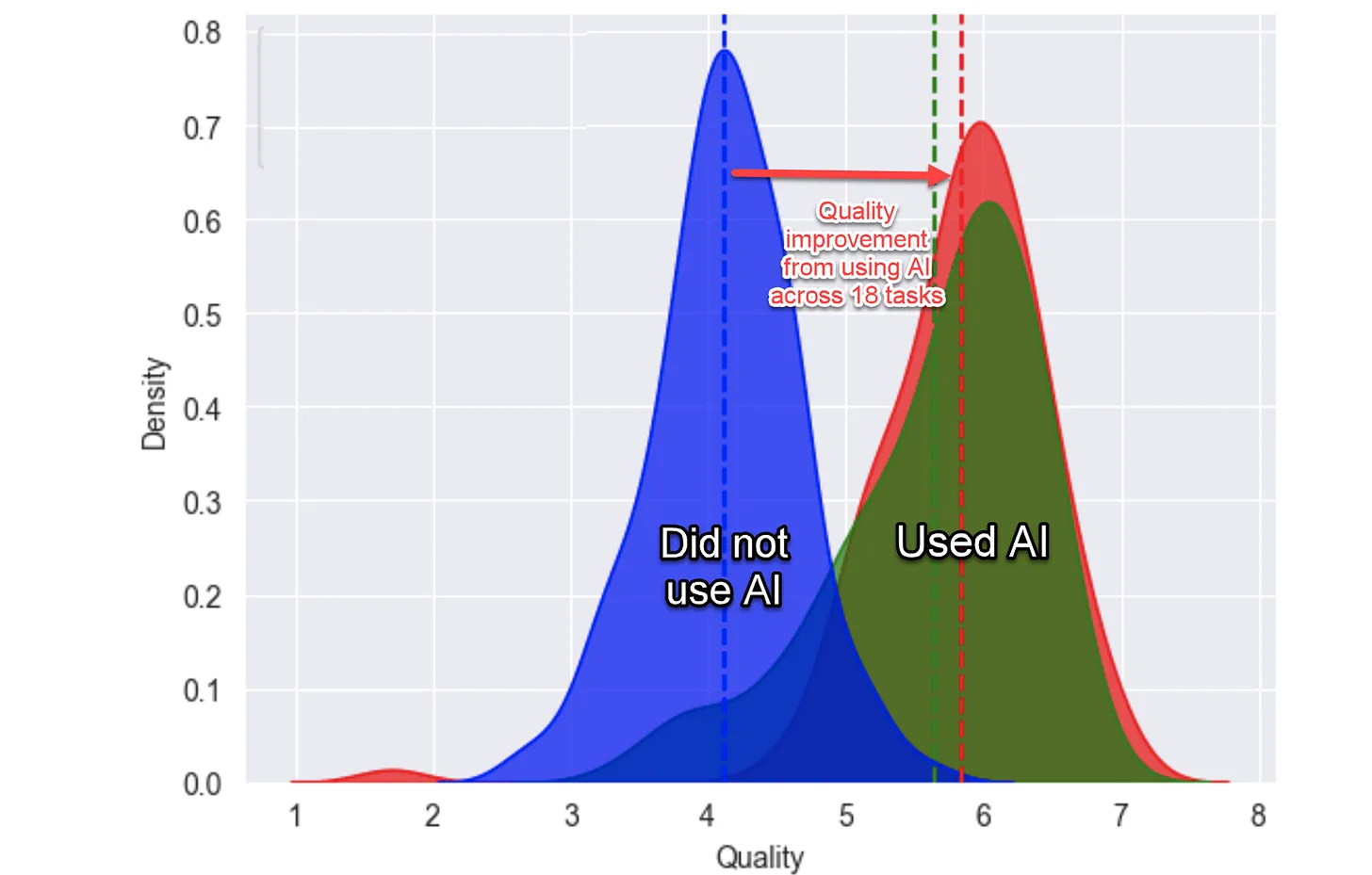
Consultants using AI finished 12.2% more tasks on average, completed tasks 25.1% more quickly, and produced 40% higher quality results than those without. Those are some very big impacts. Now, let’s add in the nuance.


From DSC:
In Rick Seltzer’s Daily Briefing for 9-18-23, he ends the briefing with this important point:

The bigger picture: Culture is exceedingly hard to change, especially after trust evaporates in a crisis. And crises can be particularly wrenching when institutions haven’t established cultures of transparency and accountability during good times. Instead, trust continues to erode in a vicious cycle.

And I thought to myself, the scope of Rick’s conclusion could likely be expanded/applied to institutions of higher education as a whole.


What Will Determine AI’s Impact on College Teaching? 5 Signs to Watch. — from chronicle.com by Beth McMurtrie (behind a paywall)

One of the biggest challenges to navigate now is the fact that more digital tools will come with generative AI already embedded in them, says Annette Vee, director of composition and an associate professor at the University of Pittsburgh. “It’s everywhere in professional writing.”

“We need to be fundamentally rethinking ways we teach writing, so we are thinking about integrating tools mindfully,” says Vee, who helped develop a new resource, TextGenEd, that provides guidance in this area. “The real challenge is how do we teach courses that are preparing students and that are smart about generative AI? We have very few teachers currently equipped to do that work.”

“It’s best if there are real stakes attached to the work, for example, an authentic audience the student is writing to,” he writes. “A subject on which students have both sufficient interest and knowledge in order to feel as though they can write convincingly to this audience also matters a lot.”


Also relevant/see — via Robert Gibson on LinkedIn:

Learnt.ai — Built for Learning Specialists — from learnt.ai
Harness the power of artificial intelligence to enhance your learning and development efforts with our easy-to-use platform – no technical expertise required!

Introducing Learnt.ai – a revolutionary collection of AI-powered content generation tools and AI chatbots that are specifically designed to support the common writing tasks of educationalists and learning and development professionals. Imagine being able to generate learning objectives on any topic of your choice, create engaging icebreakers and activities, write assessment questions with ease, and so much more.


Also relevant/see:

An AI and higher education panel — from aiandacademia.substack.com by Bryan Alexander
Live notes

Today I took in a webinar on AI and higher education. The American Association of Colleges and Universities hosted “The AI Revolution: Transforming Higher Education for the Workforce of Tomorrow” and I’d like to share my running notes.


Also relevant/see:

Students’ Perspectives on Using AI — from er.educause.edu by Sarah J. Buszka, Jeremy Cortez, and Isabella Meltzer

Students are using artificial intelligence tools to assist them in their academic careers. Three students share their viewpoints on the tools they use and how using these tools helps them in their coursework and prepares them for the professional world.


Also relevant/see:

Why Professors Are Polarized on AI — from insidehighered.com by Susan D’Agostino
Academics who perceive threats to education from AI band together as a survival mechanism. The resulting alliances echo divisions formed during online learning’s emergence.


Ask the Chair: Are Great Chairs Born or Made? — from chronicle.com by Kevin Dettmar (behind a paywall)
Higher education is finally getting serious about training new department heads.

Great chairs aren’t born, but made; “trial and error” isn’t actually a professional-development strategy. The provost and deans should recognize that a confident and competent chair makes their job easier, creates a well-functioning department, and buoys faculty, student, and staff morale.

As someone vitally engaged with the chair’s role, I do think we are experiencing a sea-change when it comes to how institutions are preparing chairs. For too long, colleges have treated the position as simply a minor cog in the chain of command. But more and more institutions are now investing in their chairs.


Teaching: These office hours offer more than academic support — from chronicle.com by Beckie Supiano

Why do so many students have the impression that they should attend office hours only if they’ve got a question? Here’s my hunch: Well-meaning, supportive professors mention their office hours at various points throughout the course: If you have questions about fill-in-the-blank, come to my office hours. The professors mean, “I am here to help! Come talk to me.” Students hear: “If you have a question.”

It’s a frustrating misunderstanding, because it contributes to the big problem my article focuses on: Many students miss out on the support professors stand to provide.

‘Adjunct Faculty 101’
“Sessions offered this year included ‘An Orientation to the Canvas LMS,’ ‘The First Day of Class,’ ‘Creating Student-Centered Course Materials,’ ‘Classroom-Management Tips,’ ‘Academic-Integrity Tips and Processes,’ ‘An Introduction to Our Tutoring Services and Writing Center,’ ‘Writing Across the Disciplines With AI,’ and more.”

From DSC:
I like the idea of using “office hours” for building relationships, helping students with their future career decisions, building broader understanding, ongoing mentoring, and for developing potential networking opportunities.


2 Corinthians 9:6

Remember this: Whoever sows sparingly will also reap sparingly, and whoever sows generously will also reap generously.

Psalms 105:1-4

Give praise to the LORD, proclaim his name; make known among the nations what he has done. Sing to him, sing praise to him; tell of all his wonderful acts. Glory in his holy name; let the hearts of those who seek the LORD rejoice. Look to the LORD and his strength; seek his face always.

2 Corinthians 5:18-19

All this is from God, who reconciled us to himself through Christ and gave us the ministry of reconciliation: that God was reconciling the world to himself in Christ, not counting people’s sins against them. And he has committed to us the message of reconciliation.

Isaiah 16:5

In love a throne will be established; in faithfulness a man will sit on it— one from the house of David— one who in judging seeks justice and speeds the cause of righteousness.


An excerpt from ‘The Magnificent Seven’ posting from Brandon Busteed on LinkedIn:

6. Create externship programs for faculty. Many college and university faculty have never worked outside of academia. Given a chance to be exposed to modern workplaces and work challenges, faculty will find innovative and creative ways to weave more work-integrated learning into their curriculum.

From DSC:
This is a great idea — thanks Brandon!

I might add another couple of thoughts here as well:

  • And/or treat your Adjunct Faculty Members much better as well!
  • And/or work with more L&D Departments at local companies (i.e., to develop closer, more beneficial/WIN-WIN collaborations).


Big Ideas in Education — from edweek.org by various

Big Ideas is Education Week’s annual special report that brings the expertise of our newsroom—and occasionally those beyond our newsroom—to bear on the challenges you might be facing in your classroom, school, or district. Big Ideas questions the status quo and explores opportunities to help you build a better, more just learning environment for all students. Browse our collection.


© 2025 | Daniel Christian