Tips for managing remote culture fatigue — from trainingmag.com by Jo Deal, Chief Human Resources Officer, LogMeIn
Making sure employees know which virtual meetings/social gatherings are mandatory, giving them the freedom to prioritize other tasks, and learning from those who already have experience working remotely are all important lessons for finding the right cultural fit.

Excerpts:

1. Be clear about what is and isn’t mandatory.
2. Reinforce a healthy work/life balance.
3. Overhaul your meetings.
4. Learn from remote employees with experience.


Teachers at high risk for COVID-19 face a terrible choice: Your job or your health — from edsurge.com by Stephen Noonoo

Excerpt:

Yet a majority of teachers aren’t sold, due to poor guidance from state and district administrators and few realistic ways to achieve social distancing on school buses and in crowded classrooms that were overspilling with students even before schools closed in March. On social media and in interviews, they cite health concerns and age—about 30 percent of teachers are over age 50—as well as the disastrous school reopenings in Israel that reportedly contributed to a surge of new cases.


Here’s how colleges should help close the digital divide in the COVID-Era — from edsurge.com by Dr. Mordecai I. Brownlee

Excerpt:

One key problem prevalent in many low-socioeconomic communities around the nation—like San Antonio, which now has the highest poverty rate of the country’s 25 largest metro areas—is the digital divide. Digital divide is a term used to describe the gap present in society between those who have access to the internet and technology and those who don’t.

It speaks directly to a primary challenge facing our education system in this COVID-era: Some students and families have the means to succeed in a remote learning environment, and others do not.


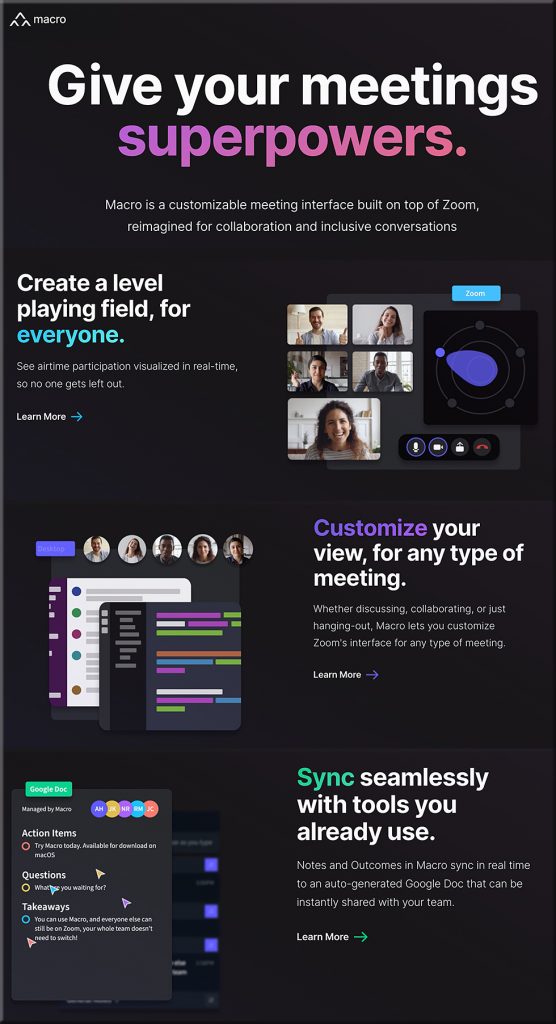
“Existing meeting interfaces had been designed with a singular goal, to simply enable virtual conversations. How could we build a meeting interface from the ground-up that intentionally facilitates engaging, productive, and inclusive conversations?”


What will tools like Macro.io bring to the online-based learning table?!


Online learning critical to the ‘reskilling’ of America — from thehill.com by Jeff Maggioncalda
[From DSC: As Jeff is the CEO of Coursera, a worldwide online learning platform, it causes this to be an opinion piece for sure; but his points are nevertheless, very valid in my opinion as well.]

Excerpts:

America is facing the worst unemployment crisis since the Great Depression. One in four American workers has filed for unemployment insurance since March. In less than four months, over 44 million American workers have watched their jobs be put on hold or disappear entirely — and that number is expected to grow in the coming months.

Policymakers should use this opportunity to launch a large-scale effort to help Americans develop the skills to do the jobs of the future.

Amidst this pandemic, Americans require a solution that meets them where they are, offering a safe learning environment during social distancing while preparing them for in-demand jobs now and post-COVID.

Online learning helps workers develop skills at an unparalleled speed and scale, as seen with the recent experience of training tens of thousands of contact tracers in a matter of weeks.

Learning from the living class room


Which links to this article:

Another regional accreditor drops geographic limits — from educationdive.com by Hallie Busta

Dive Brief:

  • The Middle States Commission on Higher Education (MSCHE) announced Monday that it will accept applications for accreditation from institutions located outside its historical territory, which is primarily the mid-Atlantic states.
  • It will also begin taking applications from international institutions seeking accreditation.
  • MSCHE is the second of the country’s seven historically regional accreditors to make such a move, the result of new federal regulations removing their geographic boundaries.

We will consider the ways that the Commission engages in its work and whether an alternative structure may be necessary to support the changing nature of accreditation, and its more modern demands. Believe it or not, our requirements and standards are also scheduled for evaluation.  We will need to begin to have conversations about the ways we can improve the language of our requirements and standards or our accreditation processes.  — source


‘No college degree required’: Google expands certificate program for in-demand job skills — from fastcompany.com by Lydia Dishman

Excerpt:

Google just announced that it is expanding its skills certification program to help more people land high-paying tech jobs without a college degree.

The Grow with Google Career Certificates will be available soon for in-demand jobs including Data Analyst, Project Manager, and UX designer. These jobs pay between $60,000 and $90,000, on average.

From DSC:
Does this get at what Professor Scott Galloway was talking about yesterday at the Remote Conference? That is, that Big Tech is coming for healthcare and education. Could be. 

Also see:

  • Google to launch 3 more tech certificates on Coursera — from educationdive.com by Natalie Schwartz
    Excerpt:
    The certificates — which will be in data analytics, project management and user experience design — will cost $49 a month and take three to six months to complete. Google will fund 100,000 need-based scholarships for those who take them.
 

What a Black tech movement might look like — from venturebeat.com by Khari Johnson

Excerpt:

That’s why, Wilson told VentureBeat, she is launching the National Black Tech Ecosystem Association. The group’s initial community gathering will focus on bringing together people in tech and the Black faith community.

“My ultimate vision is to build an association that allows for all of those entities to share information, to collectively organize, develop policy, and if needed protest moments around this new tech world that’s being built,” she told VentureBeat.


The increasingly essential role of the law librarian — from abovethelaw.com by Robert Ambrogi
Robots are not coming for law librarians’ jobs.

Excerpts:

Last year, I contributed a chapter to Law Librarianship in the Age of AI, a book published by the American Library Association. In my chapter, on the future of AI in law libraries, I described what I see as four roles of law librarians that exist already and that will become more essential as technology evolves.

    1. Librarian As Gatekeeper
    2. Librarian As Guide
    3. Librarian As Ethicist
    4. Librarian As Interpreter


Science apps for high school students — from educatorstechnology.com

Excerpt:

Below is a collection of some good educational science apps curated  specifically for high school students. This work is based on Biology Apps collection in iTunes App Store. The apps are arranged into four main categories: Applying Life Sciences, Anatomy and Physiology, Cell and Genetics, and Plants and Animals.


As school year approaches, parents and educators struggle with uncertainty — from kqed.org by Anya Kamenetz

Excerpt:

What’s at stake: An unknown number of lives, the futures of tens of millions of children, the livelihoods of their caregivers, the working conditions of millions of educators and people’s trust in a fundamental American institution.


Renters, homeowners face new phase of coronavirus crisis with evictions, foreclosures looming — from finance.yahoo.com by Alexis Keenan

Excerpt:

A potential housing crisis is on the way for millions of Americans whose mortgage and rent deferrals are about to sunset.

Evictions loom as the end of state and local moratoriums will no longer protect homeowners and tenants unable to make payments because of COVID-19 lockdowns. A minority of U.S. states have already expired orders against evictions, and a host of others across the country are set to expire over the next two months.

Once they do, residents are facing a possible flood of non-payment legal actions. The COVID-19 Eviction Defense Project (CEDP) predicted recently that by the end of September, more than 20 million U.S. renters —many of them Black and Latino located in big cities — will be at risk for eviction.


Microsoft Teams Rolls Out Virtual Rooms to Fight ‘Meeting Fatigue’ — from cheddar.com by Taylor Craig


Microsoft introduced Together Mode -- July 2020


A common background in meetings helps reduce extraneous cognitive load


A common background in meetings helps reduce extraneous cognitive load


From DSC:
Again, the longer the Coronavirus hangs around and we are learning and meeting like this, the more innovations like these will occur.


Addendums on 7/14/20:

Microsoft’s Together mode can help address executives’ concerns over remote work productivity — from businessinsider.com by Hirsh Chitkara

Excerpt:

Together mode offers an alternative to “grid view,” in which video call participants are displayed on-screen — instead, through AI segmentation, participants are placed in a single virtual environment such as an auditorium or coffee bar, creating the illusion that they are in the same space.

The future of work—the good, the challenging & the unknown — from microsofot.com by Jared Spataro

Excerpt:

Together mode is a new option in the Teams meeting experience that uses AI segmentation technology to digitally place participants in a shared background. The view makes it feel like you’re sitting in the same room, which reduces background distractions, makes it easier to pick up on non-verbal cues, and makes back and forth conversation feel more natural.


Eight ways Virtual Design Festival has set the agenda for architecture and design — from dezeen.com

Excerpt:

After three months, two million video plays, over 600 posts and more than 50 live interviews, Virtual Design Festival [ended on 7/10/20]. From defining a new design movement to imagining new planets and urban wildernesses, here are a few of the agenda-setting ideas it raised.

Eight ways Virtual Design Festival has set the agenda for architecture & design


Best practices for engaging students online — from edtechmagazine.com by Amelia Pang
Norma I. Scagnoli, a higher education instructional design expert, shares her advice on how to humanize online learning.

Excerpt:

EDTECH: How do your instructors strengthen student engagement in entirely online courses?

Scagnoli: We built that engagement by following the Community of Inquiry Framework. This model was created by online learning experts such as Dr. Randy Garrison and Dr. Norm Vaughan, who research distance education and blended learning. This model focuses on cognitive presence, teaching presence and social presence to keep students engaged with online content.

You want to use every opportunity to promote critical thinking and trigger more class interactions and discussions. 

 
© 2025 | Daniel Christian