A few creative ways to use student blogs — from cultofpedagogy.com by Jennifer Gonzalez

Excerpt:

Since those early days the blog has really evolved as a genre: People have taken the basic framework of the blog and used it to build all kinds of useful, interesting things online. This evolution has given the blog limitless potential as a form of writing, and that’s just as true for student writers as it is for everyone else. So if you’re looking for a nice, meaty assignment, one that in previous decades might have been a research paper or an oral presentation, consider assigning a blog instead. It’s not only a highly relevant form of writing, but because it’s done entirely online and worked on over time, it would also lend itself beautifully to remote or hybrid learning.

blog is part of a larger website, and what makes it unique is that it is dynamic. It changes. It’s regularly updated to provide new material


Why some colleges embraced a virtual fall sooner than others — from educationdive.com by Jeremy Bauer-Wolf; July 20, 2020
More schools are expected to make the switch in the coming weeks.

Excerpt:

These colleges aren’t likely to be exceptions for much longer, as higher ed experts predict the trickle of schools staying online will become a flood as the pandemic persists.

“I expect a bunch of colleges to announce their actual fall setup within 72 hours of each other in the next two weeks,” said Robert Kelchen, an associate professor of higher education at Seton Hall University. “It just takes a few colleges to lead the way and then their competitor institutions will follow.”

Also see:

Colleges walk back their fall plans as coronavirus cases spike — from educationdive.com by Natalie Schwartz; July 16, 2020

Dive Brief:

  • As the pandemic worsens, more colleges are ditching plans for in-person instruction this fall in favor of a mostly virtual term.
  • At least six colleges have announced in the past week that they’re planning for a remote term after previously indicating they might bring students back to campus.
  • They join others including the University of Southern California, which changed its fall plans at the beginning of July. Higher education experts expect more reversals to follow over the next few weeks.
 

Florida educators file lawsuit to protect health and well-being of students, educators and communities — from feaweb.org, with thanks to Staci Maiers for this resource

Excerpt:

TALLAHASSEE — Along with educators and parents, the Florida Education Association filed suit Monday against Gov. Ron DeSantis, Commissioner Richard Corcoran, the Florida Department of Education, the Florida State Board of Education and Miami-Dade County Mayor Carlos Gimenez to safeguard the health and welfare of public school students, educators and the community at large. The lawsuit intends to stop the reckless and unsafe reopening of public school campuses as coronavirus infections surge statewide.

Also see:


From DSC:
My dad is hard of hearing and the issue continues to get worse, though his hearing aids do help some. I’ve been looking for an app that could take what’s being spoken — in real-time — and write it out for him on a device (iPad, iPhone, other). But the WiFi network is not available at the retirement home where he’s at. So this needs to work off of a cellular connection. If you know of some solid apps in this regard, please leave a note in the comments section. Thanks!

Items mentioned in a video I saw the other day, but may have different applications:


6 tips for homeschooling in fall 2020 — from forbes.com by Kerry McDonald

Excerpt:

As schools and districts across the country finalize back-to-school plans amidst the ongoing Covid-19 pandemic, some parents are instead choosing independent homeschooling. My inbox has been filling lately with messages from parents who may never before have considered homeschooling but are worried about their children’s potential exposure to the virus at school. Others are turned off by social distancing requirements being implemented by many schools, such as wearing masks all day and limiting interactions with peers.

Fortunately, research shows low infection rates for children, who seem to avoid the virus’s worst outcomes. New findings out of Germany, where schools have been reopened for several weeks, also suggest low infection rates for young people. Despite these encouraging signs, more parents are looking for schooling alternatives. As The New York Times reported this week, “a growing number of families are thinking about home schooling this fall.”

Here are 6 tips for parents considering homeschooling for this academic year…


Check out Adobe for Education on Youtube for some great resources to learn everything from podcasting to making impactful social media videos — from jeadigitalmedia.org by Aaron Manfull

Excerpt:

We’ve got a list of Adobe tutorials from the web we’ve been curating here and we’ve long advocated for using Lynda/Linkedin Learning for students and advisers to learn programs. Let’s add one more great resource into the mix and that’s Adobe’s “Adobe for Education” channel on Youtube.

One example:


20 formative assessment examples to use in your online classroom — from tophat.com
Informal assessments are an easy way to stay connected with your students and understand their progress in your course

Excerpt:

As learning environments evolve to incorporate online and remote learning, so too has the need for different approaches that provide flexibility in assessing students in-class, online or in blended learning environments. The following examples of formative assessment techniques can not only help you share more regular, reliable and useful feedback on student progress, they can also help you get started in thinking of other formative assessment strategies to incorporate into your lesson plans.


Zooming in on Gen Z — from trainingmag.com by Scott McKinney
How L&D can cater to this rising generation’s intuitive worldview and desires.

Excerpt:

As the 60-plus million members of Generation Z enter the workplace, adapting training programs to connect with them is mission-critical.

Gen Zers—born in the mid-1990s and raised in the 2000s—will account for more than 20 percent of working adults by the end of 2020, according to a report from software-based learning management system provider Docebo. Their preferences are more in line with Gen Xers than the Millennials, despite their technology fluency. They’re the first generation raised entirely in the Digital Age but—surprisingly—prefer face-to-face communication with their peers.

Here’s a look at how L&D departments can zoom in on this rising generation’s intuitive worldview and desires in a constantly changing and COVID-19-challenged world.

Other articles here >>>
 

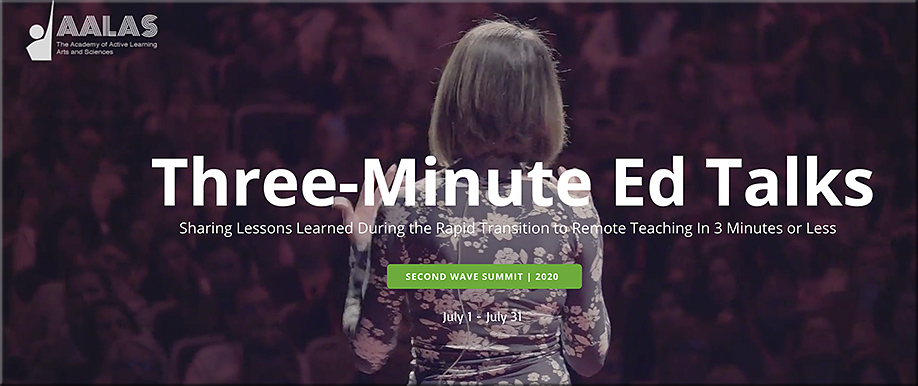
Welcome to Three-Minute Ed Talks, where educators from across the globe are invited to share an insight, a teaching strategy, or an invaluable lesson you learned during the rapid transition to online learning. Your challenge is to do it in just three minutes. Three-Minute Ed Talks are part of the month-long Second Wave Summit on reopening schools and universities and preparing for “the new normal.” Do you have a powerful idea for a Three-Minute Ed Talk? See how to make a submission here.

From DSC:
I remember being at a conference years ago when the Instructional Designer from a library spoke about doing “lightning rounds” with faculty members. The faculty member would record a 3-5 minute presentation about their idea/experiment and what problem they were trying to solve. They reported on whether the pedagogy worked or whether it didn’t work as planned. Great call me thinks!

Besides teachers and professors, trainers could do this with each other. So could those involved in homeschooling. 


From DSC:
Thanks Tony for this item. I was trying to think of how to do this just the other day…so I’m a bit late in posting this, but better late than never, heh?


Startup tackling systemic racism with virtual reality training — from gettingsmart.com by Tom Vander Ark

Excerpt:

If you haven’t been the victim of racism, imagine stepping into someone else’s shoes and experiencing it first hand. Imagine being transported into the realities of harassment.

Morgan Mercer combined insights from these immersive experiences into a venture-backed startup, Vantage Point. As a female founder, fundraising was a challenge but the Los Angeles venture launched in 2017 with a few clients and a beta product.

Participants have independent and collective experiences with facilitation to move conversations forward. After an immersion, participants respond to tough questions like, “Do you have privilege in that situation that a person of color might not?”


2020 trends in online student demographics -- from bestcolleges.com

2020 trends in online student demographics — from bestcolleges.com, with thanks to Lisa Marquez for this resource

A Note from BestColleges on Coronavirus and the Transition to Online Education
The data reported here was collected shortly before the coronavirus outbreak. The students who participated in this study had already chosen or were planning to take online courses. Their insights into the challenges of becoming successful online students, including lessons learned along the way, help to inform the development of future online programs.


Stay apart or stay home — from insidehighered.com by Greta Anderson
Colleges are implementing social contracts or making addenda to code of conduct policies requiring students to abide by social distancing guidelines this fall. Some institutions have said they will remove students from campus for noncompliance.

Excerpt (emphasis DSC):

As college leaders move ahead on plans to reopen their campuses this fall, it is becoming more clear that they lack confidence in their ability to control student behavior that can spread the coronavirus.

In addition to plans to regularly test students for COVID-19, college administrators are putting faith in conduct codes and written pledges that mandate students refrain from large gatherings, follow social distance guidelines and wear face masks. The administrators are setting up clear expectations for how students must conduct themselves and getting the message out through campus health campaigns and online training modules. What is less clear is how far colleges can go beyond their gates to enforce healthy behavior, which some students have already proven they are not willing to engage in.

She said it will also be important for campuses to come up with enforcement measures for noncompliance. A feasible university response to students who violate expectations is to remove or ban them from campus, she said.

From DSC:
Do we really think college-age students will wear masks all the time and practice social distancing? I agree with Professor Scott Galloway’s recent comments at the Remote Conference — i.e., that we are either delusional in thinking this will occur or worse, we are being dishonest. 

I’m not saying this type of thing is an easy decision and I don’t envy those folks having to make such difficult decisions. But there will likely be some colleges and universities who go ahead and make the decision to bring their students back to campus — and they do so in order to keep their doors open and/or to meet their goals for their forecasted budgets. That is, they will be sure to get the students’ tuition $$, room and board, books, fees, etc., and then after a few weeks on campus, tell everyone to go back home and finish out the term online.

These organizations better think twice before following that strategy. That strategy is short-sided. It may work for one year — or maybe not even that. Perhaps only for one semester or only for one quarter. But the bottom line is that you will get ONE shot at doing the right thing. You may not be getting those students back, as their trust in your organization will have been shattered.

Even if that isn’t your organization’s strategy, it could turn out to be a trust/PR nightmare if such a situation develops at your campus. Your organization may be unfairly compared to or lumped with other organizations who followed this strategy.

Had this Coronavirus situation happened 30-40 years ago, it would have been a different situation I think — at least trust wise. But even prior to the Coronavirus hitting us, there has been a growing backlash against higher education, especially in the last 2 decades. These days, are colleges/universities really confident that when they enforce things (and play the “heavy”), there isn’t going to be an even bigger backlash? As we’re in the process of multiplying many of the changes that we are going through by 10 years, are we ready for a 10-year leap in the backlash against higher education?

I’m grateful that the law school where I currently work — the WMU-Cooley Law School — decided early on to keep all of our courses in a 100% online-based format for this fall. It was/is the right call I think, given the current circumstances and highly uncertain future. It does the best job of protecting the students, faculty, staff, and members of administration.

But all that said, I realize this is a tough situation; there are likely many issues no matter which route(s) we take. I just encourage people and organizations to be as transparent and honest as possible here. Trust in higher education as one of our key institutions is at stake.

 
© 2025 | Daniel Christian