Podcasting for Educators — from techlearning.com by Erik Ofgang
Most educators have skills sets that translate well to the podcasting world. Here’s how to get started with your podcast.

Excerpt:

Tech & Learning talked with Young as well Dr. Kecia Ray and Dr. Frances Gipson, hosts of Tech & Learning’s Honor Role podcast, for some best practices and tips. We also collaborated with the six hosts of the AV SuperFriends podcast, asking questions for this story but recording the entire conversation for a future episode of their podcast. Watch for the release of that episode here.

From DSC:
I’d love to see even more teachers, trainers, and professors share their expertise out there. Podcasting is a great way to do that. And so is blogging. It would be nice to see the expertise of those folks reach a far greater audience — society — than just the (behind-the-paywall) journals.


What Is WeVideo And How Does It Work For Education? — from techlearning.com by Luke Edwards
WeVideo is the online video editing platform aimed at K-12 for students and teachers

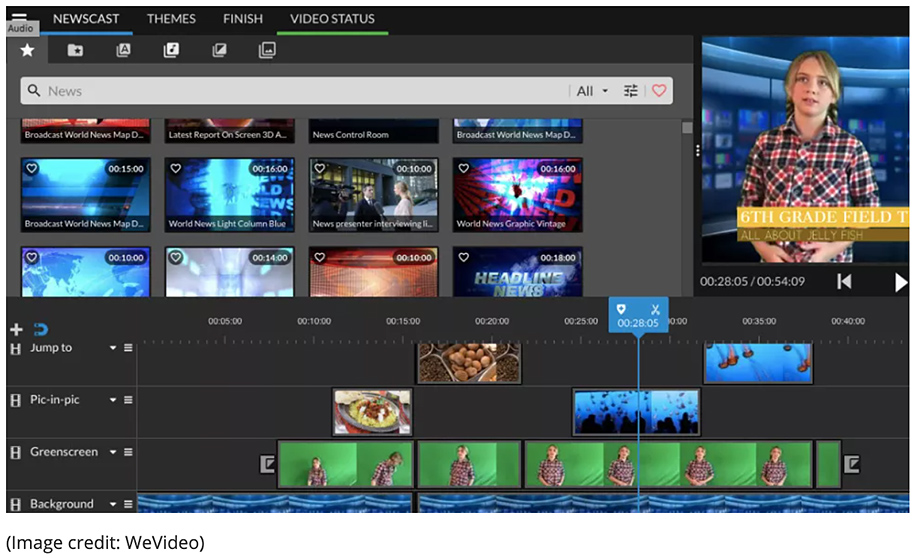
Editing digital video -- image from WeVideo

Excerpt:

WeVideo is web- and app-based with all the data crunching done in the cloud, making it ideal for use in schools and on less powerful devices. It’s built with a Chromebook focus, for example. The cloud-based nature of the platform also means it can be used collaboratively by students, both in class and remotely.

This platform is built for beginners and younger students, so it’s easy to learn and use. Essentially, there are two modes: Storyboard and Timeline. The first is easier, ideal for getting new students into video editing, while the latter is more complex, allowing students add in more detail and learn to video edit as they might on a more professional system.


“Maybe if I write it in a letter?” — from additudemag.com by Allison Leigh Solomon
Our children are easy to write off as disrespectful, lazy, and even hopeless. They are none of those things, but they will challenge you. And if you take up that challenge — and recognize the incredible potential for growth just waiting to burst out — you may just be a part of something magical.

Excerpt:

But here is what I want you to know about these children:

  • Life is not easy for them; they struggle day in and day out.
  • They know what they are doing is wrong, but most times they simply can’t stop themselves.
  • They really want to please you, but they are not very good at reading body language or knowing when enough is enough.
  • They lack confidence and need constant positive reinforcement to know that they are on the right track.
  • They are not willingly being disruptive or misbehaving.
  • Life is challenging for them and what they need the most is understanding, patience, encouragement, and acceptance.
 

Legal tech to the rescue — from nationalmagazine.ca by Julie Sobowale
The legal industry has shown it can adapt to disruption. But it has further to go in partnering with alternative service providers.

A woman walking into an abstract high tech scene

Excerpt:

“Most lawyers and legal leaders have to confront what they have done in the past,” says Chris Bentley, Director of The Legal Innovation Zone (LIZ) at Ryerson University. “They rejected technology, embraced the past, fought against having services in the cloud, fought against using online research tools, and rejected being able to video conference calls with clients.”


The Future of Wearable Computing May Be Augmented Reality – Newest Developments in AR Glasses — from wearable-technologies.com by Cathy Russey

Excerpt:

From healthcare to factory floors, augmented reality glasses are aiding people in various professions do their job efficiently. Doctors use them to conduct precise surgery and factory workers use them for productivity, efficiency, and safety. AR glasses have been identified as a vital technology supporting shop-floor operators in the smart factories of the future.


A wave of billion-dollar computer vision startups is coming — from forbes.com by Rob Toews

Excerpt:

Today, computer vision is finding applications across every sector of the economy. From agriculture to retail, from insurance to construction, entrepreneurs are applying computer vision to a wide range of industry-specific use cases with compelling economic upside.

Expect to see many computer vision startups among the next generation of “unicorns.” A crop of high-growth computer vision companies is nearing an inflection point, poised to break out to commercial scale and mainstream prominence. It is an exciting and pivotal time in the technology’s journey from research to market.


How to Remotely Support Students Who Learn Differently — from techlearning.com by Erik Ofgang
A new distance learning toolkit offers best practices and advice to support students who learn differently

Excerpt:

The National Center for Learning Disabilities recently partnered with Understood to release a  distance learning toolkit for educators to support students who learn differently during the pandemic.

The need for such a toolkit is clear. One in five students learn differently, and there is evidence that students who struggle academically or utilize individualized support in school are more likely to fall behind during distance learning.

The toolkit builds on the lessons of a 2019 report Forward Together: Helping Educators Unlock the Power of Students Who Learn Differently.


From DSC:
This is what we’re up against –> Reskilling 1 billion people by 2030” — from saffroninteractive.com by Jessica Anderson

Excerpts:

According to the World Economic Forum, this statistic is a critical economic imperative.

Does this shock or scare you? Perhaps you’re completely unflappable? Whatever your reaction, this situation will undoubtedly impact your organisation and the way you tackle skills development.

What are the roadblocks?

So, we’ve laid down the gauntlet; an adaptable, agile, multi-skilled workforce. What stands in the way of achieving this? A recent survey of the top 5 challenges facing learning leaders sheds some light:

1. Building a learning culture
2. Learning in the flow of work
3. Digital transformation
4. Learner engagement and ownership
5. Keeping informed of best practices

From DSC:
The article mentions that nations could lose billions in potential GDP growth. And while that is likely very true, I think a far bigger concern is the very peace and fabric of our societies — the way of living that billions of people will either enjoy or have to endure. Civil unrest, increased inequality, warfare, mass incarcerations, etc. are huge concerns.

The need for a next-gen learning platform is now! The time for innovation and real change is now. It can’t come too soon. The private and public sectors need to collaborate to create “an Internet for learning” (in the sense that everyone can contribute items to the platform and that the platform is standards based). Governments, corporations, individuals, etc. need to come together. We’re all in the same boat here. It benefits everyone to come together. 

Learning from the living class room -- a next generation, global learning platform is needed ASAP


LexisNexis Extends Its Context Language Analytics to Cover Attorneys’ Briefs and Motions — from legaltechmonitor.com Bob Ambrogi

Excerpt:

Last year, LexisNexis introduced Context, a refinement of an analytics tool originally developed by Ravel Law that analyzes the language of a judge’s opinions to determine the cases and arguments the judge finds most persuasive in deciding specific types of issues. As I reported then, that original launch also included Context for expert witnesses, and, since then, LexisNexis has expanded Context to also cover courts and companies.

Today, LexisNexis is further expanding Context with the introduction of Attorney Analytics, the fifth module in the platform, for researching opposing attorneys in litigation matters.

Also see:


Whistleblowers: Software Bug Keeping Hundreds Of Inmates In Arizona Prisons Beyond Release Dates— from kjzz.org

Excerpt:

According to Arizona Department of Corrections whistleblowers, hundreds of incarcerated people who should be eligible for release are being held in prison because the inmate management software cannot interpret current sentencing laws.

KJZZ is not naming the whistleblowers because they fear retaliation. The employees said they have been raising the issue internally for more than a year, but prison administrators have not acted to fix the software bug. The sources said Chief Information Officer Holly Greene and Deputy Director Joe Profiri have been aware of the problem since 2019.

The Arizona Department of Corrections confirmed there is a problem with the software.


A message about learning from the C-suite — from chieflearningofficer.com by Patricia A. McLagan
Executives are increasingly saying they want to create “learning organizations” and support “lifelong learning.” So, what should executives be saying to their workforce about learning today? Consider this sample letter to employees from the C-suite.

Excerpts:

How are you keeping up your skills and knowledge in our increasingly complex and fast-changing world of work? As today’s pandemic turmoil reminds us, it is hard to predict how the future will evolve. But one thing we do know is that continuous learning will be a key survival meta-skill for all of us — learning that each of us consciously guides every day, moment to moment, alone, in teams, with any resource, anywhere and anytime.

Consider: More than 50 percent of today’s jobs will probably disappear or change radically within 10 years. There are many reasons for this.

Beyond technology, companies like ours need more agility, innovation and self-management from everyone. We used to manage more by job descriptions, and you were best described as a box on the organization chart — probably with little expectation that you could experiment, take risks, and act with discretion and autonomy. But today and into the future, your skills and creative thinking matter more. Your “job” responsibilities shift as you move into and out of teams and as we call on you to support new strategies, customer groups and priorities.

From DSC:
I really appreciated reading this solid article from Patricia McLagan. She captured so many solid points. That said, I was bummed to see the following item included in this article (emphasis DSC):

Of course, our company is committed to supporting your learning and development, to providing formal training and access to learning opportunities for everyone. But even in the best of times, we will only be able to formally support a small part of what you will need and want. This is why I am sending this note to you: to tell you that we care about your learning and development, that we will do our best to support it, but that 95 percent of your learning is in your hands.

Of course, our company is committed to supporting your learning and development, to providing formal training and access to learning opportunities for everyone. But even in the best of times, we will only be able to formally support a small part of what you will need and want. This is why I am sending this note to you: to tell you that we care about your learning and development, that we will do our best to support it, but that 95 percent of your learning is in your hands.

Our company is committed to supporting your learning development — yeh…right…all 5% of it. 
Whoopie. The other 95% of it belongs to you and me. (Which reminds me that words are so easy to say but much harder to truly back up.) And you and I will likely do it on your/our own time. That seems to be more of the reality…the expectation…especially when job cuts are occurring all over the place and the job plates continue to expand for those who survived the cuts.

My experience over my career has been that corporations used to promote and truly support their employees’ professional development. They sent more people to courses and significantly helped many people obtain their MBA’s as well as other relevant master’s degrees and/or certifications/ and/or just to support some professional interests.

For example, I’m forever indebted to one of my formers bosses, Irvin Charles Coleman III. I worked for Irv at Kraft Foods’ HQ’s and he once let me go to a seminar on Photoshop. Though I used Photoshop in my work, it wasn’t in my formal description. That seminar changed many things for me. It supported my growth and learning and it fed my passion for designing and creating content.

I’m sure this kind of thing still occurs, but from what I can tell, it doesn’t happen at nearly the level that it used to. That said, I don’t blame the corporate world for getting bummed out at their employees that they had invested in — only to see those same employees grab the degrees and credentials and leave for greener pastures. Through the years, it seemed like the corporate world backed off from providing such a level of training/professional development.

These days, it seems like the corporations and the businesses out there have the hiring expectation that you will hit the ground running from day one. Learning and development are up to you and me. Nevermind that the way learning is supposed to go is that you:

  • introduce the learning objectives to someone
  • give them the information/content
  • provide the relevant and aligned learning activities that help them truly engage with the content
  • provide aligned formative and summative assessments along the way to ascertain whether they learned the material/concepts or not.

So I’m amazed that corporations are putting recent grads through their own tests on things that many of these students have never actually studied. (Yeh, I can hear the push backs now…and while I agree with some of them, it’s not fair to the students. They just followed what the colleges and universities offered for$100,000-$400,000+).

I could go on, but I need to go do my taxes. Gotta run. I hope to pick this line of thought up later.


The future of learning is on the front line — from chieflearningofficer.com by JD Dillon
L&D can learn a lot from the front-line experience — regardless of industry or audience. 

Excerpts:

Chief learning officers must enable ecosystems that help people get ready for whatever comes next. The future of learning isn’t a technology or strategy. The future of learning is the future of work. Nowhere is this more true than on the front line. 

The collective effort made by global learning and development teams to enable the front-line workforce may very well represent the largest workplace learning initiative ever. L&D can learn a lot from the front-line experience — regardless of industry or audience.

Microlearning played a crucial role in helping front-line workers adopt new behaviors and reinforce new habits. Content was focused on just the knowledge and skills required to execute new tasks. Microlearning could also be delivered in three- to five-minute sessions, meaning employees kept learning and practicing every day despite their hectic schedules.

Instead, they expanded the definition of “digital learning” to include everything from video and text messages to microlearning and performance support.

As organizations find their next normals, L&D must seize the opportunity to assess the digital learning strategy. This should reach beyond the LMS to include the full workplace ecosystem.

Also see:


Reflections on 2021 L&D trends survey — from by Ken Blanchard
The drastic decline of face-to-face training in 2020 is still on the minds of L&D professionals in 2021. 

Excerpt:

To present a closer view of the impact COVID-19 had on L&D efforts in 2020, we recently published the results of our 2021 HR/L&D Trends Survey. More than 1,000 L&D professionals took part in this year’s survey, which looked at challenges such as the need to convert face-to-face training designs to digital or virtual formats and plans for moving forward in 2021.

From DSC:
An example quote from the report:

In looking at ways to improve their digital and virtual designs, respondents identified learner engagement, social interaction, and more learning touch points as the three top areas for improvement.

That’s not so different than what you would hear from folks working within other learning ecosystems.


2U, Guild Education Partner to Expand Online Education for Adult Workers — from edsurge.com by Tony Wan

Excerpt:

But the current crisis is anything but, and an increasingly remote workforce will only accelerate the need for new skills and habits to keep companies running.

2U, a publicly traded company, will make its degree programs, short courses and online coding “bootcamps” available to Guild Education’s network of employers. That’s over 500 programs, spanning more than 30 disciplines, that they will have access to. It’s largely up to the employer to choose which ones they want to subsidize for their workers, Freedman says.

“Businesses are eliminating some roles, yet are desperate to hire for others. But you cannot hire away to solve what is fundamentally a training problem.” In other words, it makes more sense to invest in training internal talent, rather than firing people and hiring replacements.


100 hints that your child may be gifted — from raisinglifelonglearners.com by Colleen Kessler

Excerpt:

Here you’ll find 100 real-life and classic hints that your child may be gifted. Since gifted kids are as unique from one another as they are from the general population, not every one of these will be true for every gifted child, and there will definitely be anecdotes experienced by gifted families that aren’t mentioned here. But in general, you may very well have a gifted child on your hands if…


© 2025 | Daniel Christian