Specialties In Instructional Design and What They Do — from teamedforlearning.com
Specialties in instructional design can help both job seekers and hiring managers find the right fit for digital learning courses and programs.

Excerpt:

An instructional designer is anyone who designs and develops digital learning experiences. That may sound straightforward, but within that vague job title nest dozens of specialties. Even more confusingly, instructional designers may also be called learning designers or learning architects. Their work often overlaps with that of instructional technologists and content creators. Specialties in instructional design help both teammates and hiring managers to navigate this evolving position.

Untangling the complexities of the instructional design role can help both job seekers and hiring managers find the right fit. Identifying a specialty can help professionals carve out their own niche in the instructional design ecosystem. Greater clarity around what instructional designers actually do can help team leaders find the right instructional designer for their project.

 

Putting Your Best Self Forward: 6 Keys For Filming Quality Videos — from er.educause.edu by Jered Borup
The difference between a video that students watch and one that is ignored often comes down to a few, easily addressed factors.

Excerpt:

  • Key #1: Convey Your Voice—Is the audio clear, or is there background noise or reverberations in the room that distract from your message?
  • Key #2: Find the Light—Are you well lit with a light source in front of you, or are you backlit and/or have shadows on your face?
  • Key #3: Frame and Maintain Eye Contact—Are you about at arm’s length and eye level with the camera, or are you looking down or up at the camera?
  • Key #4: Stage—Do you have personal and/or interesting things in the background, or are you recording in front of a blank wall?
  • Key #5: Be Prepared and Natural—Are you speaking naturally in a way that conveys your interest in the topic, or do you sound somewhat robotic and/or scattered?
  • Key #6: Keep it Short—Is the video under six minutes?

This article is part of a series about incorporating asynchronous video into educational activities:


Hiperwall Introduces Cost-Effective ‘Essentials’ Video Wall Hardware and Software Packages — from hiperwall.com with thanks to Michael Farino for this resource
Hiperwall Essentials video wall bundles eliminate barriers to entry for organizations wanting enhanced collaboration, clearer communication, and the ability to make informed real-time decisions

Excerpt:

February 24, 2021 – IRVINE, Calif., – Hiperwall Inc., an industry-leader in commercialized, IP-based visualization technology, today introduces ‘Hiperwall Essentials,’ two all-inclusive video wall hardware and software bundles that get users started with a full-featured, control-room grade video wall powered by Hiperwall for just $9,995.

Most major decisions made in the public and private sectors are driven by vast amounts of data. Due to the volume of data sources, data complexity, and different analytics tools, video walls have become the perfect canvas for decision-makers to put all of this data together clearly to arrive at an informed decision faster and more confidently.

At a price point that effectively removes barriers to implementation for small to medium businesses, small government agencies, and local law enforcement, Hiperwall Essentials serves as a great baseline for integrating video wall technology into any organization. As dependence on the video wall grows, Hiperwall’s modular platform makes scaling the video wall footprint and capabilities seamless and cost-effective.


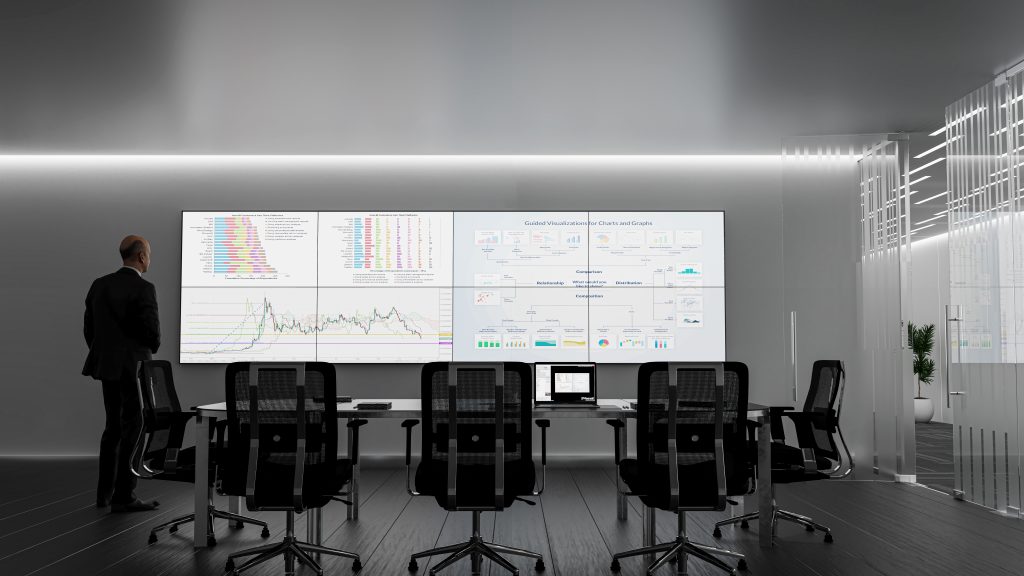
Below are some example settings:

For those interested in video walls, this is worth checking out. These pictures are example settings.


For those interested in video walls, this is worth checking out. These pictures are example settings.


For those interested in video walls, this is worth checking out. These pictures are example settings.


For those interested in video walls, this is worth checking out. These pictures are example settings.


For those interested in video walls, this is worth checking out. These pictures are example settings.


Reimagining the Future of Legal Regulatory Reform (emphasis below from DSC)

Wednesday, March 3, 2021 | 3:00 PM – 4:15 PM EST

The American legal system has been designed by lawyers for lawyers, on the assumption that parties with legal needs will be represented by lawyers. But in more than 76 percent of civil cases in state courts today, at least one of the parties is unrepresented by counsel. The result is a system that is not adequately serving tens of millions of people every year. In response, the regulations that govern legal services are starting to shift in ways that have the potential to transform the legal system so that it better serves the public. Arizona and Utah are leaders in this regulatory reform movement. In this virtual webinar, participants describe the conditions that are driving change, explain Arizona’s and Utah’s innovations, and share their visions for the future of legal services regulation.

For more information, please visit futureofthelegalprofession.org


2021 EDUCAUSE Horizon Report® | Information Security Edition — from library.educause.edu
This report profiles important trends and key technologies and practices shaping the future of information security, and envisions a number of scenarios and implications for that future. It is based on the perspectives and expertise of a global panel of leaders from across the higher education landscape.


Inclusivity Begins with Overcoming Bias — from scholarlyteacher.com by Spencer Benson

Excerpt:

On an individual level, we need to be mindful that small things that may seem inconsequential to us may have detrimental impacts on others. Numerous articles and resources are readily available detailing best practices for creating more inclusive environments for students. Small things that can help to foster a sense of belonging and inclusiveness include the following:

  • being intentional in selecting course content that reflects diverse people and voices,
  • ensuring that resources and materials reflect individuals from underrepresented groups,
  • sharing gender pronouns,
  • learning preferred names and asking students to correct mispronunciation,
  • having students do a short online biographic sketch,
  • using small group learning,
  • giving students agency in assessments and grading, and
  • using mid-term and end-of-term student surveys.
 

Never Going Back: What Online Teaching in the Times of COVID Can Add to Our Teaching Toolkits – Elisabeth Sandberg — from cft.vanderbilt.edu with thanks to Beckie Supiano at the Chronicle for this resource

Excerpt:

Teaching online has not been all challenges for Sandberg. From this period of teaching, she has gathered a set of experiences that, she expects, will benefit her in an in-person setting, too. For one thing, Sandberg has explored new ways of optimizing the element of time in students’ learning. Realizing that even the most entertaining presenters become soon-to-bore lecturers in online settings, she became more attentive to keeping her prerecorded video lectures brief and dividing them into pieces interwoven with online activities. The Explain Everything app (a collaborative virtual whiteboard platform with multi-media features) has been helpful for annotating these short pieces of recorded lectures. Sandberg’s renewed attention to student attention has also made her more mindful of things she assigns out of class, and what these might represent in terms of student efforts. “I learned over the summer,” she said, referring to the CFT’s Online Course Design Institute, “how to be more cognizant of how much time the things that I consider easy work really take the students. And that was really a revealing piece that I will carry with me when we return to in person.”


From DSC:
I agree…the teaching toolboxes have expanded. In the future, teachers, professors, trainers, (and now parents) will have a wider selection of options/tools/pedagogies to select from.

Whats in your teaching toolbox?


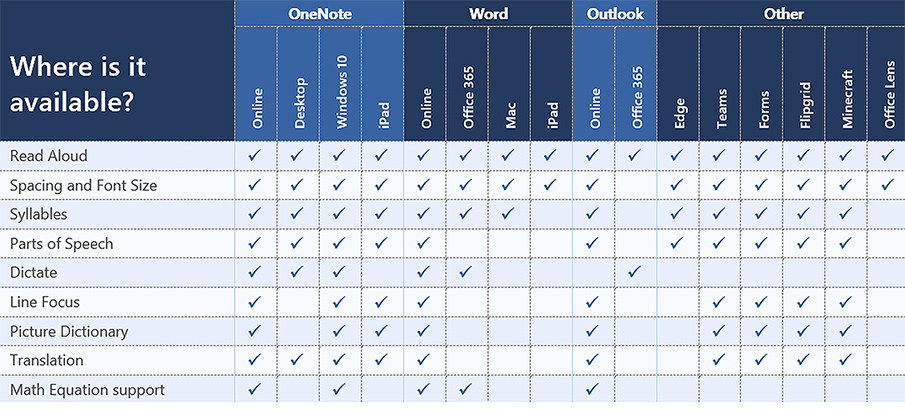
Look at the choice and control possibilities mentioned in the following except from Immersive Reader in Canvas: Improve Reading Comprehension for All Students

When building courses and creating course content in Canvas, Immersive Reader lets users:

  • Change font size, text spacing, and background color
  • Split up words into syllables
  • Highlight verbs, nouns, adjectives, and sub-clauses
  • Choose between two fonts optimised to help with reading
  • Read text aloud
  • Change the speed of reading
  • Highlight sets of one, three, or five lines for greater focus
  • Select a word to see a related picture and hear the word read aloud as many times as necessary

Also see:

All about the Immersive Reader — from education.microsoft.com

The Microsoft Immersive Reader is a free tool, built into Word, OneNote, Outlook, Office Lens, Microsoft Teams, Forms, Flipgrid, Minecraft Education Edition and the Edge browser, that implement proven techniques to improve reading and writing for people regardless of their age or ability.


Teacher, Are You There? Being “Present” in Online Learning — from er.educause.edu by Richard West

Excerpt:

Video technologies are part of that shift in helping online learners feel connected to teachers and peers. This connection comes from people developing the sense that they are “present” in the class, even if they are not physically in the same room. How is it possible to be present when you are physically separated?


Public Viewpoint: COVID-19 Work and Education Research — from cci.stradaeducation.org

Excerpt:

In the recovering economy, employers will play a central role as Americans look to reskill, upskill, and compete in the workforce. But what do people want and expect from employers’ hiring, advancement, and training practices? In this research we explore the public’s perceptions on skills-based hiring, preferences for employer-provided education and training benefits, and beliefs about who should fund education and training.

This week’s data are based on the Strada Student Viewpoint and Strada-Gallup Education Consumer surveys. The research is intended to provide insights to the education and training providers, policymakers, employers, and individual Americans who are navigating the COVID-19 crisis.


It’s Time to Take College Student Hunger and Homelessness Seriously — from edsurge.com by Jireh Deng, Nicole Delgado, Rashida Crutchfield and Stephanie Ibarra

Excerpt:

Students cooking ramen noodle packets in the dorm microwave have come to symbolize what is deemed to be the universal college experience. However, that image demeans the dire situation of students experiencing food and housing insecurity in higher education.

But it doesn’t have to be this way. Through advocacy on campuses and in communities and ongoing state and federal investment in the real cost of higher education—including housing, food and other supports—we can and should make a firm commitment to students who are doing everything they can to become economically self-sufficient.


The Triple Threat Facing Generalist Law Firms, Part 2: Legal Tech — from jdsupra.com by Katherine Hollar Barnard

Excerpts:

In Legaltech, a Walmart associate general counsel estimated the product provided a 60 to 80 percent time savings. That’s great news for Walmart – less so for lawyers who bill by the hour.

Sterling Miller, the former general counsel of Marketo, Inc., Sabre Corporation and Travelocity.com, made a compelling case for why law firm clients are turning to technology: In-house lawyers are incentivized to find the most efficient, lowest-cost way to do things. Many law firm lawyers are incentivized to do just the opposite.

To be sure, software is unlikely to replace lawyers altogether; legal minds are essential for strategy, and robots have yet to be admitted to the bar. However, technology’s impact on an industry dominated by the billable hour will be profound.

Also see:

Judge John Tran spearheaded adoption of tech to facilitate remote hearings and helped train lawyers — from abajournal.com by Stephanie Francis Ward; with thanks to Gabe Teninbaum for this resource

Excerpt:

If you need a judge who can be counted on to research all courtroom technology offerings that can help proceedings continue during the COVID-19 pandemic, look no further than John Tran of the Fairfax County Circuit Court in Virginia.

After the Virginia Supreme Court issued an order June 22 stating that remote proceedings should be used to conduct as much business as possible, Tran offered webinars to help lawyers with the Fairfax Bar Association get up to speed with Webex, the platform the court uses for remote proceedings.

“When Webex has a news release, he’s all over that. He’s already had a private demo. He is one of a small number of exceptionally tech-savvy judges,” says Sharon Nelson, a Fairfax attorney and co-founder and president of the digital forensics firm Sensei Enterprises.


The Art World Goes Blockchain — from protocol.com by David Pierce

Excerpt:

The NFT explosion is tied up in the rise of Bitcoin and other cryptocurrencies, which is tied up in a general frenzy of investment, and so who knows what will eventually crash when the rest of it does.

  • But there’s something here. You probably don’t want to spend half a mil on a Pop Tart cat, but the idea that digital goods can be authenticated and verified — that you might someday buy a GIF the same way you buy a painting or a Rolex — is transformational.
 

Henningsvaer at sunset by Yiannis Pavlis


Foster Partners Southern Dunes Hotel in Saudi Arabia -- the Red Sea Project

Foster + Partners’ hotel to be built amid Saudi Arabian sand dunes — from dezeen.com by Tom Ravenscroft


A beautiful image of a person silhoutted against the sun at dusk


Panorama Project Releases Immersive Media & Books 2020 Research Report — from panoramaproject.org

Excerpt:

The Panorama Project, a cross-industry publishing initiative, released today Immersive Media & Books 2020 a comprehensive market study that gauges the role of books and consumer engagement by age groups, ethnicity, and more.  This report contains survey data from 4,300+ pre-qualified respondents and was authored by Dr. Rachel Noorda and Dr. Kathi Inman Berens, faculty members of the Portland State University graduate program in Book Publishing.

 Data collection and analysis for Immersive Media & Books 2020 were conducted in the midst of the COVID-19 pandemic and represent Panorama Project’s ongoing commitment to research.  The report is rich with data, including graphs and tables to illustrate provocative findings that will stimulate discourse between publishers, authors, librarians, booksellers, thought leaders, advocacy groups and the media.

Panorama Project -- Data-informed insights on public libraries and their impact on book discovery, author brand development, and sales

 
© 2025 | Daniel Christian