ADDitude: Resources for families touched by attention deficit disorder (ADD/ADHD).
ADDitude: Resources for families touched by attention deficit disorder (ADD/ADHD)

Example article:

“I’m a Teacher with Nonverbal Learning Disorder. And I’m Exactly Who I Needed As a Child.” — from additudemag.com by Brittany Kramer
“I strive to create a classroom environment where my students know they will be successful, no matter what. It’s the environment I would have felt safe in as a child; one that is encouraging, warm, and free of judgment or anger.”

Excerpt:

“They tried to bury me, but they didn’t know that I was a seed.”

As a special education teacher for students with learning disabilities and developmental disorders, and as a neurodivergent individual myself, this quote defines my life.

I was formally diagnosed with Nonverbal Learning Disorder (NVLD) at 23 years old. As a child and teen, I struggled in ways that most people cannot possibly comprehend.

When people think of learning disabilities, they picture a child with dyslexia or dysgraphia who cannot read or write very well. They do not envision an intelligent and articulate child for whom tying shoes or making a paper fit into a folder is arduous at best.

 

Here Is A Great Reading App for Students with Dyslexia — from educatorstechnology.com

Excerpt:

Omoguru is an excellent reading app for students with dyslexia. It offers a wide variety of tools ‘designed to make the text more readable’. Some of these features include: tools to adjust text appearance and enhance its readability (e.g., letter spacing, line height setting, contrast setting colours, text size and weight), syllable marking (the tool allows you to mark syllables in different colours enabling readers to easily identify and read multi-syllable words), speed reading, and many more.


G Suite for Ed Gets New Name and Pile of New Features — from thejournal.com by Dian Schaffhauser

Excerpt:

Google announced a spate of changes to its education offerings, including a renaming of its education bundle of productivity applications and a limit to free storage for schools and colleges. Security and engagement updates are also being added to the education version of Google Meet, and Google Classroom will see enhancements later this year. The announcements came during a 90-minute virtual session on “learning with Google.”

A New Name
G Suite for Education has been renamed. Starting today, it’s known as Google Workspace for Education. 

Addendum on 2/24/21:


AI in the Legal Industry: 3 Impacts and 3 Obstacles — from exigent-group.com

Excerpt:

In this article, we’ll talk about three current impacts AI has had on the legal industry as well as three obstacles it needs to overcome before we see widespread adoption.

Consider JPMorgan’s Contract Intelligence (COIN) software. Rather than rely on lawyers to pour over their commercial loan contracts, the banking giant now uses COIN to review these documents for risk, accuracy and eligibility. Not only does this save JPMorgan 360,000 hours per year in contract review, it also results in fewer errors. One can also look to major law firms like DLA Piper, which now regularly rely on AI for M&A due diligence. At Exigent, we’ve had first-hand experience using AI to support document analysis for our clients as well.

2. Legal departments need to build cross-functional expertise
…bringing greater diversity into the legal department is essential if the efficiencies promised by AI in the legal industry are to be realized.

Fortunately, some legal departments have begun to bring data scientists on board in addition to lawyers. And the industry is beginning to open up to hybrid roles, like legal technologists, legal knowledge engineers, legal analysts and other cross-functional experts. It’s clear that a greater diversity of skills are in the legal department’s future; it’s just a matter of how smoothly the transition goes.


We want students to be creative, but how do we assess this? — from spencerauthor.com by John Spencer

Excerpt:

We know that creativity is vital for student learning. We also know that we tend to value the things we assess. However, when we assess creativity, we can unwittingly cause students to become risk-averse. So, how do we assess creativity in a way that encourages students to become more creative?


20 of the best free science apps for iPad & iOS — from teachthought.com by TeachThought Staff

Excerpt:

The ease-of-use and engagement factor of an iPad can really liven up a lesson.

Combine that with an app’s ability to simulate reality in br, such as chemical reactions, and you have a tool that is both safe and fun for your students.

Below, we’ve gathered 20 of the best free science apps currently available for iPhone/iPad/iOS. Note, many of the science apps below have in-app purchases but are free to download and use. The main criteria here was that it’s a science app and is worth using/teaching and learning with without making any additional purchases.


Interplay Raises $18M to Build a Lynda.com for Essential Skilled Trades — from edsurge.com by Tony Wan

Excerpt:

Plumbing is just one of many good-paying skilled trades that remain in high demand but which have largely been glossed over by the education technology industry, says Doug Donovan, co-founder and CEO of Interplay Learning. “There’s been a lot of great edtech serving the knowledge worker, such as tools like Pluralsight. But there’s a vacuum in the digital marketplace for skills for hands-on workers.”

Interplay Learning VR training for HVAC repair


Time for Reinvention, Not Just Replication or Revision — from insidehighered.com by Ray Schroeder
With enrollments falling, college budgets under strain and employers dissatisfied with the relevance of graduates’ learning, now is a time for more than replication or revision — it is time for reinvention.

Excerpt:

We are at the confluence of massive economic, technologic and social changes that demand higher education do more than small fixes. We will not thrive if we merely tweak the system to replicate practices of the lecture hall in an online delivery system. This is not an empty warning — universities across the country are closing programs, laying off staff and faculty, and teetering on the brink of bankruptcy. I have personally been tracking these economic disadvantages for some time now.

Here are the key factors we must consider…(see rest of article)

Our centuries-old model of admitting 18-year-old high school graduates for a four-, five- or six-year baccalaureate, then sending them out for lifelong careers in business and industry is no longer relevant.


Excerpt from The Dialogic Learning Weekly #204 — by Tom Barrett • Issue #204

What, So What, Now What?
Three simple questions that pack a punch when explored together. Use this method when reflecting on a shared experience.

The precise split between what is observed and why it might be meaningful is powerful. It helps participants not get lost in the swamp of interpretation, too soon at least!

The outline of the steps below is from Liberating Structures.

  • If needed, describe the sequence of steps and show the Ladder of Inference (see below). If the group is 10–12 people or smaller, conduct the debrief with the whole group. Otherwise, break the group into small groups.
  • First stage: WHAT? Individuals work 1 min. alone on “What happened? What did you notice, what facts or observations stood out?” then 2–7 min. in small group. 3–8 min. total.
  • Salient facts from small groups are shared with the whole group and collected. 2–3 min.
  • Second stage: SO WHAT? People work 1 min alone on “Why is that important? What patterns or conclusions are emerging? What hypotheses can I/we make?” then 2–7 min. in small group. 3–8 min. total.
  • Salient patterns, hypotheses, and conclusions from small groups are shared with the whole group and collected. 2–5 min.
  • Third stage: NOW WHAT? Participants work 1 min. alone on “Now what? What actions make sense?” then 2–7 min. in small group. 3–8 min. total.
  • Actions are shared with the whole group, discussed, and collected. Additional insights are invited. 2–10 min.


4 Projects Using Blockchain to Help Learners Document and Share Educational Records — from campustechnology.com by Dian Schaffhauser

Excerpt:

Four blockchain projects have received funding with the ultimate goal of helping learners take control of their educational records. Each of the projects will receive $150,000 from a competition overseen by the American Council on Education (ACE). The Blockchain Innovation Challenge supports collaborations involving K-12, higher education, technology providers and public agencies, to facilitate more secure, streamlined sharing of learning records and create stronger links between education and work.

Also see:

BLOCKCHAIN INNOVATION CHALLENGE

Excerpt from About the Challenge (emphasis DSC):

The challenge sought technology-enabled solutions that reorient the education and employment ecosystem around the individuals that they aim to serve. It invited teams to articulate a vision and design pilots that address the following themes:

  • Empower all learners: How can learners exercise agency over their digital identities, including all records of learning, so they can share them in a secure, validated, and machine-readable way?
  • Unlock lifelong learning: How can learning be better documented, validated, and shared no matter where it occurs? How can control or ownership of learning records improve the way underserved learners connect and unlock disparate learning opportunities?
  • Improve economic mobility: How can blockchain help learners to find in-demand education in employment-relevant skills to advance economic mobility and to fulfill the promise of higher education?


Teaching: Why the Term ‘Hybrid Class’ Continues to Confuse — from chronicle.com by Beth McMurtrie

Excerpt:

Hybrid Confusion
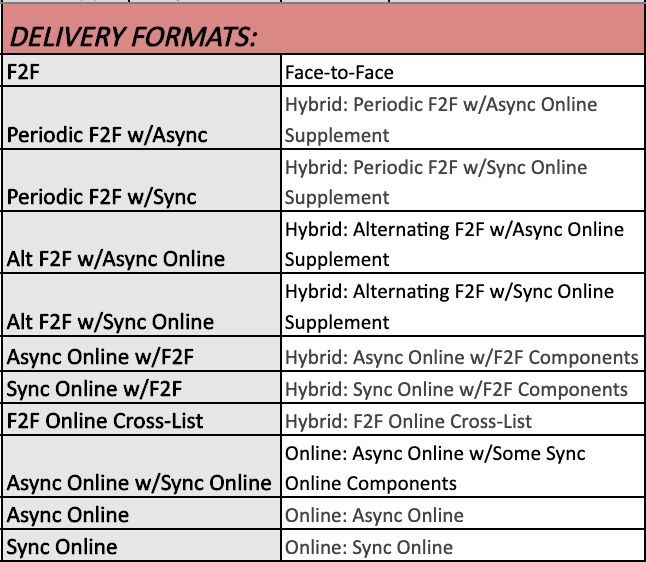
Why is it so hard to define a hybrid class? Or, rather, why is it so hard for colleges to describe it in a course catalog? That was the question that popped into my mind after seeing this chart, tweeted out recently by Kevin McClure, an associate professor of higher education at the University of North Carolina at Wilmington.

A slew of different delivery formats...whew!

But is it really helping anyone to define every possible permutation of “hybrid”? More to the point, what should colleges take into account when trying to balance specificity with clarity in course descriptions?


Legaltech Careers Guide: roles, organisations and routes into legaltech jobs — from lawtomated.com

Excerpt:

This guide includes our most frequent FAQs and advice based on our experiences and those of others working in legaltech, legal ops, and innovation who made the jump from a traditional lawyer role into this space, or who entered the space from outside of legal.


Managing In-Person and Distance Learning at the Same Time — from commonsense.org by Paul Barnwell

Excerpt:

As schools begin to reopen amid the changing pandemic, many classrooms will experience some form of hybrid instruction during the transition back to fully in-person learning. Along the way, schools and districts are embracing a variety of hybrid teaching and learning models. One particular model that can work for both students and teachers is known as hyflex instruction, but to be successful you’ll need to make room for some extra planning and consideration.


It takes a village: The pandemic learning pod movement, one year in — from crpe.org by Alice Opalka, Ashley Jochim, and Joe Lollo

Excerpt:

Since the spring of 2020, learning pods have evolved from a new idea to a significant feature of the pandemic learning landscape. As the pod movement grows in real-time through the current school year and morphs into new models and approaches, the work of learning is moving beyond the four walls of the school building and into communities across the country.

Our database of learning pods—also referred to as learning hubs—now hosts nearly 330 entries of pods organized by institutions with publicly available information from across the country. While this landscape is not a representative sample and is limited by information available on program websites, it offers a snapshot of how learning pods are reshaping education one year into the pandemic.

Our latest analysis shows that community-based organizations and adults beyond the teacher are playing an increased role supporting students and their families through the pandemic.

 
© 2025 | Daniel Christian