How Can Learning Leaders Learn? — from learningsolutionsmag.com by Marjan Bradeško

Excerpt:

You are a learning leader. Leading your team. Responsible for so many things. And you feel your personal growth stagnates. You lack time to learn new concepts, methodologies, tools, learning approaches, all the acronyms … Yet, you want to be a role model, you want to be capable to talk to your team, your customers, your audience. You want to promote learning in the whole organization. You want to become the one who brings new concepts into the company. You want people follow your curiosity. You want them to say: “If the leader learns, why would not I?”

Here are some tips that can help you to learn within your daily work. The tips are grouped into structured (“protected time”) and non-structured (“flexible time”) parts.
 

How One State Managed to Actually Write Rules on Facial Recognition — from nytimes.com by Kashmir Hill
Massachusetts is one of the first states to put legislative guardrails around the use of facial recognition technology in criminal investigations.


Coronavirus has taught Colorado school kids one key lesson: resilience — from coloradosun.com by Erica Breunlin
They have faced continued uncertainty, lost out on sporting events and missed time with friends. Through it all, kids have learned how to cope.

And as much as schooling has been disrupted in the past year, Colorado students have also grasped lessons beyond their years — the kinds of lessons that are often learned best outside the classroom: a sense of resilience, how to deal with disappointment and the ability to navigate waves of uncertainty from week to week. For all the classroom moments they’ve missed since last March, they’ve also gained a set of coping skills to steer them through whatever trying times come after the pandemic.

From DSC:
And perhaps this kind of learning is what our kids will need to survive and thrive in a rapidly-changing world.


Free Resources to Help with Remote Learning in 2021 — from thejournal.com by Dian Schaffhauser

Excerpt:

As the pandemic continues wreaking havoc in education through the current school year, districts, schools, teachers and parents are being more selective about the technology they choose for instructing and engaging students. While hundreds of education companies, nonprofits and other organizations made their software and services free during the immediate switch to remote learning, many have become more thoughtful about how they help educators master online and blended instruction. We’ve winnowed through our original collection and sprinkled additions throughout, to bring you this updated set of free resources to help with remote learning in 2021.


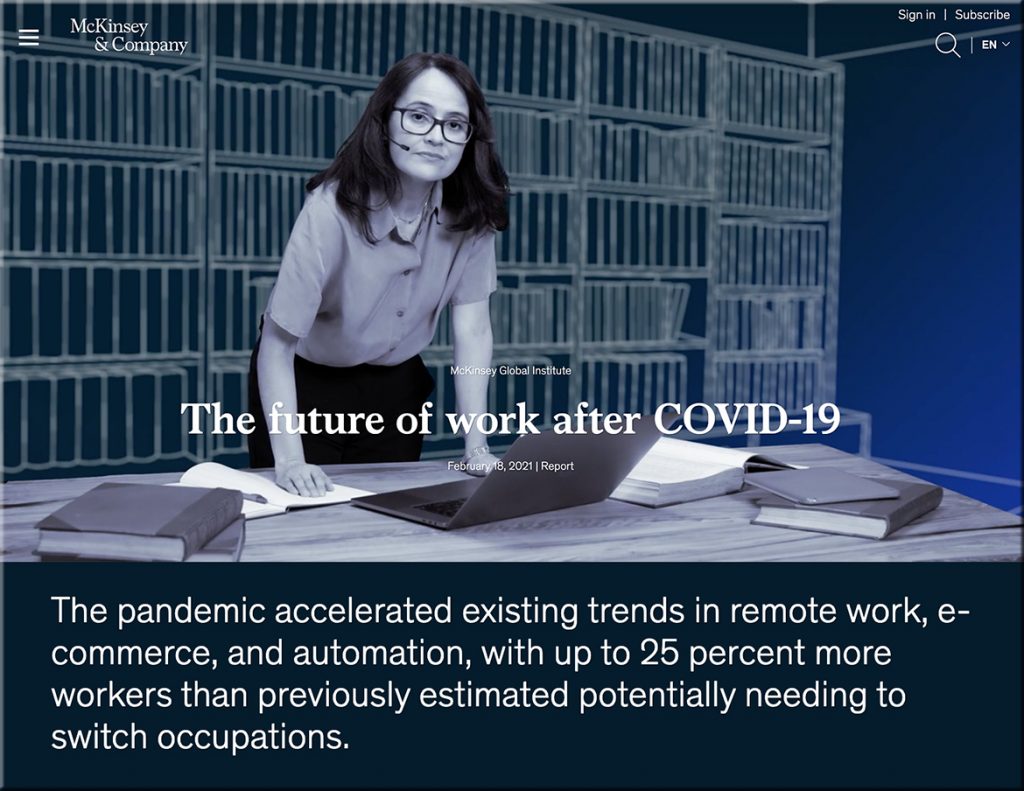
The future of work after COVID-19 -- Woman working on a computer with wireless headset

The future of work after COVID-19 — from mckinsey.com

Excerpts:

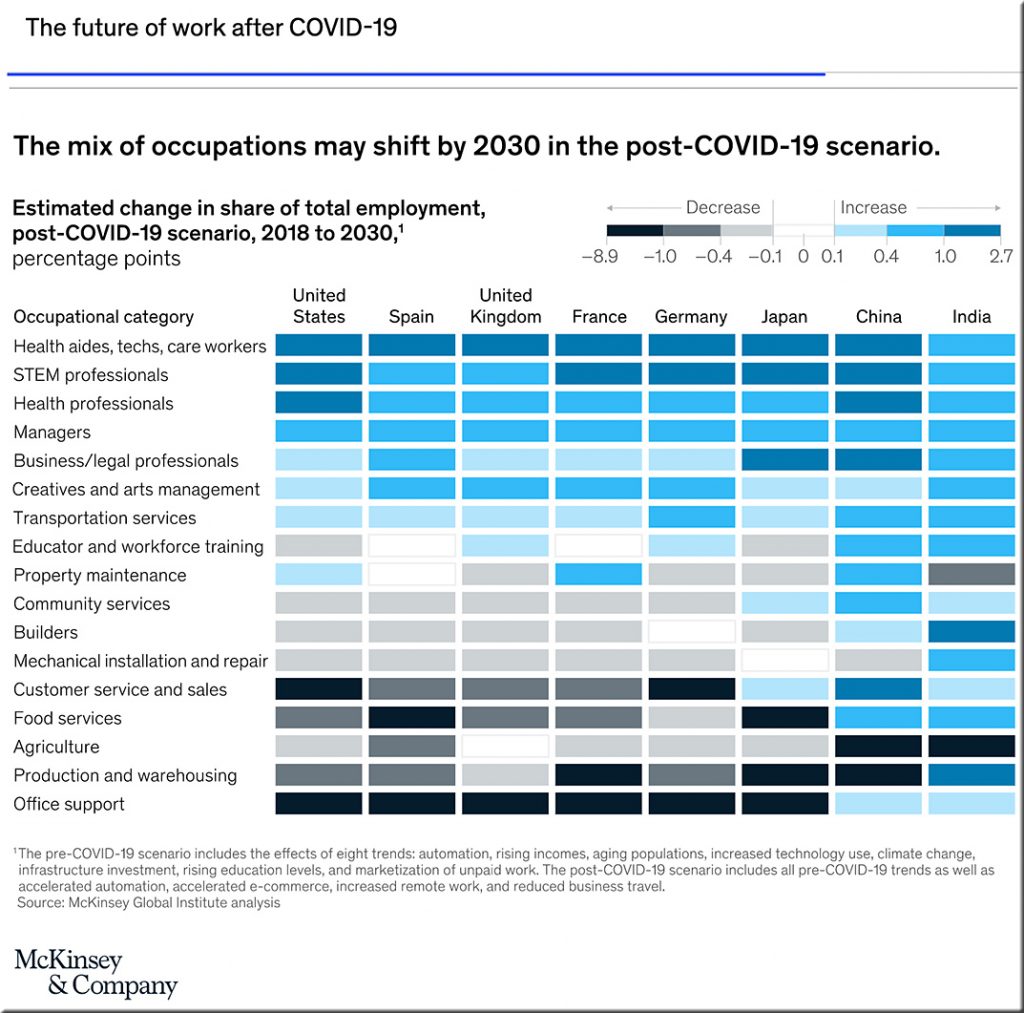
This report on the future of work after COVID-19 is the first of three MGI reports that examine aspects of the postpandemic economy. The others look at the pandemic’s long-term influence on consumption and the potential for a broad recovery led by enhanced productivity and innovation. Here, we assess the lasting impact of the pandemic on labor demand, the mix of occupations, and the workforce skills required in eight countries with diverse economic and labor market models: China, France, Germany, India, Japan, Spain, the United Kingdom, and the United States. Together, these eight countries account for almost half the global population and 62 percent of GDP.

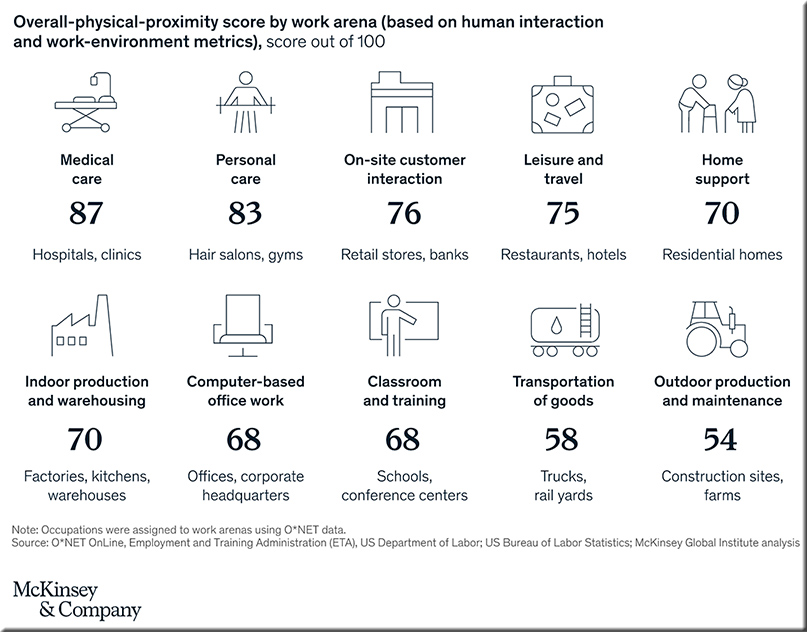
Physical proximity scores of a variety of occupations


Future occupations in 2030 -- increases or decreases


By Putting Tensions on Stage, Colleges Aim to Change Campus Culture — from edsurge.com by Rebecca Koenig

Excerpt:

That’s the creative solution more colleges are turning to as they try to make their cultures more inclusive for people who find themselves marginalized within academia. Programs for applied theater at institutions including University of Michigan, University of New Hampshire, University of Virginia and Florida International University bring to life higher ed troubles and tensions through original sketches, shows and the occasional musical number.

An applied theater sketch is like a pane of glass. For some viewers, it’s a mirror that reflects their personal experiences. For others, it’s a window into the lives of their colleagues and students. And for everyone willing to engage, it’s a magnifying lens that enlarges the details of daily interaction for clearer inspection.

From DSC:
I say we expand this line of thought even more: Here’s another idea/approach to leveraging the talents of Theatre Majors throughout higher education.

A new world of creative, engaging, active learning could open up if those involved with the Theatre Department could work collaboratively with students/faculty members from other disciplines. And in the end, the learning experiences and content developed would be highly engaging — and perhaps even profitable for the institutions themselves!


Also from edsurge.com:

Counting U.S. Postsecondary and Secondary Credentials – 2021 Report — from credentialengine.org

Excerpt (emphasis DSC):

Learners, educators and policymakers understand that high school completion and education beyond high school are critical to thrive in the workforce. However, until recently an inventory of the number or type of secondary and post-secondary credential opportunities in the United States did not exist. This is the third annual report from Credential Engine that attempts to count all these credentials. The report identifies 967,734 unique credentials in the U.S. in 16 detailed credential categories across four types of credential providers…


Asynchronous Video Conversations: 11 Tips and Best Practices — from er.educause.edu by Rob Gibson

Excerpt (first 4 of 11):

1. Closely align video conversations with the stated module, course, and/or program learning objectives. Clearly indicate those alignments in the course outline.

2. Use the syllabus, an introductory course video, or a sample student video recording to prepare students in advance for this type of activity. Since many students will use their smartphones to record, provide information about best practices for creating quality video using a phone.

3. Some students are uncomfortable recording themselves. Depending on the product, consider offering alternatives such as an audio/mic-only mode, a text-only mode, or using a proxy image or avatar in the video.

4. Consider using threaded video conversations for course introductions to build a sense of humanizing the course. Michelle Pacansky-Brock supports the use of video conversations as an alternative to text. In her book How to Humanize Your Online Class with VoiceThread, she indicates that video tools maximize presence, a dimension of online connectivity to fellow students, the faculty, and the content. Research in her own courses found an increase from 25 percent to 75 percent in voluntary voice-video comments.Footnote5 This also helps form common goals and dispositions among students—dispositions are affective learning dimensions, such as motivation, attitude, persistence, empathy, and problem solving.Footnote6


The Future of Higher Ed Viewed from Cape Town, South Africa — from eliterate.us by Michael Feldstein

Excerpt:

A while back, I had the pleasure of being interviewed by friends at the University of Cape Town about the future of higher education as part of a short video they were compiling for their senior leadership. Here’s what they came up with:

The University of Cape Town in South Africa


GPT-3: We’re at the very beginning of a new app ecosystem — from venturebeat.com by Dattaraj Rao

From DSC: NLP=Natural Language Processing (i.e., think voice-driven interfaces/interactivity).

Excerpt:

Despite the hype, questions persist as to whether GPT-3 will be the bedrock upon which an NLP application ecosystem will rest or if newer, stronger NLP models with knock it off its throne. As enterprises begin to imagine and engineer NLP applications, here’s what they should know about GPT-3 and its potential ecosystem.


Isaiah 25:1 — from biblegateway.com

Lord, you are my God;
    I will exalt you and praise your name,
for in perfect faithfulness
    you have done wonderful things,
    things planned long ago.


Student Builds Volumetric 3D TV To Complete Bachelor’s Program — from vrscout.com by Bobby Carlton

In the end, they ended up building a volumetric 3D closed-circuit TV system capable of producing live holographic imager; I’d say that’s pretty noteworthy.

From DSC:
If we can imagine it…

A picture of the Jedi Council from Star Wars

Addendum on 3/12/21:

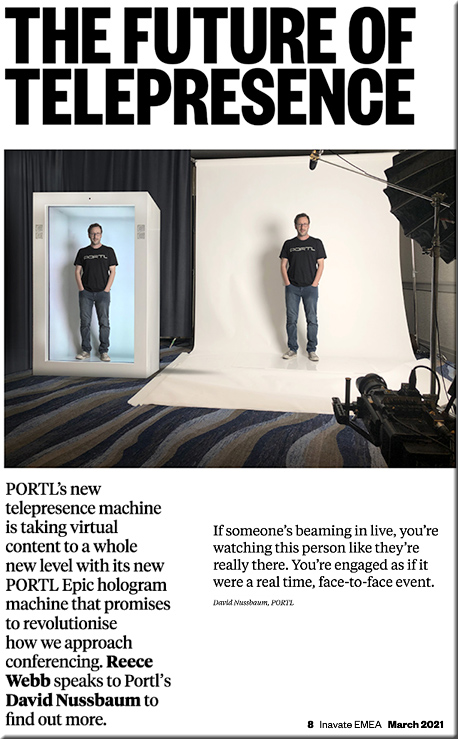
The future of telepresence article out at Inavate EMEA -- March 2021


From DSC:
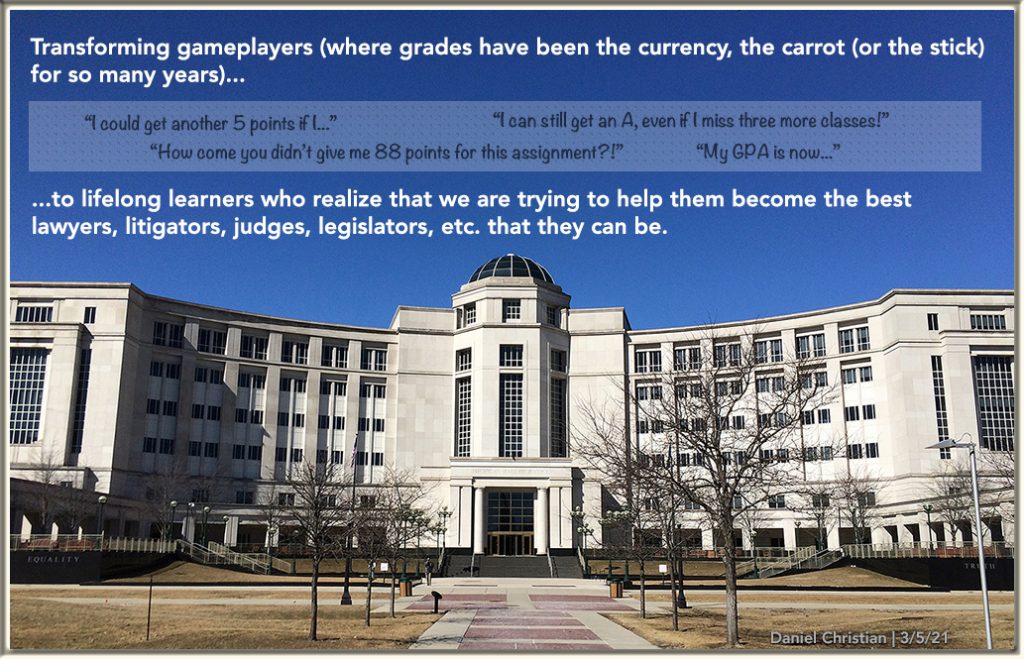
As a follow up to The Chegg situation is worse than you think [Feldstein] (which discussed cheating, buying answers, selling answers, proctoring software, and more), it seems to me that one of the challenges that we face in our teaching and learning efforts has to do with the transformation of our students: Helping them move from a K-16 world to the world of work. The below graphic tries to capture that idea. 

Transforming gameplayers into lifelong learners.

DSC: This is a picture I took of the Michigan Hall of Justice, in Lansing, MI.

What I mean to say is that our learners’ future clients don’t care about our learners’ ability to cram and score high on tests and then forget about topic XYZ. They want our learners to know and be able to apply topic XYZ in order to solve their problems/issues/needs. (Not to mention that being able to cram and do well on a high-stakes test is not nearly as helpful as spacing out their retrieval of topic XYZ over a much longer span of time.)

I hope that our students are hearing/experiencing from us: “We’re on your team. We’re here to help you.” And being transparent with our teaching techniques is key (i.e., here’s WHY I’m assigning this item or asking you to do this activity).


The Top 5 Technologies for Innovation Leaders in Electronics and IT
Digital biomarkers, edge computing, and AI-enabled sensors are among the top technologies transforming the electronics landscape, according to Lux Research

BOSTON, MA, MARCH 4, 2021?– Digital transformation is one of the hottest topics in every industry, and as consumers are eagerly adopting increasing amounts of digital tech, electronics, and IT players have a unique opportunity to impact more industries than ever before. To help guide innovation in this booming space, Lux Research released its annual report, “Foresight 2021: Top Emerging Technologies to Watch.”

Lux’s annual report analyzes the digital transformation space, reviewing what topics emerged and which technologies gained traction during 2020. Its expert analysis of the hottest innovation topics and best tech startups found that the top five technologies electronics and IT innovation leaders should look to in the next decade are:

  1. AI-Enabled Sensors – Merging hardware and software to collect and validate critical data will be a major part of use cases from consumer wearables to medical devices to industrial IoT.
  2. Digital Biomarkers – Using data analytics to detect disease through changes in streams of data analytics is a potent path for electronics companies to grab a piece of the healthcare pie.
  3. Natural Language Processing – Natural language processing (NLP) allows electronics and IT players to extend into new services and industry segments, either by using it to leverage their own data or by providing it as a service.
  4. Edge Computing – Limitations in bandwidth and latency are pushing critical computation away from the cloud and out to the edge, with rapidly improving hardware and software enablers.
  5. Synthetic Data – AI needs vast amounts of training data, and when real data is scarce, synthetic data can be a solution. It also boosts data diversity and privacy.

From DSC:
Some things to keep on your radar…


© 2025 | Daniel Christian