Legal education as a key stakeholder in legal services reform (276) — from legalevolution.org by Dan Rodriguez
To date, this highly influential stakeholder has had very little to say.

Excerpt:

The fierce and fascinating struggle underway in the American states over legal services reform brings to the table a large collection of interest groups.  These groups include law firms, legal aid organizations, entrepreneurs who might benefit financially from the liberalization of entry rules, and of course the gatekeeper entities, including state bar authorities and the state supreme courts, whose decisions are crucial to the evolution and shape of reform.  See Posts 239 (beginning of a four-part series on serious challenges of bar federalism).

The identity of these specific groups may differ from state to state, as the legal ecosystem has contours often tailored to a particular state’s history and objectives, but the configuration of stakeholders has some rather common elements.

What remains somewhat opaque in this robust and interconnected battle over the reform of legal services is the voice of legal educators and the law schools.  These are, after all, the places in which future lawyers are educated and professional values are instilled.  It is had to imagine a more fertile and opportune time to discuss the ambitions and philosophies of this next generation of legal professionals.


IAALS’ Comment to the Michigan Supreme Court on Virtual Proceedings and Lessons Learned from the Pandemic — from legaltechmonitor.com by Broke Meyer and Natalie Anne Knowlton

Excerpt:

IAALS, a nonpartisan, non-profit research organization, looks at ways to improve the legal system, specifically in the areas of civil justice, family justice, the judiciary, legal education, and the legal profession. IAALS has been monitoring court practices around the country as it relates to policies around virtual proceedings. As part of our Paths to Justice Summit Series, IAALS has held several virtual convenings with a diverse group of experts and stakeholders across the justice systems. From those convenings, IAALS published two issue papers, “Learning from this Nationwide Pilot Project—Reducing the Costs and Delays of Civil Litigation” and “Learning from this Nationwide Pilot Project—Ensuring Access to Justice in High-Volume Cases.” Both papers focus on lessons learned, upcoming challenges, and areas for further research. In this spirit, we hope to provide a broad perspective on the importance of retaining some of the virtual proceeding processes put in place during the pandemic.

After many years of urging reform in these cases, we have witnessed incredible innovation and adaptability in the Michigan court system during a crisis. IAALS and other leaders in civil justice reform have urged many of these reforms—such as remote hearings—for years, and we have now seen these innovations happen on the ground. Michigan should capitalize on the unique opportunity to evaluate and learn from these changes to improve access to justice.


The Benefits of Online Learning Are Also Its Weaknesses. That’s Where Advisors Help. — from edsurge.com by Janet Morrison

Excerpt:

While asynchronous online learning works well for many students, it is not without its challenges, and those can be the very same attributes that make it attractive—that’s the paradox of online learning. Students who are balancing multiple responsibilities of jobs, children or aging parents are generally attracted to the anytime/anyplace virtue of online courses, but they may also need the most help in managing all of these things.

Let’s examine the characteristics of online education and how they both enable and constrain learning, plus consider tips for how advisors can help students resolve these tensions.


Over 60,000 Fake Applications Submitted in Student Aid Scheme, California Says — from nytimes.com from Vimal Patel
It was unclear how much money, if any, was disbursed to the suspicious students. The federal Education Department said it was investigating the suspected fraud.

Excerpt:

According to Mr. Perry, fraud of this nature is easier to pull off at community colleges than at four-year institutions, because the two-year institutions don’t have admissions committees vetting applicants. And while colleges have had some fully virtual components for many years, the pandemic — which forced many colleges to operate entirely online — has provided the conditions for such schemes to flourish. “Somebody trying to perpetuate this would think this was a more likely time to try to get away with this,” Mr. Perry said.

He added that the next step for federal investigators should be to determine how widespread this conduct is and whether colleges elsewhere should be on the lookout.


Why Aren’t Professors Taught to Teach? — from techlearning.com by Erik Ofgang
Professors are experts in their subject matters but many have limited training in actually teaching their students.

Excerpt:

“A lot of faculty are just modeling their instruction after the instruction they’ve received as an undergraduate or graduate student,” says Tanya Joosten, senior scientist and director of digital learning at University of Wisconsin-Milwaukee and the lead of the National Research Center for Distance Education and Technological Advancements.

As a perpetually short-on-time adjunct professor, I understand those who worry about mandatory training and required course reviews, but Pelletier stresses that she’s advocating for a more organic shift and that a top-down approach isn’t best. “That’s not as collaborative and generative as really just embracing that we have these two different kinds of experts, one type of expert is an expert in their subject, and the other expert is an expert in teaching and learning,” she says. More attention is needed to meld these two kinds of expertise. 

From DSC:
It’s not just that colleges and universities are big business — if you have any remaining doubts about that perspective, take a moment to look at this new, interactive database to see what I mean. But it’s also that this type of business often rewards research, not teaching. And yet the students over the last several decades have continued to pay ever-increasing prices for skilled researchers, instead of increasingly skilled teachers. 

Healthcare and higher education face similar challenges and transformations -- costs continue to soar

Image from Inside Higher Ed


Would people put up with this with other types of purchases? I don’t think so. I wouldn’t want to…would you?  Would we like to pay for something that we aren’t getting — like paying for all the extra options on a new car, but not getting them?

What goes around, comes around.
But by allowing this to have occurred, a backlash against the value of higher education has been building for years now. In many learners’ minds, they are questioning whether it’s worth taking on (potentially) decades’ worth of debt. At a minimum, the higher the price of obtaining degrees and/or other credentials becomes, the less Return on Investment (ROI) is realized by the learners (i.e., the purchasers of these goods and services). So while getting a degree is often still worth it, the ROI is going down.
And this doesn’t address how relevant/up-to-date the educations are that these learners are receiving, which the employers out there will take issue with.

From an Instructional Designer’s perspective, it isn’t just time that’s the issue here. There continues to exist a tiered hierarchy within higher education. Faculty see themselves as more knowledgeable because they are teaching and because they are the Subject Matter Experts (SMEs). But they are not expert teachers. Many full-time faculty members don’t listen to people who are knowledgeable in the learning science world, and they often don’t value that expertise. (This can be true of administrators as well.) But when a fellow faculty member (i.e., their “true peer” from their perspective) suggests the same idea that Instructional Designers have been recommending for years, they suddenly open their eyes and ears to see and hear this seemingly new, wonderful approach.

Some possible scenarios
Thus, a wave has been building against traditional institutions of higher education — readers of this blog will have picked up on this years ago. Once alternatives significantly hit the radar — ones that get the learners solid, good-paying jobs — there could be a mass exodus out of what we think of as traditional higher education. At least that’s one potential scenario.

For example, if a next-generation learning platform comes along that offers teams and individuals the ability to deliver lifelong learning at 50% or more off the price of an average degree, then be on the lookout for massive change. If professors and/or teams of specialists — those who are skilled in instructional design and teaching —  can go directly to their learners — it could be an interesting world indeed. (Outschool is like this, by the way.) In that scenario, below are two potential methods of providing what accreditation agencies used to provide:

  • Obtaining the skills and competencies being requested from the workplace to “pass the tests” (whatever those assessments turn out to be)
  • Voting a course up or down (i.e., providing crowd-sourced rating systems)

Other possible scenarios
Another scenario is that traditional institutions of higher education really kick their innovation efforts into high gear. They reward teaching. They develop less expensive methods of obtaining degrees. They truly begin delivering more cost-effective means of obtaining lifelong learning and development “channels” for educating people.

And there are other possible scenarios, some of which I could think of and many I would likely miss. But to even ask the solid and highly-relevant question as plainly stated in the article above — Why Aren’t Professors Taught to Teach? — that is something that must be dealt with. Those organizations that use a team-based approach are likely to be able to better answer and address that question.


EPISODE 91: THE INNOVATION4JUSTICE LAB – CREATING CHANGE THROUGH LEGAL EDUCATION AND MULTIDISCIPLINARY COLLABORATION — from https://www.cli.collaw.com/

We often think about legal innovation and legal education as being separate and distinct but, what if they weren’t? What if students, not just law students, could pursue their passion for change in a way that led to more people, in more places, having access to justice?

That’s the question that the Innovation4Justice (I4J) Lab asked and is answering today.


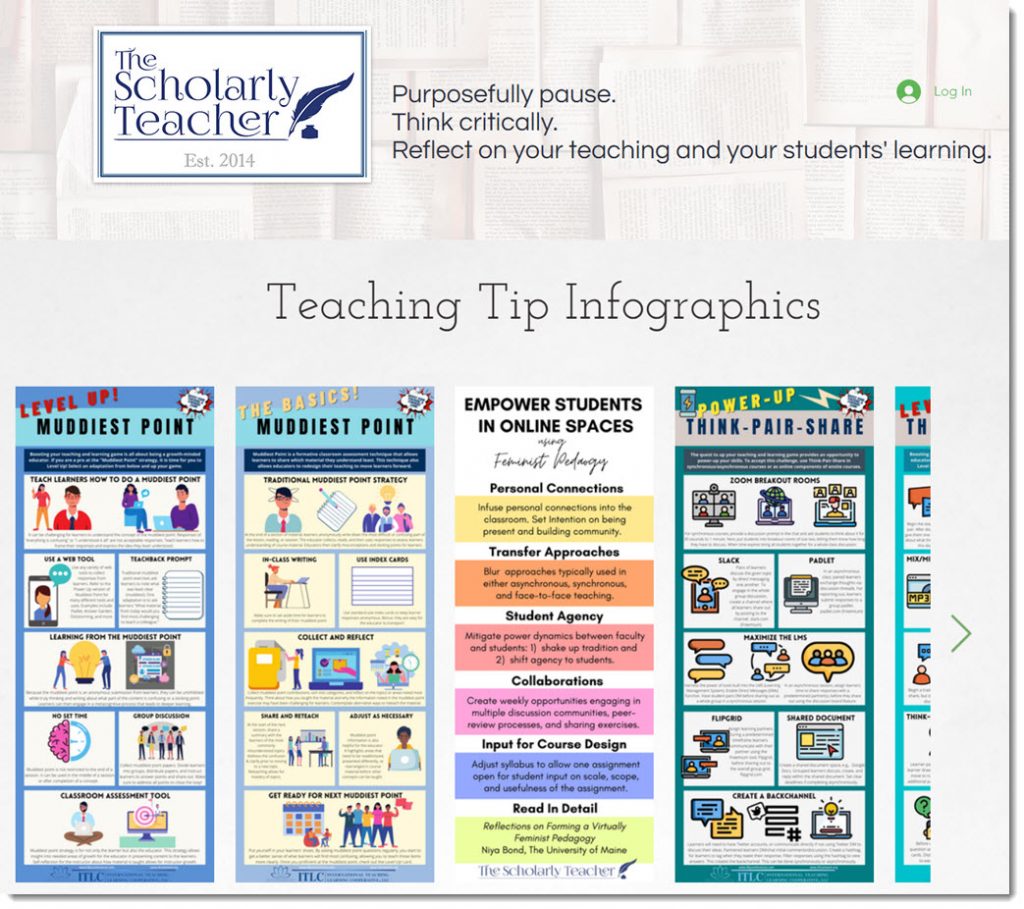
Teaching Tip Infographics — from scholarlyteacher.com


Autumn Pumpkin Spice Latte –from Tatiana Goskova out at 500px.com

Autumn Pumpkin Spice Latte --from Tatiana Goskova out at 500px.com

The Old Barn in Frost and Fire — by Jørn Allan Pedersen out at 500px.com

The Old Barn in Frost and Fire -- by Jørn Allan Pedersen out at 500px.com


Some Pods Will Outlast the Pandemic  — from educationnext.org by Michael Horn
Students, parents say they appreciate the support

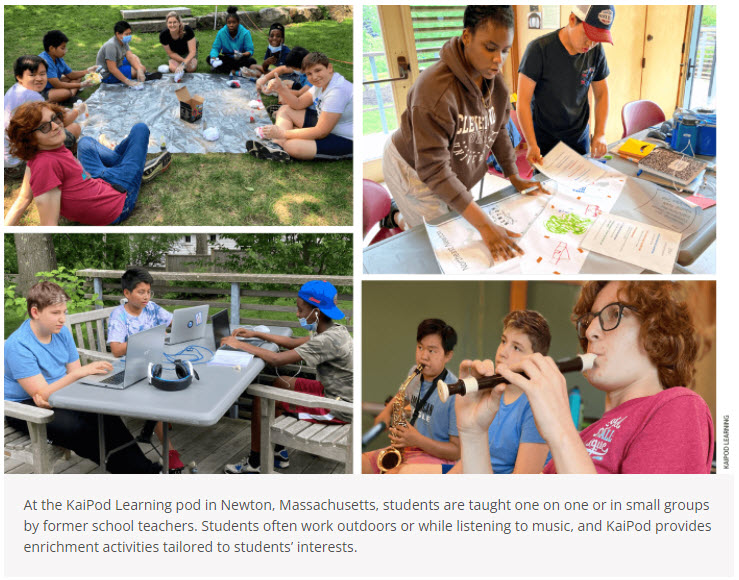
At the KaiPod Learning pod in Newton, Massachusetts, students are taught one on one or in small groups by former school teachers.

And yet many pods that have an institutional structure behind them, rather than being fully parent-run, have survived. They are finding their niches and growing. Despite fears that pods would benefit only people in prosperous suburbs such as Newton, some of the most robust pod experiments have taken place in school districts disproportionately serving low-income and minority students.


3 Tips for Making Passion-Based Learning Work Successfully — from thejournal.com by Dennis Pierce

Excerpt:

Passion-based learning, a form of self-directed learning in which students pursue projects of interest to them, is becoming more popular in schools — and for good reason: Educators who have set aside time for passion-based learning have discovered that students become highly engaged and motivated when learning about topics that intrigue them, while taking their learning much deeper than they would in a traditional lesson.


Timnit Gebru Says Artificial Intelligence Needs to Slow Down — from wired.com by Max Levy
The AI researcher, who left Google last year, says the incentives around AI research are all wrong.

Excerpt:

ARTIFICIAL INTELLIGENCE RESEARCHERS are facing a problem of accountability: How do you try to ensure decisions are responsible when the decision maker is not a responsible person, but rather an algorithm? Right now, only a handful of people and organizations have the power—and resources—to automate decision-making.

Since leaving Google, Gebru has been developing an independent research institute to show a new model for responsible and ethical AI research. The institute aims to answer similar questions as her Ethical AI team, without fraught incentives of private, federal, or academic research—and without ties to corporations or the Department of Defense.

“Our goal is not to make Google more money; it’s not to help the Defense Department figure out how to kill more people more efficiently,” she said.

From DSC:
What does our society need to do to respond to this exponential pace of technological change? And where is the legal realm here?

Speaking of the pace of change…the following quote from The Future Direction And Vision For AI (from marktechpost.com by Imtiaz Adam) speaks to massive changes in this decade as well:

The next generation will feature 5G alongside AI and will lead to a new generation of Tech superstars in addition to some of the existing ones.

In future the variety, volume and velocity of data is likely to substantially increase as we move to the era of 5G and devices at the Edge of the network. The author argues that our experience of development with AI and the arrival of 3G followed by 4G networks will be dramatically overshadowed with the arrival of AI meets 5G and the IoT leading to the rise of the AIoT where the Edge of the network will become key for product and service innovation and business growth.

Also related/see:


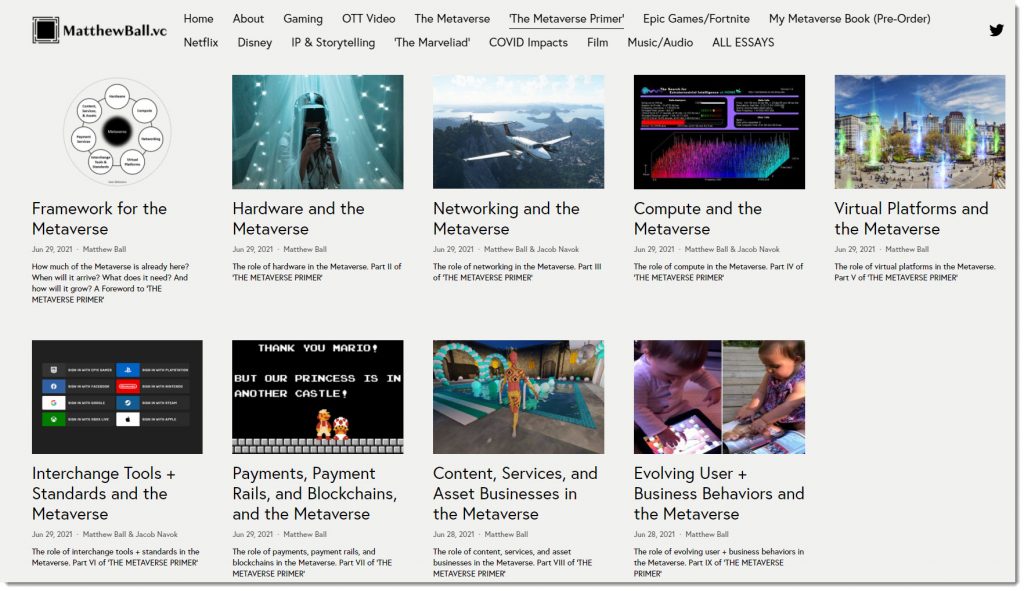
Also see Matthew Ball’s Metaverse Primer (excerpt below from this page) — with thanks to Annie Zhang for this resource:


“The Metaverse is a massively scaled and interoperable network of real-time rendered 3D virtual worlds which can be experienced synchronously and persistently by an effectively unlimited number of users with an individual sense of presence, and with continuity of data, such as identity, history, entitlements, objects, communications, and payments.”


Jacob Navok: Computing and Network Needs of the Metaverse — from hellometaverse.fm by Annie Zhang

Excerpt:

to progress towards this vision of the metaverse, jacob is focused on tackling the hard problem of improving concurrency. how do you get millions of people to concurrently be participating and interacting in one live experience with no lag? 

he breaks this down the problem into two components:

  1. limitations of the traditional network to handle multiplayer experiences: coordinating, say, positional data of where you and all the other players in a game, gets very complicated, especially when latency needs to be low. meaning, if you want to see everything that everyone is doing at all times, coordinating the traffic of that data is very difficult

  2. with more connection, internet speed slows: the internet was not built for true real time communication, but rather optimized for cost and routing efficiency. when you load a fb page, it’s okay if it takes 10 milliseconds, but when you are in a shooting game, a delay of 10 milliseconds is a matter of life or death


Everything You Need To Know About The Metaverse — from protocol.com by Janko Roettgers

Excerpt:

Silicon Valley has a new favorite buzzword: Ever since Mark Zuckerberg announced earlier this year that Facebook’s future would be in the metaverse, everyone has been rushing to figure out what a metaverse even is. And when Facebook rebranded as Meta in October, metaverse fever swept the tech industry. From Microsoft to Nvidia, every company is suddenly in the metaverse business, and seemingly overnight, countless people became metaverse experts.

But what actually is the metaverse? Why does it matter, and who needs to worry about it? If the metaverse is truly “the next chapter for the internet,” as Zuckerberg put it, it’s important to understand and define it so as not to be caught flat-footed when (or if) the metaverse wave catches on.


How to Support Students and Families through Technology and Innovation — from thejournal.com by Jeremy Davis

Excerpt:

Here are just a few district-wide innovations that resulted from the pandemic:

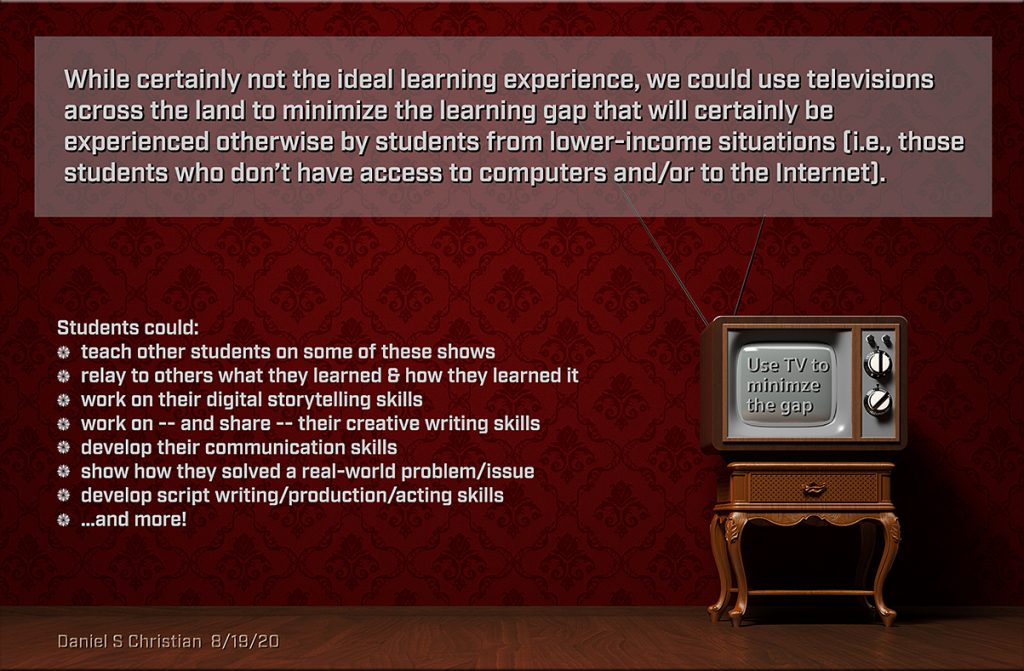
  • Worked with our local public access television station to broadcast district updates and educational resources. We contracted with Discovery Education to post some of their content to local channel 3 for students without home Internet access, and we built a television studio where our Innovation team worked with district teachers to produce content for local cable from 8–3 every week day.

DC: Which reminds me of this idea/graphic:

  • Students were provided with Internet hotspots to ensure every student in the district could access the content and the video conferencing lessons with their teachers.
  • The Educational Services department created an amazing curriculum and summer school program where students could log in and complete curricular activities as enhancements to the curriculum and throughout the summer.
  • Created videos of “how” we could do both live and online teaching at the same time to help teachers feel more comfortable with the new way of teaching.
 
© 2025 | Daniel Christian