Want Students Who Think for Themselves? Let’s Eliminate Our Standardized School System — from edsurge.com by Zachary Morita

Excerpt:

It is a wake-up call when a student feels defeated by an educational system that focuses on standardizing students who feel like they are “the problem.” We can’t expect students to understand the purpose of education on their own. They need educators, leaders and supporters to guide them to create the education system they deserve to succeed in life. I stand by what I share with all of my students: that we must reimagine and redesign our education system so that students are NOT the problem.

Instead, we must ensure that learners are intrinsically motivated through learning activities that are challenging, purposeful, relevant and empowering.
 

Students Co-authoring Their Own Learning — from gettingsmart.com by Tom Vander Ark

Key Points

  • By inviting learners to co-author learning experiences, journeys and records, we help them build the most important skills and dispositions they’ll need to succeed in a changing world.
  • Helping learners weave together learner-chosen and co-authored experiences into coherent pathways is the new learning design challenge.
 

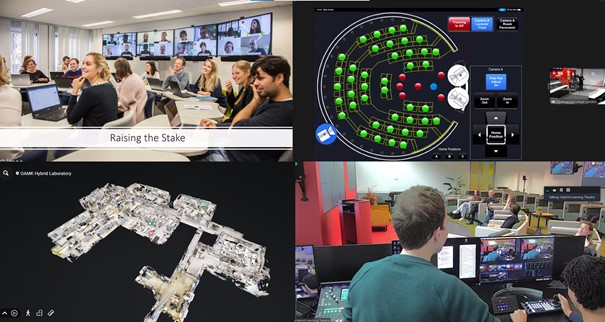
Picturesof learning spaces at KU Leuven, Imperial College London, University of Amsterdam, Oulu University of Applied Sciences, Finland

Clockwise from top left (KU Leuven, Imperial College London, University of Amsterdam,
Oulu University of Applied Sciences, Finland

.

A virtual tour of four advanced hybrid learning spaces — from zacwoolfitt.blogspot.com by Zac Woolfitt

Excerpt:

What are the next developments in the Hybrid Virtual Classroom? What kind of spaces might we be teaching in soon?

On March 16th we glimpsed the future. Colleagues from 4 higher education institutes gave virtual tours of their technology rich learning spaces in Belgium, England, Finland and the Netherlands. Media and Learning arranged the session [i]. (Disclosure: Zac is on their advisory panel of Media and Learning).

From DSC:
Here in the U.S., some would promote the use of the word “Hyflex” here instead of hybrid or blended learning — as it sounds like they are simultaneously teaching students in a physical classroom along with online-based learners.


Contrasting Cases: A Simple Strategy for Deep Understanding — from cultofpedagogy.com by Sarah Levine

Excerpt:

Contrasting cases is a valuable tool for any cognitive work—in any subject area—that involves going beyond surface traits and considering deeper connecting principles, or reflecting on specific features of a thing.

In my field of study, literary interpretation, using contrasting cases is especially useful to help students enrich their reading experiences and build interpretations of many kinds of texts, including fiction, poetry, or political speech. But you can use this approach in any subject where you’re studying rhetorically powerful texts, like advertisements, headlines, art, primary historical documents, and film.


What is ADA Website Accessibility? — from boia.org

Excerpt:

If you’re confused about ADA website compliance, you’re not alone. According to a 2021 report from non-profit organization WebAIM (Web Accessibility In Mind), 97.4% of the top one million home pages on the internet have detectable accessibility issues — and many of those issues could be interpreted as violations of the Americans with Disabilities Act (ADA).

Under the ADA, businesses and public agencies must provide reasonable accommodations to persons with disabilities in “places of public accommodation.” That certainly applies to websites, as the Department of Justice has repeatedly confirmed.

Addendum on 3/28/22:


What Colleges and Job-Training Programs Can Learn From Teenagers’ Hopes and Fears — from edsurge.com by Rebecca Koenig

Excerpts:

American teenagers don’t all have money, connections or other advantages. But they all have dreams.

Some adolescents are encouraged to follow their dreams. Others grow up hearing that their aspirations are a luxury—nice to have, but hard to afford.
..
The adolescent brain is wired for passion, purpose and experimentation. This drives young people to seek pathways to vocation, not shortcuts to work.

But young people want more than good livelihoods. They want good lives.


Best Deaf Awareness Lessons & Activities — from techlearning.com by Diana Restifo
The following free deaf history and awareness lessons and activities highlight the accomplishments of deaf people in the arts, education, sports, law, science, and music.


The art of writing funding applications — from itsnicethat.comby Isra Al Kassi
Applying for funding is a skill with its own unique processes and vocabulary that many find insurmountable. But fear no more: TAPE Collective’s Isra Al Kassi is here to offer her tips for navigating that tricky terrain in a way that works for you.

Excerpt:

With more and more creatives breaking free from institutions and traditional employment there is a greater demand than ever to secure funding to turn a passion project into a sustainable endeavour. Whether tripping over the language used, or being overwhelmed with the sheer information asked for, applying for funding is rarely a straightforward process and comes with barriers which has creatives losing hope at ever having the resources to attempt an application.

It’s true what they say: writing funding applications is a skill. There’s a procedure and language in place which you, unfortunately, have to learn and use but that’s not to say that your passion, and urgency shouldn’t seep through those very words. Ultimately there is a need for your project to exist, and a need for it to be funded: express that clearly.


Tinkerhunts — from engagetheirminds.com by Terri Eichholz

Excerpt:

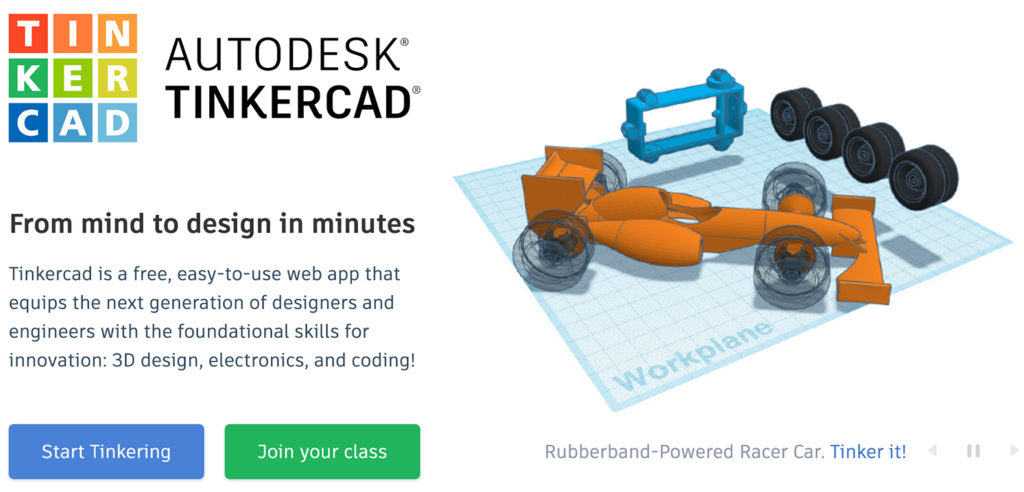
For anyone new to 3d design, Tinkercad is the perfect entry level program. It’s free, web-based, and contains lots of tutorials. As a teacher, you can create classes and assign projects that you can oversee through a dashboard. I’ve used it with students from 2nd grade through 12th, so it’s quite a versatile tool.

That’s why I think these Tinkerhunts from HL Modtech (Mike Harmon, @HLTinkercad) are pretty genius. In the first one, he gives kudos to his student, Kingston, who first gave him the idea for these three-dimensional virtual scavenger hunts.

Also see:

Tinkercad is a free, easy-to-use web app that equips the next generation of designers and engineers with the foundational skills for innovation: 3D design, electronics, and coding!


The 20 best dyslexia resources for homeschoolers — from raisinglifelonglearners.com Colleen Kessler

Excerpt:

Homeschooling a child with dyslexia can be a challenge, especially when you are struggling to find resources. I believe homeschooling is the best possible educational choice for your dyslexic child. You just need to right education and support. These are 20 of the best dyslexia resources out there for homeschoolers.

Also relevant/see:


A skier going off a cliff

Will Your College Survive the Demographic Cliff? — from chronicle.com by Jon Boeckenstedt
National trends are interesting — but enrolling students is a local challenge.

Excerpts:

We are at a critical moment: Declining enrollment even in one sector (say, community colleges) is troublesome because of downstream effects. Declining revenue and wavering state support, coupled with fewer high-school graduates, fewer families that don’t need financial help, and an increasingly negative attitude from the public toward higher education, may take us to a long-rumored tipping point.

If it’s true that all politics is local, then in some sense so is (almost) all college enrollment.


Some announcements from NVIDIA today:


Nvidia unveils server CPU to challenge Intel and AMD in the data center — from protocol.com by Max A. Cherney
Nvidia’s CEO Jensen Huang announced the company’s next-generation GPU architecture and a new CPU Tuesday.

The new Grace processor is designed for AI, high-performance computing and hyperscale data center applications.

Nvidia launched a mapping product for the autonomous vehicle industry — from techcrunch.com by Rebecca Bellan

Nvidia has launched a new mapping platform that will provide the autonomous vehicle industry with ground truth mapping coverage of over 300,000 miles of roadway in North America, Europe and Asia by 2024, founder and CEO Jensen Huang said at the company’s GTC event on Tuesday.

NVIDIA Launches AI Computing Platform for Medical Devices — from hitconsultant.net by Jasmine Pennic

Nvidia Unveils AI Chips and Software, Plus Tools for Creating Virtual Worlds — by Eric Savitz and Conor Smith

Excerpt:

Nvidia is doubling down on artificial-intelligence  technology that CEO Jensen Huang predicts will revolutionize every industry.

In the keynote speech for the annual Nvidia GTC conference—the acronym once stood for GPU Technology Conference, a reference to the company’s roots in graphics processing chips—Huang focused specifically on expanding the company’s portfolio of AI-focused chips and software applications.

Nvidia CEO lays out plans after Arm deal fell through, reveals new Hopper GPU — from marketwatch.com by Jeremy C. Owens
Roadmap seems little changed after chip maker ditched $40 billion acquisition of designer Arm, with new GPUs and first server CPU still on track as EV makers sign on for autonomous-driving tech


Addendum 3/26/22:

Nvidia’s Clara Holoscan MGX means to bring high-powered AI to the doctor’s office — from techcrunch.com


Addendum 3/28/22:

Nvidia’s $1 trillion ambitions draw cheers as software becomes a bigger piece of the pie — from marketwatch.com


World Maths Day -- March 23, 2022

Below are some excerpts from the information that Amanda Donnelly recently sent to me:

World Math Day takes place every year on March 23. It’s an annual global holiday where students are encouraged to solve mental math problems, find uses of math in their everyday lives, and utilize online games and platforms to enhance their skill sets in the subject.

Brainly, the largest online homework help community, has firsthand insight into the average American child’s relationship with math. Despite the love/hate relationship many people seem to have with the subject, according to a survey of 900 American students conducted by Brainly, math ranks #1 in students’ favorite subjects:

When asked to select their favorite subject in school, students answered:

  • Math (26.4%)
  • Science (20.3%)
  • English (20.1%)
  • Social Studies or History (18%)
  • Other (15.2%)


Over the last year, 1.3 million math answers have been shared on Brainly US, and 41% of answers shared so far this year are math. To address these questions, Brainly created Math Solver, an online feature focused specifically on providing step-by-step solutions to complex math problems.


Brainly Introduces Math Solver Providing Access to 24/7 Math Help — from the Brainly Insights Team with a special thanks to Amanda Donnelly for this information and these resources


© 2025 | Daniel Christian