Experts discuss gender diversity in the technology industry — from technative.io

Excerpt:

The International Day of Women and Girls in Science presents an opportunity for organisations in the technology industry to reflect on their efforts to correct gender imbalances

Fortunately, the industry does seem to be starting to move in the right direction. ONS statistics from last year reveal that the number of women working in technology has continued to increase, with 31% of UK tech jobs now held by women. While the industry is not there yet, it is starting to show signs of improvement.

With that in mind, a host of tech experts have shared their thoughts on the importance of encouraging young females to pursue STEM subjects in school, and some of the stereotypes that need to be banished in the sector:


One District’s Ongoing Hybrid Success — from by Erik Ofgang
Early in the pandemic, Kyle Berger, chief technology officer for Grapevine-Colleyville Independent School District, installed cameras in every classroom for hybrid learning. Those cameras continue to be used in innovative ways.

Excerpt:

In the meantime, the cameras continue to be utilized in a variety of ways, including:

  • For students who are out of school with COVID or for other medical reasons to keep participating in class.
  • To allow a teacher to quickly record an explanation or lesson so students can access it later. “The way they’re mounted on the ceiling, the teachers started taking that to a different level because you could reach up to the webcam if you wanted to and you could turn it to point down, and now in a sense, it’s a document camera,” Berger says.
  • To help with the substitute teacher shortage. “We can bridge two classrooms together through our video solutions, and maybe just have an instructional aide in the second classroom,” Berger says.
  • To allow educators to engage in professional development by watching videos of their own lectures and lessons.

“It’s really allowed us a lot more flexibility to continue to navigate the ever-changing environment and education right now,” Berger says.

From DSC:
I’d probably use the word hyflex here instead of the word hybrid…but you get the point. I would also assert that for the following relevant article as well:


Among Students, Lawyers Get a Good Rap — from insidehighered.com by Emma Whitford
Students are applying to law school in droves, spurred by the COVID-19 pandemic, the quest for racial justice and a hot job market. One Florida university is even opening a new law school.

“All the events that we’ve had—the pandemic, the Jan. 6 Capitol insurgence, the Black Lives Matter movement, the murder of George Floyd—everything has put a spotlight on why law matters,” said Kellye Testy, president and chief executive officer of the Law School Admission Council. “It’s galvanized in young people a desire to pursue justice and to find a way to contribute and to make a difference positively in the world. Law is always seen as a really good pathway for that.”


Reflections on “Do We Really Want Academic Permanent Records to Live Forever on Blockchain?” [Bohnke]

From DSC:
Christin Bohnke raises a great and timely question out at edsurge.com in her article entitled:
Do We Really Want Academic Permanent Records to Live Forever on Blockchain?

Christin does a wonderful job of addressing the possibilities — but also the challenges — of using blockchain for educational/learning-related applications. She makes a great point that the time to look at this carefully is now:

Yet as much as unchangeable education records offer new chances, they also create new challenges. Setting personal and academic information in stone may actually counter the mission of education to help people evolve over time. The time to assess the benefits and drawbacks of blockchain technology is right now, before adoption in schools and universities is widespread.

As Christin mentions, blockchain technology can be used to store more than formal certification data. It could also store such informal certification data such as “research experience, individual projects and skills, mentoring or online learning.”

The keeping of extensive records via blockchain certainly raises numerous questions. Below are a few that come to my mind:

  • Will this type of record-keeping help or hurt in terms of career development and moving to a different job?
  • Will — or should — CMS/LMS vendors enable this type of feature/service in their products?
  • Should credentials from the following sources be considered relevant?
    • Microlearning-based streams of content
    • Data from open courseware/courses
    • Learning that we do via our Personal Learning Networks (PLNs) and social networks
    • Learning that we get from alternatives such as bootcamps, coding schools, etc.
  • Will the keeping of records impact the enjoyment of learning — or vice versa? Or will it depend upon the person?
  • Will there be more choice, more control — or less so?
  • To what (granular) level of competency-based education should we go? Or from project-based learning?
  • Could instructional designers access learners’ profiles to provide more personalized learning experiences?
  • …and I’m certain there are more questions than these.

All that said…

To me, the answers to these questions — and likely other questions as well — lie in:

  1. Giving a person a chance to learn, practice, and then demonstrate the required skills (regardless of the data the potential employer has access to)
    .
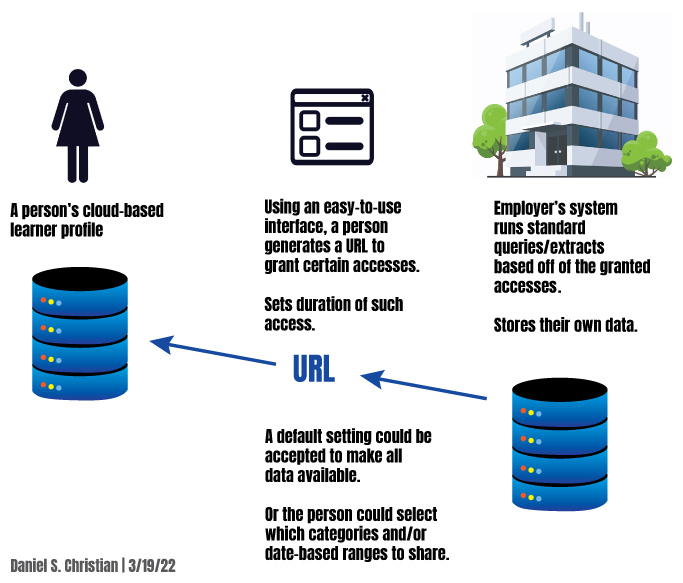
  2. Giving each user the right to own their own data — and to release it as they see fit. Each person should have the capability of managing their own information/data without having to have the skills of a software engineer or a database administrator. When something is written to a blockchain, there would be a field for who owns — and can administer — the data.

In the case of finding a good fit/job, a person could use a standardized interface to generate a URL that is sent out to a potential employer. That URL would be good for X days. The URL gives the potential employer the right to access whatever data has been made available to them. It could be full access, in which case the employer is able to run their own queries/searches on the data. Or the learner could restrict the potential employer’s reach to a more limited subset of data.

Visually, speaking:


Each learner can say who can access what data from their learner's profile


I still have a lot more thinking to do about this, but that’s where I’m at as of today. Have a good one all!


The Conversation: Twitter Trends 2022 -- from marketing.twitter.com

The Conversation: Twitter Trends 2022 — from marketing.twitter.com

Excerpt:

Billions of Tweets reveal tomorrow’s big movements. 

The biggest movements start quietly. An idea becomes conversation becomes a seismic cultural shift. And if you want in on what’s next, listen to what people on Twitter are saying right now. 

To help you out, we analyzed1 billions of Tweets over a two-year period to find three must-know trends about to go big. From The Great Restoration to Fan-Built Worlds to Finance Goes Social, the talk on Twitter reveals the underlying shifts in power shaping where the world is going. 


<blockquote class=”twitter-tweet”><p lang=”en” dir=”ltr”>Questions that provoke critical thinking: <a href=”https://t.co/AgSkJbOXO7″>https://t.co/AgSkJbOXO7</a> <a href=”https://twitter.com/hashtag/instructionaldesign?src=hash&amp;ref_src=twsrc%5Etfw”>#instructionaldesign</a> <a href=”https://twitter.com/hashtag/instructionaldesigners?src=hash&amp;ref_src=twsrc%5Etfw”>#instructionaldesigners</a></p>&mdash; Instructional Design Lady (@instructlady) <a href=”https://twitter.com/instructlady/status/1504664266661679104?ref_src=twsrc%5Etfw”>March 18, 2022</a></blockquote> <script async src=”https://platform.twitter.com/widgets.js” charset=”utf-8″></script>


Google Invites Classroom Users to Join Beta for ‘Practice Sets,’ with Auto-Grading, Instant Student Feedback, and More — from thejournal.com by Kristal Kuykendall

Excerpt:

“With Practice Sets, educators can easily transform their own teaching content into interactive assignments and use the auto-grading tool to cut down on manual grading time,” Kiecza said in his blog post. “Practice Sets also helps teachers figure out which concepts need more instruction time and who could use extra support, giving them quick performance insights to shape future lesson plans.

In an accompanying blog post explaining the Practice Sets features, Google for Education Senior Director Shantanu Sinha said the adaptive learning technology at the root of Practice Sets uses more advanced artificial intelligence than anything seen before in ed tech.


2022 10 Breakthrough Technologies -- from the MIT Technology Review

2022 10 Breakthrough Technologies — from MIT Technology Review; with thanks to Mr. Paul Czarapata for posting this out on Twitter

About the list:

Our annual list of 10 Breakthrough Technologies highlights the technological advances that we think will have the biggest impact on the world in the years to come. Every year, our reporters and editors survey a wide range of topics, from medicine to energy to digital technologies, to select advances that will affect our lives in meaningful ways. Some have already started to change the way we live and work, while others are poised to do so soon. This is the 21st year we’ve published this list. We hope you enjoy this glimpse into the future.

Also relevant/see:


Census Bureau Releases New Educational Attainment Data — from census.gov; with thanks to The Chronicle of Higher Education for this resource

Excerpt:

FEB. 24, 2022 — Today, the U.S. Census Bureau released findings from the Educational Attainment in the United States: 2021 table package that use statistics from the Current Population Survey’s Annual Social and Economic Supplement to examine the educational attainment of adults age 25 and older by demographic and social characteristics, such as age, sex, race and nativity.

Also from The Chronicle, see:

Higher Ed 101: The Credential Cluster — from futureupodcast.com with Sean Gallagher, Michael Horn, and Jeff Selingo

Higher Ed 101: The Credential Cluster


How Virtual Reality Can Be More Accessible with WalkinVR — from equalentry.com by Meryl Evans

Excerpt:

In another scenario, you can’t reach up high. Or maybe you can’t hold the virtual reality controllers or press the buttons.

WalkinVR Driver  fills in the gap. It’s a free driver that enhances virtual reality to work with the person’s abilities and preferences. One option is the Xbox Controller Move , which allows you to connect a standard Xbox video game controller to the game.

Also relevant/see:

Which Types of Colleges Have the Most Undergraduates With Disabilities? — from chronicle.com

Excerpt:

Here’s a sector-by-sector look at the percentage of undergraduates who reported a disability to the campus’s office of disability services, or a similar office, in the academic years 2016-17 to 2019-20. Undergraduate students with disabilities are those who reported that they had one or more of the following conditions: a specific learning disability, a visual impairment, a hearing difficulty or deafness, a speech impairment, an orthopedic impairment, or another health impairment. The diversity and related offices provide these students with such services as note-takers and American Sign Language interpreters.

Addendum later on 3/17/22:

Assistive technology personalizes the learning environment — from thetechedvocate.org by Matthew Lynch

Excerpt:

We talk a lot about personalized learning and how it can benefit learners by providing them with more detailed instruction catered to their needs. It helps them overcome learning challenges and achieve their educational goals.

We’ve also discussed assistive technologies – technologies designed to aid students with learning difficulties and other disabilities, understand and retain knowledge to improve their learning outcomes. The two can go hand-in-hand, as assistive technology can help all students receive a more personalized learning experience.

Let’s take a look at some of the ways that AT is used in the classroom and its personalized learning.


Nurturing Non-STEM Gifted Kids and Meeting Their Needs — from raisinglifelonglearners.com by Colleen Kessler

Excerpt:

But what about that kid who doesn’t want a new chemistry set or microscope for Christmas? What about the gifted kid who doesn’t really get your science puns? What about the brilliant child who isn’t into STEM at all?

They’re rare, but they’re out there. Artists, chefs, readers, writers, dancers, musicians, linguists, all of the above. Kids who like space just fine, but like nature even more. Gifted kids who can crush their math work but would rather crush pigments. Gifted kids who can learn to code, but whose heart swells when guitar strings strum. Brilliant babes who appreciate the arts, the stories, or are just filled with curiosity that isn’t subject-specific. You see, intelligence isn’t a stereotype. An IQ score isn’t like a horoscope. Scoring a few standard deviations above the norm doesn’t dictate your personality, your likes, dislikes, talents, passions, or hobbies. It means your brain processes information differently than the majority of the population. That’s really it. Intelligence and brilliance are as likely to be found on a stage as they are in a lab. For every Einstein there is a Beethoven, for every Musk there’s a Spielberg.

What Can You Recommend For Students Who Finish Their Work Early? — from teachthought.com

Excerpt:

How to respond when students finish their work early is a classic teacher challenge.

Most of it boils down to lesson design–creating learning opportunities where students are naturally funneled toward extending, improving, and sharing their work so that ‘stopping points’ are more of a matter of scheduling than learning itself.

Motivating your child with ADHD: 7 tips for your homeschool — from raisinglifelonglearners.com by Colleen Kessler

Excerpt:

This series is all about homeschooling a child with ADHD. Today, we are discussing 7 of our best tips for motivating a child with ADHD.

Preparing Kids With Real-World Skills via Ed-Tech — from emergingedtech.com by Kelly Walsh

Excerpt:

Educational technologies enable children to learn things on a whole new level, broadening their minds and their capabilities. The practical applications alone make ed-tech a highly valuable tool in the classroom setting, but these technologies also can enhance kids’ skills as well as their emotional and cultural awareness and intelligence, which can better prepare them for real-world situations and scenarios.

Edumilestones Has Launched Career Lab™ For Progressive Schools — from edtechreview.in

Excerpt:

Edumilestones, a pioneer in career guidance platform has now launched a next-generation Career Lab™ for schools. Based on 11 years of experience in career counselling industry, this technology is set to help students to identify and execute their career goals with clarity and confidence.


Revisiting Camera Use in Live Remote Teaching: Considerations for Learning and Equity — from er.educause.edu by Patricia Turner

Excerpts:

Given the need to balance equity concerns with effective teaching practices, the following suggestions might be helpful in articulating an approach to using cameras in live remote teaching sessions. This list is not exhaustive; these suggestions are offered as a starting point from which to begin thinking about this issue.


Given what we know from research about interaction, active learning, equity, and inclusion, one possible philosophy is this: if we believe that some students are not using a camera because of privacy issues, because they lack a quiet space in which to learn, or because of inequitable circumstances, we can let our students know that we are available if they need help and that, although we can’t solve all problems, we may be able to help students get the support and resources they need.

 
© 2025 | Daniel Christian